The Silent Iron Taps That Shook The Grand Chicago Stage
CHAPTER 1: THE MAPLE FLOOR UNDER COLD LIGHT
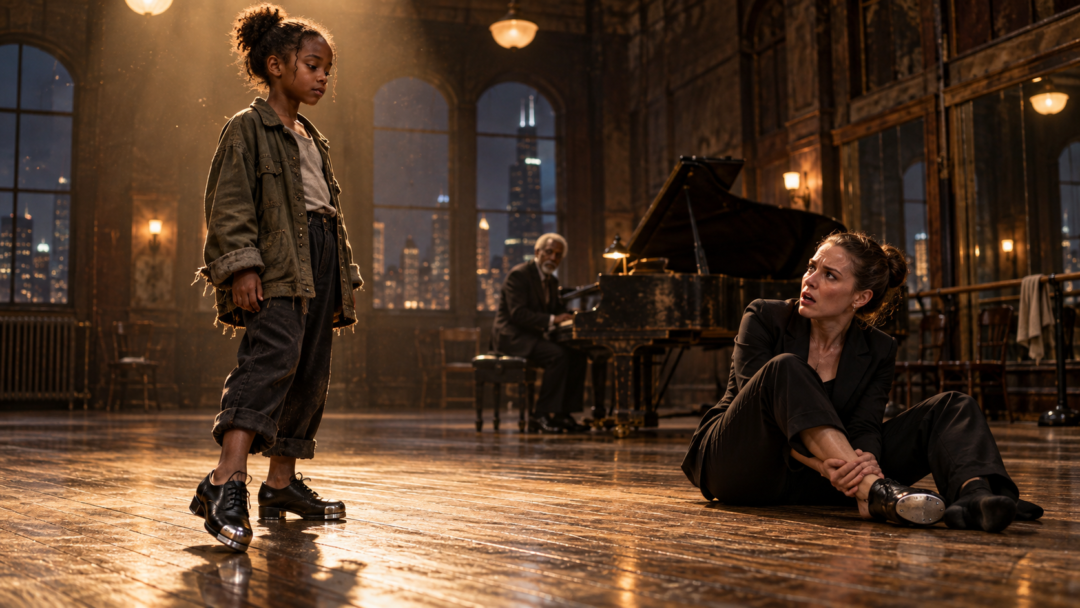
The radiator in the corner of Wabash Rehearsal Hall banged like an iron pipe hitting an engine block. Outside, November sleet battered the tall, grime-streaked arched windows overlooking the South Loop elevated tracks. Inside, the only light came from a single tungsten bulb hanging on a bare black cord thirty feet above the maple floor. The floorboards were seventy years old, dark as cured ham and scarred by three generations of steel tap plates. Every gouge in the grain held a rhythm that had once made Chicago shake.
Corinne Duvall dropped onto the oak bench beneath the mirrored wall, her chest heaving against the tailored lapels of her black rehearsal blazer. Her calves trembled under her dark tights. She grabbed a white towel from her gym bag and wiped her forehead with a vicious, sawing motion that smeared her mascara into bruised smudges. Her breathing was ragged, whistling slightly through flared nostrils. For two hours she had tried to nail the sixteen-bar transition in the second act of Chicago Rhapsody—the multimillion-dollar revival slated for the Shubert Theatre—and for two hours her heels had lagged behind the click of the metronome. Her ankles felt like wet paper.
Across the perimeter of the chalk circle drawn on the wood sat nine-year-old Maya Vance.
The child sat on an upturned wooden milk crate beside the cast-iron radiator pipes. Her thin knees were pulled tightly against her chest, tucked inside an oversized olive green canvas jacket with frayed cuffs. On her feet were a pair of men’s size-seven Capezio Oxford tap shoes. The black leather was cracked across the vamp, lined with deep grey creases, and stuffed around the tongue with thick gray wool hunting socks so her small feet wouldn’t slide out. The steel plates under the toes were not the thin, hollow stamped metal worn by commercial studio dancers; they were hand-cut quarter-inch carbon steel, fastened into the oak soles with countersunk brass screws.
Corinne threw her towel to the floor. The damp terry cloth hit the floorboards with a wet, heavy slap right beside Maya’s crate.
“Look at this,” Corinne said, her voice grating with thin, breathless venom. She looked over at the dark corner where seventy-two-year-old Walter Coleman sat behind the battered upright Steinway. “Walter, tell me why this street rat is still breathing my oxygen. I pay five hundred dollars an hour for private lockout time on this floor. I didn’t pay to run a daycare for vagrants.”
Walter did not lift his fingers from the yellowed ivory keys. His hands were wide, dark-skinned, and heavy-knuckled, resting motionless across an unresolved minor seventh chord. His wool cardigan was buttoned crooked at the neck, and his silver-rimmed bifocals reflected the yellow overhead bulb.
“The girl isn’t bothering your footwork, Corinne,” Walter said quietly. His voice had the gravel and weight of forty years in pit orchestras from Bronzeville to Broadway. “Your footwork is doing that all by its lonesome.”
Corinne’s mouth twisted into a tight, pale sneer. She pushed herself up from the bench, her heels digging hard into the maple. Her knees gave a faint, sickening pop that she quickly masked by crossing her arms.
“My footwork is contracted for three thousand a week,” Corinne snapped, stepping toward the center of the hall. “Julian Sterling auditioned forty dancers across three states and gave this revival to me because nobody else has the speed for the South Side breakdown. The producers aren’t looking for excuses. They’re looking at my marquee.” She turned her sharp gaze back down toward the milk crate. “Get her out of here, Walter. Look at her. Those shoes look like they were pulled out of a dumpster behind a pawnshop. She looks like a joke.”
Maya did not flinch. She did not pull her feet back beneath the jacket. Her dark, liquid eyes remained completely fixed on Corinne’s face, steady and calm with a silence far too heavy for a nine-year-old child. Slowly, with an unhurried deliberateness that made the cold room feel suddenly tighter, Maya lowered her heels to the floorboards.
Clack.
The single sound was not loud, but it had an acoustic density that cut straight through the hissing steam pipes. It wasn’t the tinny rattle of modern aluminum taps; it was a deep, resonant strike of pure hardened carbon steel meeting cured old-growth timber. The tone hung in the high rafters like the chime of a bronze bell.
Corinne paused mid-stride, her lips parting slightly. A sudden flicker of unease darted across her eyes before her face hardened into defensive anger.
“You think that’s cute?” Corinne took two aggressive strides toward the milk crate, pointing a manicured, shaking finger at the girl. “You do that again and I’ll have building security drag you out into the alley by your collar. You don’t have a pass. You don’t have a name.”
Walter Coleman didn’t shout. He simply struck a single, low C-minor octave on the piano. The wooden soundboard shuddered, sending deep vibrations through the floorboards beneath Corinne’s arches. He took off his bifocals and let them dangle from the cord around his neck, looking straight past the woman.
“You better watch how you talk about those shoes, Corinne,” Walter said, his voice dropping into a register that made the hair on the back of the dancer’s neck stand up. “Take a hard look at the countersunk brass screws in those toe plates. You’ve been rehearsing that routine for six weeks, trying to steal every syncopated rest in the score. But those plates right there? You’re looking at Marcus Vance’s personal shoes. And you’re standing in a dead man’s light.”
CHAPTER 2: THE SOUND OF THE BRASS SCREWS
The silence that followed Walter’s words was thick and suffocating, punctuated only by the relentless tapping of freezing sleet against the window glass.
Corinne took a half-step back, her eyes involuntarily dropping to Maya’s feet. Every professional tap dancer in the Midwest knew the myth of Marcus Vance. Ten years ago, Vance had been the undisputed king of acoustic rhythm tap—a South Side innovator who treated the stage like an eight-piece percussion kit, creating polyrhythms so intricate that conservatory drummers brought tape recorders to his street battles on 47th Street. Then, five years ago, Vance had vanished from the public eye. Rumors claimed he had fallen sick, that he had gone broke, that he had died in a county charity ward. But nobody in the commercial theater world spoke about the choreography he had left behind—the revolutionary sixteen-bar climax that Julian Sterling had registered with the Library of Congress under his own corporate publishing house.
“Marcus Vance is dead,” Corinne said, though her voice lacked its earlier bite. A thin bead of sweat trickled down the side of her neck, stinging the collar of her blazer. “Julian bought his private notebooks legally from his estate. Every beat of Chicago Rhapsody was cleared by two teams of entertainment lawyers. The choreography belongs to the production.”
“Julian Sterling didn’t buy a thing,” Walter said softly, his thumb caressing the edge of the piano’s fallboard. “He bought an unpaid medical bill from Cook County Hospital, slapped a lien on Marcus’s footlocker, and called it a contract. But paper doesn’t make a dancer, Corinne. Flesh does. And blood does.”
Corinne’s face flushed crimson. The humiliation of her failing rehearsal collided with her desperate need to prove her dominance. She spun on the balls of her feet and marched back into the chalk circle, pointing down at the center of the floor.
“If this kid is supposed to be some holy relic, let her prove it!” Corinne barked, her voice echoing shrilly in the rafters. “Let’s see her hit the eight-count turnaround. Let’s see her execute the heel-roll cascade at two hundred beats a minute! I’ve been training sixteen years in classical studios from Paris to Manhattan. You think a child sitting in an oversized coat can touch my technical line?”
Corinne threw herself into the sequence. She drove her right toe into the wood, leaped into a double shuffle, and snapped her left heel downward in a frantic attempt to force the tempo. But her balance was tilted forward, her weight caught on the balls of her feet instead of dropping into her hips. On the fourteenth bar, her trailing heel caught the lip of a raised floorboard.
A sharp, sickening crack echoed through the hall.
Corinne screamed—a raw, guttural sound of pure terror—as her right ankle buckled inward. She crashed sideways onto the bare wood, her hip slamming against the floor, her water bottle tumbling across the chalk lines and spilling cold liquid in a spreading puddle. She lay on her side, clutching her swollen ankle, tears carving ragged tracks through her stage makeup.
“My ankle…” she wheezed, her fingernails clawing at the seams of her tights. “My tendon… Julian… call the ambulance…”
Walter didn’t move toward her. He didn’t pick up the wall phone. His gaze remained locked on the corner by the radiator.
Maya stood up.
She didn’t take off the oversized olive green coat. She didn’t adjust the wool socks bunched above the collars of the massive shoes. She walked out from the shadows with an eerily balanced, panther-like gait, stepping cleanly around the puddle of spilled water. Her small frame halted precisely at the edge of the chalk circle, six feet from where Corinne lay writhing on the floor.
Maya looked down at the injured woman for one heartbeat. There was no mockery in the child’s eyes, no gloating, no anger. There was only the cold, crystalline clarity of a craft that ran deeper than pain.
Maya lifted her right knee, dropped her heel, and struck the floor.
The sound that erupted from the maple boards wasn’t a rehearsal exercise; it was a rhythmic detonation.
With breathtaking, fluid speed, Maya launched into the identical sixteen-bar breakdown Corinne had butchered. But where Corinne had fought the floor, Maya rode it like a wave. Her small feet moved with impossible precision, the quarter-inch steel plates striking the timber in microsecond clusters of five-beat heel-rolls, backward wings, and off-beat syncopated slaps that generated their own acoustic bassline. She didn’t lean forward; her spine remained straight as an iron rod, her arms floating in effortless counter-balance. The speed was terrifying—two hundred and twenty beats a minute—yet every single steel click landed with the clarity of glass shattering on marble.
Corinne stopped sobbing. Her jaw dropped slack, her hands frozen on her ankle as she stared upward in utter paralysis.
Maya drove her right heel into the final bar, suspended herself in mid-air on an inverted double-wing, and brought both brass-screwed plates down together on the exact downbeat of sixteen.
BOOM-CLACK.
The final impact rattled the glass globes in the wall sconces thirty feet above. The room fell into absolute, deafening stillness. The only sound was the faint hum of Walter’s piano strings vibrating in acoustic sympathy.
The heavy double doors at the back of the rehearsal hall slammed open with a thunderous bang.
Framed in the doorway stood Julian Sterling, wearing a cashmere camel-hair overcoat, flanked by two burly security guards in dark suits. Sterling’s face was pale, his eyes wide with furious shock as he stared at the little girl standing in the center of his private rehearsal circle.
“What in God’s name was that noise?” Sterling demanded, his voice trembling with an emotion that sounded remarkably like fear. “Who authorized a dancer on this floor?”
CHAPTER 3: THE GHOST BEHIND THE SHEET MUSIC
Julian Sterling stepped into the rehearsal hall, the leather soles of his Italian dress shoes clicking against the wood with a sharp, hollow sound that contrasted sharply with the musical weight of the taps. He was forty-five years old, with silvered temples, sharp aristocratic cheekbones, and the polished veneer of a man who had built an entertainment empire out of other people’s sweat. But behind that veneer, his cold grey eyes were darting wildly across the hall, taking in the scene: Corinne sobbing on the floorboards with a ruined ankle, Walter sitting impassive at the piano, and the tiny girl in the center of the chalk circle wearing shoes three sizes too large.
“Corinne, what happened to you?” Sterling knelt beside the fallen dancer, his voice laced with annoyance rather than genuine concern. “The private run-through for the Shubert investors is forty-eight hours away. We have two million dollars in advance ticket sales riding on this opening.”
“My ankle is torn, Julian,” Corinne wept, her hand trembling as she pointed toward Maya. “She… that little girl… Walter let her in. She did the breakdown. The whole sixteen bars. Without the sheet music. Without the metronome.”
Sterling’s head snapped toward Maya. His eyes zeroed in on the scuffed Oxford shoes, specifically the distinctive brass countersunk screws holding the heavy toe plates. A visible jolt went through his body. His jaw tightened so hard that a vein pulsed along his temple.
“Where did you get those shoes?” Sterling’s voice dropped to a harsh whisper.
Maya didn’t answer. She stood with her arms loose at her sides, her breathing calm and steady, returning his gaze without an ounce of intimidation.
“I asked you a question, kid,” Sterling said, stepping over Corinne’s outstretched legs and towering over Maya. “Those shoes are property of Vance Theatrical Assets LLC. They were listed on the probate inventory when Marcus died. You stole them.”
Walter Coleman stood up from the piano bench. He was not a tall man, but when he drew himself to his full height, his broad shoulders and long reach filled the space around the Steinway with unyielding authority.
“She didn’t steal a damn thing, Julian,” Walter said, walking slowly toward the center of the hall, his shoes scuffing softly against the wood. “Marcus gave those shoes to Maya on his deathbed in the pediatric ward at Mercy Hospital. He put them in her hands and told her never to sell them to a parasite in a three-thousand-dollar suit.”
Sterling scoffed, though the corner of his left eye twitched. “Marcus was legally incompetent during his final six months. I hold the court-appointed conservatorship release. I hold the registered copyright for the entire score of Chicago Rhapsody. If this girl is his daughter, she doesn’t inherit his work—she inherits his debt. Marcus owed my production company seventy-five thousand dollars for cancelled club appearances dating back to 2014.”
“You forged those contracts, Sterling,” Walter said, reaching into the breast pocket of his cardigan and pulling out a small brass key. “You waited until the cancer spread to his liver, then you brought a notary into his room while he was on morphine and pressed his thumb against a blanket release.”
“That is slander, Walter,” Sterling hissed, stepping closer. “And if you repeat it outside this room, I’ll strip the pension you’ve been collecting from the Musicians Union.”
“You won’t strip anything,” Walter said calmly. He walked back to the Steinway, inserted the brass key into a hidden lock beneath the piano’s lower pinblock, and turned it with a dull click. He pulled open a narrow mahogany panel behind the pedal lyre—a compartment used by vaudeville accompanists in the 1930s to hide liquor and union ledgers.
From inside the dark recess, Walter withdrew a thick, leather-bound folio tied with yellowed string. Tucked into the front cover was a sealed manila courier envelope bearing the official wax stamp of the Illinois Department of Financial and Professional Regulation.
Sterling’s face lost all its color.
“What is that?” Sterling muttered.
“This is the master rhythmic ledger Marcus registered with the Chicago Musicians Guild in 1998, four years before your shell company was even incorporated,” Walter said, holding the ledger in one hand. “Every tempo change. Every five-beat heel drop. And right here, inside this courier envelope, is the original receipt for the seventy-five thousand dollars you claimed Marcus owed you. It was paid in full by certified cashier’s check three weeks before he died. You cashed the check, kept the money off the corporate books, and filed a fraudulent lien against his estate.”
Sterling stared at the envelope, his hands balling into fists inside his coat pockets. The two private security guards behind him shifted their feet uncomfortably, sensing that this was no longer a routine trespass eviction.
“You think a piece of paper from twenty years ago will hold up against my legal team?” Sterling sneered, recovering his composure with a sharp, ugly grin. “This theater belongs to Wabash Real Estate Holdings. That’s me, Walter. I bought the building notes last winter. The Shubert revival was just the promotional front. The wrecking ball is scheduled for next Monday. By this time next month, this entire block will be a forty-story luxury residential tower. Your little piano, your scuffed floorboards, and that kid’s fairy tale will all be buried under six feet of crushed concrete.”
CHAPTER 4: THE MIDNIGHT RAFTERS OF WABASH AVENUE
By ten o’clock that night, an ambulance had carried Corinne away into the freezing Chicago dark, her career hanging by a thread of shredded ligaments. The rehearsal hall was locked from the outside by Sterling’s guards, who had chained the front entrance on Wabash Avenue and posted an official orange condemnation notice on the glass.
Inside, the heat had been cut.
A bitter chill seeped through the brick walls, coating the edges of the arched windows with delicate, fern-like patterns of frost. The only warmth came from a small kerosene space heater Walter had brought up from the basement workshop, its blue flame casting flickering shadows across the high plaster ceiling.
Maya sat on the floor with her back against the piano legs, her coat wrapped tightly around her shoulders. She had taken off the oversized tap shoes, revealing thick wool socks with worn heels. Beside her on the maple boards lay her father’s shoes, the heavy steel plates catching the blue glow of the heater.
Walter set two chipped porcelain mugs of hot black tea on the piano lid. He sat down on the bench with a heavy groan, rubbing his arthritic knuckles.
“Cold in here, little bird,” Walter said softly.
Maya looked up. It was the first time she had spoken all day. Her voice was quiet, clear as ice water, carrying none of the fear that should have lived in a child trapped in a condemned building.
“He’s going to tear down the stage, Uncle Walter,” Maya said.
“He wants to,” Walter agreed, blowing across the rim of his mug. “Sterling’s got money. He’s got the city zoning board in his back pocket, and he’s got the municipal building inspector signing whatever he slides across the table. He bought up the junior mortgages on the hall when the neighborhood went sour.”
“Daddy built that stage,” Maya said, her hand reaching out to touch the worn leather of the shoe beside her. “He spent three months in 1995 pulling up the rotten pine and laying down this sugar maple. He said you can’t hear the five-beat heel drop on soft wood. It has to be northern maple, or the iron doesn’t sing.”
Walter closed his eyes, a faint, bittersweet smile creasing his weathered face. “I remember. Carried the bundles up three flights of stairs on his back because the freight hoist was broken. He worked all day laying floorboards and played club dates until three in the morning to pay for the nails.”
Walter leaned forward, resting his forearms on his knees. “Julian Sterling thinks he bought this theater, Maya. But he only bought the debt notes from a bankrupt holding bank. He doesn’t know about the Guild covenant.”
“What covenant?”
“In 1934, during the Great Depression, the old Black vaudevillians who worked the South Loop pool their tips together,” Walter explained, his voice taking on the rhythmic cadence of a historical sermon. “Bill Robinson, John Bubbles, the whole crew. They created the Chicago Rhythm Guild Trust to protect three buildings in this city so working dancers would always have an acoustic floor that couldn’t be taxed out from under them. Your grandfather was a trustee. Your father was the last surviving chairman. Under the terms of the original deed, the land cannot be sold, demolished, or rezoned as long as a direct blood heir of the chairman holds an active performance tenancy.”
Maya looked at her father’s shoes. “A performance tenancy?”
“It means you have to dance, Maya,” Walter said, his dark eyes boring into hers with ferocious intensity. “Not for an audition. Not for a commercial Broadway show. You have to dance before the Chicago Historical Landmarks Commission at their emergency hearing tomorrow morning at City Hall. Sterling filed an expedited demolition permit under an emergency blight waiver. If nobody shows up to claim the trust tenancy, the commission will rubber-stamp the permit at noon. Once the gavel falls, the wrecking ball swings.”
Before Maya could speak, a loud, splintering crash echoed from the back fire escape.
The emergency exit doors at the rear of the stage flew open with a screech of twisting metal. Cold wind and sleet swirled into the hall, extinguishing the blue flame of the kerosene heater in a hiss of white smoke.
Two men stepped through the opening into the dim beam of Walter’s flashlight. They weren’t building inspectors. They wore heavy leather jackets, ski masks pulled low, and carried twenty-four-inch steel pry bars in their gloved hands.
“Old man,” the first intruder growled, his breath pluming in the freezing draft. “Leave the leather folio on the piano lid and take the kid out the back alley. You have two minutes before we take a crowbar to that soundboard.”
CHAPTER 5: THE MASTER REEL IN THE BASEMENT VAULT
Walter Coleman did not flinch, but his hand slid smoothly toward the heavy iron piano wrench resting on the lower music rack.
“Julian Sterling didn’t waste any time,” Walter said, his voice dropping into a dangerous gravel growl. “Sending hired thugs to smash an eighty-year-old Steinway.”
“We don’t know any Sterling,” the second man snarled, stepping forward and leveling his crowbar like a club. “We know this building is slated for tear-down, and vagrants aren’t permitted on the premises. Put the books on the lid. Now.”
Maya didn’t scream. She didn’t cower behind Walter’s legs. With movements as silent and fluid as water sliding over stone, she slipped her feet back into the oversized Capezio Oxfords. She didn’t tie the laces; she simply stepped into them, letting her heels lock against the wool socks, and stood up straight on the maple floor.
CLACK-CLACK.
The two strikes were lightning fast, delivered with the explosive force of a rifle shot. The steel plates cracked against the hollow wood directly over the floor’s central acoustic joist, sending a shockwave through the timber that reverberated up the walls and rattled the iron heating pipes.
The two intruders froze, their eyes darting nervously toward the rafters as if they expected the ceiling to collapse on their heads.
“What was that?” the first man muttered, stepping back toward the drafty door.
“That’s the alarm, gentlemen,” Walter said coldly. “This floor is wired directly into the seismic monitor of the elevated train line across the alley. Every time steel hits that joist, the transit police get an acoustic trip on their board. You’ve got about ninety seconds before the squad cars pull into the alley.”
It was a complete bluff, but delivered with the deadpan authority of an old theater veteran, it struck home. The two men exchanged a frantic look. The second man swung his crowbar into the empty air in frustration, spitting on the floorboards.
“Sterling’s tearing this dump down tomorrow anyway,” he spat. “Freeze to death for all we care.”
They backed through the fire door, slamming the heavy steel portal behind them and leaving the room plunged back into darkness and freezing wind.
Walter let out a long, ragged exhale, lowering the piano wrench to the keys with a faint metallic clink. “Good thinking, little bird. But they’ll be back with a city marshal at dawn. We can’t stay on this floor.”
“Where do we go?” Maya asked, pulling her coat tight against the bitter draft.
“Down,” Walter said, clicking on his heavy industrial flashlight. “Into the boiler catacombs beneath the orchestra pit. Marcus kept his real archive where the damp couldn’t reach it—in the old coal bunker behind the blast wall.”
They took the narrow, spiral iron stairs beside the stage wings, descending thirty feet beneath street level into the subterranean belly of the theater. The air down here was thick with the scent of sixty years of burning anthracite, damp mortar, and aged river clay. Water dripped from forgotten municipal supply pipes, pooling around rusted floor drains.
Walter led her through a maze of low brick arches until they reached a heavy steel blast door marked with a faded stencil: CIVIL DEFENSE – 1952. He slid back two rusted slide bolts and pushed the door open with his shoulder.
Inside was a completely dry, cedar-lined vault twelve feet square. Shelves of heavy industrial steel lined the walls, stacked with hundreds of cardboard audio tape boxes, black-and-white promotional photographs, and hand-stitched leather ledgers.
In the center of the room sat an antique Ampex reel-to-reel magnetic tape recorder, covered in a clean canvas tarp. Beside it was an olive drab steel ammunition case secured with a heavy master padlock.
Walter produced a small key from around his neck and snapped the padlock open. He lifted the heavy steel lid.
Inside lay three objects:
First, an aluminum cylinder containing the original 1934 parchment charter of the Chicago Rhythm Guild Trust, bearing the golden municipal seal of Cook County and the faded signatures of seven founding African-American tap pioneers.
Second, a certified copy of Marcus Vance’s last will and testament, formally transferring his sole trusteeship and proprietary rights to Maya Elena Vance upon his death.
And third, a pristine, unopened seven-inch reel of Scotch magnetic recording tape labeled in red wax pencil: THE SOUTH SIDE CANNONADE – MASTER RECORDING & ORAL COVENANT – MARCUS VANCE – AUGUST 14, 2018.
Walter reached into the case, his fingers trembling with deep, unmasked emotion as he lifted the aluminum cylinder and the tape reel into the beam of his flashlight.
“This is the deed to Wabash Hall, Maya,” Walter whispered, his voice cracking slightly. “And that tape right there? That’s your father’s voice. He recorded his testimony the night before he went into surgery. He knew Sterling was circling his work. He knew what was coming.”
Maya touched the cool aluminum tube. Her small jaw set with an immovable, quiet resolve.
“Can we play it?” she asked.
Walter threaded the tape through the guides of the old Ampex recorder, flipped the power toggle, and pressed the heavy mechanical play lever.
The capstan spun with a quiet, oily whir. A brief burst of tape hiss crackled through the small monitor speaker. Then, filling the dark concrete vault with shocking presence, came the warm, resonant, gravelly voice of Marcus Vance:
“My name is Marcus Vance. If you’re listening to this reel, it means Julian Sterling has tried to bury my work and tear down Wabash Hall. But rhythm isn’t something you can buy with a forged check, Julian. Rhythm belongs to the people who carved it out of the floorboards. To my daughter, Maya: the five-beat heel drop isn’t a step. It’s a key. When you stand before the judges, don’t argue with them. Let the iron talk.”
CHAPTER 6: THE COUNCIL HEARING ON LASALLE STREET
The council chambers on the second floor of City Hall smelled of wet wool overcoats, floor wax, and bureaucratic indifference. Sleet streaked the massive granite-framed windows overlooking LaSalle Street. Beneath the high coffered oak ceiling, forty people sat on polished benches: corporate lawyers in charcoal wool suits, architectural consultants holding foam-core presentation boards, and a handful of community activists clutching mimeographed flyers.
At the center podium stood Julian Sterling, impeccably groomed in a navy pinstripe three-piece suit, his hands resting gracefully on the mahogany rail.
“Commissioners,” Sterling said, projecting his warm, cultured baritone toward the five-member Historical Landmarks Panel seated on the raised dais. “Wabash Hall is an acoustic and structural hazard. The heating systems are condemned. The roof timbers have suffered extensive dry rot. Wabash Real Estate Holdings is prepared to invest forty million dollars in a modern mixed-use residential tower that will honor the cultural heritage of the South Loop through a designated public art installation in the lobby. We have obtained all necessary safety clearances. The property has no valid historic covenants, and the former tenant cooperative has been legally dissolved for non-payment of property liens. We respectfully request the immediate execution of the emergency demolition waiver.”
The commission chairman, a bald man named Alden Cross with thick tortoise-shell glasses, adjusted his microphone. “Thank you, Mr. Sterling. The staff report concurs with your structural findings. Unless there is formal objection from a recognized tenant or party of interest, the chair will entertain a motion to approve the waiver.”
“I object,” a voice rang out from the rear of the chamber.
The double doors swung open. Walter Coleman walked down the carpeted center aisle, his wool cardigan buttoned clean, his spine straight as an oak beam. Beside him walked Maya Vance.
She still wore the oversized green canvas jacket and the scuffed men’s Capezio tap shoes, the heavy steel plates clicking softly against the marble threshold before being muffled by the aisle runner.
A ripple of low laughter and murmurs ran through the lawyers seated in the front row. Julian Sterling didn’t laugh. His knuckles turned white against the podium.
“Mr. Chairman,” Sterling said quickly, his voice tight. “This is an administrative zoning hearing. The public comment period closed forty-eight hours ago. This gentleman is a former building accompanist with no legal standing.”
“I have standing, Mr. Cross,” Walter said, reaching the podium and placing the aluminum cylinder directly on the clerk’s desk. “And more importantly, the girl standing beside me has standing. I present the 1934 foundational charter of the Chicago Rhythm Guild Trust, registered in Cook County Book of Deeds, Volume 412, Page 88. And I present the certified heirship decree naming Maya Elena Vance as the sole surviving trustee of Wabash Hall.”
Chairman Cross frowned, leaning over his bench to inspect the parchment cylinder. “Mr. Coleman, the city is well aware of the historic trust. But our corporate records show that the trust’s commercial lease was formally surrendered by Marcus Vance in 2019 under a debt settlement agreement with Wabash Holdings.”
Sterling stepped forward, pulling a blue-backed legal document from his briefcase. “Right here, Mr. Chairman. Duly notarized. Signed by Marcus Vance himself. He surrendered all tenancy claims in exchange for debt relief.”
Walter Coleman smiled—a cold, ruthless smile that held fifty years of South Side survival.
“That signature was obtained while Marcus Vance was sedated in intensive care,” Walter said. “And here is the sworn forensic handwriting audit from the Illinois State Police Crime Laboratory, completed this morning at seven o’clock, certifying that the signature on Mr. Sterling’s surrender document was forged using an autopen stencil stolen from Marcus’s private studio.”
A collective gasp swept through the chamber. Sterling’s face went from pale to gray.
“This is an outrage!” Sterling yelled, his polished veneer completely cracking. “Even if the signature were disputed, the trust terms require an active, competent performance tenant capable of maintaining the hall’s theatrical charter! A nine-year-old child cannot hold a professional performance tenancy!”
Chairman Cross adjusted his glasses, looking down at Maya with genuine curiosity and deep administrative skepticism.
“The charter language is quite specific, Mr. Coleman,” Cross said slowly. “Section Four states that the tenancy is preserved only so long as the master rhythmic tradition is demonstrated and maintained by the holding trustee before the governing guild or municipal authority. How does a child fulfill a technical performance covenant written in 1934?”
Maya did not wait for Walter to answer.
She stepped out of the carpeted aisle and walked directly onto the open, polished terrazzo floor in front of the commissioner’s dais. The stone floor was cold, hard, and resonant as granite.
Maya looked up at the five commissioners. She drew a single, deep breath.
“My father told me that paper can lie,” Maya said, her small voice carrying to every corner of the silent chamber. “He said lawyers can write whatever they want on a form. But the floor knows the truth.”
Maya dropped her right heel.
CRACK.
The steel plate struck the terrazzo stone like a hammer striking an anvil. Before the echo could die, Maya launched into the “South Side Cannonade.”
CHAPTER 7: THE THUNDER THAT SAVED WABASH HALL
The sound was unlike anything ever heard inside the hallowed, neoclassical walls of City Hall.
Terrazzo stone has none of the soft give of wood; it reflects acoustic energy with brutal, unyielding intensity. Maya’s heavy quarter-inch steel plates struck the stone with the ferocious, machine-gun percussion of an orchestral drum section. She moved with blinding, effortless velocity, her small body carving tight circles on the marble, her feet executing a cascade of triple-time flams, syncopated five-beat heel drops, and reverse wing-pullbacks that rattled the glass water carafes on the commissioners’ desks.
Every lawyer in the room sat frozen. The court stenographer’s fingers hovered motionless above her machine, her mouth open in stunned disbelief.
It wasn’t merely fast; it was mathematically perfect. The syncopation bent time, sliding across the downbeats with a hypnotic, breathless groove that carried seventy years of Black Chicago street rhythm straight into the heart of municipal power. Maya didn’t break a sweat. Her face remained serene, her dark eyes shining with absolute clarity, her father’s presence living in every strike of the brass-screwed plates.
She drove into the final sixteen bars—the exact complex polyrhythm that Julian Sterling had claimed was his own modern composition. On the final downbeat, she leaped twelve inches into the air, snapped both heels together in a mid-air iron click that sounded like a gunshot, and landed in a dead-stop drop on both toes.
BOOM.
The sound reverberated through the granite pillars and died away into total, suffocating silence.
For five long seconds, nobody in the council chamber breathed.
Then, from the back row of benches, a lone pair of hands began to clap. An elderly architectural preservationist stood up, clapping hard. Beside him, two community organizers joined in. Within ten seconds, the entire gallery was on its feet, erupting into a thunderous, standing ovation that echoed out into the marble corridors of LaSalle Street.
Even the three junior associate lawyers at Sterling’s table were clapping, before their boss hissed at them to sit down.
Chairman Alden Cross took off his glasses and wiped his eyes with a handkerchief. He looked down from the dais at the little girl standing in her oversized coat, then turned his gaze toward Julian Sterling.
“Mr. Sterling,” Chairman Cross said, his voice cold and ringing with absolute finality. “The commission finds that the performance tenancy under the 1934 Chicago Rhythm Guild Trust is not only active—it is extraordinary. In light of the forensic forgery evidence presented by Mr. Coleman, this commission hereby revokes the demolition waiver with prejudice. Furthermore, I am referring the transfer documents submitted by Wabash Real Estate Holdings to the Cook County State’s Attorney for immediate criminal fraud investigation.”
Chairman Cross brought his wooden gavel down with a sharp, echoing crack.
“Wabash Hall is hereby designated a protected municipal landmark. This hearing is adjourned.”
The gallery cheered again. Julian Sterling stuffed his papers into his briefcase with shaking, violent motions, turning on his heel and fleeing through a side exit to avoid the reporters already rushing in from the hallway.
One week later, the sleet had cleared, replaced by crisp, bright December sunshine pouring through the arched windows of Wabash Hall.
The heating system had been fully repaired, funded by an emergency cultural preservation grant approved by the city council. The radiators hummed with steady, quiet warmth. The seventy-year-old maple floor had been freshly cleaned and oiled, its deep iron scars gleaming under the golden afternoon light.
At the upright Steinway sat Walter Coleman, playing a gentle, swinging blues progression, his foot keeping time on the wooden pedal.
Beside the piano stood eight young children from the South Side, all wearing scuffed tap shoes, their eyes wide with excitement as they watched Maya Vance demonstrate the foundational five-beat heel roll at the center of the chalk circle.
Maya paused, her heels resting lightly against the maple boards. She looked across the bright, warm hall toward the mirrored wall, where a framed photograph of Marcus Vance now hung beneath the proscenium arch, his smiling face looking out over the floor he had laid with his own hands.
Maya turned back to the students, a rare, radiant smile breaking across her face.
“Listen to the wood,” Maya said softly, lifting her right toe. “Don’t rush it. The rhythm is already in the floor. All you have to do is let it out.”
She struck the steel plate down, and the music began again.