The Quiet Cedar Arrow That Pierced Her Bitter Bow Range
CHAPTER 1: THE FROST ON THE MAPLE FIRING LINE
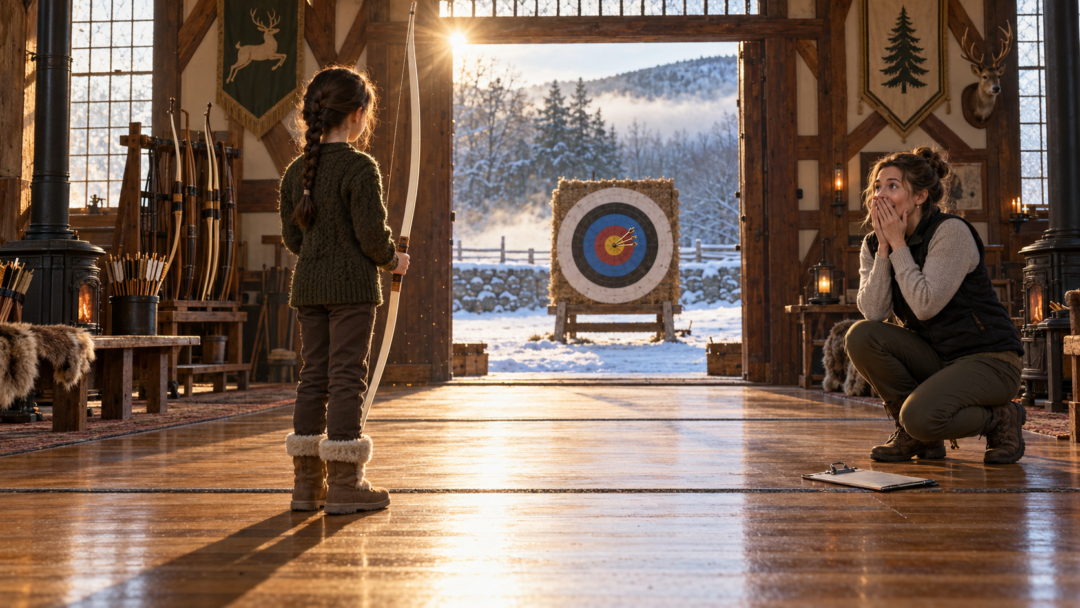
The early morning mist rising off the Saco River clung to the heavy timber walls of the North Conway Archery Guild. Built in 1910 as a water-powered sawmill, the long post-and-beam hall smelled of resinous Douglas fir, aged cedar shavings, floor wax, and the bitter bite of birch wood burning inside the massive cast-iron stove that heated the firing line. Through the high, south-facing clerestory windows, cold November sunlight sliced down in long golden beams, catching the fine dust motes floating above the fifty-meter shooting lanes that stretched out through open roll-up doors into the snow-dusted white pines. Outside, frost glittered on the granite boulders along the riverbank, and the air was thin and sharp with the promise of an incoming mountain storm.
Dana Vance stood behind the raised oak equipment counter, her hands leaning heavily against the zinc-edged countertop. She was thirty-four years old, with sharp, bird-like cheekbones, dark hair pulled back into a severe ponytail that strained her temples, and deep purple hollows beneath her eyes that betrayed weeks of sleepless anxiety. Over her wool turtleneck, she wore the black canvas vest of a certified range master, complete with a silver whistle and an official state ranking badge. But her right thumb was constantly twitching against the metal clip of her scoring board—a frantic, rhythmic tic that revealed the frayed state of her nerves. For three weeks, anonymous collection notices had been arriving in the guild’s post office box, and the district auditor’s annual review was less than forty-eight hours away.
Standing at the threshold of lane four, holding a canvas bow sleeve in her left hand, was ten-year-old Mira Finch.
Mira was small, with quiet, unhurried movements and a dark, neatly woven braid that fell past her collarbones over a hand-knitted olive wool sweater. Her boots were sensible oiled leather, lined with shearling, and around her waist was a hand-stitched leather belt carrying a side quiver of six twenty-six-inch cedar arrows. She stood with the centered, grounded stillness of a young tree, her calm dark eyes looking up at the desk without a trace of hesitation or fear.
Dana slammed her heavy aluminum clipboard onto the zinc countertop with a sharp, ringing crash that made the two adult archers in lane one jump.
“You again,” Dana said, her voice dripping with thin, exhausted venom. “I told you yesterday, Finch. The Saturday morning six-to-eight block is reserved exclusively for senior ranking competitors preparing for the New England Indoor Sectionals. We don’t have open youth time on weekends. You need to turn around and walk back out to the parking lot.”
Mira did not take a step back. She gently unzipped the canvas sleeve, drawing out a fifty-two-inch traditional longbow carved from seasoned white ash, with tips reinforced with horn nocks and a braided Dacron string.
“The public town schedule posted on the front door states that any registered Carroll County youth archer is permitted open practice on lane four if the lane is unoccupied at six o’clock,” Mira said quietly. Her voice was remarkably steady, soft as falling snow, carrying an unforced authority that grated against Dana’s raw nerves. “Lane four is empty. My mother paid the monthly youth range dues on the first of the month.”
Dana let out a harsh, mocking laugh that echoed shrilly off the high timber roof trusses. She walked around the counter, stepping onto the polished maple floorboards with her heavy rubber-soled boots.
“Your mother paid fifty dollars for a probationary permit that expired on Tuesday,” Dana snapped, pointing an aggressive, manicured finger at the wooden longbow in the child’s hands. “And look at that equipment! What is that, a piece of firewood carved with a kitchen knife? There are no sights. There is no stabilizer. There is no clicker. There is no kisser button. You don’t have an armguard, you don’t have a release aid, and that bow doesn’t even have a manufacturer’s serial stamp. It’s an unregulated safety hazard. If that limb snaps under tension, the splinter liability falls on my insurance.”
“My grandfather made this bow,” Mira said softly. Her dark eyes remained locked on Dana’s face, serene and completely unblinking. “The ash was seasoned for four years in his loft. It draws thirty-two pounds at twenty-four inches. It has never snapped.”
“I don’t care if Santa Claus whittled it in the North Pole,” Dana sneered, stepping closer until her shadow covered the little girl. “You’re ten years old, Finch. You’re a kid playing games while real athletes are training for Olympic team trials. Hand that bow over to me. I’m impounding it behind the counter until your mother comes to pick it up with a signed liability release.”
Dana reached her hand out aggressively, her fingers grasping for the horn nock of the ash longbow.
Before her hand could make contact, the heavy iron latch of the armory door at the rear of the hall clicked open.
Out stepped seventy-six-year-old Thomas Finch, wearing his leather work apron over a red flannel shirt, his white hair bristling like wire under a wool cap. In his right hand, he held a heavy twelve-inch steel caliper. His piercing blue eyes locked onto Dana with the terrifying weight of half a century of mountain authority.
“Touch that bow, Dana,” Thomas said, his gravelly voice dropping into a register that made the window glass hum in its wooden sashes, “and you’ll explain to the Carroll County Sheriff why fifty-four thousand dollars in state youth athletic endowment grants vanished from the guild’s operating account over the last six months.”
CHAPTER 2: THE THREE SHAFTS IN THE MORNING MIST
Dana Vance’s hand froze two inches from the bow, her fingers recoiling as if she had touched a live electrical wire. The color drained from her face, leaving her sallow skin the shade of dirty parchment. Her eyes darted wildly toward the two adult archers down on lane one, who had stopped shooting and were now staring toward the counter in stunned silence.
“Thomas…” Dana stammered, her voice dropping to an anxious, strained whisper as she pulled her hands back to her chest. “You… you shouldn’t be back in the armory. The board passed a resolution last month restricting access to the equipment vaults to bonded staff members.”
“I built this armory forty years before you ever learned how to hold a finger tab, Dana,” Thomas said, walking slowly down the center aisle, his steel-toed boots thumping with deliberate weight on the maple boards. “And the charter that created this guild was signed by my father in 1954. You don’t restrict my access to anything in this valley.”
Dana swallowed hard, her throat bobbing as she fought to regain her composure. She crossed her arms tightly, trying to hide the violent tremor that had spread from her fingers into her forearms.
“The financial audits are completely routine, Thomas,” Dana said, her voice regaining a sharp, defensive edge. “The youth fund was restructured into high-yield certificates of deposit under the direction of the treasurer. But that has nothing to do with range safety rules! Your granddaughter cannot shoot on a senior qualifying lane without demonstrating certified fifty-meter grouping accuracy! That is standard National Field Archery Association protocol!”
Thomas stopped beside Mira, resting a heavy, warm hand on the child’s shoulder. He looked down at the ash longbow, noting the crisp Dacron serving and the polished horn nocks that he had shaped with his own hands.
“What is the standard senior qualification requirement, Dana?” Thomas asked, his voice calm, flat, and dangerous.
Dana scoffed, pointing out through the roll-up door toward the outdoor target butt on lane four. Fifty meters away, through the drifting morning mist, the eighty-centimeter target face stood mounted on a heavy straw bale, its bright yellow bullseye looking no larger than a gold coin against the dark fir trees. The mountain wind was beginning to rise, stirring the pine branches and sending faint ripples across the frozen puddle at the threshold.
“Three arrows at fifty meters,” Dana barked, her eyes flashing with cruel, desperate certainty. “Inside the red eight-ring or better. No sight adjustments. No warmup shots. If a single shaft drifts into the blue or misses the paper, she packs her gear, surrenders her range pass, and stays off this property until she turns sixteen. And you leave with her.”
Thomas looked down at his granddaughter. “Mira. Are your fingers warm?”
“Yes, Grandpa,” Mira said softly.
She walked out from behind the counter, stepping up to the red painted shooting line on lane four.
The two adult archers set their compound bows on their stands, stepping over to the spectator rail to watch. The hall had grown completely quiet, save for the crackle of pine logs in the cast-iron stove and the distant murmur of the Saco River rushing over granite boulders outside.
Mira stood sideways to the target. Her shearling boots settled into the floorboards with effortless balance. She reached into her hip quiver and withdrew three identical Port Orford cedar arrows, their shafts hand-planed to five-sixteenths of an inch, fletched with barred grey goose feathers bound with red silk thread.
She nocked the first arrow with a single, silent click of her index finger.
Dana watched from the counter, her lips twisted in a cold sneer, waiting for the child’s arms to shake under the thirty-two-pound draw weight.
Mira raised the bow.
There was no hesitation, no frantic adjustments, no aiming down the shaft. She drew the braided string to the corner of her right jawbone in one continuous, liquid breath. Her left arm extended like an unbending iron branch, her back muscles engaging with the textbook kinetic alignment of a master archer.
THWACK.
The arrow was gone before the eye could track it.
Fifty meters downrange, through the swirling morning mist, a sharp, clean THUD echoed back into the hall. The cedar shaft stood trembling in the dead center of the yellow X-ring, exactly on the central intersection of the crosshairs.
Dana’s eyes widened. Her sneer slipped.
Mira didn’t pause. Without dropping her bow arm, her right hand flashed to her hip, drew the second cedar shaft, nocked it, drew to the anchor, and released.
THWACK-THUD.
The second arrow drove into the target face less than an eighth of an inch from the first, its goose feathers brushing against the fletching of the lead shaft.
Dana took an involuntary step forward, her mouth falling open. “That’s… that’s impossible. She didn’t even check the wind flags…”
Mira drew the third arrow. The mountain wind suddenly gusted through the open roll-up door, swirling snow dust across the firing line and tugging at her woolen sweater.
Mira held her draw for two seconds, reading the chill against her left earlobe, tilting the bow by a fraction of a millimeter to compensate for the thermal downdraft.
THWACK-CRACK.
The third shaft struck the target with explosive violence, sliding between the two preceding arrows and wedging itself into the exact center hole, forming a perfect three-arrow cloverleaf grouping that could have been covered by a silver half-dollar.
A thirty-point maximum score. At fifty meters. With a bare wooden longbow.
The adult archers at the rail gasped in utter amazement. Thomas Finch smiled softly, his eyes shining with quiet, generational pride.
Dana stood paralyzed behind the counter. Her face was gray as ash. Her hand knocked against her metal clipboard, sending it crashing to the floorboards.
“She altered the arrows,” Dana whispered, her voice cracking with hysterical panic. “She’s using illegal tungsten cores… I’m confiscating those shafts right now!”
CHAPTER 3: THE AUDIT IN THE BOWYER’S SHOP
Before Dana could take two steps toward the target lane, Thomas Finch stepped into her path, his broad, flannel-clad shoulder blocking her completely. His massive presence was immovable, backed by seventy years of standing on New Hampshire granite.
“You won’t touch a feather on those arrows, Dana,” Thomas said, his voice hard as tempered tool steel. “Those shafts were inspected and weighed by the state technical committee at the county fair last August. You know exactly what that grouping means. It means my granddaughter just shot the highest fifty-meter barebow qualification score in the history of this guild. It is an automatic invitation to the New England Indoor Sectionals.”
“The score isn’t official without my signature on the range ledger!” Dana yelled, her eyes darting frantically toward the front door as if looking for an escape from the silent judgment of the room. “I am the range director! I certify the results! And I refuse to sign a scorecard for an unregistered junior using non-standard equipment! The board gave me executive authority over all qualifying documentation!”
“Then we will have the regional association certify it,” Thomas said calmly. He turned to Mira. “Retrieve your arrows, child. Pull them straight out by the shaft near the point, just like I taught you. Check the wood for grain fractures and replace them in the quiver.”
Mira nodded, stepping out through the roll-up door into the crisp morning snow. She walked down the gravel path toward the target butt, her boots crunching softly on the crust, completely unfazed by the storm of adult panic raging behind her. She approached the straw bale, gripped the three tightly clustered shafts firmly, and drew them cleanly from the foam, inspecting the goose fletching with quiet reverence before sliding them back into her leather belt.
Thomas turned back to Dana, leaning down until his eyes were level with hers.
“Come into the bowyer’s shop, Dana,” Thomas said quietly. “Now. Before I ask Sheriff Miller to come down here with an audit warrant and open your desk drawers in front of the morning league.”
Ten minutes later, the heavy pine door of the rear workshop was bolted from the inside.
The workshop was a sacred sanctuary of traditional New England craftsmanship. Walls of aromatic northern white cedar were lined with hundreds of wooden templates: English longbows, American flatbows, recurve risers, and horn-backed composite limbs. The room smelled of hot hide glue, beeswax, mineral spirits, and cedar shavings that curled across the floorboards. On the center workbench sat a heavy iron safe dating back to the founding of the guild in 1954, its dial mechanism polished bright by decades of use.
Thomas sat at his desk, having pulled out a green leather-bound accounting ledger stamped with the municipal seal of Carroll County. Beside it lay a stack of photocopied bank statements bearing the letterhead of the North Conway Savings Bank, obtained directly from the county clerk’s office.
“Look at this statement from October fourteenth, Dana,” Thomas said, pointing a thick finger at a highlighted debit line. “A wire transfer of eighteen thousand five hundred dollars from the Donald Finch Memorial Youth Endowment to an offshore sports-wagering account registered in Curacao. Followed by another twelve thousand on November third. And another fourteen thousand on the seventeenth.”
Dana slumped into a wooden ladder-back chair, her face buried in her trembling hands. Her shoulders shook with silent, ragged sobs that stripped away the last remnants of her haughty professional veneer.
“I was going to pay it back, Thomas,” she wept, her voice muffled through her fingers. “I swear to God, I was going to replace every single dime after the Belmont Stakes. I got in deep with a sports syndicate in Boston three years ago… after I washed out of the Olympic trials in Colorado. I spent eighty thousand dollars on private coaching, high-speed cameras, sports psychologists… and I missed the third team spot by two points. Two points! The girl who beat me had father who owned six car dealerships. She had an equipment trailer. I had a leased subcompact car and ten maxed-out credit cards.”
She looked up, her mascara ruined, her eyes wild with twenty years of unhealed bitterness and physical exhaustion.
“I gave my entire youth to this sport!” Dana cried, her voice cracking. “I lived in unheated motels, I ate canned beans in the back of my car, I shot six hundred arrows a day until the skin peeled off my fingers! And what did I get? An hourly job managing a drafty barn in New Hampshire while kids like your granddaughter walk in off the street with thirty-dollar sticks of wood and hit the gold without even trying! It isn’t fair, Thomas! It isn’t fair that some people just have it and the rest of us kill ourselves for nothing!”
“Fairness has nothing to do with it, Dana,” Thomas said, his voice surprisingly gentle, carrying the sorrow of an elder who had seen too many promising athletes consumed by pride and wounded vanity. “You didn’t miss the Olympic team because of two points on a target. You missed it because you shot with anger in your heart instead of joy. You shot to prove you were better than other people, to prove your father was wrong about you. And when you shoot to feed your ego, the bow knows. The string knows. You can’t deceive a piece of seasoned wood with hatred.”
Thomas closed the ledger with a heavy, final thud.
“I’m calling Regional Director Arthur Sterling,” Thomas said. “He’s in Concord for the district meeting. He will be here by noon to inspect these accounts. If you cooperate fully, surrender your keys, and sign a full restitution agreement, I won’t press for immediate criminal charges with the state police. The money can be recovered from your family’s guild share over time.”
Dana stared at the safe, her expression suddenly freezing into a cold, desperate mask of defiance. She stood up slowly, wiping her eyes on the sleeve of her canvas vest, her jaw tightening.
“Arthur Sterling doesn’t control this building, Thomas,” Dana said, her voice dropping into an icy whisper. “The commercial lease was restructured with an investment group last week. The paperwork is already filed with the county. You’re too late.”
CHAPTER 4: THE MIDNIGHT TARGET LANE IN THE SNOW
By nine o’clock that evening, an Arctic blizzard had descended upon Mount Washington Valley with ferocious intensity.
Heavy, wet snow fell in thick sheets, burying the tall pines and drifting five feet deep against the northern wall of the archery guild. Outside, the thermometer read fourteen degrees, and the wind howling down from the Presidential Range whistled through the eaves like a shrieking whistle. Inside the main hall, the lights were dead. Dana Vance had padlocked the front entrance with heavy case-hardened steel chains, posted an official “Closed by Order of the Board” sign on the glass, and shut down the main circuit breakers before driving off into the swirling storm in her four-wheel-drive SUV.
Behind the guild, in the sheltered clearing flanked by ancient hemlocks, Mira Finch stood on the outdoor shooting line.
The only illumination came from two battery-powered halogen work lanterns set on five-gallon paint buckets behind the mark, casting long, sharp shadows across the pristine snow. The fifty-meter target butt had been fitted with a heavy canvas snow shroud to protect the straw core, its yellow center ring glowing warmly under the portable halogen beams.
Mira stood in her wool coat, drawing her ash longbow through the falling snowflakes. Her breath rose in a steady, rhythmic plume of white vapor.
THWACK-THUD.
Arrow after arrow whistled through the freezing mountain air, piercing the center gold with relentless, mathematical regularity. Beside her, wrapped in a heavy sheepskin coat and holding a thermos of hot cider, Thomas Finch checked each strike with his binoculars, recording the scores in a small pocket notebook.
“Good alignment, little bird,” Thomas said, his breath pluming like white clouds. “Feel the weight of the snow on the feathers. When the air is heavy with moisture and falling flakes, the arrow drops half an inch at fifty yards. You have to aim for the top edge of the ten-ring and let the wet air bring it home.”
Suddenly, the roar of a heavy diesel engine cut through the silence of the blizzard.
A yellow industrial skid-steer loader equipped with a six-foot hydraulic snowblade rumbled into the clearing from the maintenance road, its orange warning beacon flashing rhythmically against the snowdrifts. Behind the loader walked two men in heavy winter work jackets carrying twenty-four-inch steel bolt cutters and heavy sledgehammers.
Driving the loader was Dana’s cousin, Bradley Vance, who operated a commercial grading business in Conway.
Bradley killed the engine and leaped down from the cab into the knee-deep snow, carrying a heavy steel tow chain across his shoulders. His face was flushed from whiskey and cold wind.
“Clear out, Thomas!” Bradley shouted over the howling wind, pointing toward the target butts. “Dana signed an emergency maintenance order this afternoon! This entire outdoor lane is being cleared for a two-million-dollar indoor commercial expansion! We’re tearing down these wooden target frames tonight before the county inspector arrives on Monday morning!”
Thomas stepped forward, his boots sinking into the fresh powder, his jaw set like granite.
“You won’t touch those frames, Bradley,” Thomas said, his voice cutting through the engine tick of the cooling loader. “Those target butts sit on land deeded under a municipal recreation covenant. You operate heavy equipment on this ground without a town permit, and I’ll have the county sheriff impound that loader before morning.”
“The town permit was signed by the board chairman two hours ago, old man!” Bradley yelled, waving a crumpled carbon form. “The North Conway Archery Guild is now registered as a private commercial LLC! We don’t answer to your 1954 memories anymore! Move your granddaughter out of the way or she’ll get buried in twenty yards of snow!”
The two men with sledgehammers stepped toward the target frames, raising their heavy tools to smash the timber uprights into kindling.
Mira didn’t scream. She didn’t drop her bow.
She pulled a cedar shaft from her hip quiver, nocked it with fluid grace, and raised her bow toward the sky.
She drew the string to her cheek in one seamless breath.
THWACK.
The arrow streaked through the falling snow, burying itself with terrifying speed into the heavy ash handle of the lead workman’s sledgehammer, exactly two inches below his gloved fingers.
The shockwave rattled the man’s arms, knocking the heavy steel hammer out of his grip and sending it tumbling into the snowbank.
The workman leaped backward with a shriek of terror, clutching his stinging hands. “She… she just shot my hammer! She’s crazy! She almost took my fingers off!”
“That was a warning, gentlemen,” Thomas Finch said, his voice ringing with cold mountain fury. “My granddaughter can split a coin at fifty yards in a blizzard. If you take one more step toward those targets, she’ll pin your boot soles to the frozen dirt.”
Bradley stared at the cedar arrow trembling in the handle of his tool, then looked at the quiet ten-year-old girl standing motionless in the snow with another shaft already nocked on the string, her dark eyes completely unblinking.
A long, tense silence hung over the clearing, broken only by the whistling mountain wind.
“This isn’t over, Thomas,” Bradley spat, backing toward his loader cab. “The county commission meets at nine tomorrow morning. When the commercial zoning variance is approved, the sheriff will be the one driving you off this land.”
CHAPTER 5: THE CARROLL COUNTY COMMISSION REVIEW
The Carroll County Courthouse in Ossipee was packed to overflowing on Sunday morning for the emergency zoning commission review.
Over two hundred local residents—hunters, high school archery coaches, shop owners, high school athletes, and parents—crowded onto the polished oak benches. The air smelled of wet wool coats, radiator steam, hot diner coffee, and tense civic rebellion. Outside, the blizzard had cleared, leaving three feet of glittering white snow under a brilliant, freezing blue sky that reflected off the granite courthouse steps.
Behind the elevated commissioners’ dais sat three county board members, led by Commissioner Harold Thorne, a retired surveyor with thick bifocals and a reputation for strict administrative neutrality. Beside him sat the county zoning director and the assistant county prosecutor.
At the petitioner’s table sat Dana Vance, impeccably dressed in a tailored navy pantsuit, flanked by two corporate attorneys from a prominent Manchester law firm and her cousin Bradley, who wore a clean sheepskin jacket over his bruised knuckles.
“Commissioners,” Dana’s lead attorney declared, holding up an architectural rendering of a multi-million-dollar sports complex. “The North Conway Archery Guild cannot survive on ten-dollar municipal fees. The facility is aging, the heating systems are inefficient, and the public access policy creates untenable liability risks. Mount Washington Sports LLC is prepared to inject two point four million dollars of private capital into the property, creating a premier, members-only target academy that will generate forty thousand dollars in annual commercial tax revenues for Carroll County. We urge the immediate approval of the commercial variance and the dissolution of the archaic 1954 municipal trust.”
Commissioner Thorne leaned forward, adjusting his glasses. “The board has reviewed the economic projections. However, we have received a formal remonstrance signed by seventy-eight voting freeholders of North Conway. Does the public trust representative wish to speak?”
Thomas Finch walked up to the public podium, accompanied by Regional Director Arthur Sterling of the US Archery Association, who had driven through the night from Concord.
Beside them walked Mira, wearing her clean wool sweater, carrying the wooden ash longbow in its canvas case.
“Commissioners,” Thomas Finch said, his deep, resonant voice filling the silent chamber. “In 1954, my father, Donald Finch, donated sixty acres of prime timber land along the Saco River to the children of Carroll County. The deed is recorded in Book 112, Page 404 of the County Registry. It states clearly that the land was granted upon one unbreakable condition: that no fee shall ever be charged to any local youth who desires to learn the traditional art of the bow.”
Thomas placed a thick, red-bound audit dossier on the clerk’s desk.
“Furthermore, Director Sterling and I have completed an emergency forensic review of the guild’s operating accounts,” Thomas continued, his voice ringing with absolute certainty. “Over the past twenty-four months, fifty-four thousand dollars in state youth development grants and municipal fees were systematically embezzled by Dana Vance to cover illegal private sports gambling debts. The commercial LLC she claims owns the facility is a fraudulent shell entity created to shield her from criminal liability and liquidate public assets to pay her offshore bookmakers.”
A collective, outraged gasp erupted from the gallery. Spectators began shouting questions, their anger shaking the decorum of the court.
Dana leaped to her feet, her face flushed with hysterical rage, knocking her leather briefcase to the floor. “That’s a lie! Those accounts were restructured under board authority! This old man is using his granddaughter as an emotional prop to protect his private playground! The money was invested in municipal bond trusts!”
Director Arthur Sterling stepped to the microphone, his expression stern and unforgiving.
“It is no lie, Ms. Vance,” Director Sterling said, his voice carrying the full weight of the national governing body. “I personally inspected the bank records this morning at the North Conway branch. The funds were wired directly to an offshore wagering account in Curacao. Furthermore, as regional director of the US Archery Association, I am officially suspending your range master credentials and referring this entire dossier to the New Hampshire Attorney General’s Public Integrity Unit for grand jury indictment.”
Commissioner Harold Thorne brought his wooden gavel down with a thunderous crack that shook the mahogany dais and silenced the room in an instant.
“The petition for commercial variance is denied with prejudice!” Thorne announced, his eyes flashing with righteous fury. “The 1954 municipal trust is hereby reaffirmed in its entirety. The Carroll County Sheriff’s Department will take custody of the guild’s financial records immediately. Mr. Finch, your granddaughter is recognized as a lawful legacy member of the range.”
Dana sank into her chair, her face buried in her hands, her empire of bitter lies crumbling around her ears as her lawyers frantically stuffed their files into their briefcases.
CHAPTER 6: THE STATE JUNIOR QUALIFIER SHOWDOWN
Following the dramatic hearing in Ossipee, the New England Junior Archery Championship was convened that afternoon at the North Conway Guild under the personal supervision of Director Arthur Sterling.
The roll-up doors were thrown open to the crisp mountain air. Banners from twelve New England clubs hung from the timber rafters. Over three hundred spectators filled the gallery bleachers, their breath pluming in the sunlit chill. Local sports reporters, television crews from Portland and Manchester, and families of competitors packed the aisles.
Down on the firing line stood thirty of the finest young archers from Massachusetts, Vermont, Maine, and New Hampshire, their high-tech recurves and compounds gleaming in the golden afternoon light.
In lane one stood fifteen-year-old Ethan Cole, the reigning state junior champion, shooting a three-thousand-dollar Hoyt competition recurve equipped with dual carbon stabilizers, micro-clicker sights, and custom Easton arrows.
In lane four stood ten-year-old Mira Finch with her simple ash longbow.
Dana Vance was permitted to remain in the facility solely under the custody of two county deputies to observe the official scoring certification. She sat on a wooden bench against the back wall, her arms crossed tightly, her eyes burning with sullen, desperate resentment as she watched the little girl step to the mark.
“Senior division rules,” Director Sterling announced through the PA system. “Seventy-meter outdoor target round. Six ends of three arrows each. Maximum possible score: one hundred and eighty points.”
The air horn sounded.
Ethan Cole shot with flawless, mechanical precision. His arrows hissed through the mountain air, landing consistently in the nine and ten rings. At the end of five rounds, Ethan had accumulated an astonishing score of one hundred and seventy-four points—a score that threatened the all-time state tournament record.
The crowd cheered wildly. Ethan smiled, high-fiving his coach at the rail.
Then came the final round.
Mira Finch stepped to the line. Through five rounds, shooting purely by instinct with her bare wooden bow, Mira had matched Ethan point for point, standing at one hundred and seventy-four points. Everything hung on her final three arrows.
The mountain wind suddenly shifted, howling down from the summit of Mount Washington in a bitter, gusting downdraft that caused the orange wind socks to whip violently.
Ethan Cole stepped up for his final three arrows. Rattled by the sudden thirty-knot crosswind, his high-tech stabilizers caught the draft. His first arrow drifted into the red eight-ring. His second caught the blue seven. He finished with a total score of one hundred and ninety-nine out of two hundred and ten.
A hushed, breathless silence fell over the three hundred spectators.
Mira needed three consecutive tens—an impossible feat in a thirty-knot mountain gale—to take the state championship title and shatter the thirty-year-old scoring record.
Dana leaned forward from her bench, her lips moving silently, praying for the wind to tear the child’s wooden arrows off course.
Mira nocked her first cedar shaft.
She did not rush. She stood motionless on the maple floorboards, feeling the rhythm of the wind against her neck. She drew, waited for the gale to reach its apex, and released into the exact microsecond lull that followed.
THWACK-THUD.
Ten ring. Dead center.
The crowd held its collective breath. Nobody dared to clap.
Mira drew her second arrow. The wind roared again, shaking the timber rafters. Mira tilted her bow three degrees into the teeth of the gale, releasing with majestic, unshakeable confidence.
THWACK-THUD.
Ten ring. Touching the first shaft.
Dana Vance stood up from the bench, her fingernails digging so hard into her palms that blood welled beneath the skin. “No… it’s impossible… the wind is thirty miles an hour…”
Mira pulled her final arrow. The entire valley seemed to hold its breath. The young girl drew the feather to her smile, looked through the mountain mist, and let the string sing.
THWACK-CRACK.
The final cedar shaft struck the target face with a loud, resounding crack that echoed all the way to the granite cliffs of Cathedral Ledge.
CHAPTER 7: THE GOLD RING IN THE WHITE MOUNTAINS
At seventy meters, through the howling mountain gale, all three cedar arrows stood clustered together inside the inner spider ring—a flawless thirty-point final end.
Total score: two hundred and four points.
A new, all-time New England championship record that shattered the previous mark by seven full points.
For three long, agonizing seconds, the three hundred spectators in the North Conway hall sat in stunned, breathless disbelief.
Then, Director Arthur Sterling dropped his binoculars, stepped to the microphone, and shouted with pure, uncontained joy:
“Ladies and gentlemen… the new New England Junior Champion… Mira Finch!”
The gallery exploded.
Spectators leaped from the bleachers, cheering and applauding in a thunderous standing ovation that shook the pine rafters. Local archers threw their woolen caps into the air. Ethan Cole walked across the shooting lanes with a broad, generous smile, offering his hand to Mira in genuine, sportsmanlike respect, admiring the simple craftsmanship of her ash longbow.
Thomas Finch walked onto the firing line, his eyes shining with tears of generational pride as he lifted his ten-year-old granddaughter into the air, holding her high against the golden mountain sunlight pouring through the clerestory windows.
At the back of the hall, two Carroll County deputies stepped up to Dana Vance.
“Dana Vance,” the lead deputy said, his voice firm and formal. “You are under arrest for grand larceny, forgery, and municipal embezzlement. Please step forward and put your hands behind your back.”
Dana didn’t fight. She didn’t scream. She looked across the cheering hall toward the shooting line, where Mira stood holding her grandfather’s handmade ash longbow, surrounded by love, respect, and the enduring truth of the craft.
A single tear carved a clean path through the dust on Dana’s cheek. The handcuffs clicked shut around her wrists with a cold, metallic snap, and the deputies led her out through the double doors into the winter air, her career and bitterness ended forever.
One week later, the North Conway Archery Guild was officially rededicated in a public ceremony attended by over four hundred residents from across the state.
By unanimous resolution of the Carroll County Commission, the facility was permanently renamed the Donald Finch Community Archery Academy, operating under an ironclad public endowment funded by the recovery of the embezzled assets. Free equipment and professional instruction were established for every child in Mount Washington Valley who wished to learn the discipline of the bow. A bronze commemorative plaque was mounted beside the front door, honoring the founders who had protected the land for future generations.
On a bright, clear Saturday morning, the roll-up doors were wide open to the warming sunshine, and the smell of fresh cedar shavings once again filled the hall.
Ten young boys and girls stood along the maple firing line, each holding simple, hand-carved wooden bows shaped by Thomas Finch in his workshop.
Mira stood beside a shy, eight-year-old boy named Leo whose fingers were trembling nervously as he struggled to pull a twenty-pound cedar bow.
Mira knelt beside him, placing her small, warm hand over his shaking knuckles, her dark eyes filled with gentle, sisterly patience and deep understanding. She knew the fear of holding a bow for the first time, the doubt that whispered in a child’s mind when the distance seemed too far and the target seemed impossibly small.
“Don’t worry about the target, Leo,” Mira whispered softly, guiding his small fingers into the proper deep hook on the braided Dacron serving. “Listen to the wood. Feel how the ash wants to bend, how the string wants to leap forward. When your heart is quiet, the arrow already knows where home is. Don’t fight the mountain wind. Trust your breath, trust your fingers, and let it fly.”
The boy drew. His fingers steadied into solid, unshakeable stone, his breath catching in a moment of pure, crystalline focus.
He released, and the cedar arrow soared true through the cool air, striking the gold center ring with a clean, sharp thwack that echoed across the pine-covered valley. The legacy of the master bowyer lived on in the hands of the children.