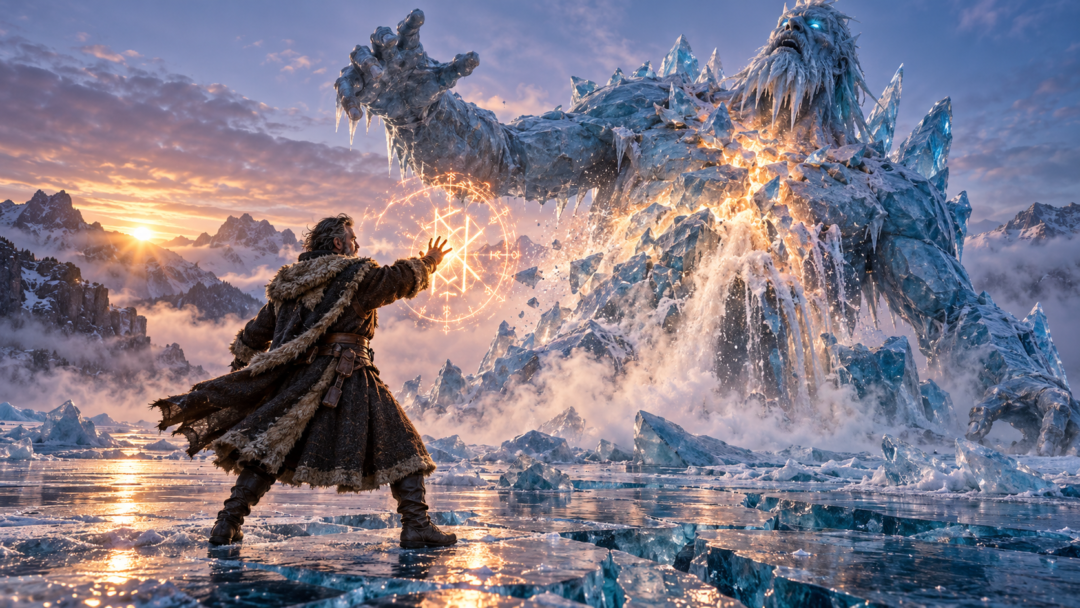
The Silent Rune Caster Who Melted The Ancient Frost Giant
CHAPTER 1: THE PALE BLUE DAWN ON LAKE SKALDHEIM
The dawn over Lake Skaldheim arrived not with warmth, but with the sterile, indigo glare of a dying star reflecting across forty miles of unbroken sheet ice. Perched six thousand feet above the civilized valleys of the south, the lake was a frozen inland sea locked between the jagged granite teeth of the Iron Range. For nine months of the year, the mercury in the glass thermometers froze solid in the settlement porches, and the wind screamed out of the northern polar cap with the shrieking fury of a thousand circular saws. The ice beneath was six feet of crystalline permafrost, so dense and clear that looking down into its depths was like staring into the abyss of an ancient sapphire. Long, hairline tension fractures snaked through the shelf for miles, groaning and booming in the stillness like naval artillery firing under deep water.
Walking slowly across the center of that vast, glazed expanse, his boots making rhythmic, crunching rasps in the frozen crust, was Eirik.
Eirik was fifty-two years old, a master thermal rune caster whose face was a weathered topography of mountain blizzards, frostbite scars, and long, solitary silences. He was broad-shouldered and thick-chested, moving with the heavy, unhurried deliberation of an old bull moose navigating deep snowdrifts. His beard was a thick spade of iron-gray and silver bristles, encrusted with frozen droplets from his nostrils. He wore a long, heavy coat of dense gray wool lined with sheepskin, reinforced at the hem with oiled sealskin to keep out the slush, and thick mittens of boiled beaver pelt. Yet his right hand was bare of fur, wrapped from knuckles to wrist in layers of yellowed, salt-cured linen inscribed with intricate, crimson runic ligatures that pulsed with a faint, sub-audible mechanical thrum.
In the northern settlements, Eirik was known as the Last Hearth. Twenty years earlier, during the terrible winter of the Great White Frost, he had been away in the provincial capital of Nidaros, debating mineral charters before the High Conclave, when a sudden polar drop hit the Iron Range. By the time he completed the two-hundred-mile trek back on snowshoes, his small stone cabin on the lakeshore was buried under ten feet of drift. Inside, huddled beside a cold iron stove whose firewood had run out three days prior, he found his wife Astrid and his nine-year-old son Jon, their hands locked together, frozen as solid and cold as the lake stone.
He had buried them beneath the permafrost with his bare hands. And on that frozen mound, he had sworn an oath to the old gods of the bedrock: no child in the Iron Range would ever freeze in the dark again so long as his blood retained a single drop of warmth.
The cost of his craft was absolute. The primal fire-runes did not summon energy from thin air; they demanded caloric reciprocity. Every time Eirik drew a thermal glyph in the freezing atmosphere, the magic fed directly upon his cardiovascular core, permanently lowering his basal body temperature, deadening his nerve endings, and turning his veins into cold, sluggish rivers of gray sludge. He had not felt the pleasant sting of a hot bath in a decade. His pulse was twenty-eight beats a minute. He was a dying furnace who burned his own life to keep the frontier alive.
Eirik stopped three miles from the southern shore, planting his heavy boots on the ice.
A strange, low-frequency acoustic rumble resonated up through the soles of his feet. It was not the natural expansion of the ice under the rising dawn, nor the surge of the deep water currents.
It was rhythmic. Cyclical. Massive.
Directly ahead of him, sixty yards across the translucent blue ice, was a perfectly circular bore-hole forty feet in diameter, surrounded by heaps of crushed white slush and discarded steel drill teeth.
The ice began to dome upward.
With a concussive, deafening roar that shook the snow from the distant mountain ledges, the six-foot-thick surface of Lake Skaldheim shattered into thousands of jagged, vertical ice floes. Erupting from the freezing black depths beneath the shelf, throwing plumes of pressurized mineral water eighty feet into the freezing air, was the titan.
It was the Frost Giant of Skaldheim.
It stood fifteen feet tall, an elemental colossus forged of compressed blue glacial ice, ancient compacted snow, and black lake silt. Its torso was the width of an iron smelting furnace, its legs thick as cathedral columns, its skin translucent azure through which the dark veins of frozen mountain aquifers were visible like frozen lightning. It had no eyes, no mouth, no nostrils—only a smooth, monolithic brow of solid sapphire permafrost that seemed to radiate a localized field of negative sixty-degree cold that instantly flash-froze the falling water into a hailstorm of ice pellets.
In its massive right fist, tangled in its frozen beard of dangling icicles, was a heavy six-inch diamond mining drill bit, snapped off from an industrial steam crawler.
Eirik did not reach for a weapon. He stood motionless in the swirling mist, his gray coat whipping in the icy vortex, his right wrapped hand dropping to his side.
“I came for this,” Eirik whispered into the roar of the wind.
The titan turned its smooth, faceless brow toward the solitary man, raising both boulder-sized ice fists high above its head, and brought them crashing down toward the shelf.
CHAPTER 2: THE COLOSSUS THAT ROSE FROM THE DEEP
The impact of the giant’s twin hammer-fists was apocalyptic. A concussive shockwave ripped through the six-foot ice shelf, opening a yawning, thirty-foot-wide crevasse that erupted directly toward Eirik’s boots in a spray of razor-sharp blue shards. The entire lake seemed to groan beneath the blow, the acoustic energy traveling through the water column with enough hydraulic force to rupture the air bladders of every fish within five miles. Columns of freezing black water geysered up through the tension cracks, freezing almost instantly as they hit the sub-zero atmosphere, raining down as sleet across the fractured ice floes.
Eirik did not leap backward into the snow. He did not turn and run across the treacherous glazed surface.
He moved with the patient, calibrated precision of a master ice-harvester who knows the breaking strain of every winter fault line. For thirty years, he had tracked the freeze-thaw cycles of the northern lakes, mapping where the subterranean currents thinned the crust and where the bedrock pillars anchored the shelf against the polar tide.
As the fissure tore across the ice toward him, Eirik took one single, deliberate step to his right, placing the heel of his sealskin boot upon a structural compression ridge where the ice had buckled upward during the autumn freeze.
The shockwave parted around him. The chasm opened two feet to his left, plunging forty feet into the freezing black waters of the abyss, while Eirik remained balanced on the solid lip of the ridge.
The frost giant took a heavy, tectonic stride forward, its massive azure foot smashing an eight-foot ice floe into powder. The air surrounding the monster was so cold that the moisture in Eirik’s eyelashes instantly froze into thick white needles, threatening to blind him. The creature possessed no human intellect, but it was driven by an ancient, territorial fury—an elemental instinct awakened by the mechanical drills that had violated its dormant subterranean sanctuary beneath the lakebed.
It swept its left arm in a horizontal scythe across the surface.
The massive forearm, thick as an oak trunk and studded with frozen river boulders, screamed through the freezing fog, aiming to sweep Eirik off the ridge and smash him against the jagged ice walls of the chasm. The wind pushed ahead of the arm was like a solid wall of freezing iron, threatening to tear the heavy wool coat from his shoulders.
Eirik did not attempt to duck beneath the blow; the mass of the arm was too broad, spanning nearly six feet of vertical clearance. Instead, he unfastened the top two bone toggles of his heavy wool coat with his left hand, dropped his center of gravity, and leaned hard into the oncoming vortex.
As the giant’s icy forearm whistled three inches above his head, Eirik raised the index finger of his right hand.
The yellowed linen wrapping around his fingers began to glow with a deep, internal vermilion light that illuminated the frost crystals clinging to his knuckles.
With a motion that was agonizingly slow, precise, and steady despite the howling gale, Eirik traced a single geometric glyph in the freezing air between his chest and the passing ice arm.
It was the Sól-Glyph—the ancient sun-rune of the Northern Conclave.
As his fingertip completed the final triangular junction of the rune, the air itself seemed to combust.
A blinding burst of pure, radiant orange flame detonated along the invisible lines of the glyph. The heat was instantaneous, localized, and terrifying—not a wild wood-fire, but a surgical laser of five thousand degrees Fahrenheit that distorted the atmospheric density of the freezing fog into visible optical ripples. The temperature within that three-foot sphere spiked from thirty below zero to the heat of molten slag in a millisecond.
The fiery rune struck the underside of the frost giant’s passing left forearm.
The thermal shock was catastrophic.
Glacial ice, frozen under immense hydrostatic pressure for five centuries, cannot absorb sudden, localized heat without violent structural failure. With a high-pitched, shrieking crack that sounded like an artillery breech rupturing, the titan’s left arm shattered from wrist to elbow. Massive blocks of blue permafrost, each weighing three hundred pounds, exploded outward in a blinding blizzard of scalding steam and boiling water. The concussive expansion blew a hole through the surrounding fog, revealing the jagged granite peaks of the Iron Range against the indigo dawn.
The giant recoiled violently, its massive body stumbling back into the open water of the bore-hole with a concussive splash that sent twenty-foot waves washing over the surrounding ice.
Eirik lowered his hand, his boots skidding back four inches on the wet slush.
He took a slow, deep breath.
No white cloud of steam issued from his lips.
None at all.
His breath was completely invisible in the negative thirty-degree mountain air. He looked down at his right arm; beneath the linen wrapping, the skin of his forearm had turned the dead, waxy white of a frozen corpse. The thermal rune had executed its purpose, but the heat it had radiated had been pulled directly from the left ventricle of his own heart. His core temperature had dropped by five full degrees, leaving his extremities numb, heavy, and shivering with an internal, bone-deep frost that no fire could ever thaw. His veins felt brittle, like glass capillaries filled with freezing brine.
Across the shattered ice, the frost giant rose from the depths once more, its severed left arm hissing with boiling steam, its faceless brow locking onto Eirik with a terrifying, unyielding focus that promised complete obliteration.
And then, from the northern tree line three miles away across the lake, the sharp, rhythmic crack of a high-caliber steam-rifle echoed off the frozen crags.
CHAPTER 3: THE ORANGE FLAME IN THE FREEZING AIR
The heavy lead bullet screamed across the frozen expanse, striking the ice four feet to Eirik’s right and kicking up a plume of pulverized white crystals.
Eirik did not look toward the tree line. In the high wastes, a stray bullet was merely another element of the climate, no more personal than a sudden avalanche or a falling icicle. His gray eyes remained fixed on the titan rising from the chasm. He understood the rhythm of the duel; in the presence of an elemental, turning one’s gaze away for a fraction of a second was an invitation to be crushed beneath twenty tons of frozen weight.
The frost giant was regenerating.
From the freezing black water beneath the shelf, thick tendrils of slush and blue permafrost were drawn upward into the monster’s shattered forearm by a powerful, localized magnetic vortex. The ice solidified with sickening speed, knitting together with the sound of cracking bone until a new, jagged fist of black river ice had formed, studded with sharp quartz shards and iron-rich gravel dredged from the ancient lakebed. The creature’s wounds did not bleed; they froze harder, reinforcing its mass with every second it remained anchored in the sub-zero water.
It let out a low, infrasonic rumble that vibrated through Eirik’s boots, shaking the fillings in his jaw and sending ripples through the slush pooling around his heels.
The giant charged.
Fifteen tons of blue glacial ice accelerated across the frozen lake at thirty miles per hour, its massive strides tearing the shelf to ribbons behind it. It did not attempt another hammer strike. It lowered its massive shoulder like an iron icebreaker prow, intending to pulverize the rune caster into a fine paste against the frozen expanse, crushing him beneath the sheer kinetic momentum of its advance.
Eirik stood his ground. His heart was beating like a muffled drum inside an iron barrel, barely twenty beats a minute now, but his mind was an unruffled lake of ice. He had faced the wild blizzards that tore roofs from homesteads; he had survived the white-outs where men lay down and froze within sight of their own hearths. Fear was a luxury for men with warm blood.
He raised both hands before him.
With his left hand, he held his right wrist, steadying the trembling, deadened fingers. With his right index finger, he began drawing the complex, interlocking ligatures of the Kenaz-Glyph—the Torch of the Deep Mines.
The linen wrapping burst into flames.
The crimson runes inscribed upon the cloth ignited into vivid, searing orange fire that scorched the hair on his knuckles and filled the freezing air with the sharp, medicinal stench of burning tallow and dried arnica root. As the giant closed the final twenty yards, Eirik thrust the burning glyph forward like an iron shield.
The orange rune expanded into a four-foot disk of blinding, incandescent heat.
The giant slammed into the thermal barrier.
The sound was not an impact of solid mass, but the violent, explosive cavitation of flash-boiling water. Thousands of gallons of superheated steam erupted in all directions, creating an opaque white cloud that blotted out the pale blue dawn and enveloped the two combatants in a roaring thermal shroud. The giant shrieked—a terrible, metallic scream of shearing ice—as its forward momentum was violently arrested by the thermal wall. The outer layers of its chest and shoulders liquefied in an instant, pouring down its torso in scalding torrents of boiling meltwater that flooded the surrounding ice sheet.
Eirik held the rune, his teeth gritted until the enamel cracked, his muscles locked in agony.
He felt the magic feeding.
Deep inside his chest, behind his sternum, the warm ember of his life-force was being scraped away like ash from a hearth. A wave of bone-chilling, paralytic cold swept down his spine, into his hips, and down through his thighs. His knees buckled. His vision tunneled into a pinpoint of gray mist. The pain of the frostbite was not sharp; it was a heavy, suffocating numbness that whispered of sleep, of snowdrifts, of lying down beside Astrid and Jon beneath the sod. He could see his wife’s face in the steam, her gentle gray eyes looking at him with endless sorrow, asking him why he had stayed away so long.
Not yet, Eirik thought, his mind screaming into the dark. Not while the valley sleeps. Not while the children are cold.
The giant, blinded and half-melted, lashed out in a blind panic.
Its massive, regenerated right arm—a club of solid, three-ton river ice—whipped through the steam cloud in a desperate, wild backhand swipe.
The blow missed Eirik’s head, but the concussive pressure wave caught him in the chest like an iron battering ram.
Eirik was lifted clean off the ice.
He flew twenty feet through the freezing air, his heavy sheepskin coat tearing along the seams as he struck the frozen shelf on his right hip. He slid fifty yards across the slick, wet ice, his body spinning like a thrown log, before crashing hard into the raised rim of a pressure ridge.
He came to a halt on his back, gasping for breath, his eyes staring up at the pale indigo sky where the first golden rays of the morning sun were touching the mountain peaks.
His mouth was full of blood, but it was cold.
He spat the red slush onto the ice.
Beside him, kneeling in the snow with a pair of brass surveying binoculars and a loaded hunting carbine, was Astrid Lind.
CHAPTER 4: THE SHATTERED ICE AND THE TORN COAT
“Eirik! Stay down!” Astrid shouted, her voice cutting through the roar of the wind.
Astrid Lind was twenty-eight years old, a senior cartographer and frontier scout for the Northern League. She was dressed in a rugged parka of wolf pelt and oiled canvas, her face reddened by the cold, her sharp green eyes wide with terror and professional fury. Strapped across her back was a brass surveying sextant and a rolled topographic map case. She smelled of pine oil, snow, and the crisp ozone of the high timberline.
She racked the bolt of her carbine, leveling the iron sights toward the rising steam cloud where the frost giant was already reconstituting its mass from the lake.
“Don’t shoot,” Eirik rasped, his voice a dry, hollow rattle like stones tumbling down an iron chute. He pushed himself onto his elbows, his hands trembling so violently he could barely find purchase on the slick ice. “Lead… lead cannot kill winter, Astrid. You are throwing pebbles at a glacier.”
“I’m not shooting the monster, Eirik!” Astrid said, pointing her carbine toward the northern tree line where three plumes of black industrial soot rose into the morning sky. “I’m shooting at Kenneth Hauge’s steam crawlers! They’ve surrounded the southern neck of the lake with three heavy harpoon barges! They’re the ones who awakened this thing!”
Eirik turned his head slowly, looking past the towering column of steam toward the distant shoreline.
Emerging from the pine forests onto the ice were three massive tracked steam crawlers, belching thick black coal smoke into the pristine morning air. Mounted on their forward iron platforms were heavy, pneumatic harpoon ballistas used for hunting right whales in the polar bays. Standing on the lead crawler, wrapped in an ankle-length sable coat and holding a brass speaking trumpet, was Kenneth Hauge. Behind him stood a dozen armed mercenaries in thick sheepskin coats, checking the breech-locks of heavy steam rifles.
“Hauge…” Eirik whispered, the pieces clicking into place with cold, sickening certainty. “He wasn’t drilling for iron ore. The provincial assay reports were forged.”
“He was drilling for the Hearthstone of Skaldheim!” Astrid said fiercely, kneeling beside Eirik to help him haul his heavy frame against the ice ridge. “My survey crew found the ancient thermal chambers two weeks ago, sixty feet beneath the lakebed. The Hearthstone is a pre-cataclysmic geothermal core that keeps the valley aquifers from freezing to the bedrock. Hauge broke into the vault with his diamond drills to steal the stone for the southern industrial cartels! When he breached the seal, he woke the titan that was sleeping over the vault to guard it!”
Eirik looked down at his torn coat. The heavy sheepskin lining had been shredded by his slide across the razor ice, exposing his coarse wool tunic to the biting, negative thirty-degree wind. The cold bit into his flesh with thousands of icy teeth, but his right hand was completely numb; the linen wrapping was charred black, and his fingers were rigid, unresponsive claws of gray flesh. His pulse had dropped below twenty. The ice was creeping into the arteries of his neck.
Across the lake, the frost giant emerged from the thinning steam.
It was no longer fifteen feet tall.
By drawing upon the deep, freezing waters of the lake through the open bore-holes, the monster had expanded its mass until it towered twenty feet into the air. Its body was a colossal monolith of jagged, deep-blue pack ice, its brow crowned with sharp icicle horns, its arms ending in massive glacial mauls capable of flattening a stone fortress. The diamond drill bit was embedded in its chest like a crude, twisted talisman.
It turned its faceless head toward the steam crawlers on the shoreline, letting out a concussive roar that shattered the ice between them into a labyrinth of open water.
“It’s heading for the shoreline,” Astrid gasped, her face draining of color as she tracked the giant’s bearing through her binoculars. “The southern ice dike is right behind those crawlers! If the giant breaks the dike, forty million gallons of lake water will flood down the gorge and wipe out the three fishing hamlets in the lower valley before noon!”
“Three thousand people,” Eirik murmured, his vision blurring as the cold crept closer to his heart. He saw the children of the valley, the fishermen in their wooden skiffs, the women tending the hearths. If the dike broke, they would be swallowed by freezing mud and crushed beneath fifty thousand tons of broken permafrost.
“Eirik, you can’t cast again,” Astrid said, grabbing his shoulder, her eyes welling with desperate tears. “Look at your hands! Your breath isn’t even steaming! If you draw another rune, your heart will stop! You’ll freeze where you stand!”
Eirik looked at the young cartographer. He saw the fire in her eyes, the fierce, unyielding will to live that had once burned in the eyes of his wife and son. In her face, he saw the reason he had survived the Great White Frost.
“A hearth,” Eirik said softly, his deep baritone carrying an absolute, serene peace that silenced the howling wind, “is only as good as the wood it burns to keep others warm. My fire was never meant to be hoarded, Astrid.”
He reached to his belt with his left hand, drew a sharp bone-handled skinning knife, and sliced the blackened linen wrapping from his right arm.
He exposed the bare flesh of his forearm to the biting mountain wind.
The skin was carved with dozens of silver scars—the ancient glyphs of the First Caster.
Eirik took the point of the knife and drew a long, deliberate line across his own palm.
His blood welled dark, thick, and steaming—not with ordinary warmth, but with the concentrated, final caloric fire of a man who was preparing to burn his entire life in a single, magnificent ignition.
CHAPTER 5: THE FINAL RUNE AT THE WATER’S EDGE
Eirik rose to his feet.
He did not stumble. He did not lean against the ice ridge for support.
The sheer, transcendent will of an unbroken spirit surged through his limbs, driving back the paralyzing frostbite through sheer defiance. He stepped over the lip of the ridge, walking out onto the bare, wet sheet of ice that separated him from the twenty-foot titan. Every step was deliberate, heavy, and resonant, his sealskin boots gripping the frozen crust as if he were an ancient king mounting the steps of a forgotten throne.
The giant stopped thirty yards away, sensing the sudden, violent concentration of thermal energy radiating from the lone mortal before it. Its massive sapphire brow tilted forward, its icicle horns bristling like defensive pikes.
The wind between them died completely. The pale blue light of dawn was swallowed by a deep, pulsing amber glow that emanated directly from Eirik’s open, bleeding palm. The blood dripping from his fingers did not freeze; it hissed against the ice, turning the surface into steaming trenches of liquid fire.
Eirik raised his right hand high into the freezing air.
He did not draw the small glyphs of the miner’s torch, nor the localized sparks of the sun-rune.
He began tracing the colossal, sweeping strokes of the Dagaz-Rune—the Rune of the New Day, the ultimate sigil of transformation and planetary dawn that had not been cast in the High Basin for five hundred years. It was the glyph of planetary renewal, the ancient formula by which the first mountain clans had broken the Great Ice Age.
His finger moved with sweeping, majestic curves through the empty air, eight feet across, five feet high.
Wherever his bleeding finger passed, the air did not merely burn; it erupted into a solid ribbon of pure, blinding white light. It was the white-hot brilliance of the sun breaking over a polar glacier, so intense and pure that the surrounding mountains were illuminated in sharp, razor-edged relief. The thermal radiation was so immense that the ice beneath Eirik’s boots instantly turned to steaming water, but he did not sink; the sheer upward updraft of heated air held him aloft.
The giant sensed its mortality.
It roared—a deafening, desperate scream of ancient winter—and charged forward, bringing its twenty-foot bulk down in a desperate, lunging crush to obliterate the source of the heat before the glyph could close.
Eirik completed the final ligature of the rune, joining the two opposing triangles of light.
“Let there be dawn,” Eirik whispered.
He thrust both palms forward, driving the white-hot Dagaz-Rune directly into the center of the giant’s chest.
There was no sound.
No explosion, no concussive crack, no thunderclap.
The silence that fell over Lake Skaldheim was so absolute, so complete, that the universe seemed to hold its breath.
The white glyph sank into the blue glacial permafrost of the giant’s heart.
For one suspended second, the titan froze mid-stride, its massive arms poised above Eirik’s head, its icy talons suspended six inches from his scalp.
Then, from the center of its chest, cracks of pure golden light began to race outward through the blue ice. The fractures did not shatter the monster; they warmed it. They transformed it. The twenty tons of compacted permafrost, ancient winter malice, and frozen lake silt did not explode; they liquefied.
Silently, smoothly, and with breathtaking, impossible grace, the twenty-foot frost giant dissolved into a colossal, cascading waterfall of warm, steaming meltwater.
Thousands of gallons of crystal-clear, forty-five-degree water poured from its brow, its shoulders, its arms, and its chest, cascading across the frozen lake in a wide, gentle tidal wave that washed over Eirik’s boots and spread out toward the horizon. The dark river silt settled peacefully to the lakebed; the diamond drill bit fell to the ice with a soft, clean clink.
The giant was gone.
In its place was only a vast, tranquil lagoon of warm, steaming water that reflected the golden rays of the morning sun like a mirror of liquid bronze.
Eirik stood in the center of the warm flood, his wool coat soaked to the knees, his arms falling slowly to his sides. Around him, the steam rose in fragrant, humid plumes that smelled of wet slate, clean moss, and the thawed roots of subterranean cedar. The ice beneath the shallow water was slick, but the bitter, needle-sharp chill of the polar wind had been broken, softened by the thermal vapor into a mild autumn draft.
He looked down at his trembling hands.
The frostbite was gone, but his skin was completely drained of color—a translucent, alabaster white that bore no pulse. He took a slow breath. The air entered his lungs, cold and clean, but inside his chest, the furnace was dark. He had given every calorie, every heartbeat, every degree of warmth he possessed to melt the ancient winter. His core temperature had plummeted to the threshold of life, yet his mind remained lucid, bathed in the quiet stillness of a warrior who had expended his final arrow.
He shivered violently—not with fear, but with the bone-deep, quiet chill of a man who had reached the end of his road, waiting for the cold to claim his limbs.
Then, from the edge of the meltwater lagoon twenty yards away, came the sharp, oily mechanical clanking of a steam crawler grinding to a halt against the broken ice.
Standing on the iron deck of the lead crawler, flanked by six mercenaries holding loaded steam rifles leveled at Eirik’s chest, was Kenneth Hauge. The syndicate director wore heavy wolf-pelt gauntlets, and behind him, the twin boilers of the machine hissed with foul, sulfurous black smoke that stained the clear morning sky.
In the center of the deck, secured by heavy iron chains to an industrial hoist, sat a four-foot sphere of glowing, volcanic basalt that pulsed with a rhythmic, subterranean heartbeat.
It was the stolen Hearthstone of Skaldheim.
CHAPTER 6: THE MELTWATER FLOOD AND THE LOST HEAT
Kenneth Hauge stood on the iron deck of the steam crawler, his sable coat parted to reveal an ivory-hilted matchlock pistol tucked into his red silk sash. His face was twisted in a mixture of greed, disbelief, and venomous calculation.
“Remarkable,” Hauge called out across the steaming water, his cultured southern accent dripping with condescending amusement. “The legends were true after all. The old hermit of the south shore actually melted a five-hundred-year-old glacial titan with his bare hands.”
He signaled with his right hand, and the six riflemen cocked their weapons, aiming their barrels directly at Eirik’s chest.
“A pity you spent your last spark on an overgrown icicle, old man,” Hauge sneered, tapping the glowing basalt sphere with his gold-headed cane. “Do you have any idea what the Royal Smelting Syndicate in the capital will pay for this Hearthstone? Fifty thousand imperial sovereigns. It produces enough perpetual geothermal heat to run twelve iron foundries without a single pound of coal.”
Eirik did not move. He stood knee-deep in the warm meltwater, his gray beard dripping with moisture, his eyes resting upon the glowing stone.
“That stone,” Eirik said, his voice low, steady, and carrying across the water with quiet authority, “belongs to the lakebed. It regulates the thermal vents that keep the valley settlers alive. If you remove it from the basin, the winter freeze will penetrate seventy feet into the soil. The wells will burst. The orchards will die. Three thousand people will starve before spring.”
“Then they should have moved south,” Hauge laughed, stepping to the edge of the crawler’s iron railing. “The frontier is for extraction, Eirik. Not for charity. Hand over your runic seals and kneel in the slush, or my men will turn you into fish bait.”
Before the riflemen could tighten their fingers on the triggers, a sharp, concussive CRACK echoed from the rocky bluff above the shoreline.
A high-velocity lead ball tore through the wooden stock of the lead mercenary’s rifle, shattering the walnut into splinters and spinning the man flat onto his back on the iron deck.
Standing atop the granite pressure ridge forty yards away, her hunting carbine smoking in the cold air, was Astrid Lind.
“Drop your weapons!” Astrid’s voice rang out, clear, fierce, and carrying the authority of the Northern League. “You are in violation of the Provincial Conservation Charter! The valley militia has already sealed the southern pass!”
“Kill her!” Hauge screamed, reaching for his matchlock pistol.
The five remaining mercenaries pivoted toward the ridge, raising their rifles to return fire.
Eirik did not hesitate.
Even with his core warmth extinguished, the mechanical instincts of fifty years of frontier survival took over. He lunged through the two feet of warm meltwater, closing the twenty yards to the steam crawler in four powerful, bounding strides.
He did not draw a rune; he had no warmth left to burn.
He reached up, caught the heavy iron towing cable dangling from the crawler’s forward winch, and hauled himself over the bulwark onto the deck.
The nearest rifleman turned in surprise, swinging his steel barrel toward Eirik’s face. Eirik caught the rifle by the fore-end with his left hand, twisted the weapon out of the guard’s grip, and drove the heavy butt-stock into the man’s jaw with a concussive crunch that knocked him over the railing into the water.
He swung the rifle in a wide horizontal arc, clearing the deck of two more mercenaries who scrambled backward over the coal bins in sheer terror.
Hauge drew his matchlock pistol, cocking the hammer, his face purple with rage. “You freezing bastard!”
Hauge fired.
The lead ball caught Eirik in the meat of his left shoulder, tearing through the wool and sheepskin, spinning him half a step back. But Eirik felt no pain; the sub-zero numbness in his nerves deadened the trauma completely.
Eirik stepped forward, closed his right hand around Hauge’s wrist, and squeezed.
The bones in Hauge’s wrist ground together with a sickening crunch. The matchlock pistol slipped from his nerveless fingers, clattering onto the iron deck plates.
Eirik hoisted the syndicate director off his feet by the collar of his sable coat, walking him to the edge of the railing, and looked into his terrified, bulging eyes.
“You wanted the heat of the north, Kenneth,” Eirik whispered into his ear, his voice as cold as the deep glacial trenches. “Take it.”
He threw Hauge over the railing.
The syndicate boss struck the warm meltwater with a massive, flailing splash, screaming as the current pulled him toward the ice chasm where the freed miners were already advancing with ropes and irons.
Eirik turned back to the center of the deck.
He knelt beside the four-foot glowing sphere of the Hearthstone. He cut the iron chains with a heavy steel pry bar, bracing his uninjured shoulder against the warm, pulsating basalt.
With a final, heroic heave of his broad back, Eirik rolled the sacred stone off the deck of the crawler.
The Hearthstone plunged into the sixty-foot bore-hole in the center of the lake with a deep, resonant thunk.
For three seconds, nothing happened.
Then, from the deep subterranean chambers sixty feet below the permafrost, came a sound like a giant breathing after a five-hundred-year sleep.
A massive, warm hydrothermal pulse erupted through the bore-hole, turning the entire surface of Lake Skaldheim into a vast, swirling geyser of warm, mineral-rich thermal water that spread out across the forty miles of winter ice, melting the ancient freeze into the first true spring the north had ever seen.
CHAPTER 7: THE UNYIELDING SPRING OVER THE NORTHERN WASTES
The transformation of Lake Skaldheim was unlike anything recorded in the annals of the Northern League.
Within three days of the Hearthstone’s return to the subterranean vents, the six-foot-thick sheet of permafrost that had locked the inland sea for five centuries had dissolved into deep, crystal-blue navigable water. The warm geothermal currents rose continuously from the bedrock, heating the surrounding air until the biting polar winds were softened into gentle, humid breezes that smelled of wet earth, blooming lichen, and wild alpine moss. The jagged snowdrifts on the mountain ridges retreated fifty yards a day, exposing rich, black glacial silt that had not felt the sun since the First Age. Wild northern swans, absent from the valley for generations, circled down from the crags to land upon the calm, warm water.
Kenneth Hauge and his surviving mercenaries had been marched down the southern pass in iron neck-shackles, delivered into the custody of the High Conclave to face thirty years of hard labor in the northern salt mines for corporate plunder and elemental endangerment. His steam crawlers had been stripped of their armor, converted by the League mechanics into agricultural tractors to plow the newly exposed lakebed silt.
The fishing hamlets in the lower valley had not flooded; the warm water had been absorbed by the ancient monastic drainage canals, filling the irrigation reservoirs and bringing clean, warm drinking water to three thousand settlers who had spent their lives shivering over smoky peat stoves. The threat of famine and winter sickness had been banished from the basin forever.
On the southern shore of the reclaimed lake, where the green tundra grasses were already thrusting their pale shoots through the thawing mud, sat Eirik.
He had shed his heavy sheepskin coat and torn woolens, wearing a clean, simple tunic of unbleached linen and soft elk-hide moccasins. His left shoulder was bound in clean linen, healing cleanly under Astrid’s medicinal poultices. His right hand, once wrapped in blackened prayer cloths and scarred with fire-runes, rested open and relaxed upon his knee. The deep silver scars remained, but they no longer burned; they were smooth, silver tracks of honor etched into seasoned flesh.
The skin of his hands was still pale, and his veins still carried the quiet, slow cadence of the deep cold, but his face was relaxed, lined with a peaceful, golden warmth that had never been there before.
Sitting beside him on a fallen birch log, her sketching board resting across her knees, was Astrid Lind.
“The Conclave has officially ratified the charter,” Astrid said, looking over at him with a soft, affectionate smile as she sharpened her charcoal pencil. “The entire basin of Lake Skaldheim has been declared a Sovereign Thermal Sanctuary under the joint protection of the League and the frontier clans. No corporate drill will ever touch this ice again. And the council has named the new shipping port on the eastern bluff Port Eirik.”
Eirik looked out across the wide, glittering blue expanse of the lake. Small wooden fishing dories with red sails were already cutting across the water, their nets pulling in abundant harvests of lake char and silver trout. Children were running barefoot along the pebbled shoreline, laughing and skipping flat stones across the gentle, lapping waves. The sound of their joy carried across the water, clean and untainted by fear. On the eastern slopes, smoke curled peacefully from stone cottages where bread was baking in ovens fired by birch logs, and cattle grazed upon the young rye grass emerging from the mud.
“Port Eirik,” the old rune caster murmured with a faint, self-deprecating shake of his head. “Julian Rook always told me that men love to carve their names into stone. But the only name that matters is the one the water remembers.”
Astrid reached out, placing her warm, sun-browned hand over Eirik’s cold, pale fingers.
She did not flinch from the chill of his flesh. She closed her fingers around his hand, letting her own living warmth seep gently into his skin, an offering of gratitude from a world that had been brought back to life. Her pulse was steady, strong, and vibrant with youth and purpose.
“They won’t forget, Eirik,” Astrid said softly. “The children playing in that water will tell their grandchildren about the man who stood on the ice at dawn and melted the ancient winter so they could see the spring. You gave them their lives, their homes, and their future. There is no debt left between you and the mountains.”
Eirik looked down at their joined hands, feeling the faint, miraculous miracle of another human being’s pulse beating against his knuckles. For the first time in twenty years, the cold in his chest did not feel like a grave; it felt like a quiet room waiting for a candle.
He had carried the crushing weight of grief and the bitter cold of his loss across two decades of solitude, believing that survival was merely an endurance test against an unforgiving universe. But sitting here in the morning sun, surrounded by the greening mountains and the laughter of free children, he realized that the fire had never truly died.
It had simply moved from his hands into the heart of the land he had saved.
Eirik lifted his face to the golden sky, closed his eyes against the brilliant, warm light, and took a long, deep breath of the northern spring. Across the tranquil lake, the bells of the frontier chapels began to chime in unison, welcoming the dawn that would never fade. The water lapped gently against the shore, whispering an eternal lullaby of warmth and peace over the quiet valley.