The Cardboard Sign On Desert Highway And The Road Of Mercy
CHAPTER 1: THE BOY ON MILE MARKER 84
The midday sun beat down upon US Route 90 in the Trans-Pecos desert of West Texas with the merciless weight of molten brass. At two in the afternoon, the temperature hovered at one hundred and four degrees, heat rising from the asphalt in shimmering mirages that dissolved the distant Davis Mountains into wavy ribbons. On either side of the two-lane highway, the desert stretched out in endless flats of dry caliche dirt, yellow grama grass, and stunted creosote scrub, utterly empty of human presence for thirty miles in any direction.
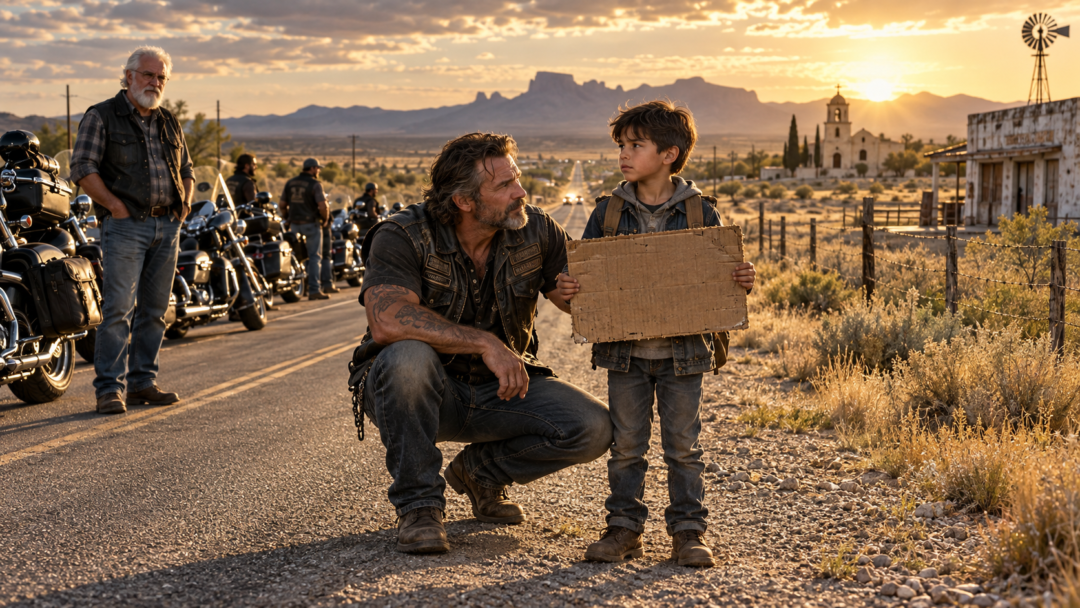
Standing on the narrow gravel shoulder near Mile Marker 84 was a nine-year-old boy.
He was small for his age, wearing a faded red-and-black plaid button-down cotton shirt, sun-bleached blue jeans caked with white caliche dust, and scuffed leather cowboy boots. Sweat plastered his unruly dark brown hair to his forehead, cutting clean, pale tracks through the dust on his sunburnt cheeks. His thin arms were raised high above his head, his small, calloused hands gripping the jagged edges of a large piece of corrugated brown cardboard torn from an industrial water carton. Written across the cardboard in thick, uneven black permanent marker were two desperate words: NEED HELP.
Three long-haul tractor-trailers had blown past without slowing, their sonic displacement shaking the child on the shoulder. But the boy had not lowered the sign, standing firm under the brutal sun with unyielding faith.
From the shimmering heat waves to the west, a low, rhythmic vibration began to hum through the roadbed.
It grew steadily—a deep, rolling, earth-shaking rumble like a localized thundercloud rolling across the desert flats. Within seconds, the black silhouettes of fourteen custom touring motorcycles crested the low rise, riding in a disciplined, double-staggered military formation under the blazing sky.
Leading the pack was Mason Creed, the forty-seven-year-old road captain of the Desert Cross Motorcycle Club. Mason was a broad-shouldered, weathered veteran with a trimmed dark goatee, salt-and-pepper hair, and calm, intelligent hazel eyes. A former US Army flight paramedic with the 160th Special Operations Aviation Regiment, Mason wore a heavy black leather riding vest adorned with combat medic wings over a sweat-dampened denim shirt, his hands resting easily on the polished chrome handlebars of his customized Harley-Davidson Electra Glide.
Thirty yards before Mile Marker 84, Mason’s sharp eyes caught the flash of red plaid and the jagged cardboard sign on the shoulder.
Instantly, Mason raised his left arm high into the air, making a crisp, downward fist pump.
Behind him, thirteen heavy motorcycles responded instantly. Amber signals blinked, brake lights flared, and the rumble of fourteen V-twins dropped to a throaty purr as the convoy decelerated smoothly onto the caliche gravel shoulder.
Mason brought his heavy cruiser to a stop five feet from the boy, kicking the sidestand down into the gravel with a solid metallic click. He lifted his dark aviator sunglasses with a swift, fluid motion, looking down at the small child with deep, compassionate concern.
“You okay, kid?” Mason asked, his gravelly baritone gentle yet carrying the unmistakable steadying presence of a seasoned medic.
The young boy lowered the cardboard sign just enough to peer over its torn upper rim. His brown eyes were wide with a mixture of terror, exhaustion, and sudden, overwhelming relief. His lower lip quivered violently as he looked up at the tall man in leather.
Mason leaned forward over his chrome tank, his voice softening further. “What’s wrong, son?”
The boy swallowed hard, a single tear cutting through the dust on his cheek. “My mom…” he whispered, his voice cracking with desperate, suffocating terror. “She’s sick. She won’t wake up.”
Directly behind Mason’s left shoulder, the club patriarch cut his engine.
He was seventy-two years old, an imposing figure sitting tall in the saddle of an antique 1978 Shovelhead cruiser. His face was weathered like old saddle leather, etched with the deep lines of a lifetime spent under open skies and inside surgical trauma theaters. Falling across his leather vest was a magnificent, flowing, waist-length white beard that gleamed like spun silver in the desert glare. Behind his dark aviator glasses, Solomon Reed—a retired military trauma surgeon and lifelong guardian of rural medical missions—froze in total, solemn stillness.
Solomon pulled off his glasses, his piercing blue eyes locking onto the child. The fourteen rugged bikers sat in breathless silence, cooling exhaust pipes ticking in the wind.
“Where is she, son?” Solomon asked, his voice rolling like distant thunder, rich with profound, paternal warmth.
“Three miles down the arroyo road,” Toby said, pointing a shaking finger toward a rutted dirt trail cutting south through the creosote flats. “Our power went off two days ago… and the well stopped pumping. She’s in the bedroom.”
Solomon looked at Mason. Not a single word needed to be spoken. Between men who had served in combat, the look conveyed total, unconditional mobilization.
“Mount up, brothers,” Mason commanded, his voice hardening into absolute resolve. “We’ve got a mother to save.”
Fourteen engines roared to life in an explosive crescendo of thunder. With Toby riding securely in front of Mason on the wide leather seat of the Electra Glide, the convoy turned off the paved highway, tearing down the dusty caliche trail in a cloud of white dust toward the Morales homestead.
Three miles south, nestled in a dry wash beneath a stand of stunted mesquite trees, sat a small, flat-roofed adobe ranch house.
As the motorcycles rolled into the dusty courtyard, Mason’s tactical instincts immediately flared. The heavy primary electrical service line from the utility pole hung limp in the dirt—its thick copper core cleanly severed by heavy hydraulic shears. The solar well pump inverter was smashed, its circuit breakers shattered.
Mason, Solomon, and four riders sprinted through the front screen door into the suffocating, sweltering heat of the unpowered adobe home. The temperature inside was a blistering one hundred and five degrees.
In the back bedroom, lying motionless on a sweat-soaked mattress, was thirty-four-year-old Lucia Morales. Her skin was ashen and bone-dry, her breath coming in rapid, deep, fruity-smelling gasps.
On the saltillo tile floor beside the bed lay two smashed, crystal-clear glass medicine vials, their liquid contents evaporated into dried sticky rings.
“Kussmaul breathing,” Solomon said grimly, dropping to his knees and pressing two fingers to the woman’s carotid artery. “Pulse is one hundred and forty, thready and weak. Her skin turgor is completely depleted. She’s in advanced diabetic ketoacidosis. Someone deliberately destroyed her insulin.”
Before Mason could open his medical pack, the crunch of heavy tires on gravel echoed from outside.
Through the dust-streaked bedroom window, Mason saw a marked Presidio County Sheriff’s patrol truck and two unmarked black heavy-duty pickup trucks pull into the yard, parking bumper-to-bumper to completely blockade the ranch driveway. Three men in tactical vests, their hands resting on unholstered sidearms, stepped out into the blazing sun.