The Cardboard Sign On Desert Highway And The Road Of Mercy
CHAPTER 3: THE COLD CHAIN RUN
The silence that followed Commissioner Greer’s transmission was heavy and suffocating.
Inside the locked patrol truck, Deputy Vance buried his face in his hands, knowing his career and freedom were finished. On the porch, Mason Creed looked at Solomon Reed, whose jaw was set like a block of iron.
“Solomon, what do we need to keep Lucia alive?” Mason asked, his voice stripping away all emotion to focus on operational reality.
“She needs two immediate interventions,” Solomon answered, his blue eyes intense and focused. “First, aggressive volume rehydration with at least three liters of Lactated Ringer’s solution or normal saline to flush the ketones and restore vascular volume. Second, an initial intravenous bolus of ten units of regular human insulin, followed by a continuous subcutaneous infusion of rapid-acting Humalog. Without the insulin, fluid alone cannot halt the intracellular acidosis.”
“Where is the nearest supply of medical insulin?”
Toby looked up from the porch steps, clutching his cardboard sign. “The Marfa clinic! Mommy kept a backup refrigerator in the rear dispensary before Commissioner Greer locked the chains on the doors last month!”
Solomon nodded grimly. “Presidio County Community Clinic, twenty-two miles north on Route 90. When Greer shuttered the facility, the state pharmaceutical supplies were quarantined in the back dispensary under municipal seal. If the backup generators are running, the cold-chain storage units will still hold intact vials of Humalog and IV fluid bags.”
“Twenty-two miles,” Mason calculated. “At highway speeds, eight minutes there, three minutes to breach and extract, eight minutes back. Nineteen minutes total.”
“She has forty-five minutes before irreversible multi-organ failure,” Solomon warned. “And the insulin must be kept cold. If the vial temperature rises above eighty-six degrees in this desert heat, the peptide chains denature and the insulin becomes useless water.”
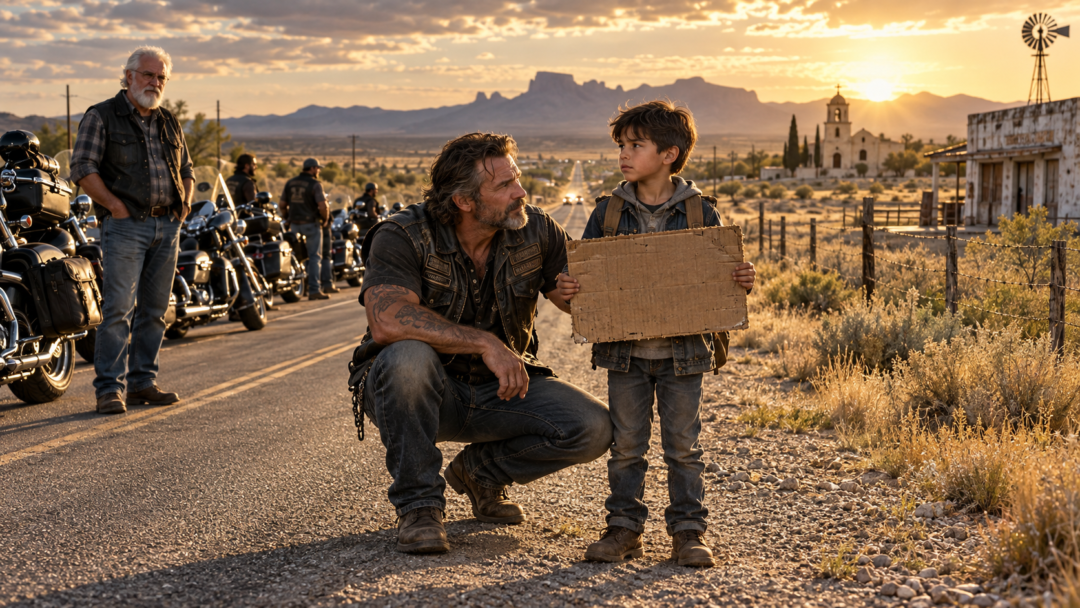
“I’ve got a tactical thermoelectric cooler wired to my auxiliary battery on the Electra Glide,” Mason said. “Dutch, Bear, Hawk, take point with me. Four bikes, fast and light. Solomon, you and the rest of the brothers hold the ranch. Nobody enters this perimeter.”
“Go with God, Mason,” Solomon rumbled, resting his heavy hand on Mason’s shoulder. “We will guard this child and his mother with our lives.”
Four modified Harley-Davidsons erupted into life with a deafening roar that shook the caliche dust from the mesquite trees. Mason, Dutch, Bear, and Hawk launched out of the ranch driveway, their rear tires throwing roostertails of gravel as they hit the asphalt of Route 90, opening the throttles until their speedometers climbed past ninety miles an hour.
The desert flashed by in a blur of bleached grass and telephone poles. Within twelve minutes, the low adobe skyline of Marfa appeared against the horizon.
Mason led the squad off the main drag down an industrial side street behind the historic railway depot. Surrounded by a ten-foot chain-link fence topped with barbed wire stood the shuttered Presidio County Community Clinic—a modern, single-story brick medical facility with plywood sheets nailed over the windows and heavy steel chains padlocked across the front glass doors.
Parked in the rear alley behind the ambulance bay were two black Chevrolet Suburbans bearing the logos of Greer Agricultural Resources. Four private security guards in tactical plate carriers were loading cardboard boxes of clinic records into the back of an unmarked box truck.
“We don’t negotiate,” Mason radioed through his helmet headset. “Dutch, take the gate. Clear the alley.”
Dutch didn’t hesitate. He dropped two gears, aiming the heavy steel crash bars of his Road Glide directly into the padlocked double gates of the service alley. The steel chain snapped with a violent metallic screech, the chain-link gates folding inward like paper as the four motorcycles roared into the loading bay.
The security guards turned in shock, reaching for sidearms, but Bear and Hawk were already off their saddles, moving with the overwhelming speed of veteran combat scouts. Bear tackled the nearest guard into a stack of empty pallets, disarming him in one fluid sweep, while Hawk leveled a twelve-gauge beanbag shotgun at the two men by the box truck.
“Down on your faces! Now!” Hawk bellowed.
The guards threw their hands into the air, dropping to their knees on the concrete.
Mason leapt from his motorcycle, pulled an industrial hydraulic spreader tool from his saddlebag, and wedged the hardened steel jaws into the padlocked rear oxygen-storage door. With a high-pressure hiss, the hydraulic pump cracked the steel deadbolts with a deafening SNAP.
Mason kicked the heavy door open and rushed into the dark, echoing interior of the clinic.
The emergency generator was humming in the basement, providing power to the critical storage wing. Mason navigated the darkened corridor, guided by his tactical penlight, until he reached the pharmaceutical dispensary.
Inside, sitting against the far wall, was a large stainless-steel medical refrigerator, its digital display glowing a steady 38°F.
Mason threw open the glass door. Resting on the center shelf were twelve pristine, unopened ten-milliliter vials of Humalog rapid-acting insulin, alongside half a dozen boxes of Lactated Ringer’s IV infusion bags, sterile macrodrip tubing, and twenty-gauge intravenous catheters.
Mason grabbed four vials of insulin, packed them into an insulated cold-pouch with two frozen gel packs, swept four bags of IV saline into his canvas backpack, and sprinted back down the hallway toward the loading dock.
As Mason burst out into the bright sunlight of the alley, a deafening crash shook the asphalt.
A third black armored Suburban had just slammed into the alley entrance, ramming Hawk’s motorcycle against the brick wall. From the rolled-down windows, two masked gunmen opened fire with semi-automatic rifles, their high-velocity rounds spattering concrete shrapnel across the loading dock!