The Hand That Let Go
Part I — Borrowed Reputation
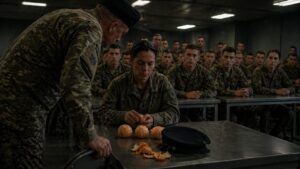
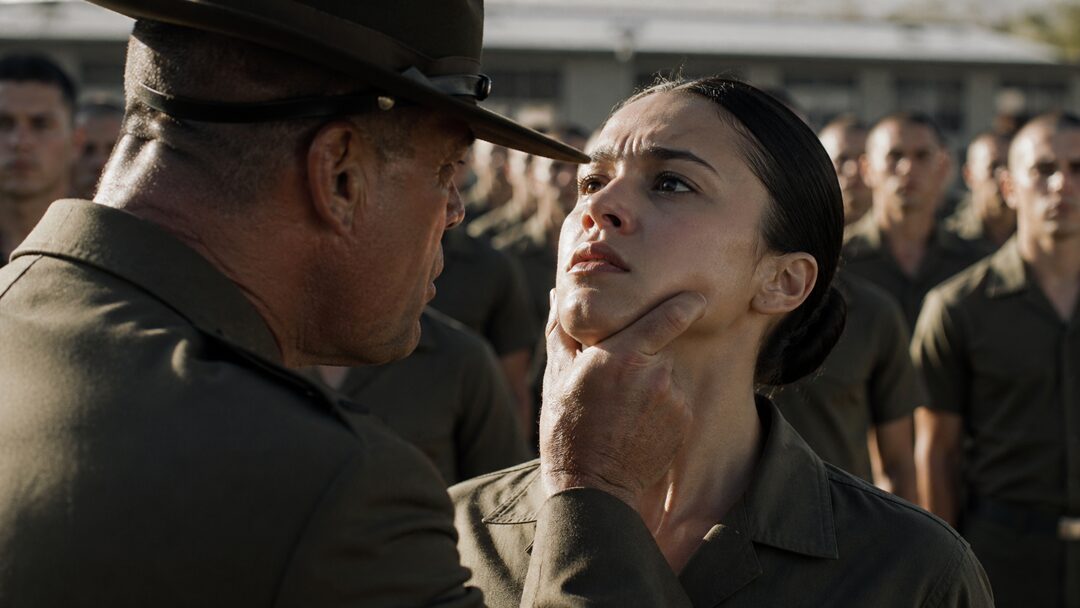
Staff Sergeant Aaron Briggs stopped in front of Maya Carter, read the name tape over her chest, and put his hand under her chin before she had time to breathe.
The whole platoon saw it.
His fingers were rough against her jaw. His thumb pressed just beneath the place where fear tried to move. He lifted her face until she was staring straight into him, into the weathered skin, the close-cropped hair, the eyes that looked like they had already decided she was a mistake.
Morning heat rose off the gravel.
No one coughed. No one shifted.
“You think that name buys you something?” Briggs asked.
Maya kept her heels locked. Her hands stayed pinned to her sides. She could feel thirty recruits watching from the corners of their eyes, each one grateful it was not them, each one terrified it would become them if they breathed too loudly.
Briggs leaned closer.
“You’re borrowing a dead man’s reputation,” he said. “And the uniform will not love you back.”
Something moved behind his shoulder.
A captain stood near the barracks, hands folded behind his back, still as a cutout against the beige wall. Trim uniform. Polished boots. Tired eyes.
He was watching her.
No, Maya thought.
He was watching her name.
Briggs’s grip tightened just enough to make the bones in her face feel small.
“Did you come here to prove something, Carter?”
Her jaw trembled under his hand. She hated that it did. She hated that her body wanted to answer before she did.
But she did not look away.
“No, Staff Sergeant.”
His eyes narrowed.
Her voice came out quiet, but it held.
“I came to earn what he couldn’t bring home.”
The silence after that was worse than shouting.
Briggs stared at her as if she had spoken a language only the dead understood. Then he let go.
Not gently.
He dropped his hand and stepped back.
“Then start earning,” he said.
Maya faced forward. Her skin burned where his fingers had been. She could still feel the shape of his hand, as if he had left a mark no one else could see.
From the barracks, Captain Elias Hayes turned away.
That was the first thing Maya noticed.
Not Briggs.
Not the platoon.
The captain.
He walked away like a man avoiding the sound of a door closing.
Formation broke ten minutes later, but no one came near her at first. Recruits moved around her with the careful distance people gave live wires. A few looked impressed. Most looked irritated. Special attention from command was not a compliment. It spread like smoke.
By noon, everyone knew her name.
By evening, they knew enough to resent it.
Carter.
Dead hero’s daughter.
The girl Briggs had touched and not broken.
Maya sat on the edge of her rack that night, unlacing her boots with fingers that had gone stiff. The barracks smelled like detergent, sweat, plastic, and panic. Someone two rows down was crying into a pillow like the pillow had rank.
“You always this popular?” a voice asked.
Maya looked up.
The recruit standing across from her was compact and quick-eyed, with damp hair tucked back and a look that said she had survived worse rooms than this one. Her name tape read REYES.
Maya said nothing.
Reyes pointed at Maya’s jaw. “Still red.”
Maya’s hand almost rose to touch it. She stopped herself.
“That’s what he wanted,” Reyes said. “For you to keep feeling it after his hand was gone.”
Maya looked back at her boots. “You a therapist?”
“No. I just pay attention before people start swinging.”
That almost made Maya smile. Almost.
“Juno Reyes,” the girl said. “And for what it’s worth, that was messed up.”
“It’s training.”
“That was not training. That was a man reading your name and deciding your face needed a lesson.”
Maya pulled the lace tight. “I didn’t ask to be defended.”
Juno’s expression sharpened, but her voice stayed low.
“No,” she said. “You came here to be punished by people who never knew him.”
Maya’s hands went still.
Across the aisle, another recruit laughed too loudly at something that was not funny. Someone else slammed a locker. The world kept moving because it had no respect for sentences that cut too close.
Maya finished tying her boot.
“You don’t know why I came here.”
Juno looked at her for a moment.
“Neither do you,” she said, and walked away.
Maya hated her for that.
Then she hated herself more because some part of her believed it.
Outside, across the parade deck, Captain Hayes stood alone near the memorial path. One hand rested briefly against his right pocket before he turned toward the administrative building.
Maya watched him through the barracks window.
She had never seen him before that morning.
But he had known her name.
And whatever he knew, it had made him leave.
Part II — The People Who Watch
The next week, Briggs never touched Maya again.
That made it worse.
His hand had done its work. Now he only had to stop in front of her, look at her name tape, and let the platoon remember.
During weapons safety, he asked her the question everyone else had already missed.
During movement drills, he put her at the front and then blamed her when the back fell apart.
During inspection, he found dust on her buckle that would not have mattered on anyone else’s.
“Carter,” he barked one morning, loud enough for three rows to stiffen. “You waiting on your father to polish that for you?”
Maya said, “No, Staff Sergeant.”
“Then why does it look like a museum piece?”
“No excuse, Staff Sergeant.”
That was what training wanted. No excuse. No explanation. No person behind the mistake.
She learned the safest words quickly.
Yes, Staff Sergeant.
No, Staff Sergeant.
No excuse, Staff Sergeant.
But Juno watched her after each one.
Not with pity. That would have been easier to dismiss.
With recognition.
“You know silence can look like strength until it starts doing the enemy’s work,” Juno said one afternoon while they cleaned mud from their boots.
Maya scraped at the sole with a dull edge of plastic. “Who’s the enemy?”
“That’s the problem,” Juno said. “You keep volunteering for the job.”
Maya did not answer.
The truth was worse than Juno knew.
Maya had carried her father into every room since she was six years old. Sergeant Daniel Carter, the framed photo on the mantle. Sergeant Daniel Carter, the folded flag. Sergeant Daniel Carter, seven civilians saved during a classified evacuation in a border town no one would name in front of children.
Her mother never called him a hero.
Other people did.
Her mother called him Daniel.
That had always felt smaller to Maya. Less worthy.
Now, on base, everyone else seemed to know which word hurt more.
A few days after the first formation, Hayes pulled Briggs aside near the armory. Maya did not hear the beginning. She was passing with a crate of training gear when their voices cut through the heat.
“Why did you single her out?” Hayes asked.
Briggs’s voice was lower, rougher. “You saw her name.”
“That is not an answer.”
“It’s the only one you need.”
Maya slowed.
A corporal snapped, “Carter, move.”
She moved.
But not far enough to miss Briggs’s next words.
“Carter’s daughter should be forged fast or sent home fast. The Corps eats people who join for ghosts.”
Hayes answered sharply. “Do not make her father part of training.”
A pause.
Then Briggs said, “Her father is already here. She brought him.”
Maya kept walking, but the crate had doubled in weight.
That night, she lay awake listening to controlled breathing all around her. Juno slept with one arm tucked under her pillow and one boot angled toward the aisle like she expected trouble.
Maya stared up at the metal frame above her bunk.
Her father is already here.
She had thought she brought him because she loved him.
Now she wondered if she had brought him because she did not know how to put him down.
The next day, Hayes appeared at the edge of the endurance course.
Not close. Never close.
He stood where officers stood when they wanted to be visible without being involved. His hands were behind his back. His face gave nothing.
Briggs noticed.
Everyone noticed Briggs noticing.
The field exercise was simple in the way punishment was simple. Packs loaded. Sand trail. Time limit. Move as a squad. Finish together.
The sun did not shine so much as press.
Halfway through, a recruit named Miller stumbled. Then stumbled again. His pack dragged him backward as if it had hands.
“Keep moving,” someone hissed.
Maya heard his breath catch. Not fatigue. Panic.
She fell back.
“Give me the side strap,” she said.
Miller shook his head. “I’m good.”
“You’re not.”
“Carter, don’t—”
She took part of his load anyway, hooking the strap against her own shoulder. It burned instantly. Her pace broke. Juno looked back and muttered something that sounded like a prayer and an insult sharing the same uniform.
They missed the time mark by forty-three seconds.
Briggs waited at the finish with a stopwatch in his hand.
Forty-three seconds might as well have been forty-three dead men.
He looked at Miller first. Then at Maya.
“You proud of that?” he asked.
“No, Staff Sergeant.”
“You think leadership is carrying everyone until you collapse?”
“No, Staff Sergeant.”
“Then explain why your squad failed.”
Maya’s throat tightened. She could feel Hayes watching from the shade. She could feel Miller’s shame beside her. She could feel Juno’s attention like a hand at her back.
“No excuse, Staff Sergeant,” Maya said.
Briggs stepped closer.
There it was. The safe answer. The answer training wanted.
But Briggs smiled without warmth.
“Liar.”
Maya’s eyes lifted.
“You want to rescue people?” Briggs asked. “Join a fairy tale. This is not leadership. This is ego wearing compassion.”
Maya felt something inside her snap cleanly, like a cord pulled too hard.
“Leaving someone behind is not leadership.”
The formation went silent.
Briggs moved close enough that she smelled coffee and salt on his breath. His hand stayed at his side.
This time, he did not touch her.
“You don’t know what that sentence costs,” he said.
At the edge of the course, Captain Hayes looked away.
And Maya understood then, not fully, but enough.
This was not about Miller.
It was not only about her.
There was a room somewhere inside these men that had her father’s name on the door.
And neither of them wanted her to open it.
Part III — The Clean Story
Maya found the photograph because she was trying not to cry.
She had been sent to the administrative building with a stack of signed forms and a warning not to look like she had been personally offended by gravity. The hallway was cool enough to feel rude. Glass display cases lined the wall, full of old unit patches, folded citations, yellowed photos, and polished artifacts arranged into a version of history that knew how to stand at attention.
She almost walked past it.
Then she saw her father.
Not the framed portrait from home. Not the official photo with the dress uniform and the calm eyes. This was Daniel Carter younger, thinner, dirt on one cheek, standing between two men she knew too well.
Aaron Briggs, younger but unmistakable, grinning like he still believed the world could be beaten by force.
Elias Hayes, a captain even then, standing straight with a face that looked hollow around the eyes.
And Daniel Carter in the middle.
Alive.
His hand rested on Briggs’s shoulder. His sleeve was torn. He looked exhausted, but not afraid.
Maya leaned closer to the caption.
Humanitarian Evacuation — Border Sector Kestrel. Seven civilians recovered. Mission success.
Mission success.
The words sat beneath her father’s face like a closed coffin.
Maya forgot the forms in her hand.
She found Hayes outside the building ten minutes later, standing beneath the shadow of the flagpole, speaking to another officer. She waited until the officer left.
“Captain Hayes.”
He turned.
For half a second, before rank returned to his face, she saw it.
Fear.
Not of her.
Of what she might ask.
“Recruit Carter,” he said.
“You knew my father.”
His jaw moved once.
“Yes.”
The answer was too small for what it carried.
Maya stepped closer. Not too close. She had learned how people in power measured distance.
“You served with him.”
“Yes.”
“And Staff Sergeant Briggs.”
Hayes looked toward the training yard, where Briggs’s voice carried over the gravel like a thrown object.
“Yes.”
Maya’s hands tightened around the forms.
“No one told me that.”
“It would not be appropriate for me to discuss your father during training.”
“My father is being discussed during training every day.”
Hayes looked back at her.
That landed.
For a moment, the officer mask thinned.
Maya asked the question she had hated herself for needing.
“Was he brave?”
The wind lifted the corner of one form and slapped it against her wrist.
Hayes took too long to answer.
Then he said, “Braver than I had any right to ask him to be.”
Maya should have felt pride.
The sentence had the shape of praise. It had the weight of something carved into stone.
But Hayes did not look like a man praising anyone.
He looked like a man touching a wound through a bandage.
Before Maya could ask more, Briggs’s voice cut across the yard.
“Carter!”
She turned.
He stood near the far gate, arms crossed.
Hayes said, quietly, “You should go.”
Maya wanted to refuse.
Instead, she went.
Briggs waited until she was close enough to hear without the rest of the platoon.
“You found the shrine,” he said.
Maya’s face hardened. “You mean the display case?”
“I mean the clean story.”
She stared at him.
Briggs looked past her, toward the building. For once, his voice did not rise.
“The version of your father you worship is incomplete.”
Maya’s stomach dropped.
“Don’t.”
“He was not fearless,” Briggs said. “He was scared. Angry. Disobedient when it mattered.”
“Do not talk about him like that.”
“Like what? Like he was a man?”
Maya took one step toward him.
His eyes sharpened, but he did not move.
“You don’t get to disrespect the dead because you can’t tolerate the living,” she said.
For the first time since she had arrived on base, Briggs did not answer right away.
When he did, his voice was quieter.
“If you keep chasing a clean story, Carter, the Corps will sell you one. Then it will bury you inside it.”
He left her there with that.
Not dismissed.
Not punished.
Just left.
That evening, Juno found Maya behind the laundry building, where the machines shook the wall and gave people a reason not to hear themselves think.
“You look like you want to hit a building,” Juno said.
Maya leaned against the cinder block. “Briggs knew my father.”
Juno’s expression changed.
“So did Hayes.”
“Ah,” Juno said. “That explains the haunted statue routine.”
Maya almost laughed. It came out wrong.
“They keep talking about him like I don’t know him.”
“Do you?”
Maya turned on her. “What?”
Juno did not flinch.
“I’m not saying that to be cruel. I’m asking because you talk about him like a flag. Not a person.”
Maya swallowed.
Juno softened, but only slightly.
“Do you want to become a Marine,” she asked, “or do you want the Marines to apologize for your father?”
Maya opened her mouth.
Nothing came.
There it was again.
The silence she had thought was strength.
Juno nodded once, like the answer had arrived anyway.
“Yeah,” she said. “That’s what I thought.”
Part IV — Hold Position
The rain came hard during night navigation, the kind that erased distance and made every tree look like a person standing where a person should not be.
Maya’s squad had been ordered to hold position after reaching the third marker.
Hold position until instructors arrive.
Simple.
Maya hated simple orders now. They always seemed to be covering something complicated.
Juno crouched beside a slick washout, one hand clamped around her ankle, her face pale beneath the mud.
“I’m fine,” she said.
“You’re lying.”
“Obviously. I thought that was allowed now.”
Maya checked the radio again. Static. A broken shape of a voice. Then nothing.
Miller shifted beside her. “We’re supposed to hold.”
“I know.”
“Then we hold.”
Juno’s teeth had started to chatter.
The rain turned the ground loose under their boots. The low area where they waited had become a channel for runoff. Water moved around their ankles, cold and insistent.
Maya looked toward the ridge.
Through the rain, a dim light blinked near the old memorial path. A service light. Barely there.
Higher ground.
Briggs’s voice returned to her, sharp as a blade.
You think leadership is carrying everyone until you collapse?
Then another voice.
Leaving someone behind is not leadership.
Her own.
She hated how young it sounded in memory.
Miller said, “Carter?”
Maya looked at Juno. Then at the others. Six recruits soaked through, scared, waiting for someone else to be responsible for the consequences.
That was the trap, she realized.
Not obedience.
Not disobedience.
The wish to choose without paying.
“We move,” Maya said.
Miller stared. “That’s against the order.”
“Conditions changed.”
“You don’t get to decide that.”
Maya pulled a strip of reflective tape from her kit and tied it to a branch above their position. “I do if I accept what comes after.”
No one moved.
So Maya lowered herself beside Juno. “Can you stand?”
Juno’s face was tight with pain. “With help.”
Maya nodded to Miller. “Take her left side.”
He hesitated for one second too long.
Maya looked at him.
“Now.”
He moved.
They climbed in ugly increments. Maya marked their route with tape, snapped branches, and one chem light cracked dim under her boot heel and wedged in a forked trunk. She counted heads every thirty seconds. She made Miller repeat the count back until his voice stopped shaking.
The ridge was not far.
It felt endless.
Juno stumbled once and bit back a sound that made Maya’s chest tighten.
“Leave me and I’ll haunt you,” Juno said through clenched teeth.
“I thought you didn’t believe in ghosts.”
“I believe in spite.”
Maya almost smiled.
By the time they reached the service road near the memorial light, Juno’s lips had gone pale. Maya got her under the narrow overhang of a maintenance shed and ordered two recruits to strip dry layers from their packs.
That was where Briggs found them.
His flashlight hit Maya first.
Then Juno.
Then the whole squad huddled under the shed, soaked, miserable, alive.
“What part of hold position did you fail to understand?” Briggs roared.
Maya stood. Her legs shook from cold and adrenaline.
“All of it, Staff Sergeant. After the site began flooding.”
“You moved without authorization.”
“Yes, Staff Sergeant.”
“You broke the exercise.”
“Yes, Staff Sergeant.”
“You risked losing your whole squad.”
“No, Staff Sergeant.”
His eyes changed.
Maya pointed into the dark. “Original position is marked with reflective tape at eye level, broken branches on the east side, and a chem light on the route. Head count stayed at six. Reyes couldn’t safely remain in runoff with a compromised ankle. I moved the squad to higher ground and accept responsibility.”
Briggs stared at her.
Rain ran down his face. For a moment he looked less angry than wounded.
Then another flashlight beam cut across the road.
Captain Hayes arrived in a poncho, two instructors behind him. He took in the shed, the recruits, Juno’s ankle, Maya standing in front of them like a soaked fence post that refused to fall.
Then he saw the light.
Not the flashlight.
The service light above the memorial path.
His whole body went still.
Maya turned.
The rain blurred the shape of the memorial beyond the road, but she could make out the bronze plaque, the low stone ledge, the small flag snapping under the storm.
She had led them there without knowing what it was.
Briggs’s voice was rough when he spoke.
“Daniel’s light,” he said.
Hayes looked at him sharply.
Maya’s blood went cold.
“What did you say?”
Neither man answered.
Juno, sitting under the shed with her arms wrapped around herself, looked from Briggs to Hayes to Maya.
And even through pain, she understood before Maya did.
The room with her father’s name on it had just opened.
Part V — The Man, Not the Statue
They brought Maya in before dawn.
Not to a courtroom. Not to anything formal enough to hide behind.
Just a plain office with wet coats hanging near the door, fluorescent lights overhead, and Captain Hayes behind a desk he did not sit at.
Briggs stood by the wall.
Maya stood in the center of the room with mud drying on her boots.
Her jaw ached. Not from Briggs’s hand this time.
From holding back too much.
“The violation is clear,” Hayes said. “You were instructed to hold position.”
“Yes, sir.”
“You moved your squad.”
“Yes, sir.”
“You understand why that order exists?”
“Yes, sir.”
“Then explain why you believed instinct over instruction.”
Maya looked at him.
Because Juno was shaking.
Because the ground was filling with water.
Because orders written for one minute can become dangerous in the next.
Because her father had died somewhere between retreat and rescue, and no one had ever said the whole sentence out loud.
She said, “I judged conditions had changed.”
Hayes’s face stayed controlled. “Judgment under pressure can save lives. It can also get people killed.”
Briggs shifted by the wall.
Maya heard it. So did Hayes.
She turned slightly toward Briggs. “Is that what happened to him?”
No one spoke.
The fluorescent lights hummed.
Maya looked back at Hayes.
“What got my father killed?”
Hayes’s hand moved toward his right pocket.
Stopped.
Briggs said, “She deserves the truth.”
Hayes did not look at him. “This is not the place.”
“It never is,” Briggs said.
Maya’s chest tightened. “I’ve been carrying a statue my whole life. I want the man.”
That did it.
Not completely.
Not dramatically.
But something in Hayes’s face gave way.
He walked to the window. Outside, the rain had softened to a gray mist over the training yard. Recruits would be waking soon. Boots would hit floors. Voices would start barking. The machine would resume.
Hayes spoke without turning around.
“Your father died during an evacuation in Border Sector Kestrel. The official report says he saved seven civilians during enemy contact.”
Maya’s hands curled.
“That part is true,” Hayes said.
Briggs’s jaw tightened.
Hayes continued. “The part left out is that he was ordered to withdraw before he entered the school building.”
Maya felt the office tilt.
“No.”
“He heard children inside,” Hayes said. “We all did.”
Briggs looked down.
“I ordered the unit to fall back to the perimeter,” Hayes said. “The structure was unstable. Visibility was gone. We had civilians already moving, wounded Marines, and contact pressing from the east. I ordered him back.”
“And he refused,” Maya whispered.
Hayes finally turned.
“Yes.”
The word should have made her proud.
It did not.
It made her feel six years old again, holding a folded flag too heavy for her lap.
“Briggs was ordered to hold the perimeter,” Hayes said. “Your father entered the school alone. He brought out seven civilians in two trips.”
Maya could see it though she did not want to. Not clearly. Not like a movie. Just fragments. Smoke. Hands. A man she loved only through photographs moving toward voices everyone else was ordered to leave.
“On the third attempt,” Hayes said, “the west wall collapsed. We tried to reach him. We could not do it without losing the perimeter and everyone behind it.”
His voice did not break.
That made it worse.
“I made the decision to hold.”
Maya stared at him.
There it was.
Not murder. Not cowardice. Not clean heroism.
A decision.
A man dead inside it.
“You left him,” she said.
Hayes accepted the words like he had been waiting years to be handed them.
“Yes.”
Briggs looked up then. “He saved seven people.”
“And died abandoned,” Maya said.
Hayes said nothing.
Briggs’s voice roughened. “He was scared, Carter. Don’t let anyone make him less brave by pretending he wasn’t scared.”
Maya turned on him. “And you thought grabbing my face in front of everyone was going to honor that?”
“No,” Briggs said.
The answer came too fast. Too plain.
“I thought if you had his instinct, I had to find out before it killed you.”
“That’s not protection.”
His eyes held hers.
“No,” he said. “It isn’t always.”
The room went quiet.
Maya had imagined this truth so many ways without knowing she had imagined it. In some versions, her father had been betrayed. In others, he had been perfect. In the worst ones, he had been afraid and died anyway.
That one was true.
And somehow it hurt less cleanly than the lie.
Hayes reached into his pocket.
This time, he did not stop.
He drew out a small dark unit coin, worn at the edges, the emblem nearly rubbed smooth by years of thumb and guilt.
Maya knew before he said it.
“Daniel gave me this before Kestrel,” Hayes said. “For luck. I meant to return it to your family.”
“But you kept it.”
“Yes.”
“Why?”
His eyes met hers.
“Because I could not decide whether it was a debt or evidence.”
Maya almost laughed. It came up like pain.
Briggs looked away.
Hayes held the coin out.
Maya did not take it.
The refusal surprised all three of them.
For a moment, the coin sat between Hayes’s hand and Maya’s silence.
Then Maya said, “Put it where it belongs.”
Hayes lowered his hand slowly.
She looked from him to Briggs.
“I’ll take whatever discipline comes for moving my squad,” she said. “But my record will state what happened. Not that I got confused. Not that I panicked. I disobeyed the hold order, judged conditions, moved the squad, marked the route, and kept accountability.”
Hayes watched her.
“And after that?” he asked.
Maya’s answer came with no heat.
“I continue training.”
Briggs’s expression shifted, almost imperceptibly.
Maya looked at him. “Not to become my father’s monument.”
Then Hayes.
“And not so either of you can finish whatever conversation you never had with him.”
The words stayed in the room after she said them.
Hayes nodded once.
Not forgiveness.
Not absolution.
Just acknowledgment.
“That will be entered,” he said.
Maya turned to leave.
At the door, Briggs spoke.
“Carter.”
She stopped.
For one terrible second, she expected him to say something that would ruin what little truth had survived.
Instead he said, “Your father would have hated that display case.”
Maya did not turn around.
For the first time all morning, her throat loosened.
“Good,” she said.
And walked out before either man could see her cry.
Part VI — Forward
At formation the next morning, the sky was clean.
That felt insulting too.
The storm had stripped the air and left the training yard bright, sharp, and washed. Gravel crunched under boots. Recruits lined up in rows, backs straight, eyes forward, every one of them pretending not to know that something had happened in the night.
Juno stood two places behind Maya, ankle wrapped, weight balanced carefully but stubbornly.
“You look terrible,” Juno muttered.
Maya faced forward. “You’re welcome.”
“I didn’t say I wasn’t grateful.”
“You implied it.”
“I imply many things. Keeps morale up.”
Maya nearly smiled.
Then Briggs entered the line.
The platoon hardened.
He moved the way he always did, with that severe economy that made each step feel like a decision already made. He corrected one recruit’s posture. Paused before another. Said nothing.
Then he stopped in front of Maya.
Every breath in the formation changed.
Maya could feel them waiting for the old scene to repeat.
The name tape.
The stare.
The hand.
Briggs looked at her chest, then at her face.
His arm stayed at his side.
The absence of touch was so loud Maya almost forgot to breathe.
“Carter,” he said.
“Yes, Staff Sergeant.”
“You have squad lead for movement drill.”
Behind her, someone shifted in surprise.
Maya did not.
“Yes, Staff Sergeant.”
Briggs held her gaze for one second longer than necessary.
There was no apology in it.
There was something harder to accept.
Recognition.
He stepped away.
Maya turned to face the squad. Juno’s eyes met hers briefly, quick and bright with pain and approval.
Near the barracks, Captain Hayes stood in the same place he had stood that first morning.
Hands behind his back.
Still.
Watching.
But when Maya looked toward him, he moved.
Not toward her.
Toward the memorial path.
The platoon waited for her first command, but Maya could not stop seeing him from the corner of her eye. Hayes reached the low stone ledge beneath the bronze plaque. For a moment he stood with his head bowed, his right hand closed around something small.
Then he placed Daniel Carter’s coin on the ledge.
He did not bring it to Maya.
He did not make her hold his guilt.
He left it with the dead.
The wind moved across the yard. The flag snapped once.
Maya looked away before the ache could become a spectacle.
“Squad,” she called.
Her voice carried.
Not loud. Not forced.
Clear.
“Move out.”
The first step felt heavier than it should have.
The second came easier.
Behind her, boots struck gravel in rhythm. Juno limped, but she kept pace. Miller stayed close enough to help without being asked. The squad moved with her, not because her name was Carter, not because Briggs had chosen her, not because Hayes watched from a distance with an old coin no longer in his pocket.
They moved because she had given the order and accepted the cost of giving it.
Maya passed the memorial without turning her head.
She did not need to look to know the coin was there.
Her father was not in her jaw, held still by another man’s hand.
He was not in the display case.
He was not in the clean sentence under an old photograph.
He was in the broken truth, the seven people, the fear, the refusal, the order, the cost.
And he was gone.
That remained the one fact no uniform could decorate.
Briggs watched from the yard with his arms crossed, face unreadable.
Hayes remained by the memorial.
Maya led her squad forward under the white morning sun.
For the first time since she had arrived, she did not feel like she was walking toward her father.
She was walking away from the statue.
And toward whatever her own name would have to earn.