The Fault Line In The Forty Second Floor And The Broken Blueprint
CHAPTER 1: THE WIND SHEAR AT FORTY STORIES
The November gale screamed across Lake Michigan, hurtling between the glass canyons of Wacker Drive before slamming directly into the open framework of the Aurora Tower. At four hundred and eighty feet above the pavement, the air tasted of freezing mist, diesel soot, and raw limestone dust. Dr. David Sterling leaned against the perimeter cable on the forty-second floor, his heavy canvas coat snapping like sailcloth against his ribs. Beneath the scuffed rubber soles of his steel-toe boots, the concrete slab vibrated with the deep, sickening harmonic tremor of an unanchored load.
David did not look at the panorama of the Chicago skyline. His attention was focused entirely on Column 42-B, a massive wide-flange vertical column that was supposed to anchor the northern shear wall against lateral wind oscillation. In his gloved right hand, David held a handheld ultrasonic flaw detector, its transducer coated with glycerin acoustic couplant and pressed flush against the outer steel flange. The green phosphor screen of the instrument flickered erratically. Instead of the crisp, clean echo characteristic of dense ASTM A992 structural steel, the digital readout displayed a fragmented, mushy waveform.
The ultrasonic sound waves were scattering inside the core of the beam. That meant only one thing: internal air voids, slag inclusions, and porous cooling cavities. The column was not solid American roll-forged steel. It was cast scrap metal, dressed in black primer and stamped with fraudulent mill markings.
A blast of freezing wind carried the smell of cheap cigar smoke and sour adrenaline. Heavy footsteps slammed against the temporary plywood ramp leading from the central utility core.
“Hey! You deaf, grease monkey? Get your goddamn hands off that framing!”
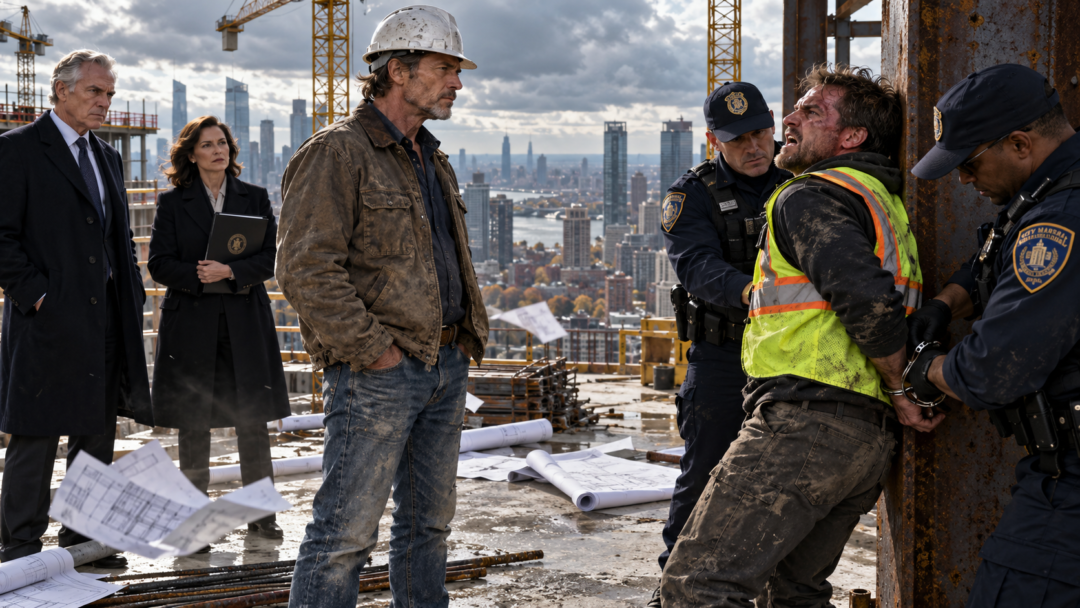
Frank Kowalski strode across the slab like a bull entering an arena. He wore a brand-new high-visibility neon parka over a barrel chest, his bright yellow hard hat tilted back on a balding, sweat-streaked skull. Behind him flanked two hulking site security guards in matching black tactical jackets, their hands resting heavy on utility belts. Kowalski marched straight up to David, his face flushed purple with the manic fury of a man who believed the entire high-rise was his personal kingdom.
“Who the hell authorized an unregistered day laborer up on the framing deck?” Kowalski barked, spraying flecks of spit into the freezing draft. “This entire floor is restricted pending the evening concrete pour! Drop those instruments right now, or my boys will throw you headfirst down the material chute!”
David did not flinch. He slowly wiped the couplant gel from the transducer with a clean shop rag, tucking the precision instrument into the inner breast pocket of his weathered jacket. Underneath the plain white hard hat, David’s grey eyes remained as cold and level as Lake Michigan ice.
“The personnel hoist operator let me up when I presented my structural credential,” David said, his voice quiet, measured, and effortlessly cutting through the roar of the wind. “My name is David Sterling. I am here conducting an independent verification of the structural steel heat certificates for Vance Development.”
Kowalski froze for half a heartbeat. A flicker of naked panic flashed behind the foreman’s bloodshot eyes, quickly replaced by a snarl of vicious defiance. “I don’t give a damn if you’re the Pope with an iron diploma! Nobody touches my girders without my personal sign-off! I run the Apex Construction field operations on this build! Vance signs the checks from his penthouse, but out here in the dirt and wind, I’m the law!”
With a sudden, violent swipe of his thick forearm, Kowalski struck the heavy bundle of rolled blueprints tucked beneath David’s left arm. The heavy archival sheets tore against the metal banding, uncoiling like wounded white ribbons. The Lake Michigan gale seized them instantly, scattering floor-load schematics and load-transfer diagrams across the damp concrete slab. Several sheets fluttered over the perimeter safety cable, spiraling into the gray mist toward the street four hundred feet below.
“Now pick up your trash and get off my deck before I have you arrested for criminal trespass,” Kowalski hissed, stepping into David’s personal space until his sour breath washed over the engineer’s collar.
David looked down at the trampled blueprint fragments beneath his boots, then looked back up into Kowalski’s bloodshot eyes. David did not raise his voice, nor did he shift his balance. He reached out with one bare, calloused hand, his fingers clamping down on the cold flange of Column 42-B directly beside Kowalski’s ear. With his thumb, David rubbed hard against the black protective paint over the stamped mill mark.
Under the pressure of David’s calloused thumb, the supposedly hardened steel flange did not offer the unyielding resistance of structural iron. A tiny sliver of metal yielded with a brittle, sickening crunch. A fine gray powder—oxidized slag and unbonded silica—crumbled from a hairline fissure and drifted into the icy wind. The column was actively cracking under the dead weight of thirty-eight unfinished floors above them.
David kept his boots planted forty-two inches apart, his center of gravity aligned directly over the concrete shear wall beneath the slab. Decades of working on bridge cables over the Tacoma Narrows and deep foundation caissons in lower Manhattan had taught him that steel did not forgive arrogance. When an eight-hundred-pound wide-flange beam bent under load, it gave off a distinct ultrasonic groan—a dry, metallic metallic pinging that sounded like violin strings snapping in sub-zero air. Here on the Aurora Tower, that groan had transformed into an irregular, dull thudding.
The wind shear off the lake was registering sixty-two miles per hour on his handheld digital anemometer. Under Chicago municipal code title fourteen, any exposed framing above thirty stories had to withstand wind gusts of up to one hundred and ten miles per hour with a structural redundancy safety factor of two-point-five. But looking through his macro loupe at the root pass of the weld connecting Column 42-B to the floor deck, David saw extensive porosity. The weld pool had cooled with pockets of trapped gas resembling honeycomb.
No certified journeyman welder from Local 63 would ever have walked away from a joint in that condition. A true ironworker would have gouged the entire bead out with an arc-air torch and ground the joint clean before striking another arc. The only reason a crew would leave such catastrophic porosity on a high-rise perimeter column was extreme haste—or direct, coercive orders from a site supervisor desperate to pour concrete before the independent inspection deadline. Kowalski’s threats were not the bluster of a proud tradesman; they were the desperate cornered barking of a criminal who knew his foundation was built on sand.