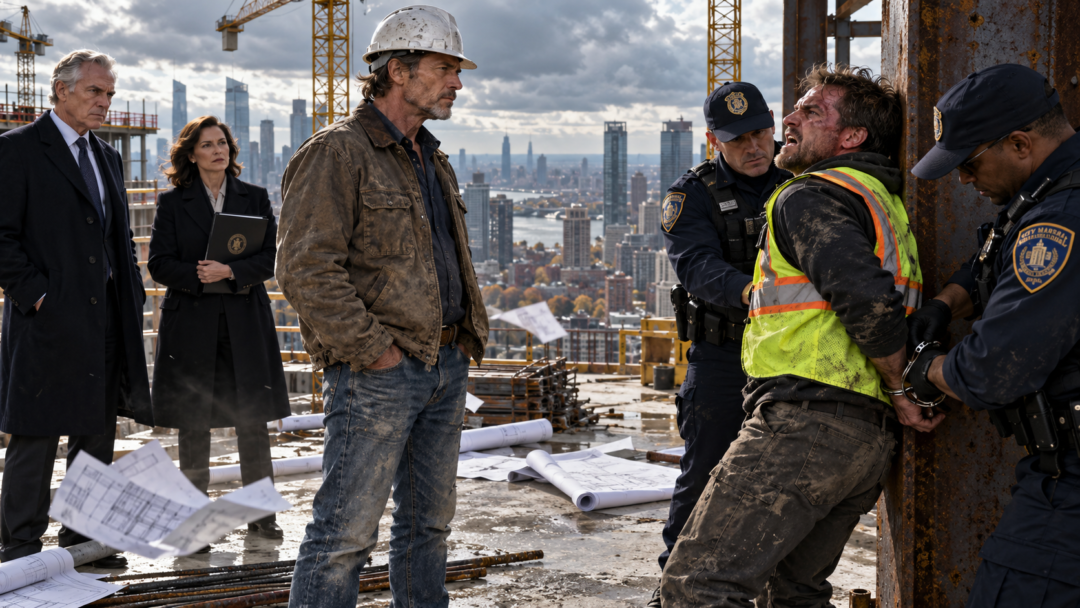
The Fault Line In The Forty Second Floor And The Broken Blueprint
CHAPTER 5: THE AMBUSH IN THE HOIST SHAFT
“I told you that you were a dead man walking, Sterling!”
Frank Kowalski stood on the landing of the central personnel hoist, surrounded by four burly site enforcers armed with heavy iron pry bars and spud wrenches. In Kowalski’s right hand was a handheld two-way radio, squawking with the panicked voice of Deputy Commissioner Bradley.
“The guard at the Gary yard called Bradley twenty minutes ago,” Kowalski said, his voice dripping with venomous amusement. “He said an old bastard in a canvas coat was taking pictures. I knew right away you’d come straight back here like a rat looking for cheese.”
David stood up slowly, slipping the sealed titanium tube into the zippered inner pocket of his heavy canvas jacket. He did not reach for a tool. He stood tall against the howling gale, the city lights shimmering behind him like scattered jewels.
“You’re out of moves, Frank,” David said calmly. “I have the core sample. I have Tommy Miller’s photographs, the Vulcan Iron bills of lading, and the forged heat stamp records. The Department of Justice already has an automated encrypted archive on their secure intake server.”
Kowalski sneered, but the men flanking him hesitated, their eyes darting nervously toward the elevator controls. “You don’t have shit until you make it down to street level, Sterling. And accidents happen all the time on high-rise jobs. Just ask your nephew Tommy. One little push in the dark, and you’re just another stain on the pavement that the street sweepers wash away before breakfast.”
Kowalski barked an order, and the four thugs charged across the wet concrete slab, raising their heavy steel bars.
David didn’t retreat. He grabbed the heavy steel magnetic base of the core drill—weighing thirty-five pounds—and swung it in a vicious, sweeping arc. The heavy iron block caught the lead enforcer squarely in the chest, lifting him off his feet and slamming him onto the wet slab with a sickening groan.
The second man swung an iron bar at David’s head. David ducked beneath the blow, drove his shoulder into the man’s gut, and executed a classic judo hip throw, launching the attacker over his shoulder into a stack of heavy wooden cribbing timbers.
The remaining two men stopped in their tracks, their eyes wide with sudden terror. They were street muscle hired to intimidate day laborers; they had never faced a seasoned veteran who had survived four decades of high-iron rigging.
David didn’t give them time to reconsider. He vaulted onto the personnel hoist platform, slammed the heavy chain-link safety gate shut, and engaged the emergency descent lever. The industrial hoist groaned, its electric motors whining as the cage began to drop down the exterior of the tower.
“Cut the power! Cut the main breaker!” Kowalski screamed from the landing above.
Thirty feet down, between the thirty-ninth and thirty-eighth floors, a deafening mechanical pop echoed through the steel tower. The hoist lights flickered and died. The emergency mechanical safety jaws clamped onto the vertical mast guide rails with a teeth-jarring screech of tearing metal. The elevator cage shuddered violently and hung suspended in the freezing black void, four hundred feet above the Chicago streets.
David grabbed the overhead cage frame, stabilizing himself as the cage swung in the wind. Above him, through the wire mesh ceiling of the hoist, he could hear Kowalski shouting down the shaft.
“You’re stuck in the cage, Sterling! The concrete trucks are at the staging gate! In one hour, five hundred tons of slurry are going down that core, and by noon, we’re cutting that hoist down for scrap!”
Trapped inside the Alimak construction hoist between the thirty-ninth and thirty-eighth floors, the wind howling through the open wire mesh felt like knives against David’s face. Below him, the dark canyon of Wacker Drive was completely silent except for the distant rumble of the early morning street sweepers and the hiss of commuter trains crossing the Wells Street Bridge.
David inspected the control panel on the hoist wall. Frank Kowalski had deliberately tripped the primary three-phase circuit breaker at the base substation, cutting power to the hoisting winch. But Kowalski had made a rookie mistake: he had forgotten that high-altitude personnel hoists installed in high-wind zones were equipped with an autonomous pneumatic descent reservoir designed to lower the cage during total grid failure.
David pulled his twelve-inch spud wrench and unbolted the inspection plate beneath the main motor housing. Reaching inside the dark enclosure with gloved fingers, his knuckles brushed against a secondary relay box that shouldn’t have been there. It was a magnetic GPS tracking beacon with an illuminated green cellular uplink diode, wired directly into the hoist’s power bus.
Kowalski hadn’t just stumbled across David’s presence on the high-rise; he had been monitoring David’s movement through a cellular beacon slipped into David’s toolbox during his brief visit to the site office earlier that week. David yanked the beacon free, crushing the circuit board beneath the heel of his boot. He then located the manual pressure valve for the pneumatic reservoir. With three steady turns of the brass relief nut, hydraulic fluid hissed through the bypass orifice, and the heavy hoist cage smoothly broke free of its locked teeth, sliding down the mast with silent mechanical momentum toward the safety of the lower floor. Outside the cage mesh, the wind howled like a wounded wolf through the exposed structural bracing. David kept his fingers firmly clamped to the emergency brake lever, his eyes tracking every foot of descent against the structural column marks. He knew that the moment he touched the slab, the war for the Aurora Tower would enter its final, lethal phase.