The Lakeside Timber Pavilion And The Regional Conservation Trustee
CHAPTER 1: THE STEAM FROM THE STONE HEARTH
The crystalline, mid-morning sunshine of early summer poured down across the west shore of Lake Tahoe, illuminating the vast, transparent alpine waters in mesmerizing bands of luminous aquamarine, shimmering turquoise, and deep, bottomless sapphire blue. The mountain air was cool, invigorating, and sweet with the rich, resinous perfume of towering Jeffrey pines, incense cedars, and massive white firs that clung to the rugged granite slopes of the Sierra Nevada. High along the western horizon, the snow-dusted granite crests of Desolation Wilderness and the crags of Mount Tallac stood sharply etched against an immaculate, cloudless sky of pale alpine cobalt. Down at Emerald Point, where the ancient forest met the water’s edge, a gentle mountain breeze rustled through the evergreen boughs, sending small, gentle ripples lapping rhythmically against smooth, pale granite boulders and clean quartz-sand beaches. For centuries, this sacred shoreline had been stewarded by native peoples and local families, prized for its pristine clarity where submerged granite ledges were visible sixty feet beneath the glassy surface.
Set fifty feet back from the water’s edge stood the grand open-air community pavilion of Emerald Point. Built entirely of massive peeled Douglas fir timbers, rough-hewn cedar beams, and native Sierra river rock quarried from the Truckee River canyon, the pavilion featured a soaring twenty-foot cathedral roof that sheltered eight long cedar picnic tables, polished flagstone flooring, and a massive, double-sided stone barbecue hearth flanked by two heavy iron wood-burning grills. The pavilion had been engineered to blend seamlessly into the mountain landscape, its heavy stone footings anchored deep into the living bedrock, offering sweeping panoramic vistas of the lake stretching twenty-two miles across to the Carson Range. For thirty years, this facility had served as a beloved sanctuary where local residents, mountain visitors, and school groups gathered to celebrate milestones, surrounded by the towering pines and the peaceful majesty of the blue water.
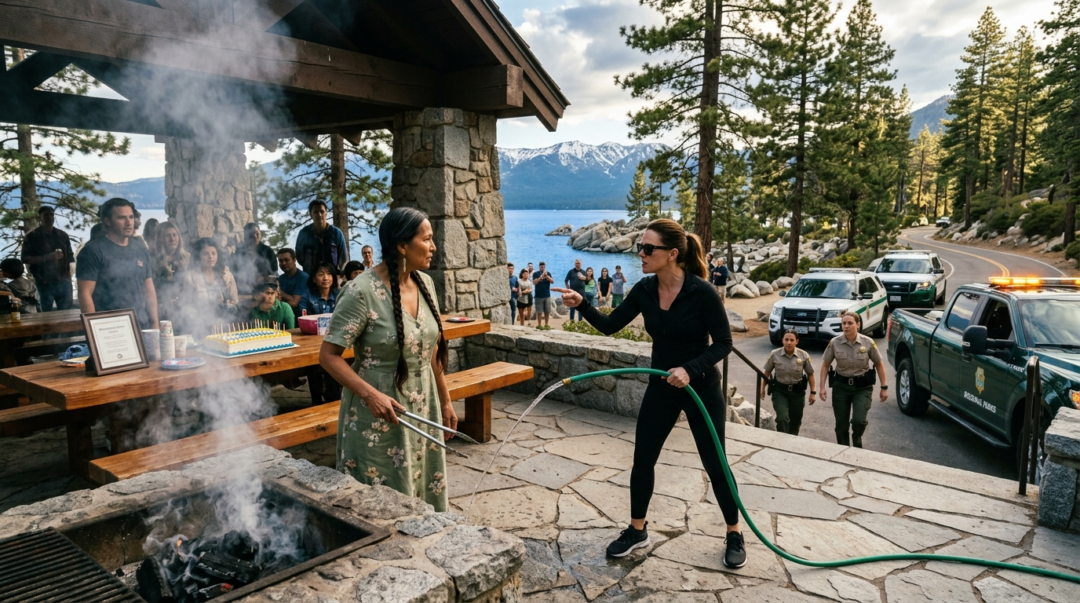
Standing beside the stone hearth, holding a pair of long stainless-steel barbecue tongs, was Dr. Cheyanne River. She was fifty years old, tall, graceful, and regal, carrying herself with the quiet, centered composure of a world-renowned environmental toxicologist, university research fellow, and regional conservation trustee. Her long, lustrous dark hair was woven into a single elegant braid that rested over her shoulder, framing a warm, bronze complexion, high cheekbones, and dark, perceptive eyes that radiated profound intelligence, patience, and serenity. She had dedicated three decades of her scientific career to preserving the fragile limnological ecology of the Sierra Nevada lakes, publishing foundational treatises on water clarity, watershed protection, and public land ethics. She possessed an intimate understanding of every stream, aquifer, and granite formation in the Tahoe basin. She wore a flowing, ankle-length linen dress of sage-green adorned with delicate floral embroidery, and comfortable leather sandals. On the grill before her, thick seasoned steaks, marinated chicken skewers, and sweet summer corn on the cob were searing gently over red-hot hickory charcoal, filling the pavilion with a mouthwatering, woodsmoke aroma that drifted pleasantly across the beach.
Seated around the central cedar picnic table was Cheyanne’s family: her beloved seventy-eight-year-old mother, Clara River, a retired public school teacher dressed in a lavender cardigan and a wide straw hat; her younger brother, Daniel, an environmental educator; and Daniel’s ten-year-old daughter, Maya, who was happily coloring a birthday card. The table was decorated with colorful paper streamers, a vase of wild mountain lupines, and a beautifully frosted strawberry cream birthday cake. Resting on the center of the table was a clear acrylic stand holding an official, laminated document: STATE REGIONAL PARKS COMMISSION — OFFICIAL PAVILION RESERVATION PERMIT #408 — ISSUED TO THE RIVER FAMILY. The permit had been formally processed through the regional parks division, confirming exclusive reservation of the hearth and northern picnic bays for the family’s annual gathering.
The joyful murmur of family conversation was violently shattered by the loud, aggressive scrape of running shoes marching across the flagstones.
Storming into the pavilion with an expression of pinched, theatrical fury was Brenda Hollister. She was forty-four years old, slender and intensely taut, wearing expensive designer black compression tights, a neon-pink athletic jacket with luxury logos, dark polarized visor sunglasses, and high-end trail runners. Her bleached-blonde hair was tied in an aggressive high ponytail, and she carried a stainless-steel fitness water bottle in one hand and a smartphone in the other. Brenda served as the self-appointed President of the Homeowners Association for The Ridges at Tahoe—an ultra-exclusive gated enclave of multimillion-dollar vacation mansions situated on the ridge overlooking the lake. For three years, Brenda had treated the public shoreline beneath her subdivision as her private fiefdom, harassing anyone who did not look like a member of her private country club. She had repeatedly boasted to her board that public parks attracted “undesirable elements” and lowered property values, actively seeking any excuse to close the lakeshore to non-residents. She had organized private patrols, erected unauthorized private property signs, and lobbied local politicians to privatize the shoreline.
“Excuse me! What do you think you’re doing here?” Brenda barked in a sharp, nasal voice, stopping three feet from the barbecue hearth and waving her smartphone aggressively. “Extinguish that fire right now and clear out this entire structure! This pavilion is an exclusive community amenity reserved strictly for residents of The Ridges! You have no authorization to occupy these facilities! We have private security patrols monitoring this cove, and we do not permit unauthorized gatherings!”
Cheyanne did not flinch, nor did she lower her cooking tongs in alarm. She turned around with unhurried, sovereign grace, her dark eyes meeting Brenda’s hostile glare with serene, impenetrable composure.
“Good morning,” Cheyanne said softly. Her voice was smooth, resonant, and remarkably calm, carrying an effortless natural dignity that contrasted sharply with Brenda’s high-pitched hysteria. “This is Emerald Point Public Sanctuary, a designated regional state park. This pavilion is a public recreational facility open to all citizens under state law. Furthermore, we reserved this pavilion two months in advance for my mother’s seventy-eighth birthday. Our official permit is displayed on the table.”
Brenda let out a loud, mocking scoff, marching right past Cheyanne to glare at the picnic table where elderly Clara River sat holding her granddaughter’s hand.
“A permit? You think a piece of paper printed from a government website gives you the right to squat in our private neighborhood?” Brenda sneered, crossing her arms with vicious contempt. “The Ridges Homeowners Association maintains the private access road, and we pay millions of dollars in property taxes to keep this shoreline exclusive! We don’t pay high annual dues so that ordinary outsiders, day-trippers, and tourists can crowd our lakefront, smoke up our mountain air with cheap barbecue, and leave trash on our stones! Look at this clutter! You’re turning a high-end luxury resort area into a carnival! This whole cove is slated for private redevelopment, and you people don’t belong here! My husband’s investment firm has already prepared the zoning filings to reclassify this entire point!”
Daniel River stood up, his face firm with principled resolve. “Mrs. Hollister, our family has lived in this basin for four generations. When the logging companies were clear-cutting these hillsides and the casino developers were trying to build high-rise towers along the water in the nineteen-sixties, our grandfather organized the local citizens to purchase and protect these parcels. This land was deeded to the state precisely to prevent private speculators from turning Tahoe into a walled enclave for millionaires. You cannot erase thirty years of public history with a private gate.”
“Don’t give me a history lesson, you barefoot hippie!” Brenda scoffed, her voice rising in shrill fury. “The past is irrelevant! What matters is capital and private ownership! We have forty homeowners on that ridge with net worths exceeding fifty million dollars each! We have the best real estate litigators on the West Coast on retainer! When our petition is approved, this entire beach will be secured with biometric gates and guard dogs, and anyone who steps foot on this sand will be prosecuted for criminal trespass!”
With an arrogant, spiteful motion, Brenda reached out and shoved a small wicker basket of colorful birthday party favors resting on the bench edge. The basket tumbled off the cedar wood, clattering onto the hard flagstone patio, spilling colorful party blowers, hand-painted wooden whistles, and paper napkins across the floor.
Little Maya gasped, tears welling in her eyes, while Daniel rose to his feet in protest. “Hey! That is completely uncalled for! This is a family gathering for our mother! Pick those up right now!”
“Stay where you are!” Brenda shouted, spinning around and pointing her finger like a weapon. “Don’t you dare raise your voice to me on my community’s land! I told you to put out that fire, and if you won’t do it, I’ll do it myself! I am the president of this association, and my word is law on this ridge! We have an agreement with the county development office, and you are violating our neighborhood peace!”
Before anyone could intervene, Brenda strode over to the pavilion’s brass spigot, snatched the heavy green garden hose, twisted the valve wide open, and dragged the nozzle to the stone hearth. With a vindictive, triumphant sneer, she pointed the high-pressure water stream directly into the glowing charcoal bed.
HISSSSSSSSS!
A deafening, violent roar of steam exploded from the stone hearth as cold lake water struck the white-hot coals. A towering, dense cloud of boiling white vapor and gray woodsmoke billowed into the pavilion rafters, suffocating the delicious aroma of roasted food and leaving the steaks covered in soggy, black ash and dirty runoff.
Brenda tossed the running hose onto the wet flagstones, folded her arms, and pulled out her smartphone with a malicious smirk.
“There! Your little picnic is over!” Brenda laughed mockingly, typing rapidly on her screen. “Now I’m calling municipal police dispatch to have you formally cited for illegal trespassing, public nuisance, and resisting community security! Let’s see how smug you look when the squad cars haul you off in front of the entire lake!”
Cheyanne River did not shout. She did not raise her hand, nor did she display the slightest tremor of panic. She walked calmly to the spigot, turned off the running water with a gentle twist of her hand, and stepped beside her mother, placing a reassuring hand on the elderly woman’s shoulder.
She looked at Brenda Hollister, her voice dropping into a low, chilling baritone of absolute sovereign authority that silenced the echo of the steam:
“Mrs. Hollister, you have made a catastrophic mistake. Key your call to dispatch. Ask them to send the Senior Patrol Commander and the Regional Parks Director immediately. Tell them you are standing in the pavilion of Dr. Cheyanne River.”