The Severed Pool Return Line And The Flooded Basement Window
CHAPTER 1: THE DIAMOND BLADE AT UNIT EIGHTEEN
The relentless southwest Florida sun beat down through the shimmering crowns of towering royal palms, baking the narrow maintenance easement between Villas Seventeen and Eighteen in the gated enclave of Palmetto Palms. Located five miles inland from the turquoise waters of the Gulf of Mexico in Collier County, the development was an architectural showcase of opulent Mediterranean revival homes. Here, barrel-tile clay roofs glowed like terracotta embers, textured stucco walls were painted in pale ivory, and multimillion-dollar villas sat on zero-lot-line parcels separated by slender service corridors barely eight feet wide. Every square foot of manicured St. Augustine turf, Mexican river stone swale, and subterranean utility infrastructure was governed by strict architectural review covenants, municipal drainage easements, and the unforgiving reality of a shallow limestone water table.
David Chen stood on his side of the narrow corridor, his sneakers planted firmly in the clean gray crushed granite of his decorative drainage path. At forty-six, David was a lead software systems architect for a high-security biomedical diagnostics firm, a quiet, analytical man with wire-rimmed titanium glasses, calm posture, and a meticulous habit of preserving digital paper trails for every physical modification to his real estate. For six months, David had endured relentless suburban skirmishes from his neighbor, but he had refused to engage in shouting matches. Instead, he relied on county records, certified engineering schematics, and licensed tradesmen who understood the rule of law.
Beside him stood Marcus Bell, forty-two, the owner and operator of Bell Aquatic Infrastructure. Marcus wore clean navy utility work shorts, heavy waterproof composite-toe boots, and a moisture-wicking field shirt bearing the official embroidered seal of a Florida Master Commercial Plumbing Contractor. Clipped securely to the heavy nylon webbing of Marcus’s chest harness was an Axon commercial body-worn camera. Its high-resolution wide-angle lens captured the narrow corridor with continuous, certified 4K video recording, time-stamping every frame in the upper right-hand corner. Marcus carried a ruggedized field tablet in an armored shock-case, displaying real-time digital GIS overlays of the county water mains.
Between the two pristine stucco villas ran a low, eight-inch-wide concrete curb, poured with fiber-reinforced hydraulic cement and smoothly troweled along the grade. Embedded directly into the center of the concrete was a heavy cast-brass utility medallion, permanently stamped with clear mechanical lettering: POOL RETURN LINE — UNIT 18 PRIVATE SUPPLY — COLLIER CO. PLUMBING PERMIT #4412. Along the property line, three bright orange wooden survey stakes with fluttering neon surveyor’s ribbon had been driven into the ground by a licensed county surveyor only two hours earlier. The stakes had been positioned using GPS satellite base stations, marking the absolute legal boundary between the two estates with sub-millimeter precision.
The peaceful silence of the palm-shaded alley was violently shattered by the harsh screech of an aluminum service gate being kicked open against a stucco wall.
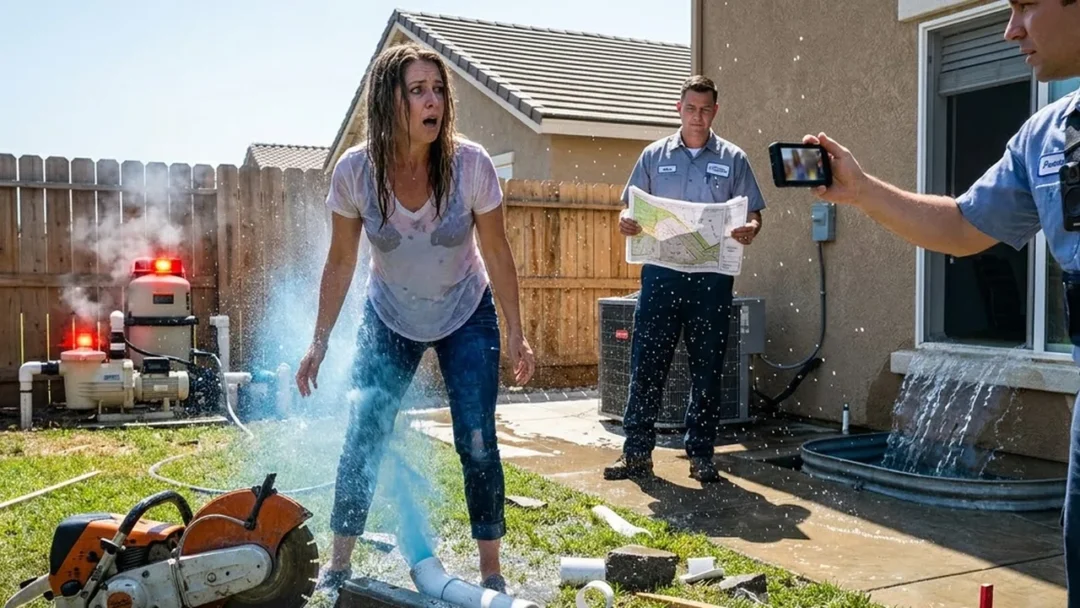
Evelyn Sterling marched into the corridor, her heavy steel-toed work boots crunching aggressively against the river rock. At fifty-three, Evelyn was a retired corporate contract litigator from Chicago who treated every neighborly boundary line as a hostile courtroom deposition. Dressed in grease-splattered cargo trousers, heavy industrial chemical-splash safety goggles, and thick leather welding gloves that reached past her forearms, she carried a twenty-pound Stihl commercial gas-powered cut-off saw. Mounted to the heavy arbor of the industrial tool was a brand-new fourteen-inch diamond-grit abrasive cutting wheel, designed to slice through reinforced bridge decking, pre-stressed highway beams, and granite curbing like warm butter.
For six months, ever since David had replaced his deteriorating wooden fence with an approved county-compliant drainage swale to prevent standing water during the summer tropical storms, Evelyn had waged an unrelenting campaign of intimidation. She had sent four frivolous cease-and-desist letters from her former law firm, claimed David’s rainwater runoff was causing microscopic foundation subsidence on her villa, and repeatedly threatened to demolish any physical structure within two feet of her stucco wall.
“Chen!” Evelyn bellowed, her voice raspy with venom and tobacco smoke as she rested the heavy saw against her knee. “I told you yesterday was your final deadline to jackhammer this illegal concrete curb out of my easement! You poured this curb over my boundary line to block my professional landscapers from running their commercial edgers along my turf!”
David Chen remained perfectly still, keeping his hands loosely at his sides, taking two deliberate steps backward so that Marcus’s chest-mounted camera maintained a wide, unobstructed field of view. “Good morning, Mrs. Sterling. That curb was not poured by me. As you were shown in the county deed registry this morning by the zoning compliance officer, that curb was installed during the original 2015 subdivision construction. It serves as a structural protective sleeve for a sub-grade high-pressure utility line.”
“Don’t quote municipal registry records to me, Chen!” Evelyn snapped, stomping forward until her boots were inches from the concrete boundary. “I reviewed my original purchase survey plat. My fee-simple property boundary extends twelve inches past the foundation footer of my villa. This concrete curb encroaches eight inches onto my deeded land. Under Florida property common law, any unauthorized encroaching structure on my real property constitutes an actionable trespass, and I possess the statutory right to abate the nuisance immediately with direct self-help remedies!”
Marcus Bell stepped forward, raising one gloved hand in a clear, universal gesture of professional caution. “Mrs. Sterling, I am Marcus Bell, licensed master plumbing contractor for Collier County. I strongly advise you to set that saw on the ground. That concrete curb is not an encroaching landscaping border. It is a protective encasement poured specifically under Collier County Plumbing Code section four-hundred to protect a high-pressure commercial water line from surface compaction, root intrusion, and mechanical puncture.”
Evelyn turned her furious glare toward the plumber, her lip curling into a sneer of unadulterated contempt. “I don’t care who you are, boy. You’re an unlicensed handyman hired by an encroaching trespasser. My property, my boundary, my rules. If an unauthorized piece of masonry sits on my gravel, it gets cut.”
Evelyn planted her right boot firmly on the concrete curb, grasped the rubber-coated pull cord of the Stihl cut-off saw with both leather-gloved hands, and ripped the starter cord with savage force. The heavy two-stroke engine fired instantly with an ear-splitting scream that echoed off the stucco walls at nine thousand revolutions per minute, filling the narrow corridor with a thick cloud of blue exhaust smoke.
For nearly a decade, Palmetto Palms had cultivated a reputation as an oasis of refined coastal tranquility. The community was bordered by pristine mangrove preserves and championship fairways, attracting retired executives, medical specialists, and venture capitalists who paid hefty monthly association dues to ensure that not a single blade of grass was out of alignment. But behind the serene stucco facades and terracotta barrel tiles, the development’s zero-lot-line configuration created an inherent architectural friction. The villas had been engineered with narrow side setbacks, sharing subterranean utility easements where water mains, fiber-optic lines, and irrigation conduits ran side by side through five-foot-wide service corridors.
David Chen had lived at Unit Seventeen for seven years without incident until Evelyn Sterling inherited Unit Eighteen following her husband’s passing. Within six months of taking occupancy, Evelyn had turned the quiet corridor into a war zone. She claimed that the drip line from David’s eaves moistened her exterior stucco, that the morning shadow of his bougainvillea trellis robbed her rare bromeliads of solar energy, and that his weekend barbecues created unconstitutional smoke nuisances. She had sent four formal letters drafted on the legal stationery of her former corporate firm, citing obscure nineteenth-century riparian statutes and demanding thousands of dollars in decorative restitution. David had remained unflappable, calmly forwarding every threatening missive to the association’s legal counsel. But this morning, Evelyn had escalated beyond paper filings into direct, physical aggression.