The Chained Trailer Axle And The Hinged Porch Column
CHAPTER 1: THE BOTTLENECK ON IRONWOOD
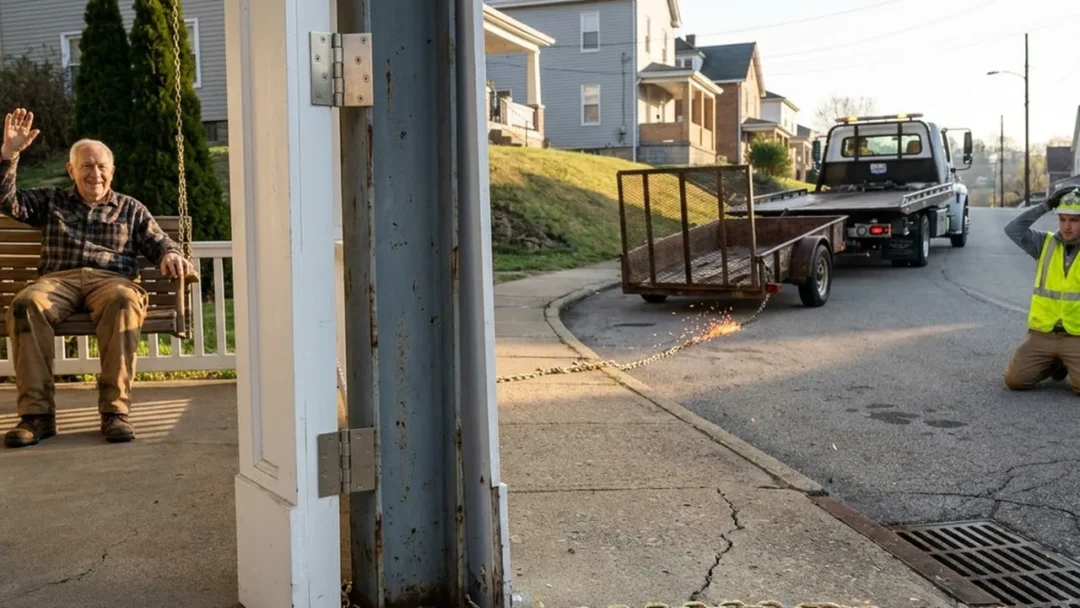
The early morning sun rose over the rolling ridges of Allegheny County, burning through the industrial river mist that drifted up from the Monongahela Valley. In this storied cradle of American steel, where generations of immigrants had poured hot metal to build the nation’s skyscrapers, railroads, and aircraft carriers, the hillside neighborhoods were defined by an unpretentious, hard-nosed respect for honest physical labor. The houses on Ironwood Road were built of heavy timber, local sandstone, and slate, standing solid against winter blizzards and summer humidity for nearly a century. At seven o’clock on a cool Thursday morning, seventy-seven-year-old Frank Kowalski sat peacefully on his covered front porch swing at Number 12 Ironwood Cul-de-Sac. Dressed in a faded gray union sweatshirt bearing the emblem of the United Steelworkers Local 1397, heavy canvas work trousers, and comfortable leather moccasins, Frank held a steaming ceramic mug of black roast coffee in one hand and the morning edition of the Pittsburgh Post-Gazette in the other.
For forty-one years, Frank had worked as a master structural ironworker, erecting high-rise steel frameworks across downtown Pittsburgh and maintaining the heavy crane runways and blast furnace gantries of the historic US Steel Homestead Works. In the brutal, unforgiving world of commercial ironworking, mistakes were measured not in lost dollars, but in human lives. Frank had walked six-inch steel I-beams four hundred feet above the Allegheny River in sub-zero February blizzards, driving three-quarter-inch red-hot carbon rivets with a pneumatic buster gun while balanced on swinging scaffolds. He understood tensile strength, shear stress, moment arms, and dynamic loading with an instinctive physical familiarity that no university engineering textbook could impart. To a man who had rigged fifty-ton bridge trusses over raging river currents, a spoiled thirty-three-year-old house flipper wielding a hardware-store transport chain was a source of quiet, seasoned amusement. He was a widower who lived with the quiet, orderly discipline of a retired tradesman. His two-story timber-and-stone craftsman home, built in 1928, was maintained with surgical precision: the cedar shakes were oiled every three seasons, the copper gutters were hand-soldered, and his wide front porch overlooked a quiet, tight residential turnaround circle where neighbors had raised their children for generations.
Today, however, the peaceful residential cul-de-sac was completely paralyzed.
Down at the mouth of the street, the deep, mechanical rumble of two twenty-ton asphalt paving machines and a tandem roller shook the morning air. Hank Snyder, the municipal paving supervisor for the borough, was pacing the curb with a bright yellow clipboard in hand, his face flushed with exasperation. Behind him, three dump trucks loaded with sixty tons of steaming black asphalt sat idling on the lower street, their diesel exhaust puffing into the morning trees.
The entire paving operation was completely halted by a single obstacle parked squarely across the turnaround bulb.
It was a rusted, dilapidated twenty-foot tandem-axle commercial utility trailer piled eight feet high with rotted drywall, broken concrete blocks, bent copper pipes, and construction trash. The trailer was an environmental eyesore and a severe fire hazard. Rain had soaked through the rotted gypsum board, producing a rancid, moldy stench that wafted across Frank’s front garden whenever the wind shifted. Jagged rusty nails protruded from splintered framing studs, discarded paint cans leaked mineral spirits onto the street, and the dual axles had settled so deeply into the asphalt that weeds were growing through the spokes of the steel rims. The trailer belonged to Brad Mercer.
Brad was thirty-three years old, an aggressive, unlicensed house flipper who had purchased a foreclosed bungalow across the street eight months earlier. Known throughout the borough as a belligerent scofflaw who ignored building permits, parked his commercial vehicles across neighbors’ driveways, and threatened code inspectors with frivolous lawsuits, Brad had dumped the trailer in the public turning circle three weeks earlier. Despite four written municipal notices posted on his door and an orange impound sticker slapped across the rusted tongue, Brad had simply laughed and refused to pay for a commercial dumpster.
“Hook it up, Bill!” Hank Snyder shouted down the street, waving his clipboard toward a heavy-duty municipal flatbed tow truck operated by driver Bill Murray. Hank was fifty-four years old, carrying the stress of managing a borough road budget that had been cut by fifteen percent by the county commissioners. His paving crew had been on the road since five in the morning, battling traffic on Route 837 to bring three fifty-ton loads of hot asphalt mix to Ironwood before ambient temperatures dropped. To have a three-day paving contract brought to an absolute standstill by an unpermitted contractor who treated the cul-de-sac like a private dump site was an insult to every taxpayer in the borough. “We’ve got forty tons of asphalt cooling in those dump beds! If we don’t start rolling this turnaround circle in fifteen minutes, the mix will set in the hoppers! Tow this piece of junk down to the county impound lot!”
Bill Murray backed the heavy municipal wrecker into position with professional care, lowering the reinforced hydraulic steel wheel-lift toward the trailer tongue with a steady hiss of air brakes.
Before the steel forks could slide beneath the axle, the front door of Number 15 flew open with violent force, rebounding off the vinyl siding.
Curiosity Lock: Brad Mercer came charging down his front steps in his work boots, holding a massive, gold-chromate Grade-70 transport binder chain in both hands, screaming profanities at the top of his lungs.