The Locket at Her Throat
Part I — The Plate That Broke First
The plate shattered before anyone admitted anything was wrong.
It slipped from Evelyn Hart’s hands and struck the marble floor with a crack so sharp the crystal glasses trembled. White porcelain scattered beneath the Harrington dining table, between polished shoes and silk hems, and every guest in the room turned to look at her as if she had broken something more valuable than china.
Vivian Hart did not flinch.
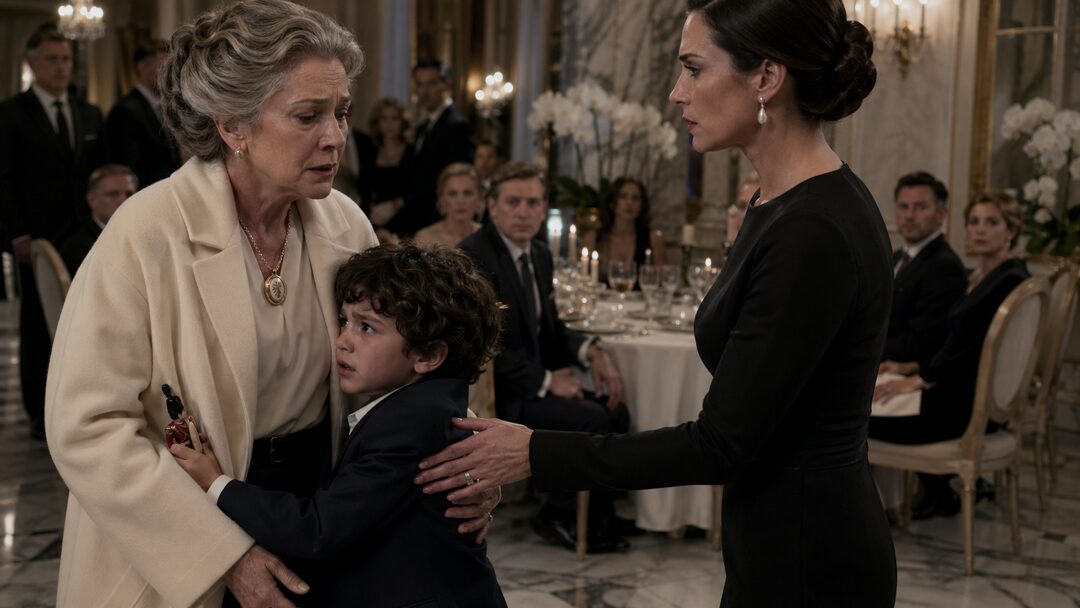
She stood in her black dress near the head of the table, pearl earrings still as little moons against her neck, one hand resting lightly on the back of Julian’s chair.
“Guests don’t serve here,” Vivian said.
Her voice was soft enough to pass as manners.
Then she looked at Evelyn’s cream coat, at the worn cuffs she had tried to brush clean before coming inside, and added, “And servants don’t sit.”
No one laughed.
That made it worse.
Evelyn bent instinctively, because for most of her life she had cleaned up what other people dropped. But her knees had barely moved before Julian stood.
“Mother,” he said under his breath.
Not Vivian, stop.
Not She is my mother.
Just that one embarrassed word, as if Evelyn herself were the accident.
The dining room of Harrington House looked exactly as it had when Evelyn’s husband was alive: long windows, white orchids, silver candlesticks, a chandelier bright enough to make every lie look expensive. But Evelyn no longer belonged to its reflection. She stood at the edge of the table where guests had been seated by rank, charity value, and usefulness. Vivian had placed her near the sideboard.
Close enough to be seen.
Far enough not to matter.
“I’m sorry,” Evelyn said, though she was not sure who she was apologizing to.
Vivian gave her a small smile. “Of course you are.”
That was when the child screamed.
It came from the hallway behind the dining room, high and broken, followed by the pounding of small feet. A little boy burst past the doorway in a gray shirt and jeans, his dark curls damp against his forehead, his face crumpled with panic.
“Nana!”
The word struck Evelyn in the chest.
She did not know him.
She knew him.
Both things were true for one impossible second.
The boy ran straight across the marble, past Vivian, past the staring donors and board members and women holding forks halfway to their mouths. His shoes skidded through broken porcelain. Evelyn saw one shard nick his ankle.
She opened her arms.
Vivian moved first. “Noah, stop.”
But the boy did not stop.
He threw himself into Evelyn so hard she nearly fell backward. His arms locked around her neck. His small body shook against her coat, all heat and fear and desperate trust.
Evelyn’s hands closed around him.
The room disappeared.
Only the child remained.
His hair smelled faintly of soap and rain. His cheek pressed under her chin. His fingers clutched the collar of her coat as if she were the last solid thing in the house.
“Nana,” he sobbed again.
Evelyn felt the word break open a place in her she had kept bandaged for years.
Vivian crossed the room with controlled speed. “Give him to me.”
Evelyn looked down at the boy’s face.
He was five, perhaps. Dark eyes. Soft mouth. A thin scar near his eyebrow. But beneath the panic, beneath the unfamiliar child’s features, there was something she knew too well.
Lily at four, hiding behind Evelyn’s skirt after breaking a vase.
Lily at seven, refusing to cry when her father left for another long business trip.
Lily at nineteen, looking at Evelyn like love had become a place too painful to enter.
Evelyn’s grip tightened.
“Who is he?” she whispered.
Vivian held out her hand. “My nephew.”
It sounded practiced.
It did not sound true.
Julian reached them, pale beneath his careful tan. “Mother, let him go. You’re upsetting the child.”
Evelyn stared at her son.
The child was the one shaking.
The child was the one bleeding lightly from the ankle.
The child had run to her.
“Julian,” she said, “who is he?”
He looked at Vivian before he looked at her.
That was answer enough to make the room colder.
Noah’s fingers twisted in the chain at Evelyn’s throat. The clasp of her gold locket gave way with a tired click. It fell open against her chest.
The faded photograph inside caught the chandelier light.
Lily.
Her Lily.
Laughing in a hospital bed, exhausted and radiant, holding a newborn wrapped in a blue blanket.
Noah went still.
His crying stopped so suddenly Evelyn heard the fountain outside the windows.
He touched the photograph with one trembling finger.
“That’s Mommy,” he whispered.
The room breathed in.
Vivian’s hand froze in the air.
Evelyn looked from the photograph to the boy, and the floor seemed to tilt beneath her.
For years, she had worn that locket as a grave.
Now a child was telling her it had been a door.
Part II — The Woman Who Was Not Invited to Grieve
Vivian recovered first.
She always did.
“Nora,” she called, without raising her voice.
A young nanny appeared at the doorway, white-faced. Vivian did not look at her. She kept her eyes on Evelyn and Noah.
“Take him upstairs.”
“No,” Evelyn said.
The word came out before fear could stop it.
Several guests shifted. One older man Evelyn recognized from her late husband’s company lowered his gaze to his plate. He had eaten in her kitchen once, laughing over coffee while Evelyn’s husband praised her apple cake. Now he found the tablecloth fascinating.
Vivian’s smile thinned. “This is not the moment.”
“This is exactly the moment.” Evelyn held Noah closer. “Why does this child know my daughter?”
Julian stepped between them, lowering his voice as though humiliation could be managed by volume. “Mother, please. Lily was unwell at the end. There were things you didn’t understand.”
“At the end of what?” Evelyn asked.
The room went quiet in a new way.
She had been told Lily died overseas. A sudden fever. No service. No body returned. No child. No explanation except the one Julian had delivered in her kitchen with his coat still on: She didn’t want you there, Mom. Don’t make this harder.
Evelyn had believed him because grief makes even cruelty sound like information.
Vivian’s gaze moved to the locket. “Noah is under my guardianship.”
“Why?”
“Because it is legal.”
Evelyn gave a short, broken laugh. “Legal is not the same as honest.”
Vivian’s eyes sharpened.
“Your generosity was always emotional, Evelyn,” she said. “Not legal.”
There it was.
The old debt in a clean dress.
Years ago, after Evelyn’s husband died and Julian’s first company began collapsing, Evelyn had sold the shares he left her. She had signed papers she barely understood because Julian had sat at her kitchen table looking younger than his age, saying, I can fix this if I get one more chance.
She gave him that chance.
He used it to climb back into rooms where he could be ashamed of her.
Julian’s jaw tightened, but he did not defend her.
Noah turned his face into Evelyn’s neck. “Don’t let her send me away.”
Vivian heard it.
So did everyone else.
For the first time that evening, something like panic flickered across her face.
Only for a second.
Then it was gone.
“You are confusing him,” Vivian said. “Children attach to grief. It’s unfortunate, but common.”
Evelyn looked at the boy’s bleeding ankle, at his hands still twisted around her locket, at the photograph of Lily holding him as a newborn.
“You can call a child confused,” she said. “But you cannot make a dead woman disappear twice.”
Julian flinched.
Vivian turned to the guests. “I’m sorry for the disturbance. Evelyn has had a difficult history with loss.”
The words were beautiful and vicious.
In one sentence, Vivian made Evelyn sound unstable.
Old.
Emotional.
Unreliable.
A woman to be pitied and removed.
Nora approached, hands trembling. Noah whimpered.
Evelyn wanted to fight then. To scream. To clutch the boy and run through the long hallway, past portraits of people who had never been told no, out into the night.
But Vivian had the house.
Vivian had the lawyers.
Vivian had Julian.
Evelyn had a child in her arms and a photograph at her throat.
So she did the only thing she could do without losing him in that room.
She kissed Noah’s hair.
“I will find you,” she whispered.
Vivian heard that too.
Her smile vanished.
The nanny took Noah gently, but he reached back for Evelyn until the last moment, his small fingers opening and closing around nothing.
“Nana,” he cried.
Evelyn stood among broken porcelain and watched him carried away.
Julian touched her elbow. “Mother, go home.”
She turned to him.
For a moment, she saw the boy he had been. Her son with jam on his face. Her son asleep on Lily’s bedroom floor because thunderstorms frightened them both. Her son begging for one more chance.
Then she saw the man he had become.
“I am home,” she said. “That is the problem.”
Part III — The Breakfast Room
Vivian did not receive Evelyn in the drawing room the next morning.
That was the first insult.
The second was tea served in the breakfast room, where household business was handled and flowers were not replaced until they wilted.
The third was Vivian’s expression when Evelyn entered, as though the older woman had arrived early for a cleaning shift.
“You look tired,” Vivian said.
“I did not sleep.”
“No. I imagine not.”
Vivian wore black again. Not mourning black. Armor black. Her hair was smoothed back, her makeup flawless, a single folder closed beside her teacup.
Evelyn remained standing.
“I want the truth.”
Vivian lifted her cup. “People always say that when they want a version they can survive.”
“Is Noah Lily’s son?”
A pause.
“Yes.”
The room did not move, but Evelyn did.
Something inside her stepped backward from the edge of a cliff and realized the fall had already happened years ago.
“She had a child,” Evelyn said.
“She did.”
“And no one told me.”
“Lily did not want you involved.”
The sentence entered Evelyn cleanly, like a knife sharpened for years.
Vivian set down the cup. “She came back pregnant. She was frightened, erratic, ashamed. She refused to name the father publicly. After Noah was born, she deteriorated. We did what was necessary.”
“You hid my grandchild.”
“We protected him from scandal.”
Evelyn’s fingers found the locket. “You told me she died alone overseas.”
“Julian told you what he thought would spare you.”
That name did more damage than Vivian knew.
Julian.
Her son.
Lily’s brother.
The boy who used to bring Lily warm milk when she had nightmares.
Evelyn sat, because her legs had forgotten their work.
Vivian watched her do it and did not offer comfort.
“That child called me Nana,” Evelyn said.
“Children repeat what they hear.”
“Who said it to him?”
Vivian’s jaw tightened.
There.
A crack.
Before Evelyn could press it, Julian entered.
He looked as if he had dressed in a hurry and regretted arriving at all.
“Mother.”
Evelyn did not turn. “Did you know?”
He closed the door behind him. “It’s complicated.”
“No,” she said. “A recipe is complicated. A trust is complicated. A child is not complicated.”
Vivian’s eyes moved to Julian, warning him without speaking.
He came to Evelyn’s side and lowered his voice. “Please don’t do this here.”
“Where would you prefer? The servants’ stairs?”
Pain crossed his face. Genuine pain. Evelyn hated herself for still recognizing it.
“I tried to protect everyone,” he said.
“You protected yourself.”
Vivian stood. “Julian, this is unproductive.”
But Evelyn saw him soften when Vivian turned away. His hand brushed the back of Evelyn’s chair, not quite touching her shoulder.
For one second, he was her son.
Then Vivian looked back, and he withdrew.
Evelyn saw the whole arrangement then. Not all the facts, but the shape. Julian needed Vivian. Her money. Her family. Her approval. The Harrington name had become a chandelier hanging from a frayed wire, and Vivian was the only one pretending not to see it swinging.
“You’re going to marry her,” Evelyn said.
Julian looked at the floor.
Vivian answered for him. “The engagement will be announced formally tomorrow night. Noah will be introduced as part of the family structure. Quietly.”
“Then what?”
Vivian closed the folder. “He requires stability.”
Evelyn looked at the folder.
Vivian smiled.
It was not warmth. It was a locked door.
“Do not start a war you cannot win,” Julian said.
Evelyn stood.
She was suddenly very calm.
“For years I thought my daughter died hating me,” she said. “If that is true, I will carry it. But if you made me carry it when I didn’t have to…”
Her voice failed.
Vivian finished for her. “You’ll what?”
Evelyn looked at her.
“I’ll stop apologizing.”
That was the first threat Evelyn had made in years.
It was small.
It was enough.
Part IV — The Song Under the Window
Noah left the toy soldier by the service entrance.
Evelyn saw it from the alley behind Harrington House, standing beside the delivery bins like a thief. It was made of old painted metal, one arm chipped, one eye missing. A brave little thing damaged by being held too tightly.
She picked it up and looked toward the garden wall.
A whisper came from behind the boxwood hedge.
“Nana?”
Evelyn’s heart nearly broke from the gentleness of it.
Noah crouched beneath the ivy-covered arch, still in the gray shirt from the night before. Someone had combed his curls flat, but they had rebelled by noon.
“You shouldn’t be here,” Evelyn whispered.
“You said you’d find me.”
So she had.
She knelt in the dirt, not caring about the cream coat.
Noah looked at the locket. “Can I see Mommy?”
Evelyn opened it.
He touched the photograph again, more carefully this time. “Aunt Vivian says Mommy was a mistake people loved quietly.”
Evelyn closed her eyes.
There are cruelties adults commit because they think children do not understand the words. But children understand tone. They understand shame long before they can spell it.
“Your mother was not a mistake,” Evelyn said.
Noah studied her face. “Was I?”
The question was so calm that Evelyn almost made a sound.
She took his hands. “No. You were loved before you even knew how to be seen.”
He looked unconvinced.
That was Vivian’s work too.
Noah leaned closer. “Mommy sang about a bird.”
Evelyn stopped breathing.
“What bird?”
“A little bird. In the dark.”
The garden blurred.
When Lily was small, Evelyn had made up a lullaby during a power outage. Lily was afraid of the dark, and Evelyn had sung nonsense into her hair until the storm passed.
Little bird, little bird, fold your wings tight.
Morning will find you if you last through the night.
Evelyn had not sung it since Lily died.
Now she forced the first line through her throat.
“Little bird, little bird…”
Noah’s eyes widened.
Then he finished, softly, “Fold your wings tight.”
Evelyn covered her mouth.
There it was.
Not proof a lawyer would respect.
Something stronger.
Lily had not erased her.
Lily had carried her voice into her child.
Noah pressed the toy soldier into Evelyn’s palm. “Mommy said the lady in the gold picture knew the rest.”
Evelyn could not speak for a moment.
When she did, her voice had changed.
“When are they sending you away?”
Noah’s face went still. “After the party.”
“What party?”
“Aunt Vivian says Uncle Julian will be my new uncle-daddy.” He frowned. “And then I go to school where people know how to behave.”
“Where?”
“Switzerland. I don’t know where that is.”
Far enough, Evelyn thought.
Clean enough.
Expensive enough to make abandonment sound like opportunity.
A door opened somewhere inside the house. Noah jerked.
“I have to go.”
Evelyn caught his hand. “Noah. Listen to me. If anyone tells you not to remember your mother, you remember harder.”
His lower lip trembled. “Will you come?”
“Yes.”
“They said you make people sad.”
Evelyn looked toward the mansion, its windows shining like watchful eyes.
“No,” she said. “I make people remember what they did.”
Noah ran back through the hedge.
Evelyn remained kneeling in the dirt long after he disappeared, the chipped toy soldier in one hand and the open locket in the other.
For the first time since Lily died, she was not only grieving.
She was gathering evidence.
Part V — The Letters Lily Wrote
The old cook’s name was Mrs. Alvarez, though Evelyn had called her Rosa for twenty-eight years.
Rosa now lived in a small apartment above her niece’s bakery, where the hallways smelled of yeast and cinnamon and the furniture was covered in plastic because old habits of protection die hard.
When Evelyn showed her the locket and said Noah’s name, Rosa began to cry before she sat down.
“I kept them,” she said.
“Kept what?”
Rosa went to the bedroom and returned with a sewing box Evelyn recognized. Dark wood. Brass latch. Lily had used it as a girl to store buttons, candy wrappers, birthday candles, anything too small for adults to value.
Rosa placed it on the kitchen table.
“Miss Lily asked me to mail them if anything happened,” she whispered. “But Mr. Julian came. He said it was handled. He said you were ill with grief. He said receiving them would destroy you.”
Evelyn stared at the box.
Her hands would not move.
Rosa touched her wrist. “Open it.”
Inside were letters.
Dozens.
Some folded carefully. Some written in shaking script. Some stained where tears or rain had touched the page.
The first one began:
Mom, I know Julian says you don’t want to see me, but I don’t believe him.
Evelyn made a sound that did not belong to language.
She read standing up because sitting felt too much like surrender.
Mom, I made a terrible mess of my life, but the baby is not terrible.
Another.
Adrian says he will tell them after the merger closes. I know that sounds foolish. Maybe I am foolish. But he held my hand at the doctor’s office, and for one hour I believed love could become honest.
Another.
Vivian came today. She was very kind in the way people are kind when they are measuring where to cut.
Evelyn pressed the letter to her mouth.
Lily had known.
Another.
If Julian comes to you, don’t believe him if he says I don’t want you. I want you so much I am ashamed of wanting. I am going to name the baby Noah if he’s a boy because I keep thinking of boats, floods, and things that survive.
The final letter was unfinished.
Mom, I’m scared. If I don’t get to say it later, you were home. Even when I ran, you were home.
Evelyn lowered herself into the chair.
Rosa wept quietly across from her.
Evelyn did not cry.
Something in her had passed beyond tears and become clear.
She took the letters to Julian that evening.
He met her outside Harrington House, near the side gate where staff used to smoke during parties. He looked older in the dusk.
When she handed him the first letter, he did not ask where she got it.
That was how she knew.
“You read them,” she said.
Julian’s face folded.
“I was going to give them to you.”
“When?”
He said nothing.
“When she was buried without me? When her child learned to call another woman family? When Vivian finished teaching him his mother was shame?”
“Don’t,” he said.
“She begged for me.”
His eyes filled. “I know.”
The words struck harder than denial.
Evelyn stepped back.
“You knew.”
Julian dragged a hand over his face. “Vivian said if you came, everything would collapse. Adrian’s trust, the merger, Lily’s reputation, Noah’s future—”
“Lily’s future was already gone.”
“I was trying to save what was left.”
“No,” Evelyn said. “You were trying to save what was yours.”
His silence answered.
The back door opened. Vivian appeared on the stone steps, black dress sharp against the light behind her.
“How sentimental,” she said. “The reunion by the trash bins.”
Julian stiffened.
Evelyn did not turn away from him. “Tell her.”
Vivian descended one step. “Tell me what?”
Julian looked at Evelyn, then at Vivian.
He chose the easier silence.
Again.
Vivian smiled as if the world had returned to its proper shape.
“You see?” she said to Evelyn. “People stay where they understand the cost of leaving.”
Evelyn gathered the letters back into her handbag.
Julian caught her sleeve. “Mother, please. I have already lost one sister. Don’t make me lose everything else.”
Evelyn looked at his hand until he released her.
“You did not lose Lily,” she said. “You traded her.”
Then she walked away before either of them could see her knees weaken.
Behind her, Vivian’s voice carried through the evening.
“Tomorrow night, Evelyn. If you come, I will not be gentle.”
Evelyn did not look back.
“I know,” she said.
Part VI — The Child Who Chose
Vivian’s engagement announcement filled Harrington House with people who knew how to stare without being caught.
There were donors from the children’s hospital, board members from Julian’s firm, women in diamonds, men with gentle voices and cruel memories. The same white orchids lined the tables. The same silver gleamed beneath the chandelier.
This time, Evelyn entered through the front door.
She wore the cream coat.
Cleaned, though not well enough to hide its age.
At her throat, the gold locket rested closed.
Vivian saw her before Julian did.
For a moment, only her eyes changed.
Then she smiled for the room.
“Evelyn,” she said, warm as polished ice. “No one told me you were well enough to attend.”
Several heads turned.
Julian stood near the fireplace in a navy suit, already trapped between two futures. His eyes went to Evelyn’s handbag.
He knew.
Vivian moved closer, lowering her voice just enough to make the nearest guests lean in.
“I understand grief can become confusing,” she said. “But tonight is not the place for one of your episodes.”
Evelyn felt the old reflex rise in her body.
Apologize.
Soften.
Make it smaller.
She let the reflex pass.
“I am not confused.”
“No?” Vivian tilted her head. “You arrived uninvited to an engagement dinner carrying old letters and accusations. What would you call that?”
“Late,” Evelyn said. “But not confused.”
A murmur moved through the room.
Vivian’s smile tightened.
Julian did not speak.
Evelyn looked at him once. Just once.
Then the staircase doors opened.
Noah came down with Nora behind him, dressed in a navy suit too stiff for a child. His hair had been combed flat again. His shoes shone. His face was empty in the careful way frightened children learn when adults reward quietness.
He saw Evelyn.
His lips parted.
He did not run.
That hurt more than the night he had cried.
Vivian placed a hand on his shoulder. “Noah has something to say.”
Noah looked up at her.
Her fingers tightened.
He turned toward the guests and whispered, “Thank you for giving me a family.”
The sentence was not his.
Evelyn felt the room accept it because it was convenient.
Vivian stepped forward, satisfied. “As many of you know, Julian and I believe deeply in privacy, stability, and responsible care. After our engagement, Noah will continue his education abroad, where he can grow without the burden of adult scandal.”
Abroad.
The word became a door closing.
Evelyn opened her locket.
The tiny click carried farther than it should have.
Vivian stopped speaking.
Evelyn crossed the room slowly, not toward Vivian, but toward Noah. She stopped far enough away that no one could accuse her of grabbing him.
“Noah,” she said.
His eyes filled.
Vivian’s hand remained on his shoulder.
Evelyn lifted the open locket. “Who is she?”
The room leaned toward the question.
Noah looked at the photograph.
At Lily’s young face.
At the newborn in her arms.
His voice shook, but it was clear.
“My mommy.”
A woman gasped.
Vivian laughed once. “Children invent attachments. Especially unstable children.”
Noah shrank.
Evelyn’s voice sharpened. “Do not put your sins in his mouth.”
The room went still.
Vivian’s face changed. “Careful.”
“No,” Evelyn said. “You were careful. That was the problem.”
She opened her handbag and removed the letters.
Julian closed his eyes.
Evelyn did not read them all. She did not have to.
She unfolded one page and held it out.
“My daughter wrote to me before she died. She wrote that she wanted me. She wrote that Julian told her I would not come. She wrote that Adrian Cole was Noah’s father.”
The name landed like a glass dropped in silence.
Adrian Cole.
Vivian’s brother.
Dead heir.
Private trust.
The guests understood money faster than grief.
Vivian turned to Julian. “Stop this.”
He looked at her, then at Noah, then at Evelyn.
For once, there was nowhere respectable left to hide.
“It’s true,” Julian said.
Vivian stared at him.
He swallowed. “Lily wrote. I kept the letters.”
Evelyn’s hand trembled, but she did not lower it.
Julian’s voice cracked. “Vivian helped arrange the guardianship after Adrian died. Noah’s existence complicated the trust. We told ourselves we were protecting him.”
Vivian’s composure slipped.
Only a little.
Enough.
“We did protect him,” she snapped. “From scandal. From that girl’s choices. From this woman’s hysteria.”
Evelyn looked at Noah.
Not Vivian.
Not Julian.
Noah.
“Your mother loved you,” she said. “And she loved me. People lied because truth was expensive.”
Vivian gripped Noah’s shoulder hard enough that he winced.
Julian saw it.
Perhaps he had seen it before. Perhaps he had chosen not to.
This time, he stepped forward.
“Let him go, Vivian.”
She turned on him. “Without me, you are nothing.”
The room heard it.
All the years inside it.
All the bargains.
All the humiliations polished into marriage plans.
Julian’s face went pale.
Then something tired in him finally surrendered.
“Then I am nothing,” he said.
Evelyn did not forgive him.
But she heard the truth in it.
Vivian’s hand fell from Noah’s shoulder.
Everyone watched the boy now.
That was another cruelty, but also a chance.
Evelyn crouched, ignoring the ache in her knees.
“Noah,” she said softly, “I will not take you. If you come to me, it must be because you want to.”
His little face crumpled.
Vivian whispered, “Noah.”
The word was warning.
Julian whispered nothing.
Evelyn held out one hand.
Not both.
Not a demand.
A place to land.
Noah looked at Vivian. Then at Julian. Then at the locket shining open in Evelyn’s palm.
He took one step.
Vivian inhaled sharply.
He took another.
The room did not move.
On the third step, he began to run.
Not with the blind panic of the first night.
With choice.
He crossed the marble dining room, past the orchids, past the silver, past the broken faces of adults who had tried to make him a secret, and put his hand in Evelyn’s.
She closed her fingers around his.
This time, she did not apologize.
Part VII — The Second Picture
Three weeks later, Evelyn’s kitchen smelled of toast, lemon soap, and the kind of quiet that comes after a house has stopped waiting for bad news.
It was not Harrington House.
The ceiling had a water stain near the window. One cabinet did not close properly. The table rocked unless a folded envelope was tucked beneath one leg.
Noah liked it.
He said the rooms did not echo.
Temporary guardianship was the phrase the lawyer used. Review pending was another. Vivian’s control over Adrian’s trust had become a matter for people with briefcases and calm voices. Evelyn listened when she had to and stopped listening when they began making Noah sound like a document.
He was not a document.
He was a child who still woke at night and asked whether Switzerland was far enough that songs could not find him.
Julian came once.
Evelyn saw him from the kitchen window, standing outside the gate with flowers in one hand and shame in the other. He wore no tie. He looked less expensive.
Noah was coloring at the table.
“Who is that?” he asked.
Evelyn dried her hands.
“Julian.”
“Is he family?”
The question had no safe answer.
Evelyn looked at her son through the glass. The boy she had raised. The man who had helped steal years from her. Both stood there together, and neither erased the other.
“Yes,” she said. “But family is not always a safe place to stand.”
Noah considered that.
“Can he come in?”
Evelyn watched Julian lift the flowers slightly, as if they were an apology he did not know how to pronounce.
Not today, she thought.
Maybe not soon.
Maybe not ever in the way he wanted.
She opened the door only halfway.
Julian’s eyes went to Noah behind her, then back to his mother.
“I don’t know how to ask,” he said.
“That is the first honest thing you’ve said in a long time.”
He nodded as if she had struck him and he deserved the shape of it.
“I’m sorry,” he said.
Evelyn did not move.
The words stood between them, too small for what they had to carry.
“I believe you,” she said. “That does not make it repaired.”
His mouth tightened.
He looked past her again. Noah had stopped coloring.
Julian set the flowers gently by the gate.
“I’ll come back another time,” he said.
Evelyn closed the door before pity could become permission.
That afternoon, she took Noah to the small garden behind the library. He stood very still while she photographed him beside a bare rosebush, holding his chipped toy soldier. He did not smile.
She did not ask him to.
Some children had been told to perform gratitude too often. Evelyn would not make happiness another costume.
At home, she trimmed the photograph carefully with Lily’s old sewing scissors. Noah watched from the chair beside her.
“Is that for Mommy?” he asked.
“For the locket.”
“But Mommy is already there.”
“Yes.”
Evelyn opened the gold oval.
Lily’s photograph was still on the left: young, tired, glowing, holding the baby the world had tried to call inconvenient.
On the right, Evelyn placed Noah’s new picture.
Serious.
Unsure.
Present.
The locket had once held the dead.
Then it held the truth.
Now it held the living too.
Noah leaned against her arm. “Will Mommy know?”
Evelyn closed the locket and pressed it between their hands.
“I think she already did.”
Outside, evening settled gently against the windows. In the distance, a car passed. Somewhere upstairs, a pipe clicked in the wall.
Noah’s voice came small in the dim kitchen.
“Can you sing the bird song?”
Evelyn’s throat tightened.
She began with the first line.
“Little bird, little bird, fold your wings tight…”
For a moment, she sang alone.
Then Noah joined her on the second line, his voice thin but steady.
“Morning will find you if you last through the night.”
Evelyn held him close, not because she was afraid he would vanish, but because he was there.
Love had found them late.
But not too late to be held.