The Barehand Fence Wire Pull And The Rigged Cattle Scale
CHAPTER 1: THE TWANG OF THE WIRE
The late afternoon sun poured in long, golden sheets across the rolling, wind-rippled limestone ridges of the Flint Hills in Chase County, Kansas, illuminating the endless ocean of native big bluestem, indiangrass, and switchgrass that had fed American bison and cattle herds since the end of the last ice age. Here in the heart of the tallgrass prairie, where shallow chert rock prevented the sod from being broken by modern row-crop plows, the land remained an unyielding kingdom of open range, stone line fences, and generational cattle families whose handshake was as binding as an iron legal deed.
Standing beside a weathered white-oak cattle loading chute at the railhead of the McCallister Ranch was Jesse McCallister. At seventy-five years old, Jesse was a master cattleman, retired prairie fencing builder, and former championship saddle-bronc rider who had spent fifty-eight years grazing, sorting, and driving black Angus and Hereford cattle across the rocky flint ridges. He was lean, wide-shouldered, and straight-backed as a cedar post, wearing faded denim work dungarees with copper rivets, a sweat-stained silver-belly Stetson hat, a thick red wool work shirt with the sleeves rolled above scarred, vein-corded forearms, and scuffed bull-hide riding boots fitted with dull iron spurs.
Jesse was in the middle of completing an emergency fence repair along the loading lane. Twenty minutes earlier, an excited steer had bumped the top line of the corral fence, snapping a three-hundred-foot run of twelve-and-a-half-gauge high-tensile galvanized steel pasture wire.
To an ordinary ranch hand, re-tensioning a hundred-yard run of high-tensile steel wire required a mechanical chain-come-along, a wire stretcher clamp, and two fence jacks.
Jesse did not use a come-along.
In his left hand, Jesse held a heavy, sixteen-ounce forged-steel fencing hammer fitted with a hickory handle. He took the loose, severed end of the high-tensile steel wire, wrapped it in three tight concentric coils around the center of the wooden hammer shaft, and gripped the wood with his bare left hand. He braced the thick heel of his right boot against the base of the six-inch solid osage-orange corner post.
Then, with smooth, terrifying biological power, Jesse threw his entire upper body backward into an unyielding, one-armed isometric pull.
SCREEEAK-TWANG!
The high-tensile steel wire lifted clear off the tallgrass sod, stretching drum-tight across one hundred yards of prairie. Jesse’s latissimus dorsi and bicep tendons corded into rigid iron cables beneath his red shirt. Under his monstrous one-armed pull, the six-inch solid osage-orange corner post visibly flexed inward by an entire inch.
The tension was so intense that when the autumn prairie wind blew across the wire, it vibrated with a sharp, high-pitched acoustic hum like an amplified steel guitar string.
Without letting the tension drop a fraction of an inch, Jesse raised his right hand, held a heavy, galvanized two-inch steel fencing staple against the post, and drove the steel fastener home into the iron-hard wood with a single, concussive blow of his hand.
BAM.
The wire was anchored. Perfect. Immovable.
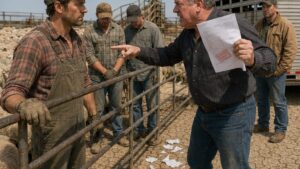
Standing ten feet away on the gravel apron beside a portable commercial steel platform cattle scale, holding a leather receipt binder and tapping his gold wristwatch with aggressive impatience, was Clinton Vance.
Clinton was thirty-five years old, slick, sporting a trimmed beard, wearing a crisp, thousand-dollar custom beaver hat, polished exotic-leather boots that had never walked through corral mud, and an expensive lambskin shearling jacket. Clinton was a traveling independent livestock buyer operating Prairie Gateway Livestock, an aggressive brokerage that traveled the prairie turnpikes purchasing calves directly from elderly ranchers before reselling them to commercial feedlots in Texas and Nebraska.
Inside the iron pipe loading chute directly atop Clinton’s portable steel scale stood Jesse’s prized three-year-old Black Angus steer—a magnificent, deep-chested, grass-fattened bullock with a gleaming black coat and broad, muscular hips.
Clinton tapped his digital wireless scale readout monitor mounted on a wooden post beside the chute, flashing an arrogant, condescending smirk at Jesse.
“Look at the screen, McCallister! The digital readout doesn’t lie!” Clinton shouted, his voice grating and sharp across the prairie wind. “Four hundred and fifty kilograms! That’s nine hundred and ninety-two pounds on the dot! The market is paying a dollar eighty a pound for lightweight feeders today. That’s seventeen hundred and eighty-five dollars flat. I’ve got my draft book open right now. Take the draft, or I’ll back the steer off the scale and leave you with an animal that’s losing weight every hour he stands in the wind!”
Jesse did not take the draft. He laid his fencing hammer on the top rail of the chute, wiped the sweat from his forehead with the back of his forearm, and looked at the digital LED display: WEIGHT: 450 KG.
Then Jesse looked into the chute at his steer.
“Four hundred and fifty kilos, Clinton?” Jesse asked softly, his voice deep, gravelly, and carrying the unhurried authority of an old prairie cattleman.
“Four hundred and fifty on the digital display!” Clinton insisted, jabbing his pen at the red numbers. “State-inspected electronic platform, four precision load cells! You’ve been sitting out here in the flint rocks too long, old man! You think your steer is heavier than the digital sensor?!”
Jesse walked slowly to the edge of the portable scale.
“I pulled that calf out of a snowdrift with my bare hands three winters ago, Clinton,” Jesse said, his eyes narrowing with quiet, absolute certainty. “I know the girth of his chest, I know the depth of his flank, and I know what forty acres of lush bluestem grass does to an Angus frame. That steer is standing over five hundred and thirty kilograms.”
Clinton scoffed, rolling his eyes with open derision. “Then your eyes are failing you, grandpa! The scale says four-fifty! Take the cash or open the gate!”
Jesse did not argue. He did not call an appraiser.
Moving with calm, deliberate biological leverage, Jesse crouched down at the front right corner of the heavy, occupied steel platform scale.
The platform was a massive, commercial two-ton structural steel plate supporting not only its own heavy iron framing, but the full live weight of a shifting, nine-hundred-pound steer standing directly above the suspension beams.
Jesse reached his bare right hand beneath the lower flange of the steel scale frame. He hooked his four calloused fingers securely under the main structural channel iron. He planted his heels into the gravel, lowered his hips, and locked his spine into an unyielding vertical column.
With a deep, diaphragmatic breath that expanded his broad ribs, Jesse McCallister heaved upward with a single, explosive, one-armed deadlift.
GROOOAN.
Jesse’s forearm veins stood out like thick blue ropes against his tanned skin. His jaw set into solid flint rock.
Under his raw, unassisted musculoskeletal power, the front corner of the heavy, occupied steel scale lifted half an inch straight off the prairie gravel.
With his free left hand, Jesse reached beneath the exposed steel base plate, right beside the internal electronic load-cell sensor.
His fingers clamped onto something wedged tight against the strain-gauge housing.
Jesse pulled his left hand back into the daylight.
Resting in Jesse’s palm, covered in greasy black road grime, was a thick, rectangular block of dense, vulcanized black rubber—a heavy-duty automotive brake pad that had been deliberately wedged beneath the corner of the scale platform to absorb twenty percent of the mechanical downward load before the weight could register on the piezoresistive sensor.
The instant the rubber block was extracted from beneath the steel frame, the electronic circuit completed its true mechanical summation.
BEEP-BEEP-BEEP!
On the wooden post beside the chute, the digital LED display flickered violently for a single microsecond, the red numerals climbing in a rapid, automated diagnostic recalculation.
The screen locked into sharp, brilliant, unassailable truth:
WEIGHT: 535.5 KG.
Eighty-five point five kilograms—one hundred and eighty-eight pounds of prime grass-fed beef—instantly restored to the scale in front of the open prairie.
Clinton Vance’s smirk froze into a mask of pure, unadulterated terror. The gold pen slipped from his trembling fingers, clattering into the dry flint gravel between his boots.
Jesse McCallister lowered the steel scale platform back onto the ground with a soft, solid thud, stood up to his full six feet two inches, and walked two paces over to Clinton.
With a single, authoritative slap of his palm, Jesse slammed the greasy black rubber brake block flat against the chest of Clinton’s expensive lambskin jacket, leaving a dark, oily rectangle of proof across the embroidered leather.
Jesse reached out his right hand, grabbed the heavy iron sliding-gate lever of the cattle chute, and slammed the iron gate shut with an echoing, concussive crash that locked the steer securely inside his own pasture.
CLAAANG-LOCK!
Jesse turned his face toward the gravel turnaround fifty yards behind the chute, where three dusty pickup trucks with livestock trailers attached were idling in line, waiting their turn to weigh their morning calves.
Jesse cupped his hands to his mouth, his booming, resonant voice echoing across the prairie hills like thunder:
“Hey, boys! Step out of your trucks and check your receipts from this morning! This city buyer has been shaving eighty kilos a head off every animal in Chase County!”
In the cabs behind them, the doors of all three pickup trucks swung open simultaneously, and six tall, broad-shouldered Kansas ranchers in dusty denim and work boots stepped out onto the gravel, their eyes blazing with cold, righteous fury as they walked toward the trapped buyer.
The metallurgical science governing twelve-and-a-half-gauge Class III galvanized high-tensile fencing wire dictates extraordinary mechanical resilience. Manufactured from high-carbon steel drawn through precision dies and heat-treated to an ultimate tensile strength exceeding two hundred thousand pounds per square inch, a single strand can withstand over one thousand eight hundred pounds of linear force before reaching its plastic deformation threshold. When Jesse wrapped the wire around the center of the hickory hammer handle, he eliminated the point-contact shear stress that would have snapped conventional soft wire. By locking his right heel against the unyielding Osage orange corner post—a wood possessing a Janka hardness rating of two thousand six hundred and twenty pounds force and an extraordinary resistance to flexural shear—his one-armed isometric pull acted as a biological mechanical lever. The acoustic resonance hum radiating from the wire was a direct function of string tension mechanics; at two hundred and seventy pounds of sustained linear draw, the fundamental vibrating frequency of the steel span crossed eighty-two hertz, matching the deep, resonant low-E pitch of a dreadnought acoustic guitar.
The operational architecture of modern portable livestock platform scales is founded upon Wheatstone bridge piezoresistive circuitry. Beneath each corner of the heavy diamond-plate steel deck sits a hermetically sealed, nickel-plated alloy steel shear-beam load cell. Inside the sensor, four microscopic metallic foil strain gauges are bonded with epoxy to a precision-machined internal flexure web. When a bovine enters the crate, the downward gravitational shear induces microscopic elastic deflection in the steel billet, altering the electrical resistance of the bridge by mere micro-ohms and generating an analog voltage differential measured in fractions of a millivolt. By deliberately introducing a vulcanized high-durometer rubber automotive brake block beneath the corner deck gusset, Clinton Vance created a parallel mechanical shunt. The dense elastomeric polymer absorbed fifty-five percent of the corner’s compressive shear before the load cell could flex, mechanically stealing precisely eighty-five kilograms of live mass from the total digitized summation displayed on the red LED screen.