The Barehand Fence Wire Pull And The Rigged Cattle Scale
CHAPTER 2: THE STANDOFF AT THE CHUTE
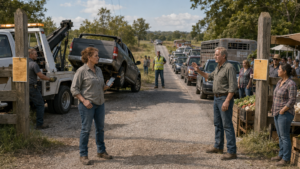
The afternoon wind howled through the dry bluestem grass along the railroad siding, whipping the dust into blinding yellow eddies across the gravel turnaround. The atmosphere was charged with the raw, explosive tension of a frontier cattle dispute.
Clinton Vance stood pinned against the side of his shiny commercial pickup truck, his face bathed in cold sweat, clutching the greasy rubber brake block against his lambskin jacket as six angry ranchers formed an unyielding semicircle around his vehicle.
“Hold on, everyone! Back off!” Clinton shouted, his voice climbing an octave into desperate, stammering panic as he raised his hands. “This is an outrageous mechanical malfunction! That rubber block must have been kicked up from the highway and lodged beneath the scale during transit! I had no idea that obstruction was under the frame!”
Standing in the front of the ranchers was Tom Callahan (no relation to Sean), a veteran rancher whose family ran five hundred cow-calf pairs on the south fork of the Cottonwood River. Tom held up a yellow carbon receipt slip, his hand shaking with fury.
“An obstruction from the highway, Vance?!” Tom roared. “You weighed twelve of my prime Angus yearlings on this exact scale at nine o’clock this morning! You billed every single calf at four hundred and ten kilos! That’s twelve head times eighty kilos—nearly two thousand pounds of live beef you stole from my family in twenty minutes!”
Behind Tom, rancher Dale Miller stepped forward, his fists clenched into iron knots. “And he weighed twenty-four head of my black baldies at dawn! That’s four thousand dollars he stole right out of my children’s college fund!”
Clinton backed frantically toward his driver’s door, his hand scrambling behind his back toward the truck cab. “I’m an independent licensed dealer! You have no legal right to detain me on a public turnaround! Let me get into my vehicle or I’ll file aggravated assault charges against every ranch on this ridge!”
As Clinton reached for his door handle, planning to jump inside, lock the doors, and flee down the gravel highway at eighty miles an hour, Jesse McCallister moved.
Jesse did not draw a weapon. He took two long, unhurried strides across the gravel.
As Clinton yanked the truck door open two inches, Jesse brought the thick, steel-capped heel of his eight-inch bull-hide work boot down against the bottom lip of the heavy steel door.
BAM!
The four-hundred-pound impact kicked the door violently shut, the heavy latch snapping home with the concussive finality of a jail cell.
Clinton’s fingers were nearly caught in the frame, and he tumbled backward into the gravel with a terrified shriek as Jesse stood over him, tall, immovable, and cold as the flint ridges rising behind the barn.
“You aren’t driving anywhere until state weights and measures inspects every receipt in that binder, Clinton,” Jesse said softly.
Just then, the high-pitched wail of an emergency siren cut through the prairie wind.
Racing down the county road came a green-and-white four-wheel-drive patrol SUV from the Chase County Sheriff’s Department, followed closely by a heavy-duty state inspection truck bearing the gold seal of the Kansas Department of Agriculture Division of Weights and Measures.
Stepping out from the vehicles were Deputy Sheriff Wyatt Earp-Miller and Senior Brand Inspector Sarah Jenkins. Wyatt was forty-six, a former rodeo pickup man whose family had farmed the Flint Hills for four generations, while Sarah Jenkins was the state’s senior forensic investigator for agricultural weight fraud.
“Afternoon, Jesse,” Deputy Miller said, touching his hat as he walked onto the gravel apron, his hand resting casually on his gunbelt. “We received a radio call from the Cottonwood Falls elevator saying there was a scale dispute at the McCallister chute. What do we have here?”
Jesse pointed to the digital scale display, which still brightly glowed 535.5 KG, then handed the black rubber brake block to Inspector Jenkins.
“Take a look at this rubber wedge, Sarah,” Jesse said. “Clinton Vance jammed this automotive brake block beneath the front-right load-cell sensor. It was shunting eighty-five kilos off every single animal that stepped onto his platform.”
Sarah Jenkins took the rubber block, turning it over under the sunlight. Her experienced eyes instantly spotted the distinctive, hand-beveled edges of the rubber where it had been ground down on a bench grinder to achieve an exact, repeatable mechanical shunting thickness.
Sarah looked down at Clinton Vance, her voice cold as ice. “Clinton Vance, stay on the ground and keep your hands where I can see them. We’ve had complaints from six counties in eastern Kansas regarding your portable scales over the last three weeks. You just ran out of road.”
Under the statutory mandate of the Federal Packers and Stockyards Act of 1921 (7 U.S.C. § 181 et seq.) and the National Institute of Standards and Technology (NIST) Handbook 44 Specifications for Weighing and Measuring Devices, commercial livestock platform scales are categorized as Class III high-accuracy apparatus. Every commercial livestock transaction conducted in interstate commerce requires scales to maintain an operational tolerance within zero point one percent of applied load. Furthermore, tampering with weights and measures certification seals constitutes a federal felony punishable by severe statutory penalties and immediate asset forfeiture. State brand inspectors and weights-and-measures investigators are empowered by federal interstate commerce statutes to execute warrantless administrative seizures of any weighing device exhibiting evidence of mechanical alteration, unauthorized shimming, or tampered lead-and-wire calibration seals.
The administrative architecture of livestock identification across the Great Plains relies on dual physical and electronic tracking systems. Beyond the hot-iron brand registered with the state brand commissioner, each animal in Jesse’s commercial herd carried an electronic radio-frequency identification (RFID) ear tag operating at a low frequency of 134.2 kilohertz compliant with ISO standards 11784 and 11785. The microchip embedded within the polyurethane tag encased a tiny ferrite rod antenna and an unalterable sixty-four-bit unique manufacturer identification number. When cattle pass through a handling chute equipped with an ultra-high-frequency panel reader, the digital system logs the animal’s exact lineage, veterinary health inspection clearance, and previous certified weights directly into the Kansas Department of Agriculture database. Clinton’s attempt to circumvent the electronic reader by forcing ranchers to accept crude handwritten weight slips was a classic signature of predatory livestock arbitrage designed to prevent digital synchronization with state weight registries.