The Room Where It Cost Him
Part I — The Man at the Grave
Julian Vale was supposed to announce his engagement in four hours, but at nine that morning he sat at his dead wife’s grave with both hands over his face, crying so hard he could not hear the cemetery gates closing behind him.
The ring box was still in his coat pocket.
It pressed against his ribs every time he bent forward, a small velvet accusation. In front of him, fresh white roses lay across Celeste Vale’s grave, their petals too bright against the gray stone. Behind him stood the Vale family mausoleum, polished, expensive, locked. Even grief had architecture when your family owned half the city.
Julian had told his driver to wait outside the private wing of Graymere Cemetery. He had said he needed ten minutes.
That had been forty minutes ago.
His mother had already called twice.
He could imagine Evelyn Vale’s voice before he heard it: soft, controlled, faintly disappointed. Julian, darling, people are arriving at one. We cannot have another display today.
Another display.
As if grief became vulgar once it became visible.
He lowered one hand and looked at Celeste’s name carved into marble.
CELESTE ASHFORD VALE
BELOVED WIFE
The words were true enough to hurt.
She had been beloved. Not the way people whispered about love at weddings. Not wild. Not chosen in the beginning. But she had become gentle with him in the years after the contract, after the photographs, after the merger their families called a marriage. Celeste had never pretended not to understand what she had been purchased to save.
On their second anniversary, she had lifted a glass of champagne at dinner and said, “At least we are both useful people.”
Julian had laughed because she did.
Later, he realized neither of them had found it funny.
Now she was dead, and his mother had found another useful woman before the roses on Celeste’s grave had fully browned.
Julian pressed the heels of his palms into his eyes.
He was thirty-nine years old. He ran board meetings, negotiated towers into existence, smiled beside senators, and survived headlines with his name in them.
But alone in the cemetery, he was just a man who had obeyed too much and loved too late.
A small voice said, “Are you crying because she left, or because you let her?”
Julian froze.
He looked up.
A little girl stood on the path a few feet away, wearing a tan wool coat and a scarf too large for her narrow shoulders. She had dark shoes, wind-flushed cheeks, and the solemn expression of a child who had learned to watch adults before speaking to them.
She held a crumpled tissue in one hand.
Julian wiped his face too quickly. “You shouldn’t be here.”
“I know,” she said.
“That’s a private section.”
“I know that too.”
“Where are your parents?”
“My mom is visiting somebody.”
“Then go back to her.”
The girl did not move. She looked at the roses, then at Julian’s face.
“My mom says people cry hardest when they waited too long.”
Julian felt something in his chest pull tight.
The girl stepped closer and offered the tissue. It was soft from having been folded and unfolded too many times.
He almost refused it.
Instead, he took it because she was seven or eight and because his own hand was shaking.
“What’s your name?” he asked.
“Lily.”
“Lily,” he repeated, as if saying it correctly might return the world to order. “You should not talk to strangers.”
“You looked sad.”
“That doesn’t make me safe.”
She considered this carefully. “No. But it makes you real.”
Julian almost smiled. It hurt too much, so he looked away.
His phone vibrated again in his coat pocket. The ring box shifted with it. Lily’s eyes dropped to the movement before he could hide it.
“Are you giving someone a present?” she asked.
“No.”
“But there’s a box.”
Julian closed his hand over his pocket.
Lily tilted her head. “My mom says some presents are apologies wearing ribbons.”
The words landed in him with the precision of a blade.
He looked at her properly then. Not as an interruption. Not as a child lost in the wrong part of a rich cemetery. As a messenger from some place he had spent years pretending did not exist.
“Your mother says a lot of things,” he said.
Lily nodded. “Mostly when she thinks I’m asleep.”
The wind moved through the leafless trees. A dry leaf skated across the stone path and came to rest near Julian’s polished shoe.
He should have stood. He should have called for security, or led her back to the public section, or returned to the car where his driver would pretend not to notice the condition of his face.
Instead he asked, “Who did your mother come to visit?”
“My grandma.”
“And you wandered all the way here?”
“I saw you.”
“You don’t know me.”
Lily’s fingers tightened around the edge of her scarf.
“I think I do,” she said.
Julian’s throat closed.
Somewhere beyond the mausoleums, a crow called once and went silent.
Part II — The Girl Who Knew Too Much
Julian stood too quickly, ashamed of being seated before a child who spoke like a wound.
“Come on,” he said. “I’ll walk you back.”
Lily did not resist, but she did not hurry. She moved beside him with careful little steps, looking at the names on the stones as if they were signs in a museum.
“You’re rich,” she said.
Julian gave a dry laugh. “That’s not usually how children begin conversations.”
“My mom says rich people don’t like when you notice.”
“Your mother sounds observant.”
“She says observing is what poor girls learn when nobody asks them questions.”
Julian stopped walking.
The private path curved toward the older section of Graymere, where the stones grew smaller and the grass less perfect. Past the iron boundary fence, the public cemetery opened in uneven rows. That was where groundskeepers stopped replacing dead flowers before visitors noticed.
He should have asked Lily again for her mother’s name.
He did not want to.
“Why were you crying?” she asked.
“My wife died.”
Lily’s expression softened. “The grave with the flowers?”
“Yes.”
“Did you love her?”
Julian looked back at Celeste’s grave.
That question should have been easy.
“Yes,” he said. Then, after a moment, “Not at first.”
Lily seemed to accept this as adults’ business.
“Then why are you giving someone else a present?”
The ring box seemed to grow heavier.
“It’s complicated.”
“My mom says people say that when they want the wrong thing to sound tired instead of wrong.”
Julian laughed once, but there was no humor in it. “Your mom and I would not get along.”
Lily looked up at him. “I think you did.”
The cold entered him all at once.
“What did you say?”
She reached into the pocket of her tan coat and pulled out a folded corner of paper. Not a photograph, he realized, but a drawing. A child’s copying of one. Pencil lines, awkward and tender. A tall man in a suit. A woman beside him with her hair loose. Underneath, in careful letters: MOM’S OLD FRIEND.
Julian stared at it.
He knew the original without seeing it.
It had been taken behind the library at Westbridge University, before his family name became a cage he stopped trying to rattle. He had been twenty-three. Mara Bell had been twenty-one, wearing a green sweater with a hole near one cuff because she spent her money on textbooks first and everything else second.
He remembered how she had laughed when the wind blew her hair across both their faces.
He remembered telling her, “One day I’ll take you somewhere warm.”
She had said, “One day you’ll stop promising me weather.”
Lily folded the drawing again.
“My mom keeps the picture in a cookbook,” she said. “Between pancakes and banana bread.”
Julian could not breathe for a second.
“What is your mother’s name?”
Lily looked toward the public section of the cemetery.
“Mara.”
The path seemed to tilt under him.
Mara Bell.
A name he had not spoken aloud in eleven years, though he had heard it in every quiet room.
He had loved Mara before Celeste. Before the Ashford merger. Before his father’s debts became “temporary liquidity pressure” in newspapers. Before Evelyn Vale turned family survival into a ceremony and called it duty.
Mara had been a scholarship student working nights at the Ashford Club, where Evelyn lunched with women who treated staff like furniture that breathed. She had been sharp, serious, funny only when she trusted you. She had called Julian “Mr. Tower” the first time they met because he had tried to impress her by explaining zoning law.
“You build boxes in the sky,” she had said. “Congratulations.”
He had loved her immediately and badly.
Badly, because he loved her in private first.
Badly, because he believed private love was enough.
Lily watched his face change.
“Are you mad?” she asked.
“No.”
“Are you scared?”
Julian looked toward the public graves.
“Yes.”
That answer seemed to satisfy her more than a lie would have.
“My mom didn’t want to come today,” Lily said. “But Grandma’s birthday is in April. She always comes.”
Julian swallowed.
“Mara’s mother is buried here?”
Lily nodded. “Not over there.” She pointed behind them, toward marble and iron. “Here.”
Julian heard, beneath that simple word, everything it carried.
Not with your people.
Not in your section.
Not protected.
“What did your mother tell you about me?” he asked.
Lily considered him for a long moment.
“She said you were kind when no one was watching.”
Julian closed his eyes.
An accusation would have been easier.
Kind when no one was watching.
He was twenty-eight again, standing under the gold chandeliers of the Ashford charity gala while applause filled the ballroom. Celeste beside him in silver silk, her hand cool on his arm. Evelyn smiling like a knife wrapped in velvet.
And Mara across the room.
In a black service uniform.
Holding a tray of champagne.
Julian had not known she would be there. That was the lie he had repeated to himself.
But once he saw her, he knew Evelyn had arranged it.
Mara stood perfectly still as Evelyn lifted a glass and announced that Julian Vale and Celeste Ashford would join not only two families, but two futures.
The room applauded.
Mara lowered her eyes for one second. Only one.
That was all the mercy she allowed herself.
Julian did nothing.
Afterward, he found her outside in the service alley, where the music came through the walls as a dull, expensive heartbeat. She was still holding the empty tray.
“Mara,” he had said.
She did not turn.
“I didn’t know.”
She laughed once.
That sound had followed him longer than any scream would have.
He took money from his wallet. “Let me get you a cab.”
Then she turned.
Her face was dry. That was the worst part.
“You were always kindest when kindness cost nothing,” she said.
He still held out the money because he had no idea what to do with his hands.
Mara looked at it, then at him.
“Keep it,” she said. “You’ll need something to hold when you realize what you sold.”
Now, eleven years later, her daughter stood before him in the cemetery with a tan scarf slipping from one shoulder.
Lily said, “My grandma called you the boy who borrowed courage from poor girls.”
Julian opened his eyes.
The words did not strike him.
They recognized him.
Part III — The Woman at the Edge of the Path
“What else did your grandmother say?” Julian asked.
Lily’s face changed, as if she had reached a place where children knew they were carrying adult glass.
“She said your mom sent envelopes.”
Julian went still.
“What envelopes?”
“At Christmas. My mom put them back in the mailbox every time.”
The wind seemed to disappear.
“No,” Julian said quietly.
Lily looked uncertain. “She did. I saw once. There was a gold V on the paper.”
A gold V.
Vale stationery.
His mother’s stationery.
Julian had heard a different story.
Evelyn had come to him two weeks after the gala, dressed in cream, smelling faintly of gardenias, and told him Mara had accepted a settlement. Not much, she had said. Enough to move forward. She was practical in the end, Julian. Girls like that often are.
Girls like that.
He had hated her for saying it and believed her anyway because belief made him less guilty.
Mara had taken the money.
Mara had left.
Mara had chosen pride in the form of payment.
That version had kept him alive through the wedding.
Through Celeste’s quiet understanding.
Through the years when he donated to scholarship funds and never asked whose names appeared on the checks.
“She returned them?” he asked.
Lily nodded. “Mom said some money is just a leash with better paper.”
Julian covered his mouth.
Not to hide tears this time.
To keep from making a sound.
Across the cemetery, a woman appeared between two rows of stones.
She wore a dark coat, practical boots, and her hair tied back. She was too far for detail at first, but Julian knew the way she held herself. Straight without stiffness. Guarded without fear. The posture of a woman who had learned that the world would call dignity coldness if it could not make her bend.
Lily turned and ran.
“Mom!”
Mara Bell looked up.
For one second, her face did not move.
Then her eyes found Julian.
The years between them did not vanish. They assembled.
Julian took one step forward, then stopped, because her daughter had reached her and Mara’s hand had gone instantly to Lily’s shoulder.
Protection first.
Always protection first.
“Mara,” he said when she came close enough to hear.
She looked at him as if his name were a room she had once escaped.
“Julian.”
Lily glanced between them. “He was crying.”
“I saw.”
“I gave him my tissue.”
“That was kind.”
Julian almost said, She is beautiful. He did not. Every obvious sentence felt like theft.
“I didn’t know about the envelopes,” he said.
Mara’s expression did not change.
“No?”
“My mother told me you accepted money and left.”
“Of course she did.”
“I believed her.”
“I know.”
There was no cruelty in it. That made it worse.
Julian looked at Lily, then at Mara.
A terrible question formed before he could stop it.
“Is she—”
“No,” Mara said.
The word was not sharp. It was final.
Julian looked down.
Mara’s voice stayed quiet. “You don’t get to make yourself the center of every wound.”
Lily leaned closer to her mother’s side, sensing a danger she could not name.
Julian nodded once. He deserved that.
“I’m sorry,” he said.
Mara’s mouth moved into something that was not a smile.
“You were sorry in alleys too.”
He flinched.
She noticed. She did not apologize for it.
Behind them, Julian’s phone buzzed again. This time he took it out.
EVELYN VALE.
Mara saw the name.
The air tightened.
“You should answer,” she said. “Your mother never liked being kept waiting.”
He silenced the call.
“I’m not going.”
“To what?”
“My engagement luncheon.”
Mara looked at his coat pocket.
The ring box had become visible again, a dark square against black wool.
“Still being useful?” she asked.
Julian looked away.
“It’s not like that.”
Mara’s eyes hardened almost imperceptibly.
“That sentence has done a lot of damage in your family.”
He had no defense.
Lily tugged at her scarf, then handed one loose end to her mother. “Can we go?”
“Yes,” Mara said.
Julian stepped back from the path. “Let me walk you to the gate.”
“No.”
“I didn’t mean—”
“I know what you meant.” Mara adjusted Lily’s collar. “You always meant less harm than you caused.”
He stood there, unable to move.
She turned to leave.
Then Lily looked over her shoulder. “You still have the present.”
Julian touched the ring box.
Mara did not look back.
But she heard.
Part IV — The Luncheon
The Vale house had never looked like a home. It looked like a place where portraits came to judge you after dark.
By the time Julian arrived, the driveway was lined with black cars, the front hall smelled of lilies and money, and guests stood under crystal chandeliers pretending not to wonder whether the widower would look appropriately renewed.
His fiancée-to-be, Caroline Whitmore, stood near the windows in pale blue. She was thirty-four, composed, and kind in a careful way. Julian had met her six times. She had never once pretended their arrangement was love.
When he approached, she looked at his face and said quietly, “You went to the cemetery.”
“Yes.”
“Your mother said you were with the attorneys.”
“My mother says what rooms require.”
Caroline glanced at his pocket. “Are we still doing this?”
Julian almost answered with the old language. It’s complicated. It’s expected. It helps everyone.
Instead he said, “I don’t know.”
Something like relief crossed her face before she hid it.
Across the room, Evelyn Vale moved through guests in a pale suit and pearls, laying one hand briefly on each arm she wished to own. She saw Julian, measured the redness around his eyes, and smiled as if he had arrived with an untied shoe.
“Darling,” she said. “There you are.”
He did not kiss her cheek.
Her smile held.
“Not now,” she murmured.
“That has always been your favorite time for the truth,” Julian said. “Not now.”
Evelyn’s eyes sharpened.
Before she could answer, the butler appeared at her side and whispered something. Evelyn looked toward the entrance.
Julian turned.
Mara stood just inside the front door with Lily beside her.
Lily’s tan scarf was missing.
Julian understood at once. She had left it at the cemetery. He had called the gatehouse and asked them to let Mara retrieve it if she came by. He had not told anyone to bring her inside.
But Evelyn Vale never wasted an opportunity to remind someone of their place.
“Mara Bell,” Evelyn said, loud enough for nearby guests to turn. “What a surprise.”
Mara’s face became perfectly still.
Lily reached for her hand.
Julian crossed the room, but Evelyn was faster in the way powerful people were always faster inside their own houses.
“My son mentioned an old acquaintance might stop by,” Evelyn said. “Please. Come in out of the cold.”
“We only came for my daughter’s scarf,” Mara said.
“Of course.” Evelyn smiled at Lily. “And who is this?”
“My daughter,” Mara said.
“How lovely.”
The words were pleasant. The room heard the insult anyway.
Evelyn looked back at Mara. “Are you still in service, dear? I remember you were always so efficient.”
The silence fell cleanly.
A few guests looked into their glasses.
Someone near the fireplace whispered a name, then stopped.
Caroline closed her eyes for half a second.
Julian felt the old ballroom rise around him: gold light, applause, Mara with a tray, his own hands empty at his sides.
History did not repeat itself dramatically.
It repeated itself politely.
Mara’s chin lifted.
“I work at Westbridge Academy now,” she said. “Children are easier to serve. They usually know when they’re being cruel.”
A small sound moved through the room.
Evelyn’s smile thinned.
“How admirable,” she said. “Julian has always had a soft spot for charitable work.”
There it was.
Not a slap. Something cleaner.
A reminder that Mara had never been allowed to stand in this room as anything but charity.
Julian reached into his coat pocket.
The ring box fit in his hand like a verdict.
“Mother,” he said.
Evelyn did not look at him. “In a moment.”
“No.”
The word was not loud.
It was enough.
The room turned toward him.
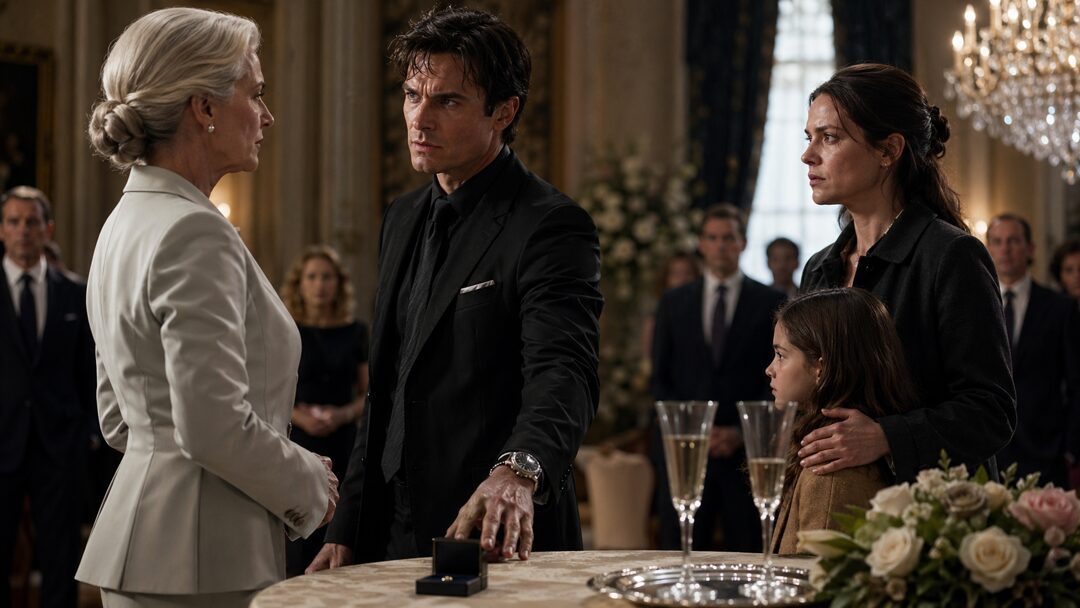
Julian walked to the center table, where champagne waited in narrow glasses and a white floral arrangement blocked guests from seeing one another too clearly. He placed the ring box on the table unopened.
Caroline stared at it.
Evelyn’s face changed for the first time.
“Julian,” she said softly.
He knew that tone. It had trained him his whole life.
He opened his mouth and, for one sick second, nothing came out.
Then Lily’s voice came from beside Mara.
“Are you giving the present back?”
Julian looked at her.
“Yes,” he said. “I am.”
Evelyn laughed gently, for the guests. “My son has had an emotional morning.”
“My son,” Julian repeated.
He looked at his mother.
“I have been that longer than I have been anything else.”
“Do not do this here.”
Julian almost smiled.
“Where should I have done it? In another alley?”
Mara’s face flickered.
The room stopped breathing.
Julian turned to Caroline first.
“I’m sorry,” he said. “You deserved to be asked for something better than usefulness.”
Caroline’s mouth tightened. She nodded once.
Then he looked toward Celeste’s portrait, newly framed on the side table with white flowers beneath it because Evelyn believed grief photographed well.
“Celeste deserved better too,” he said. “She was not a rescue plan. She was not a bridge loan with a wedding veil.”
“Julian,” Evelyn warned.
He looked back at her.
“And Mara deserved better than being invited to watch her own replacement from behind a tray.”
No one moved.
Mara closed her hand around Lily’s.
Julian’s voice did not rise. If it had, he might have survived it more easily.
“My mother arranged that night. She arranged the room, the announcement, the uniform. She made sure Mara stood where everyone could see what happened to girls who loved above their station.”
Evelyn’s face had gone white.
“That is enough.”
“No,” Julian said. “It was enough eleven years ago.”
A champagne glass trembled in someone’s hand.
“My mother told me Mara took money and disappeared,” Julian said. “She did not. Evelyn sent envelopes every Christmas, and Mara sent them back. Every year. My mother bought silence and lied when silence refused to be bought.”
“Careful,” Evelyn said.
That word contained inheritance, company shares, board seats, family names, newspaper favors, every lock on every door.
Julian felt all of it.
Then he looked at Mara.
She was not crying.
Of course she was not crying.
The room would have enjoyed that too much.
“I let her tell the lie,” Julian said. “Because it made me less ashamed. That was my part.”
Mara looked at him then, fully.
There was no forgiveness in her face.
But there was witness.
Julian turned to the guests, to the donors, to the relatives, to the people who had applauded once and pretended not to understand why a waitress went pale.
“This family has survived for years by calling cruelty protection,” he said. “By calling women useful when they are rich and greedy when they are poor. By calling silence dignity when it belongs to someone else.”
Evelyn stepped toward him. “You are destroying your father’s name.”
“No,” Julian said. “I’m returning what I borrowed from it.”
He lifted the ring box and placed it in front of Caroline.
“Do what you want with this. Sell it. Throw it in the lake. Keep it as proof that you escaped.”
Caroline gave a soft, broken laugh.
Evelyn looked around the room, already calculating salvage.
But some damages could not be unspoken.
Mara turned toward the door.
Julian wanted to call after her.
He did not.
Lily looked back once, her small face serious beneath her unwrapped collar.
Then she followed her mother out of the room Evelyn had tried to use against them.
Part V — The Scarf
By dusk, the white roses on Celeste’s grave had begun to close at the edges.
Julian returned to Graymere Cemetery alone.
No driver this time. No calls answered. No speech left in his mouth.
He stood before Celeste’s grave with the ring box in his hand. For a long moment, he thought of the woman who had sat across from him in a marriage neither of them had chosen and still found ways to be kind.
Celeste, who once said, “You know, Julian, being trapped together is not the same as being enemies.”
Celeste, who saw Mara’s name in an old book once and said nothing.
Celeste, who had deserved a husband not built out of apology.
Julian knelt and placed the unopened ring box beside the white roses.
“I’m sorry,” he said.
It was not enough.
It was also all he had that did not ask the dead for comfort.
Then he walked away from the Vale mausoleum.
The public section was colder. Fewer flowers. Older stones. Names softened by weather instead of maintained by family foundations. He found the grave because he remembered Lily pointing toward it from the path.
BELL.
The stone was modest.
Someone had left daisies there, the cheap grocery kind, bright even in the dimming light.
Julian took Lily’s tan scarf from inside his coat. One of the house staff had found it near the cemetery gate and brought it to him before anyone knew what to say to him anymore.
He folded it carefully and laid it across the base of Mara’s mother’s grave.
Not as a gift.
As a return.
He stood and stepped back.
“Martha Bell hated cold weather,” Mara said behind him.
Julian turned.
Mara stood a few yards away with Lily beside her. The child’s hand was tucked inside her mother’s, small and certain.
“I didn’t know,” Julian said.
“There was a lot you didn’t know.”
“Yes.”
That single word held more shame than any defense he could have made.
Mara looked past him to the scarf.
“Lily was upset she lost it.”
“I’m sorry.”
“You keep saying that.”
“I know.”
“What do you want me to do with it?”
“Nothing,” he said. “I’m not asking you to carry it.”
Mara studied him.
He forced himself to stay still under her gaze. No reaching. No pleading. No turning her pain into a chance for his relief.
“I should have defended you,” he said. “Then. Not today. Today was late.”
“Yes,” Mara said.
The word hurt because it was fair.
“I believed what made me easier to live with,” he said. “That you took the money. That you left. That my mother was cruel but practical. That I was weak but trapped.”
Mara’s eyes stayed on his.
“And now?”
“Now I think trapped people still choose who gets crushed under the door.”
For the first time, something in her face shifted. Not softness. Recognition, maybe.
Lily pulled gently at her mother’s hand. “Did he fix it?”
Mara looked down at her daughter.
“No,” she said.
Lily frowned.
Mara squeezed her hand. “But he told the truth where lying would have helped him.”
Julian looked away.
That mercy was almost too much.
Mara stepped forward and picked up the scarf. She brushed a bit of dry grass from the wool, then wrapped it around Lily’s neck.
The motion was ordinary.
That was what broke him.
Not the speech in the luncheon room. Not Evelyn’s face when control slipped from it. Not the ring left among the roses.
This: a mother protecting her child from the cold, in front of the grave of a mother who had watched her own child be humiliated by people with polished silver and soft voices.
Mara looked at Julian one last time.
“You finally told the truth in a room where it cost you something.”
He nodded.
There was nothing to add that would not make the sentence smaller.
Lily watched him with solemn eyes.
“Are you still sad?” she asked.
“Yes,” Julian said.
“Because she left?”
He looked at Mara.
Then at Celeste’s grave beyond the iron boundary.
Then at the girl in the tan coat, carrying a past she had never asked for and a future he had no right to enter.
“Because I let people leave,” he said. “And called it surviving.”
Lily seemed to think about that.
Then she slipped one hand out of her mother’s and lifted it in a small wave.
Not pity.
Not forgiveness.
A child’s acknowledgment that he was real.
Mara took her hand again.
They walked away down the public path, past the weathered stones and the brown leaves gathered along the edges. Julian did not follow. He did not call her name. He did not turn the moment into another request.
At the bend, Lily looked back once.
Mara did not.
Julian remained where he was until they disappeared through the cemetery gate.
The cold settled around him.
For the first time that day, he did not cover his face.