The Room Went Quiet
Part I — The Center Table
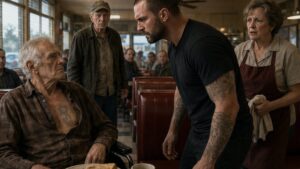
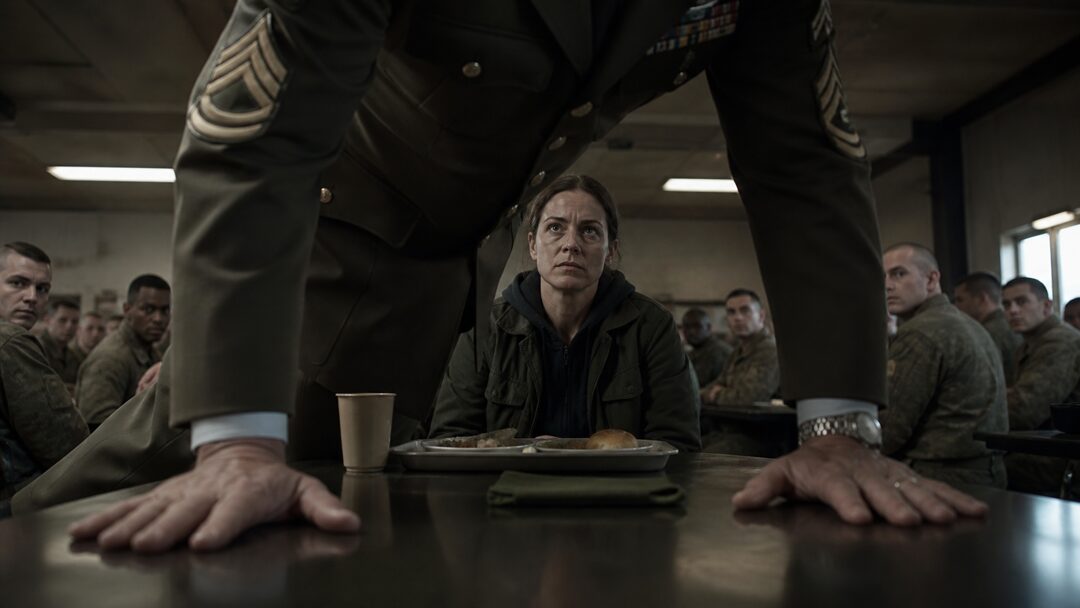
Sarah Mitchell had taken only three bites of her eggs when the dining hall went quiet enough for her to hear Sergeant Major David Keller’s boots cross the floor.
No one told him to stop.
No one warned her.
Forks paused above trays. Plastic cups hovered halfway to mouths. Forty-seven soldiers in camouflage watched the broad-shouldered man with close-cropped gray hair walk straight toward the civilian woman sitting alone at the center table.
Sarah did not look down.
She did not stand.
Beside her plate sat a folded strip of green cloth, squared at the edges like something that had once belonged to a uniform. Her right hand rested near it, but not on it. Her left hand held a paper cup of coffee that had gone cold ten minutes ago.
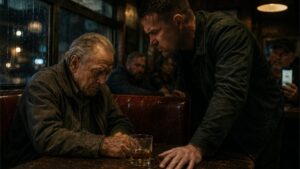
Keller reached her table and planted both palms on the metal surface.
The tray jumped.
Coffee trembled in the cup.
Sarah looked up into his face.
He leaned close enough for everyone in the room to hear him.
“You don’t get to eat with them.”
The sentence hit the room harder than a shout.
Sarah said nothing.
A spoon clattered somewhere behind her. Someone swallowed. Someone else whispered, “Don’t.”
Keller’s eyes did not leave Sarah’s. He was fifty-one, but he carried himself like a door that had never once failed to hold. Every crease in his uniform looked deliberate. Every ribbon on his chest looked polished by memory. He was the kind of man young soldiers straightened for before they knew they had moved.
Sarah was not in uniform.
She wore a dark hoodie under a plain field jacket, hair tied back, face pale from too little sleep. Her watch was the only thing on her wrist. No badge. No rank. No visible protection.
That made the table look smaller.
That made Keller look larger.
“You hear me?” he said.
“I heard you,” Sarah said.
Her voice did not rise. It barely crossed the table. But the room caught it anyway.
Keller’s jaw shifted.
“You think sitting there makes you brave?”
Sarah’s gaze held.
“No.”
“Then what do you think it makes you?”
She glanced once at the folded cloth beside her tray.
Keller saw it. His face changed by half an inch. Not enough for most people to notice. Enough for Sarah.
“I think,” she said, “Captain Hayes asked me to come.”
The room tightened.
The name moved through the dining hall without anyone saying it again.
Captain Brian Hayes had been gone for three months, but every person in that room still arranged themselves around his absence. His regular table near the windows stayed open longer than it should have. His old chair was never the first one taken. His laugh still seemed to belong to certain corners of the building.
And Sarah Mitchell was the woman they blamed for the empty space he left behind.
Keller bent lower.
“Don’t you say his name in here.”
Sarah’s fingers tightened once around the paper cup. Then relaxed.
“You opened the envelope?” she asked.
The question landed wrong.
It was too calm. Too specific. Too private.
Keller went still.
At the far side of the room, Specialist Emily Carter stopped twisting the black radio cord bracelet around her wrist. Her face drained of color so quickly that the soldier beside her reached out, then thought better of it.
Keller did not turn.
“What envelope?” he said.
Sarah watched him.
He knew.
That was the first thing the room could not see.
He knew about the envelope, because Sarah had left it in his office two weeks after the memorial. Plain white. His name in Captain Hayes’s handwriting. No return address. No explanation.
Keller had placed it in the top drawer of his desk and locked it away like something that might make noise in the dark.
Sarah had not asked about it again.
Until now.
“Captain Hayes left it for you,” Sarah said.
Keller’s hands pressed harder into the table.
“Captain Hayes left a lot of things,” he said. “A team without a leader. A room full of men and women trying to stand up straight. A mother who still calls every Thursday because she doesn’t know what else to do.”
Sarah’s face did not change.
“And you,” Keller said, his voice lowering, “left him with just enough doubt to get him killed.”
The word passed through the room like a match dragged across stone.
Sarah did not move.
Emily Carter shut her eyes.
Keller saw that too late.
Part II — The Unopened Envelope
Three months earlier, Sarah had met Captain Brian Hayes in a beige counseling room with no windows and two chairs that looked borrowed from a school office.
He had not sat down at first.
Most of them didn’t.
They came in with jokes, paperwork, irritation, politeness. They looked at the tissue box like it was a trap. They looked at Sarah like she was one more civilian sent to measure something she had never carried.
Hayes had stood by the door with his sleeves rolled and two fingers tapping the back of the chair.
“You’re the one they sent to tell my people they’re tired,” he had said.
Sarah had looked up from the file.
“No,” she said. “I’m the one they sent because some of them already know.”
That had made him smile, but not happily.
He was thirty-nine, lean, steady, with the kind of calm that made other people mistake exhaustion for control. His soldiers trusted him because he never asked them to believe something he did not first demand from himself.
That was also what frightened Sarah.
On her third week at Fort Mercer, Hayes came back alone.
He closed the door.
“Can men come back from admitting they’re broken?” he asked.
Sarah remembered the exact way he said it. Not people. Men. Not heal. Come back.
She had known then that he wasn’t asking for himself.
“Only if someone lets them be seen before they snap,” she said.
Hayes looked at the floor.
“Sergeant Major Keller says the mission will settle them.”
“Does he believe that?”
“He believes discipline settles everything.”
“And you?”
Hayes tapped two fingers against the chair.
“I believe I’m short three people, long on pressure, and responsible for bringing everybody home.”
Sarah did not ask for classified details. She never did. She asked about sleep. Tremors. Startle responses. Anger. Detachment. The human things command reports turned into softer words.
Hayes gave her one name without meaning to.
Joshua Reed.
He said Joshua had stopped laughing. Then that he was fine. Then that he had been fine until the last deployment. Then that he froze when a generator backfired near the motor pool and tried to pretend he had dropped a wrench.
“Pull him,” Sarah said.
Hayes’s expression hardened. Not at her. At the cost.
“I pull Reed, I pull the whole team apart.”
“If he breaks in the field, it may break anyway.”
Hayes stood.
“Write that down?”
“I don’t need to.”
“Good,” he said. “Because if it comes from you, Keller will think I let a counselor command my roster.”
He regretted the words as soon as he said them.
Sarah did not punish him for them.
That was another thing soldiers did not understand about her. She did not need to win the room. Most days, she only needed the truth to survive long enough to be useful.
Now, in the dining hall, Keller used that truth like a blade turned backward.
“You talked him into second-guessing himself,” Keller said. “You got in his head with your little office and your little questions.”
Sarah’s tray sat between them. Eggs untouched. Toast cooling. Coffee cold.
“I asked him to look at his people,” she said.
“He was always looking at his people.”
“Not the way they needed.”
The words were barely out before Keller’s face went flat.
A dangerous kind of silence passed over him.
Several soldiers shifted in their seats.
Sarah knew she had pressed too close. She had not meant to wound him. But truth, once trapped in a room too long, did not always come out clean.
Keller straightened slightly, but did not remove his hands from the table.
“You think I didn’t know Brian Hayes?” he asked.
Sarah did not answer.
“I trained him when he still thought rank meant volume. I watched him become the only officer in this place who could tell a scared private to breathe and make it sound like an order. I watched him take every hard lesson and turn it into something useful.”
His voice roughened.
“And then I watched him come home in a box because he lost faith at the worst possible moment.”
Sarah’s eyes flickered.
Only once.
But Keller saw it.
“There it is,” he said. “That’s the closest thing to shame I’ve seen on your face.”
Sarah’s hand moved toward the folded green cloth.
She stopped herself before touching it.
Across the room, Emily Carter stood halfway out of her seat, then sat back down.
Keller finally turned his head.
“Something you want to add, Specialist?”
Emily froze.
She was twenty-four, small in a uniform that always seemed a little too large, with red-rimmed eyes and a mouth that opened before courage arrived.
“No, Sergeant Major,” she whispered.
Keller held her there with one look.
Sarah spoke before he could.
“Emily.”
The young woman flinched at the sound of her first name.
Keller turned back, furious now in a colder way.
“You do not address my soldiers like they belong to you.”
Sarah looked past him to Emily.
“Don’t carry it alone.”
Every soldier in the room felt the floor change under that sentence.
Emily’s lips trembled.
Keller leaned in again.
“What did you just say?”
Sarah met his eyes.
“You heard me.”
Part III — What Emily Heard
Emily Carter had been on the radio when Captain Hayes made his last call.
That was the part everyone knew.
The part they didn’t know was that Emily still heard him at night.
Not screaming. Hayes had not screamed.
That made it worse.
His voice had stayed calm even when the room behind him filled with shouting and static and someone kept saying Reed’s name like a prayer they had forgotten how to finish.
Emily had been in the vehicle outside, headset pressed too tightly to her ear, pencil snapping in her hand as the extraction window narrowed.
“Captain, confirm movement,” she had said.
A pause.
Then Hayes: “Reed’s not out.”
Another voice cut in. “Sir, we have to move.”
Hayes again, closer this time, breath short but controlled. “Not without him.”
Afterward, everyone talked about timing.
Window. Delay. Compromise. Collapse.
Words that let people imagine the failure as a clock problem.
Emily knew better.
It had been a people problem.
It had been Joshua Reed frozen near an interior wall because somewhere inside the building, behind dust and shouting and the hard edges of command, a child had cried.
Reed had heard it.
So had Hayes.
Emily never told anyone that.
When Keller’s version took hold, it was almost a relief at first. Not because it was fair. Because it was simple.
Sarah Mitchell had weakened Hayes.
Sarah had filled his head.
Sarah had made him hesitate.
Sarah was easier to blame than a captain who had chosen one man over time, or a sergeant major who had insisted that pain could be drilled into obedience, or a platoon that had needed the myth of perfect strength more than the truth of human limits.
In the dining hall, Emily stood before she knew she had decided.
Her chair scraped backward.
Every head turned.
Keller’s eyes found her.
“Sit down.”
Emily’s hands were shaking.
“She wasn’t the one who changed the call.”
The sentence came out thin.
But it came out.
Keller did not move for two seconds.
Then he turned fully toward her.
“What did you say?”
Emily’s throat worked.
“She wasn’t the one.”
The room seemed to shrink around her.
Sarah stood then.
Not fast. Not dramatically.
Just enough that Keller’s attention snapped back to her.
“Let her breathe,” Sarah said.
Keller pointed one thick finger at the tabletop.
“You sit back down.”
Sarah did not.
For the first time since he reached her table, the height difference disappeared.
It did not last.
Sarah looked at Emily, then lowered herself back into the chair.
The movement was deliberate.
Chosen.
The room saw it.
Keller saw it.
She had not sat because he ordered it. She had sat because standing had served its purpose.
Emily gripped the edge of her table.
“I heard him,” she said.
“No,” Keller said. “You heard fragments in a bad signal.”
“I heard him.”
“You were scared.”
“Yes.”
The honesty stopped him for a beat.
Emily swallowed.
“I was scared. I was confused. I was twenty-three and trying to sound like I knew what I was doing while Captain Hayes was still inside and everyone kept asking me for updates I didn’t have.”
Her eyes filled, but she did not wipe them.
“But I heard him.”
Keller’s face had lost color under the tan.
Sarah’s hand rested flat on the metal table. She had placed it inches away from the folded cloth now.
Keller looked at her, and for the first time that morning, uncertainty entered his anger.
“What did she tell you?” he asked.
“Nothing,” Emily said.
Keller did not believe her.
Emily shook her head once, hard.
“She didn’t tell me what to say. She told me not to carry it alone.”
Keller’s mouth tightened.
“And what is ‘it’?”
Emily’s eyes dropped.
The dining hall waited.
Even the refrigerators behind the serving line seemed too loud.
Sarah said softly, “Emily, you don’t have to give them everything.”
Emily looked at her.
That was what broke the last of it.
Not pressure. Not command. Permission.
“Reed froze,” Emily said.
The words did not echo, but they might as well have.
Someone at the back whispered, “No.”
Emily kept going before Keller could stop her.
“He heard children in the building. He stopped responding. Captain Hayes went back for him.”
Keller’s hands closed into fists.
“That is enough.”
“No,” Emily said, and this time her voice was not thin. “It isn’t.”
Keller stared at her as if she had stepped across a line he had painted with his whole life.
Emily’s shoulders shook.
“He didn’t lose faith,” she said. “He chose Reed.”
No one moved.
Sarah closed her eyes for half a second.
Not in relief.
In grief.
Because once the truth entered the room, it did not save anyone immediately.
It only made the old lie impossible to live inside.
Part IV — The Thing He Wouldn’t Open
Keller left the dining hall without dismissing anyone.
That frightened the room more than if he had shouted.
He walked past Emily. Past the serving line. Past two captains who looked away when he passed. He pushed through the side door into the hallway where the light was colder and the walls carried framed photographs of men and women caught forever in formal poses.
At the end of the hall was a bench.
Keller did not sit.
He pulled his keys from his pocket and stood there with them in his palm like he had forgotten what they opened.
The envelope was in his office.
He knew exactly where.
Top drawer. Under a stack of range reports he had stopped reading. Plain white. Slight bend at the corner from the day he had picked it up and almost torn it open.
Sarah had left it on his desk without ceremony.
“Captain Hayes asked that you read this when you’re ready,” she had said.
He had hated her for saying when.
As if readiness had anything to do with duty.
As if grief was a door a man could approach with proper timing.
He had waited until she left. Then he had taken the envelope in both hands.
Brian Hayes’s handwriting had undone him.
Not the words. Just the slant of his name.
Sergeant Major Keller.
Hayes had written it the way he spoke it: with respect, with affection hidden under formality, with the slight upward stroke on the K that Keller had corrected on field reports for years.
Keller had locked it away.
Then he had built a story strong enough to keep it there.
Sarah did this.
Sarah made him hesitate.
Sarah planted doubt.
Sarah was easier to face than the drawer.
Now Keller stood in the hallway outside the dining hall, hearing Emily’s voice through the closed door.
He chose Reed.
Keller’s office was ten doors away.
It took him longer to reach it than it should have.
Inside, everything was as he had left it: desk squared, chair pushed in, framed photograph of the platoon from two years earlier, Hayes standing at the edge with one hand on Reed’s shoulder. Reed had been smiling then. A wide, open, unguarded smile.
Keller stared at the photograph.
He remembered clearing Reed.
Sarah’s report had been carefully worded. Not an order. Not a diagnosis. A warning.
Shows signs of acute stress response. Recommend removal from immediate operational rotation pending evaluation.
Keller had read it and called Hayes into his office.
“You going to let a civilian decide your roster?” he had asked.
Hayes had stood quietly.
“No, Sergeant Major.”
“Good. Because men don’t get steadier by being told they’re fragile.”
Hayes had looked at him then, really looked at him.
“No,” he had said. “Sometimes they get steadier because someone tells the truth before they have to prove it.”
Keller had dismissed him before the sentence could settle.
Now the memory stood in the office with him.
He opened the drawer.
The envelope waited.
For a moment, he hated Brian Hayes.
Not for dying.
For leaving this behind.
Keller opened it with his thumb.
Inside was a folded note and a strip of green cloth.
Hayes’s name tape.
HAYES.
The letters were simple. Faded at the edges. One corner torn.
Keller held it like it weighed more than anything on his desk.
Then he read the note.
Sergeant Major,
If you’re reading this, I didn’t get to make the argument in person.
Don’t turn me into proof that hardening works.
Don’t use what happened to bury the people who were already breaking.
Sarah knows enough. Emily heard enough. Reed carried enough before he ever stepped into that building.
If I don’t come back, protect them from the version of me everyone will want to build.
I turned back because he was mine.
That part is not shame.
— Brian
Keller read it once.
Then again.
At the end, his eyes stopped on the last line.
I turned back because he was mine.
For years, Keller had taught men and women to claim one another that way. Mine. My team. My people. My responsibility.
He had never imagined that the word could cost this much.
He folded the note with hands that were no longer steady.
Then he took the name tape and walked back toward the dining hall.
Part V — The Table Between Them
Sarah was seated again when Keller returned.
Emily stood near her now, not beside her, not yet. Halfway between her own table and Sarah’s, trapped in the space between obedience and truth.
The room had not recovered.
No one had gone back to eating. Trays sat cooling. Coffee cups sweated onto the tables. Soldiers stared at nothing with the stunned expressions of people who had just felt a shared story crack down the middle.
Sarah looked toward the door before Keller opened it.
Maybe she heard his steps.
Maybe she had been waiting.
Keller entered holding the folded note in one hand and the green name tape in the other.
Every eye went to his hands.
Sarah’s face changed when she saw the cloth.
Only a little.
Enough.
Keller walked to her table.
The room braced itself.
He stopped in the same place as before.
Same table.
Same woman.
Same watching room.
But something in his shoulders had given way. Not collapsed. Changed shape.
He placed both hands on the table again.
This time, the tray did not jump.
Sarah looked up.
Keller’s voice was lower now.
“Why didn’t you say it?”
Sarah did not answer quickly.
Keller’s mouth tightened with old instinct.
“Why did you let me stand here and say all that in front of them?”
Emily looked at Sarah.
So did everyone else.
Sarah’s hand moved to the name tape Keller had placed near the edge of the table.
This time she touched it.
Two fingers.
Gently.
As Hayes used to tap a chair before making hard calls.
“Because he asked me to protect them,” Sarah said. “Not myself.”
No one breathed.
There were sentences that explained things.
This was not one of them.
This one rearranged the room.
Keller looked at the note in his hand. Then at Emily. Then at the soldiers who had watched him turn grief into judgment because judgment felt cleaner than fear.
His face had gone older.
Sarah did not rescue him from it.
That was its own mercy.
Keller turned toward Emily.
“You heard him say he was going back?”
Emily nodded.
Her chin shook once.
“Yes, Sergeant Major.”
“For Reed?”
“Yes.”
Keller’s eyes shut.
A hard breath moved through him.
“And Reed?”
Emily looked down.
“He knows.”
The two words made Sarah look up sharply.
Emily continued, voice almost gone.
“He’s been asking to talk. Nobody lets him finish.”
Keller absorbed that.
Another failure entered the room and took its place among the others.
No one named it.
Sarah did not say I told you.
Emily did not say You should have listened.
Keller did not say I was wrong.
Not yet.
Some truths were too large to lift all at once.
He looked at Sarah again.
“You should have defended yourself.”
Sarah’s answer was immediate.
“That would have made it about me.”
“It was about you.”
“No,” she said. “That’s what made it easier.”
The line found Keller somewhere unguarded.
For the first time that morning, he looked away first.
Behind him, a young corporal lowered his eyes to his tray. Another soldier wiped his mouth with a napkin he had not used. Someone near the windows breathed out like he had been holding air since Keller crossed the room.
Keller took the name tape and set it in the center of the table.
Between Sarah’s tray and the empty chair across from her.
Then he pulled that chair back.
The sound of metal legs scraping the floor made three people flinch.
Keller sat.
The room changed more in that one movement than it had in all his words.
The man who had towered over Sarah lowered himself until his eyes were level with hers.
He did not look smaller.
He looked less alone.
Emily stood frozen, as if sitting without an order might still be a violation.
Sarah looked up at her.
“Emily.”
The young woman came forward.
No one stopped her.
She sat at the end of the table, one hand still wrapped around the radio cord bracelet on her wrist. Keller saw it now, maybe truly saw it for the first time.
“Carter,” he said.
She straightened automatically.
Then he stopped himself.
“Emily,” he said, rougher.
Her eyes filled again.
“Yes, Sergeant Major.”
Keller looked at the name tape.
“I should have opened it.”
Sarah did not say yes.
That made the admission heavier.
Keller’s hand hovered near the cloth, but he did not touch it yet.
“He wrote,” Keller said, and had to clear his throat, “that we were not to turn him into proof that hardening works.”
A few faces in the room broke.
Not loudly.
A jaw folded. A hand covered a mouth. A soldier near the back stared at the ceiling with wet eyes and refused to blink.
Keller kept going because stopping would have been easier.
“He wrote that Reed carried enough.”
Emily’s hand went still on the bracelet.
Sarah lowered her eyes.
“And he wrote,” Keller said, “that turning back for him was not shame.”
The words moved from table to table.
Not an order.
Not a speech.
Something harder to ignore.
A permission no one had known they needed.
Part VI — What Stayed on the Table
No one applauded.
That would have ruined it.
No one rushed Sarah with apologies. No one surrounded Emily. No one transformed into a better person in a clean, public minute.
The dining hall remained a dining hall.
Fluorescent lights hummed. Trays cooled. Someone’s coffee spilled slowly from a cup Keller had shaken earlier and spread in a thin brown line across the table.
But the silence had changed.
At first, it had been a weapon.
Now it was a place to set things down.
Keller looked at Sarah’s untouched food.
“You came here knowing what they thought of you.”
Sarah gave a small nod.
“Brian asked me to come when the room was full.”
Keller’s eyes narrowed, not in anger now.
“He planned that?”
A faint, tired sadness crossed her face.
“He knew how rooms work.”
Keller almost smiled.
It hurt too much, so he didn’t.
Hayes had always known rooms. When to command them. When to leave them. When to make a joke just before fear hardened into something useless.
Keller looked toward the table near the windows.
Hayes’s table.
Still half-empty.
For three months, they had preserved the space as if absence needed a chair.
Maybe it had.
Maybe that was not the problem.
Maybe the problem was what they had placed in the chair with him.
A clean story.
A heroic story.
A story that let the living keep their hands empty.
Keller turned back to Sarah.
“Reed needs to be heard,” she said.
It was not an accusation.
That made it worse.
Keller nodded once.
“He will be.”
Emily’s breath shook.
Sarah looked at her.
“And not alone.”
Keller understood the correction.
He nodded again.
This one cost more.
“Not alone.”
A few soldiers began to move.
Not away. Not toward.
Just back into their bodies.
A fork touched a tray. A chair shifted. Someone poured water into a cup with hands that were not steady. The sounds were small, but after the morning’s silence, they felt almost human.
Sarah finally picked up her coffee.
It was cold.
She drank it anyway.
Keller noticed.
For some reason, that nearly undid him.
“You really going to drink that?” he asked.
Sarah looked at the cup.
Then at him.
“It’s what I have.”
The sentence was plain.
It stayed.
Keller lowered his gaze to the name tape between them.
HAYES.
Five letters. One man. Too many meanings.
He touched the edge of it with two fingers.
Not claiming it.
Not taking it.
Sharing its weight.
Emily’s hand moved from her bracelet to the table. She did not touch the cloth, but her fingers rested near it.
Sarah’s hand remained on the other side.
The three of them sat that way while the room slowly remembered how to breathe.
Keller spoke quietly enough that only Sarah and Emily heard.
“Then we protect them.”
Sarah did not smile.
Emily did not cry.
Outside, beyond the dining hall windows, morning kept moving across Fort Mercer like nothing had happened.
But inside, a standing man had sat down.
A silent woman was no longer carrying the truth by herself.
And on the table between them, the name that had once divided the room stayed where everyone could see it.