What the Silence Could Not Show
Part I — The File With Nothing In It
Daniel Reed knew something was wrong before the audio played.
The file arrived at 6:12 a.m. through a secure channel he had not used in three years, under a subject line that made his coffee go cold in his hand.
FINAL VISUAL CONFIRMATION.
He sat in the small kitchen of his townhouse with the blinds still closed, gray morning pressing against the glass. The old field jacket hung on the back of his chair. His laptop hummed softly on the table.
Daniel clicked the file.
A black screen opened.
No image. No frame. No timestamp burn. No thermal overlay. No shaky helmet feed. Nothing.
Then the sound began.
Wind first.
Not the soft kind that moved trees. Hard wind, open-space wind, the kind that scraped across a microphone and turned every breath into static.
Then breathing.
Strained. Close.
A metallic impact.
A voice, broken by interference.
Someone shouted something that might have been a name.
Then the file ended.
15.09 seconds.
Daniel stared at the black screen long after the audio stopped.
The title still sat above it, clean and official.
FINAL VISUAL CONFIRMATION.
He played it again.
Wind. Breath. Metal. Voice. Maybe a name.
Black screen.
He played it a third time and felt an old, familiar pressure settle into his chest. Not fear. Not exactly guilt.
Recognition.
Someone had already decided what this file meant.
They were only asking him to bless it.
His phone rang before he touched the keyboard.
“Reed,” he answered.
“Mr. Reed. Major Sarah Mitchell.”
Her voice was clipped, controlled, and tired in a way people tried to hide by speaking faster.
“I assume you received the package.”
“I received a file.”
A pause.
“We need your written assessment by close of business.”
Daniel looked at the black rectangle on his screen.
“Assessment of what?”
“The recording.”
“You called it visual confirmation.”
“That is the label on the evidence bundle.”
“That is not what it is.”
Another pause. Smaller this time. More careful.
Sarah said, “The report concerns Sergeant Michael Hayes. Missing after the Red Valley evacuation. Suspected abandonment of position and failure to obey direct order.”
Daniel took his hand off the mouse.
Outside, a truck passed on the wet street. For a moment, the kitchen window trembled.
“Missing,” he said.
“Yes.”
“And you’re finalizing discipline on a missing man?”
“We’re finalizing findings. Your review is one component.”
“Major, there is no video.”
“The audio is believed to correspond to the last known visual sequence.”
“Believed by whom?”
Her silence answered before she did.
“Command needs clarity,” she said.
Daniel looked back at the file.
Wind. Breath. Metal. A voice.
Nothing to see.
“Clarity is not the same as evidence,” he said.
Sarah exhaled through her nose, almost too softly to hear.
“We are not asking you for philosophy, Mr. Reed.”
“No,” Daniel said. “You’re asking me to say I saw something in the dark.”
Part II — The Words Already Written
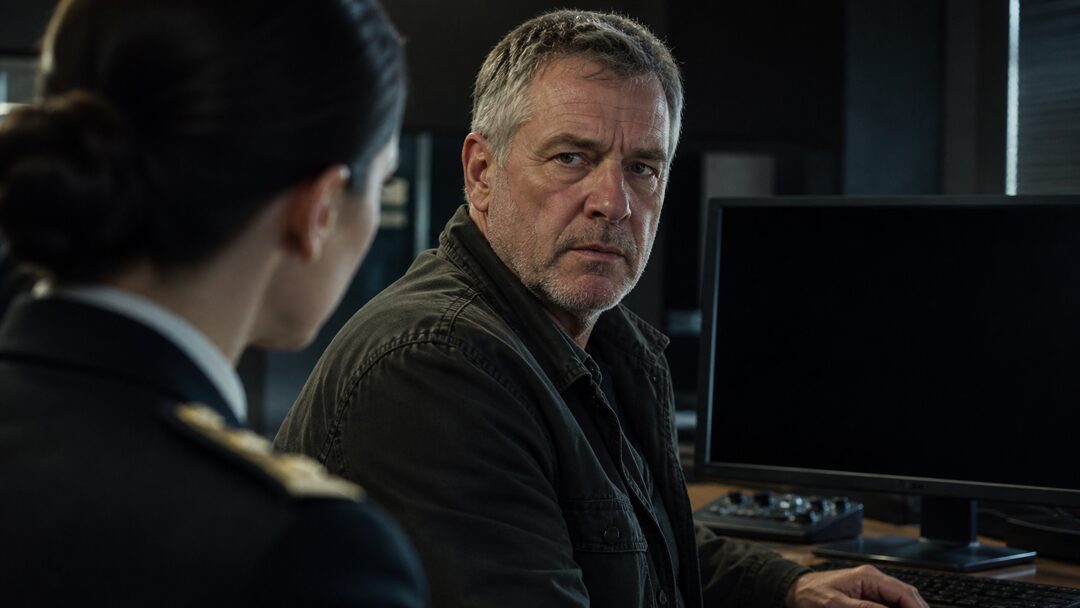
Sarah arrived at Daniel’s office two hours later in a pressed uniform and polished restraint.
The office was not really an office anymore. After retirement, Daniel had leased a narrow room above a dental clinic because he could not stand working from home every day. One desk. Two chairs. Three monitors. A locked cabinet. No photographs.
Sarah noticed the absence. People always did.
She placed a thin folder on the desk.
Daniel did not touch it.
“I sent everything authorized,” she said.
“You sent one audio file with a misleading label.”
“I sent what I was cleared to send.”
“That’s not the same thing.”
Her jaw tightened, but she remained standing.
Major Sarah Mitchell looked younger than her voice and older than her face. Early forties, maybe. The kind of woman who had learned to keep emotion from reaching her shoulders. Her hair was pulled back so tightly it seemed less styled than disciplined.
Daniel pressed play.
The black screen filled the center monitor.
The room became wind.
Sarah did not look at the screen. She watched Daniel.
He let the file run once.
Then again.
Then a third time.
He wrote five words on a yellow pad.
Wind. Breathing. Impact. Voice. Unknown.
Sarah leaned forward slightly.
“That’s it?”
“That’s what’s there.”
“The voice?”
“Unclear.”
“The name?”
“Possible name. Not confirmable.”
“The movement after the impact?”
Daniel looked at her.
“What movement?”
“In the corresponding sequence.”
“There is no sequence.”
“The analysts before you—”
“Then use them.”
Her eyes sharpened.
“We did.”
“And?”
“They disagreed.”
Daniel almost smiled, but there was no humor in it.
“Then you wanted someone old enough to sound final.”
Sarah’s face changed for half a second. Not anger. Exposure.
Then it closed again.
“The report states Hayes turned away from his assigned corridor, left position, and ignored an order to return. We need to know whether the audio is consistent with that description.”
Daniel reached for the folder then.
Inside were printed pages with black redactions and official formatting. The language was dry, but dry language could still bury a person.
Subject turned away.
Subject left position.
Subject ignored order.
Subject proceeded out of view.
Daniel read the lines twice.
Out of view.
That phrase had the neatness of a locked door.
He looked back at the monitor. The screen remained black.
“Where are these visual observations from?”
Sarah did not answer immediately.
“Compiled from field accounts and available media.”
“Where is the media?”
“You have it.”
“No,” Daniel said. “I have sound.”
Sarah’s hand closed around the edge of the folder.
“Mr. Reed, no one is asking you to create evidence.”
“That is exactly what you are asking.”
“I’m asking whether the audio contradicts the report.”
“It cannot confirm it.”
“That was not my question.”
“It’s my answer.”
For the first time, Sarah looked tired enough to be human.
“Do you know what happens if this stays unresolved?”
Daniel glanced at the name on the page.
Michael Hayes.
“No,” he said. “But I know what happens when unresolved things are made convenient.”
Sarah gathered the folder back, but he put two fingers on the edge and stopped her.
“I’ll need a copy of the report.”
“You already have the relevant excerpt.”
“I’ll need the whole thing.”
“That won’t be possible.”
“Then my assessment will say the file is insufficient and the supporting materials were withheld.”
Her eyes held his.
In another life, he would have respected her. Maybe he still did. She was not careless. That made it worse. Careless people made sloppy lies. Careful people made useful ones.
“I’ll see what can be released,” she said.
At the door, she stopped.
“Sergeant Hayes had orders.”
Daniel did not look up.
“So did everyone who ever got blamed after the room had already decided.”
Sarah left without answering.
The black screen remained open behind her.
Part III — The Sister
The call came from a number Daniel did not know.
He almost ignored it.
Then he saw the voicemail transcription appear before the phone stopped buzzing.
My name is Emily Hayes. I know you have the file.
Daniel stared at the words until the phone went dark.
He waited ten minutes before calling back, which was both discipline and cowardice.
Emily answered on the first ring.
“Mr. Reed?”
“Yes.”
A sharp breath. Not relief. Preparation.
“You’re reviewing Michael’s recording.”
“I can’t discuss active materials with you.”
“They’re calling him a coward.”
Daniel closed his eyes.
She said it flatly, like someone who had repeated the sentence so often it no longer sounded impossible.
“I didn’t say that,” Daniel said.
“But they are.”
He said nothing.
“I know how this works,” Emily said. “They use words that sound careful so no one can accuse them of lying. ‘Failed to return.’ ‘Departed position.’ ‘Inconsistent conduct.’ Then by the time anyone reads it, my brother is already whatever they needed him to be.”
Daniel looked at the black monitor.
“Who told you I had the file?”
“A man who still has a conscience.”
“That man may have put you in a difficult position.”
“No. My brother being missing did that.”
Her voice cracked only on the last word, and she seemed to hate that it had.
Daniel heard traffic behind her. A door chime. She was outside somewhere, or in a public hallway, holding herself together where strangers could see.
“I can’t tell you what’s in the file,” he said.
“Can you tell me if there is a file?”
“Yes.”
“Can you tell me if it proves he ran?”
Daniel’s fingers went still.
That was the word no report would use. Ran. The civilian word. The family word. The word that did not know how to hide inside procedure.
“I can’t discuss the evidence.”
“You can discuss whether you’re going to let them do this.”
“Ms. Hayes—”
“He sent me a message two nights before he disappeared,” she said. “He said, ‘If anything sounds simple after this, don’t trust it.’ I thought he was being dramatic. Michael was always like that. Quiet for weeks, then one sentence that made you feel like he’d been carrying a whole room alone.”
Daniel leaned back.
A memory moved in him, unwelcome.
Another young man. Another file. Another room that wanted simplicity.
“Ms. Hayes,” he said carefully, “wanting your brother cleared is not the same as knowing what happened.”
“I know that.”
But she said it too quickly.
Daniel let the silence sit.
When she spoke again, her voice was lower.
“I just need one person in that building to admit they don’t know.”
The sentence reached him with more force than accusation.
One person.
Daniel had once been that person and had failed.
He saw a room twelve years earlier. Fluorescent lights. A grainy recording. Men with rank speaking in complete sentences about incomplete things. A young interpreter named Nabil who had turned his head at the wrong second, or had not turned at all. Daniel had signed the assessment because everyone knew.
Everyone knew.
The phrase had done more damage than the file.
“Mr. Reed?” Emily said.
Daniel opened his eyes.
“I can’t promise you the answer you want.”
“I’m not asking for what I want.”
“Yes,” he said softly. “You are.”
That silence hurt more than if she had shouted.
Then Emily said, “Maybe. But they’re asking for what they want too.”
The line went quiet.
Not disconnected. Just quiet.
Daniel heard her breathing.
Finally she said, “Please don’t let a blank screen become my brother’s face.”
Then she hung up.
Daniel sat alone in the office with his hand still around the phone.
On the monitor, the file waited.
Black screen. Fifteen seconds.
He played it again.
This time the unclear voice sounded less like refusal.
More like warning.
Part IV — The Line They Wanted
The full report arrived at 4:38 p.m., stripped thin by redactions but still heavier than Sarah had meant it to be.
Daniel read it once standing.
Then again sitting.
Then a third time with the audio open beside it.
The report did not say “we believe.”
It said “subject turned.”
It said “subject left.”
It said “subject ignored.”
It said “visual review supports.”
Daniel highlighted that phrase and felt something cold move through him.
Visual review supports.
There had been no visual review.
Not from this file.
He called Sarah.
She answered with no greeting.
“You got it,” she said.
“I got a report that cites visual confirmation.”
“It cites review.”
“Of what?”
“Mr. Reed—”
“Of what?”
A silence.
He heard the faint murmur of other voices around her. An office. Maybe a corridor. People moving around a story before it hardened.
“Some descriptions come from personnel on site,” she said.
“Then write witness accounts.”
“They were under extreme conditions.”
“Then write uncertain witness accounts.”
“You know how reports are written.”
“I know how men disappear inside passive voice.”
That landed. He heard it.
Sarah stepped away from the noise. A door closed on her end.
“We had a border evacuation collapsing in real time,” she said. “Civilians pushing through the south gate. Two teams separated. Communications failing. Hayes was told to hold the corridor. He did not hold it.”
“You don’t know that from this file.”
“The unit commander knew his voice.”
“The file does not establish action.”
“The commander saw him leave.”
“Then why do you need me?”
Sarah did not answer.
Daniel looked at the black screen and waited.
When she finally spoke, her voice had lost some of its polish.
“Because the commander’s account has been challenged.”
“By whom?”
Another pause.
“Surviving personnel.”
There it was.
Not certainty.
Dispute.
Daniel replayed the audio. Wind. Breath. Metal. Voice.
This time he isolated the last second, not with fancy software, just with repetition and attention. He had always trusted attention more than tools.
The voice broke under static.
Move—
Or maybe no.
Or Hayes.
Or stay.
Daniel wrote every possibility down and hated each one.
Evidence did not become stronger because grief needed it to.
It did not become weaker because command feared it.
At 7:10 p.m., Sarah appeared in his doorway without calling first.
Daniel was not surprised.
People came in person when they wanted words they could deny later.
She closed the door behind her.
“We can solve this cleanly,” she said.
“Cleanly for whom?”
“For everyone.”
“There’s no such category.”
Sarah placed a single page on his desk.
A draft statement.
Daniel did not touch it.
She had highlighted one sentence.
The available audio is consistent with the official sequence of events as currently documented.
He read it twice.
Then he looked up.
“That sentence is a trap.”
“It’s accurate.”
“No. It’s useful.”
“It does not say the file confirms the report.”
“But it will be used that way.”
Sarah’s lips pressed together.
“You’re making this harder than it needs to be.”
“No,” Daniel said. “I’m making it exactly as hard as it is.”
Her eyes flashed.
“Do you think I want to ruin him?”
“I think you want the file to close a door.”
“I want order.”
“Order is not truth.”
For the first time, Sarah’s voice rose.
“Without order, people die.”
Daniel stood then, slowly.
“And with false order, people get buried while they’re still breathing.”
The room went still.
Sarah looked away first.
Daniel knew he had said too much, not because it was wrong, but because it was old.
Nabil’s face returned to him in a flash. Young. Thin. Afraid but trying not to show it. Daniel had not known what happened to him after the assessment. That was the mercy of systems: they let you harm people without watching the end.
Sarah saw something in his face.
“This isn’t the same case,” she said.
“No case is,” Daniel answered. “Until it is.”
She took back the draft statement.
At the door, her hand paused on the knob.
“If you write this the way you’re threatening to write it, the report reopens. The families reopen. The command reopens. People who were there will have to relive everything.”
Daniel sat down.
“They already are.”
Sarah left.
For a long time, Daniel did not move.
Then he opened a blank document.
He typed one sentence.
The submitted file contains no video stream.
He stopped.
His hands were steady.
That frightened him more than shaking would have.
Part V — What the File Could Say
The next morning, Emily Hayes was waiting outside Daniel’s building.
Dark coat. Pale face. Phone clutched in one hand like it had become part of her body.
Daniel saw her through the glass door and nearly turned around.
She saw him first.
“Mr. Reed.”
He unlocked the door.
“You shouldn’t be here.”
“I know.”
“That doesn’t usually stop people who say it.”
A tired smile touched her face and vanished.
“I found a photo,” she said.
She opened her phone and held it out.
Daniel did not want to look.
He looked anyway.
Michael Hayes stood in a parking lot beside Emily, one shoulder angled away from the camera, as if he had been caught mid-exit. Lean. Serious. A faint smile that looked borrowed for his sister’s sake.
“He hated pictures,” Emily said. “Said they made people think they knew you.”
Daniel handed the phone back.
“That sounds like a man who understood files.”
Her eyes sharpened.
“Then you know he didn’t run.”
“No.”
The word hurt her. He watched it happen.
Daniel forced himself not to soften it into something false.
“No,” he repeated, quieter. “I don’t know that.”
Emily’s mouth tightened.
“So that’s it?”
“No.”
“What can you say?”
“That no one can prove he did from what I was given.”
She looked at him as if trying to decide whether that was mercy or another locked door.
“It’s not enough,” she said.
“I know.”
“My mother keeps asking if he was scared. She says she can forgive scared. She can’t forgive shame.”
Daniel felt the sentence enter the room and take up space.
“Fear isn’t shame,” he said.
“It is to people who never had to be afraid in public.”
There was nothing to say to that.
Emily put her phone in her pocket.
“Do you have children?”
“No.”
“Then I won’t ask you to imagine it.”
The line was not cruel. That made it worse.
Daniel looked past her to the wet sidewalk, the clinic sign flickering below his office window.
“I once signed a report I should not have signed,” he said.
Emily went still.
He had not planned to tell her. He had carried the story like a sealed container for years, convinced that speaking of it would make it self-serving.
But she was asking for certainty, and he needed her to understand why he would not give it.
“There was a recording,” he said. “Incomplete. Everyone in the room knew what it meant. That was the phrase. Everyone knew. So I wrote what they needed me to write.”
“What happened?”
Daniel looked at her.
“A man who trusted us lost the benefit of doubt.”
Emily’s anger changed shape. It did not disappear. It grew quieter.
“Are you telling me this because you want forgiveness?”
“No.”
“Good,” she said.
He almost smiled.
She did not.
“I’m telling you because I won’t make your brother into a hero either,” Daniel said. “Not from fifteen seconds. Not because you need him to be one. Not because they need him not to be.”
Emily’s eyes filled, but no tears fell.
“That’s a terrible kind of honesty.”
“Yes.”
She looked up at the window of his office.
“Is there anything in the file that helps him?”
Daniel should have said he could not discuss it.
He should have ended the conversation.
Instead he said, “There is something that makes the accusation less certain.”
Her breath caught.
“But it does not prove what you want.”
Her face closed again, defending itself from hope.
“What is it?”
“I can’t tell you.”
“You just did.”
“No,” he said. “I gave you less than you want because more would be dishonest.”
Emily looked at him for a long time.
Then she nodded once, as if accepting a weight she hated.
“Write that way,” she said.
“I intend to.”
“No,” she said. “Not careful. Honest.”
Then she walked away before he could answer.
Daniel watched her go.
For the first time since the file arrived, he replayed the audio without looking at the screen.
Wind.
Breath.
Metal.
Voice.
Move.
Maybe.
Not proof.
But not surrender either.
Part VI — The Statement
The hearing room had no windows.
That bothered Daniel more than it should have.
Sarah sat on one side of the long table with two officers Daniel did not know. Emily sat in the back row, alone, her phone dark in her lap. No one had invited her to speak. That was another kind of statement.
Daniel placed his folder on the table.
The presiding officer, a colonel with a lined face and unreadable hands, said, “Mr. Reed, we appreciate your cooperation.”
Daniel nodded.
Sarah did not look at him.
The colonel glanced at the page before him.
“We understand you have concerns about the evidentiary file.”
“No,” Daniel said. “I have findings.”
A slight shift moved through the room.
Good.
Concerns could be managed. Findings had to be answered.
The colonel’s mouth tightened.
“Proceed.”
Daniel opened his folder.
He did not read quickly.
He had learned years ago that rushed truth sounded like apology.
“The file submitted to me under the label FINAL VISUAL CONFIRMATION is 15.09 seconds in length. It contains audio only. It contains no video stream, no frame data, no visible timestamp, no image sequence, and no visual confirmation of any subject’s movement.”
Sarah looked down.
Daniel continued.
“The audio includes environmental wind distortion, strained breathing, a metallic impact, and at least one unclear vocalization. A possible name or command may be present, but the recording quality does not support confident transcription.”
The colonel interrupted.
“Does the audio contradict the official sequence?”
Daniel looked at him.
“The audio cannot confirm the official sequence.”
“That was not my question.”
“It is the answer the evidence supports.”
Emily’s eyes were on him now.
Daniel turned the page.
“Several statements in the current report describe visible actions: that Sergeant Hayes turned away, left position, ignored an order, and proceeded out of view. Those claims are not supported by the submitted file.”
One of the officers beside Sarah shifted.
The colonel’s voice cooled.
“Are you suggesting the report is false?”
“I am stating that the submitted source material does not support those visual descriptions.”
“That distinction matters to you?”
Daniel looked at the black monitor mounted on the far wall. Someone had prepared it to play the file if needed.
Blank. Waiting.
“Yes,” he said. “It should matter to everyone.”
The room held its breath.
Sarah finally looked up.
For a moment Daniel saw not command, not polish, not opposition. He saw a woman who had been trying to hold a cracked thing together with both hands.
The colonel leaned back.
“Major Mitchell provided a proposed wording that the audio was consistent with the documented sequence. You rejected that wording.”
“I did.”
“Why?”
“Because consistent with would become confirms by the time it reached anyone who loved him.”
The words left Daniel before he could make them smaller.
No one moved.
Emily looked down at her phone.
Sarah closed her eyes briefly.
The colonel tapped one finger against the table.
“And your final conclusion?”
Daniel read the last paragraph.
“The file is insufficient to determine Sergeant Hayes’s visible actions during the recorded interval. It cannot establish abandonment, refusal, direction of movement, or intent. Any disciplinary or reputational finding based on visual interpretation of this file would exceed the evidence.”
He closed the folder.
There was more he could have said.
He could have said the voice might have been warning someone.
He could have said the report was built too neatly around a blank center.
He could have said that institutions loved uncertainty only when it protected them.
He said none of it.
The evidence could not carry it.
The colonel whispered to the officer beside him. Sarah kept her gaze on the table.
Finally the colonel said, “The report will be held pending further review.”
Behind Daniel, Emily made a sound so small it was almost not a sound at all.
Not relief.
Not joy.
Just the body recognizing that one door had not closed.
Daniel gathered his folder.
As he passed Sarah, she spoke without looking at him.
“You understand what this does.”
Daniel stopped.
“Yes.”
“It doesn’t bring him back.”
“No.”
“It doesn’t prove he did right.”
Daniel looked at her then.
“No,” he said. “It only stops us from proving he did wrong when we can’t.”
Sarah’s face tightened.
Then, almost invisibly, she nodded.
Part VII — What Remained
Emily was waiting outside the hearing room.
People moved around her as if she were furniture. Officers with folders. A clerk with a badge. A man carrying coffee. The building continued being a building, indifferent to the fact that her brother’s name had just been pulled back from the edge of something permanent.
Daniel stopped a few feet away.
For once, Emily did not speak first.
“The report is being reopened,” he said.
“I heard.”
“That may not lead where you want.”
“I know.”
This time, she did not say it too quickly.
Daniel held his folder against his side. His hands felt older than they had that morning.
Emily looked at him.
“Can you tell me one thing?”
“Maybe.”
“Not what happened. I understand you can’t. Or you don’t know.” She swallowed. “Can you tell me whether they had the right to call him a coward from that file?”
Daniel thought of the black screen.
He thought of wind.
Breath.
Metal.
A voice breaking through noise.
He thought of Nabil, whose face he had tried for years not to remember and now could not stop remembering.
Then he said the only thing he had earned the right to say.
“No. They did not.”
Emily’s mouth trembled.
She turned away before the tears came, not because she was ashamed, but because some grief asked for privacy even in public.
Daniel stood beside her without touching her.
After a while, she took out her phone and opened the photograph again. Michael in a parking lot, half turned from the camera, almost smiling.
She did not show it to Daniel this time.
She held it for herself.
“He hated pictures,” she said.
“I remember.”
“He said they made people think they knew you.”
Daniel looked toward the end of the corridor, where Sarah stood alone by a vending machine, reading the reopened notice with one hand pressed to her forehead.
No one in the hallway looked victorious.
That seemed right.
Emily put the phone away.
“Thank you,” she said.
Daniel shook his head once.
“Don’t thank me for not guessing.”
She looked at him through wet eyes.
“Sometimes that’s all anyone has left.”
Then she walked toward the elevator.
Daniel stayed where he was until the doors closed behind her.
Later, back in his office, he opened the file one final time.
The black screen appeared.
He did not press play.
For years, he had believed silence was an absence. A failure. A space people had to fill before it embarrassed them.
Now he understood something colder and kinder.
Sometimes silence was the last honest witness.
Daniel moved the file into his final report folder, locked the cabinet, and turned off the monitor.
The room went dark.
This time, he did not pretend to see.