The Man in the Blue Suit Waited Until Everyone Looked Away
Part I — The Seat That Wasn’t His
Frank was told to step aside in the same careful voice people used when they thought age had made a man harmless.
“Sir, this section is for invited family and official guests.”
The young officer did not block him with a hand. That would have been rude. He simply shifted his polished shoes half an inch and made his body into a gate.
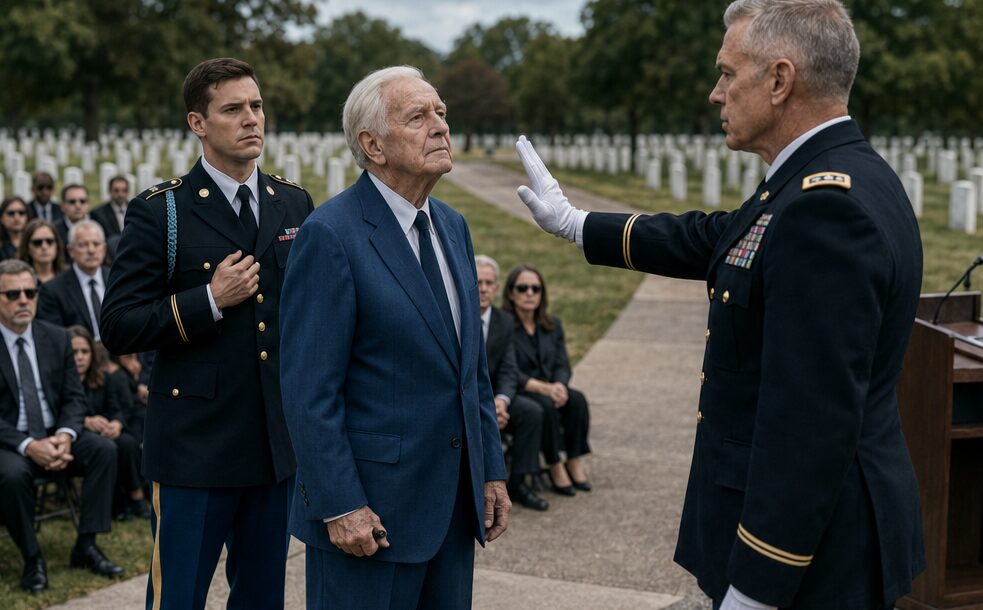
Frank looked past him at the rows of white stones, each one catching the morning light. Beyond them, black vehicles idled in a line, their windows dark, their engines low and patient. People in pressed dress uniforms moved with the confidence of those who knew exactly where they belonged.
Frank knew where he belonged.
That was the problem.
“I was invited,” he said.
His voice came out rougher than he meant it to. Time had sanded it down in odd places. Some words scraped. Some disappeared.
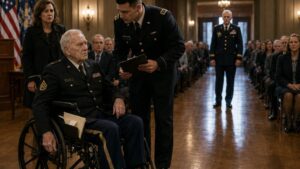
The officer glanced at the folded program in Frank’s hand, then at his blue suit. It was clean. It had been brushed twice before dawn. But it hung loose at the shoulders now, and the left cuff had been mended so neatly that only someone looking for a reason would notice.
The officer noticed.
“Of course, sir,” he said. “Let me just confirm that.”
Frank nodded as if confirmation were a reasonable thing to ask of a man who had taken three buses, one train, and a taxi he could not afford to stand twenty yards from a stone with a name on it.
He did not say any of that.
In his left palm, hidden under the program, he held a small black service pin. He had carried it all morning without putting it on.
The officer turned his head and murmured to an aide, “Keep him back until this is sorted.”
Keep him back.
Frank had heard worse phrases in his life. Shorter ones. Colder ones. Orders that came through static with men breathing hard in the dark.
Still, this one found a place under his ribs.
The aide, a woman with a clipboard and a practiced smile, stepped close to Frank. “We’ll have you wait right here, okay?”
She said okay as if she were speaking to someone who might wander.
Frank looked at the empty chair in the family section. Third row, aisle side. A small white card had been placed on it, the name printed in black.
Sergeant George Miller.
Frank closed his fingers over the pin until the point bit his palm.
“I won’t be in the way,” he said.
“No one said you were,” the aide replied.
But her eyes had already moved on.
That was the quiet cruelty of it. No one had to say he was in the way. They only had to arrange the world around the assumption.
Frank stepped back.
The grass was damp under his old shoes. He had polished them until his fingers ached, but the leather had cracked near the crease, and no amount of shine could make old things look official.
The ceremony began to gather itself.
Families took seats. Officers formed clean lines. A chaplain adjusted his pages at the podium. Somewhere behind Frank, a camera clicked and clicked. The motorcade doors opened in sequence, and the air changed, the way it always did when rank arrived.
Frank stayed near the edge of the walkway.
Close enough to hear.
Far enough to be forgotten.
He told himself that was why he had come. Not for recognition. Not for correction. Just to stand near George Miller’s name and keep one promise before there was no one left who remembered making it.
Then a young man in dress uniform, standing near the procession with his chin lifted and his hands still, turned his head.
His eyes stopped on Frank’s closed fist.
Not on Frank’s face.
On the tiny black edge of the pin showing between his fingers.
The young man went still in a way that had nothing to do with ceremony.
Frank saw recognition happen before he understood it.
Then the young man stepped out of line.
Part II — The Broken Voice
The movement was small, but everyone trained to notice movement noticed it.
A shoulder turned. A jaw tightened. An officer near the podium glanced sideways.
The young man came toward Frank with the careful speed of someone breaking a rule and trying not to make it look like panic. He was in his twenties, broad through the shoulders, too young to have learned how grief changes posture. His uniform was immaculate. His face was not.
He stopped in front of Frank and saluted.
Frank felt the salute like a door opening to a room he had locked forty years ago.
“Don’t do that,” he said softly.
The young man kept his hand raised one beat too long.
“Sir,” he said.
“I said don’t.”
The hand came down, but not as apology. As discipline.
The young man touched the nameplate over his chest, then the ribbons above it. His fingers trembled once before he forced them still.
“My grandfather told me to find you,” he said.
Frank looked over the young man’s shoulder. The ceremony was still moving, but not smoothly now. Attention had begun to snag on them.
“You have the wrong man.”
“No, sir.”
Frank almost smiled at that. Young men always thought certainty was the same as proof.
“What’s your name?”
“Jacob Miller.”
The name entered Frank like a sound through an old radio.
Miller.
Behind the young man, a woman in a dark coat turned sharply from the family section. She held a folded flag against her chest. Her hair was pinned back. Her mouth tightened as if she had heard the family name spoken in a place where it should have stayed private.
Frank did not look at her long.
He could not.
Jacob stepped closer, lowering his voice. “He said if I ever saw an old man with a black signal pin, I should ask him one thing.”
Frank’s hand closed harder.
The pin point opened the skin of his palm.
Jacob said, “Are you the man with the broken radio voice?”
For a moment, the cemetery vanished.
There was only smoke.
Static.
Rain striking metal.
A boy crying for his mother and trying to sound like he was not.
Frank’s throat tightened so suddenly he had to look down.
“No,” he said.
Jacob blinked. “Sir?”
“No.”
“I’m sorry, but—”
“I don’t know what you’re talking about.”
The lie was small. It had lived in Frank’s mouth for so many years it knew the shape of his teeth.
Jacob looked confused, then wounded, then determined. “My grandfather was Sergeant George Miller.”
Frank stared at the white card on the empty chair.
Third row. Aisle side.
“I saw the name,” he said.
“He passed three weeks ago.”
Frank had known that. Not from a letter. Not from a call. No one called men like him with news like that. He had read the notice online in the public listing, the screen bright in his dark kitchen, the name George Miller glowing like an accusation.
Jacob swallowed. “He told me you’d deny it.”
That made Frank look at him.
The young man’s eyes were wet, but his voice held.
“He said you were stubborn enough to save men who were already written off, and stubborn enough to pretend you hadn’t.”
Frank heard footsteps approaching from the right. Measured. Sharp.
A senior officer in dress uniform came toward them, white gloves bright against the dark fabric. His expression was controlled, not angry. Control was worse. Anger admitted something human had happened.
“Private,” the officer said.
Jacob straightened.
“Return to your position.”
“Yes, sir,” Jacob said.
But he did not move.
The officer’s gaze slid to Frank. “Sir, we’ll have someone escort you to the guest area.”
Frank recognized the officer’s type. The kind who could make a dismissal sound like assistance.
“I’m fine here,” Frank said.
“This area needs to remain clear.”
“I’m not blocking anything.”
The officer smiled without warmth. “The ceremony is beginning.”
“It began before you got here,” Frank said.
The words escaped before he could stop them.
Jacob’s eyes widened slightly.
The officer’s smile disappeared.
“Private Miller,” he said, each syllable pressed flat, “now.”
Jacob looked at Frank, and in that look was a question Frank did not want to answer.
Please let me say it.
Please don’t make me carry it back alone.
Frank turned away first.
Some promises were easier to keep when no one asked about them.
Part III — What His Grandfather Left
The chaplain began speaking at the podium, his voice smooth over the speakers.
Frank heard none of the words.
He heard Jacob breathing beside him.
The young man had not gone back.
The senior officer saw it too.
“Private,” he said, lower now. “You are out of formation.”
Jacob’s hand moved again to his chest, not in salute this time. More like he was holding himself in place.
“My grandfather said one sentence,” Jacob said to Frank. “Just one. He made me repeat it back.”
“Not here,” Frank said.
That got through.
Jacob’s face changed. Not because Frank had denied him, but because Frank had confirmed too much.
The woman from the family section stood now. She had left the folded flag on her chair and moved toward them with careful civilian uncertainty, as if stepping into the machinery of uniforms might get her crushed.
“Jacob,” she said.
“Mom,” he replied, but he did not look away from Frank.
Her name tag read LAURA MILLER.
Frank had never met her.
He knew her anyway.
She had George’s eyes. That same exhausted steadiness, the same way of looking at fear and deciding it could wait.
Laura looked at Frank, then at her son. “What are you doing?”
Jacob’s voice softened. “What Grandpa asked me to do.”
“This is not the time.”
“He said it had to be at a memorial.”
Her face tightened. “He said many things near the end.”
“No,” Jacob said. “Not like this.”
The senior officer stepped in before the family grief could become public.
“Ma’am,” he said, “I apologize for the interruption. Private Miller will return to formation immediately.”
Laura glanced at Frank, searching his face for an explanation he did not want to give.
Frank wished she would be angry with him. Anger was easier than hope.
“Your father was a good man,” he said.
The words were too small. He knew it as soon as they left him.
Laura’s eyes sharpened. “You knew him?”
“No.”
Jacob said, “Sir.”
Frank shut his eyes for half a second.
The chaplain continued speaking about service, memory, and the debt of a grateful nation. The words floated over them, polished and weightless.
Jacob reached into the inside pocket of his uniform jacket.
The senior officer moved sharply. “Private, stop.”
Jacob stopped.
Not because he feared the order.
Because Frank had raised one finger.
It was not a command. Frank had no command left. It was a request from an old man who knew how quickly a ceremony could turn into an incident.
Jacob’s hand remained half inside his jacket.
“My grandfather kept something,” he said. “He said you’d know it.”
Frank’s body knew before his mind allowed it.
“No,” Frank said.
Jacob’s jaw worked. “He said you would say that too.”
Laura whispered, “Jacob, what is it?”
“A tag,” Jacob said. “From a radio handset. Cracked down the middle.”
The cemetery tilted.
Not visibly. No one else lost balance. But Frank felt the ground move under his shoes, felt wet metal in his hand, felt his thumb pressed over a split piece of equipment while a voice screamed coordinates he could barely hear.
The senior officer’s gaze flicked to Frank with the first sign of true recognition.
“What did you say your name was, sir?” he asked.
Frank did not answer.
Jacob did.
“Frank Harris.”
The officer’s face did something small and quick, like a curtain dropping.
He knew.
Or he knew enough.
“Harris,” he repeated.
Laura looked between them. “What is going on?”
The officer adjusted one white glove. “Ma’am, old stories tend to attach themselves to days like this. It’s understandable.”
Frank looked at him then.
The officer continued, voice smooth enough for the people nearby to hear without alarm. “Memories can become unreliable after so many years.”
There it was.
Not an accusation. Not even an insult if you were generous.
Just a soft hand pushing an old man out of his own life.
Jacob took one step forward. “Sir, with respect—”
Frank touched his sleeve.
Jacob stopped instantly.
That small obedience hurt more than the officer’s condescension.
Frank had spent forty years telling himself silence was discipline. That quiet protected the dead from being used by the living. That his own name did not matter.
But hearing his memory dismissed in front of George Miller’s daughter felt like watching a second burial.
Laura spoke carefully. “Mr. Harris, did you know my father?”
Frank looked at her.
He could have lied again.
She deserved better.
“Yes,” he said.
Laura’s breath caught.
Frank added, “Not long.”
“How long?”
Frank’s eyes moved to the rows of stones.
“Long enough to hear him promise he’d name a daughter Laura if he got home.”
Laura covered her mouth.
Jacob looked down.
The senior officer’s hand lifted, white glove angled toward the seating area.
“That is enough,” he said.
But nothing about the morning felt enough anymore.
Part IV — The Tag in His Hand
Jacob drew the object from his jacket slowly, as if pulling it too fast might break the air.
It was small. Dark. Half the size of a man’s thumb. A cracked metal tag with numbers worn almost smooth by years of fingers. A thin cord had been looped through it, not original, something added later so it would not be lost.
Frank did not reach for it.
He did not need to.
The serial number stood up in his mind whole.
CK-4179.
He had said it once into a field log. He had said it again during an inquiry with three men sitting across from him, none of them looking tired enough to judge what happened.
Then the number had disappeared from record.
Like so many things.
Jacob held it out. “He kept this in a tobacco tin. He didn’t smoke. Never did. But he kept this in one.”
Frank’s laugh came out once, dry and broken. “He hated smoke.”
Laura flinched softly at the intimacy of that detail.
The senior officer lowered his voice. “Mr. Harris, I need you to come with me.”
Frank kept looking at the tag.
Smoke.
Rain.
A ravine full of voices.
Command saying, Channel closed. Repeat, channel closed. No recovery authorized.
Frank saying, Negative.
Not loud. Not heroic. Just the one word that changed the rest of his life.
Negative.
He had been thirty-nine then, older than some, young enough to believe a record could be corrected if truth remained intact. He had stayed on the line after the official channel was cut. He had listened through static for men who had been marked unreachable. He had given them bearings by memory after their maps were soaked useless. He had kept talking until his throat tore.
When the extraction finally happened, the report did not say rescue.
It said deviation.
It said unauthorized transmission.
It said loss of operational clarity.
It said Harris failed to comply with closure order.
Years later, the man who gave the closure order had speeches named after him.
Frank had a letter in a drawer thanking him for his service without specifying what service meant.
“What did they write?” Jacob asked.
Frank looked at him.
The young man’s face was pale now. He understood enough to fear the rest.
Frank said, “They wrote what they needed.”
Laura’s voice was almost a whisper. “My father said someone came back for them.”
“I didn’t come back,” Frank said. “I stayed on the line.”
“That was coming back,” Jacob said.
Frank shook his head. “No. Coming back would have meant standing up when the report came out.”
“Why didn’t you?”
Laura’s question was not accusing.
That made it worse.
Frank looked toward the podium, where the general had paused. People were turning now. The ceremony had developed a bruise, and everyone could see where.
“Because the man who gave the order had a wife in the front row at every memorial,” Frank said. “Because two of the men who didn’t make it had mothers who believed someone had tried everything. Because I thought the truth would become a weapon and the dead would be made to carry it.”
He closed his hand around the pin again.
“I told myself silence was respect.”
Jacob looked at him for a long moment.
Then he said, “My grandfather didn’t think so.”
Frank’s mouth tightened.
There it was. The line that broke through where respect had failed.
Jacob reached into his pocket again and took out a folded piece of paper. Old fold marks. New handling.
“He wrote this before he went into hospice,” Jacob said. “He made me promise not to read it aloud unless I found you.”
The senior officer stepped closer. “Private Miller.”
Jacob did not look at him.
He looked at Frank.
“He said, ‘Tell him he came back for us, even when they wrote that he ran.’”
Ran.
The word did not land in Frank’s ears.
It landed in his knees.
For one dangerous second, he thought he might sit down on the damp grass in front of all of them.
Laura made a small sound.
The senior officer’s expression hardened, not because he was cruel, but because the word had crossed a line no ceremony could easily uncross.
Frank had heard the rumor only twice in his life.
Once in a hallway.
Once from a man who did not realize Frank was in the room.
Harris ran the channel into confusion. Harris ran when command needed discipline. Harris ran from accountability.
No one had ever said it to his face.
George Miller had known.
Frank stared at the cracked tag in Jacob’s palm.
“He should have left me alone,” Frank said.
Jacob’s eyes filled. “He tried. For forty years.”
The words struck harder than accusation.
Because Frank had tried too.
And here they all were, at the exact place silence had led them.
Part V — Thirty Seconds
The senior officer made his decision.
Two security staff moved closer from the walkway. Not rushing. Not grabbing. Just appearing with that official calm that made removal look like assistance.
“Mr. Harris,” the officer said, “we’re going to take this conversation somewhere private.”
Frank looked at him. “What’s your name?”
“Colonel Gary Collins.”
“Colonel,” Frank said. “You know the file.”
Gary Collins’s face did not change.
That was answer enough.
“I know there are disputed accounts,” Gary said.
Frank almost smiled. “That’s a clean phrase.”
“It is the phrase that keeps this from becoming something ugly.”
“It was ugly before there was a phrase for it.”
Gary’s eyes sharpened. “This ceremony is not about you.”
“No,” Frank said. “It never was.”
That quiet answer shifted something.
Gary had expected bitterness. A complaint. A demand.
Frank gave him neither.
The general at the podium waited. The chaplain held his pages. Families turned in their chairs. The cemetery, built for silence, filled with the pressure of people deciding whether to pretend they were not listening.
Laura stepped closer to Jacob.
“Is this true?” she asked Frank.
Frank did not soften it.
“Your father survived because he kept moving when I told him to. He carried two men out with him. He argued with me through half the evacuation.”
A tear moved down Laura’s cheek before her face changed.
“That sounds like him,” she said.
Frank looked at the empty chair with George Miller’s name on it.
“I owed him a visit sooner.”
Laura looked down. “He said you wouldn’t come until everyone stopped asking.”
Frank swallowed.
That sounded like George too.
Gary lifted his white-gloved hand and pointed toward the side path. “Mr. Harris, this ends now.”
The gesture was precise. Practiced. Final.
Frank looked at that white glove, then at Jacob’s hand pressed flat over the tag, then at the endless clean rows behind them.
So many names.
So many versions.
So many things made neat because the living could not bear the mess.
Frank had one thought, sudden and clear.
He was tired of helping the lie stand up straight.
He turned to Gary. “Give me thirty seconds at the microphone.”
“No.”
“Then I’ll take twenty.”
“No.”
“Ten, then.”
Gary’s jaw tightened. “You will not approach that podium.”
Frank nodded.
Then he walked toward it.
Slowly.
Not dramatically. Not with the stride of a man in a movie. His hip hurt. His left shoe caught once in the grass. His breath pulled at the old rough place in his throat.
But he kept walking.
And that made it impossible to stop him cleanly.
If Gary grabbed him, everyone would see a decorated officer lay hands on an old man in a plain blue suit at a memorial ceremony. If security stepped in, the ceremony would become the thing Gary was trying to prevent.
So everyone watched Frank Harris walk.
The aide with the clipboard moved as if to intercept him, then froze.
The young officer who had blocked him earlier stared down at his own shoes.
Frank reached the podium.
The general stepped back.
Not far.
Just enough.
The microphone waited, taller than Frank expected. He adjusted it with both hands. The black service pin lay in his palm, slick with a small bead of blood from where it had pierced him.
He looked out over the faces.
He did not look for mercy.
He looked for George Miller’s empty chair.
“My name is Frank Harris,” he said.
The speakers carried his broken voice across the grass.
Somewhere in the family section, someone inhaled sharply.
Frank continued.
“Forty years ago, I was ordered to close a channel during an evacuation. I did not close it.”
Gary moved at the edge of Frank’s vision.
Frank did not turn.
“There were men still calling. Some were lost. Some were hurt. Some were angry enough to keep themselves alive. Sergeant George Miller was one of them.”
Laura pressed both hands to her mouth.
Jacob stood rigid near the walkway, every part of him fighting the instinct to move and the discipline to remain.
Frank named the men he could.
Not all. Never all.
Names were hard things. They carried weight. They changed air when spoken aloud.
“Andrew Cole. Joseph Rivera. Thomas Blake. George Miller.”
His voice scraped on George’s name.
“I was told the channel was closed. I was told the position was unrecoverable. I was told discipline saves more lives than sentiment.”
Gary raised his hand. “Mr. Harris—”
Frank kept going.
“They may have been right on other days.”
The cemetery held still.
“They were wrong that day.”
Gary pointed sharply now, white glove cutting the air.
Jacob moved.
Not between them. Not aggressively.
He stepped to Frank’s side and placed his right hand over his chest.
Witness, not defiance.
That was what made Gary stop.
Frank looked at Jacob, then back at the families.
“I spent most of my life believing silence protected the dead,” Frank said. “I thought if I named what happened, I would turn grief into argument. I thought quiet was the last decent thing I had left to give.”
His breath caught once.
He let it.
“But silence does not only protect. Sometimes it buries.”
No one moved.
Frank looked at Laura.
“Your father asked me to come back for him,” he said. “I did not know how.”
Then he looked at Jacob.
“Today his grandson came back for me.”
The line left him with no force behind it. It did not need force.
It only needed to be true.
Part VI — What Remained
No one applauded.
For a few seconds, the whole cemetery seemed to understand that applause would be too easy.
Frank stepped back from the microphone. His legs felt unreliable now, but not weak. There was a difference.
The black pin was still in his hand.
He looked at it as if seeing it for the first time that morning.
Then, with fingers that did not obey him quickly, he fastened it to the lapel of his blue suit.
It sat crooked.
He left it that way.
Jacob came to him slowly. His face had lost the certainty it carried at the beginning. Something heavier had replaced it. Not regret. Not exactly.
The knowledge that a promise kept does not always heal the person who receives it.
Jacob stopped in front of Frank and saluted.
This time Frank did not tell him no.
Around them, one soldier followed. Then another. Then three more, the motion spreading unevenly, without order, without command.
Gary Collins did not salute.
He stood beside the aisle, white gloves still at his sides, his face composed around something that had no official place to go.
Frank found that he did not hate him.
Hate would have required more room than he had left.
He lifted his own hand.
The salute came out imperfectly. His fingers trembled. His elbow did not rise high enough. No one corrected him.
Jacob lowered his hand first.
Laura approached with the folded flag held close again. For a moment she looked like a little girl carrying something too important for her arms.
“My father used to wake up saying numbers,” she said.
Frank knew which numbers.
Coordinates. Frequencies. Bearings. Counts of men who answered and men who stopped.
“I thought they were nightmares,” Laura said.
“They were,” Frank replied. “But they were also a map.”
She nodded, crying now without trying to hide it.
Jacob opened his palm.
The cracked radio tag lay there, dark against his skin.
“My grandfather said it belonged with you,” he said.
Frank shook his head. “No.”
Jacob’s face fell.
Frank touched the tag once.
“It belongs with him.”
They walked together to the white stone with George Miller’s name.
No one announced it. No one gave permission. The ceremony, for once, arranged itself around a human need instead of forcing the need into schedule.
Frank lowered himself carefully. His knees protested. Jacob reached out, then stopped when Frank glanced at him.
Not yet.
Frank placed the cracked tag at the base of the stone.
For a moment, his fingers rested on the engraved name.
“I heard you,” he whispered.
The wind moved lightly over the grass.
Frank did not hear an answer.
He had spent too many years listening for voices that could not return. He knew better than to invent one now.
Laura knelt beside him and set two fingers on the stone, not touching Frank, but near enough that the space between them changed.
“He wanted me to know?” she asked.
Frank looked at the tag.
“He wanted you to know he tried to come home whole.”
Laura closed her eyes.
“He didn’t.”
“No,” Frank said. “None of us did.”
Behind them, the ceremony resumed eventually, though not in the same shape. The general spoke with less polish. The chaplain forgot his place once. Gary Collins stood very still, and the young officer who had first blocked Frank no longer looked anywhere near him.
When it ended, people moved slowly.
Some came near Frank but did not speak. A few nodded. One older woman touched his sleeve and then walked away before either of them had to decide what it meant.
Frank preferred that.
Jacob stayed with him until the crowd thinned.
“Sir,” he said, “what happens now?”
Frank looked across the field of white stones.
He knew what Jacob meant. Reports. Records. Corrections. Apologies that might come shaped by committees, or never come at all.
Frank had lived long enough to know institutions often changed their wording before they changed their hearts.
“I go home,” he said.
Jacob looked wounded by the simplicity of it.
Frank almost smiled. “And tomorrow, if someone asks, you tell them what you heard.”
Jacob nodded.
Laura stepped forward. “Can I write to you?”
Frank looked at her. For a moment he wanted to say no. Not from coldness. From habit. From the old reflex that told him connection could become another thing to fail.
Then he thought of George Miller keeping a cracked tag in a tobacco tin for forty years.
A man could be silent and still leave work for the living.
“Yes,” Frank said.
Laura reached for his hand.
His palm was marked where the pin had pierced it. She saw the tiny red point but did not mention it.
That was a mercy.
Frank left the cemetery in the same blue suit he had arrived in.
It still did not fit quite right. His shoes were still old. His name had not been restored in any official file. No band played. No officer in white gloves apologized.
But when he passed the family section, no one asked him to step aside.
And that, after forty years, was not enough.
But it was something.
At the edge of the walkway, Frank stopped and looked back once.
Jacob stood near George Miller’s stone, hand over his chest again, not for rank, not for ceremony, but because some stories entered the body before they found words.
Frank touched the crooked pin on his lapel.
Then he walked on, carrying less silence than he had brought.