The Song From Before
Part I — The Boy in the Ballroom
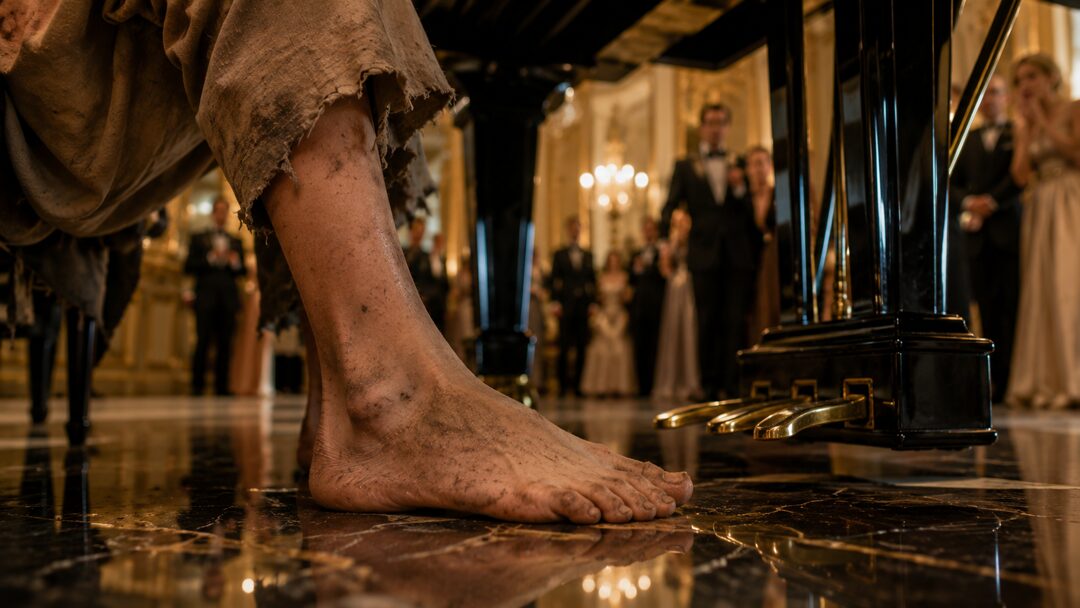
The boy stood barefoot in the center of the ballroom as if someone had placed him there to ruin the evening.
Around him, crystal chandeliers poured gold light over black tuxedos, silk gowns, champagne flutes, and a polished marble floor so bright it reflected every uncomfortable face. The guests had been laughing a moment earlier. Now they stared at the dirty child in torn beige clothes, his brown hair tangled, his feet marked by the city outside Daniel’s mansion.
No one asked if he was hungry.
No one asked where he had come from.
They only stepped back.
Joshua was used to that. People liked poor children better when they appeared in speeches, photographs, or tax-deductible foundations. In person, they became stains everyone pretended not to see.
But Joshua was not looking at the guests.
He was looking at the piano.
A black grand piano waited near the arched windows, its lid open, its surface shining under the chandeliers. All night, a hired pianist had played soft background music while wealthy people donated money for children they would never meet. Now the bench was empty.
Joshua’s eyes stayed fixed on the keys.
Daniel Cross noticed him from the far end of the ballroom.
Daniel was built for rooms like this: broad shoulders, black tuxedo, white shirt, black tie, champagne flute in hand, smile polished by years of donors, boards, and cameras. He had the kind of face people trusted before he earned it.
At first, he smiled as if this were a small mistake.
Then he saw the guests watching him.
That changed everything.
Elizabeth, his wife, stood beside him in a beige satin gown with diamonds at her throat. Her blonde hair was pinned perfectly. Her hand tightened around her phone.
Daniel turned his head slightly. “Do you know him?”
Elizabeth’s smile did not move.
“No.”
But her eyes had already betrayed her.
Joshua saw it.
He saw the way she looked at him, not like a stranger, not like a woman surprised by a child in the room, but like a person seeing a door open that she had locked years ago.
Daniel set his champagne flute on a tray and walked toward Joshua.
The guests parted.
No one wanted to stand too close to the boy. A woman lifted the hem of her silver dress so it would not brush his shoulder. A man murmured, “Security?” under his breath, but softly, as if kindness might be overheard and judged.
Daniel stopped a few feet away.
“Well,” he said, loud enough for the room, “this is one way to get attention.”
A few guests laughed.
Not because it was funny.
Because Daniel had given them permission.
Joshua did not answer.
Daniel studied the dirt on the boy’s cheek, the torn shirt, the bare feet.
“You lost, kid?”
Joshua’s voice was small but steady. “No.”
The room waited.
Daniel’s smile narrowed.
“No?”
“I came for the piano.”
A ripple moved through the guests.
Elizabeth’s fingers tightened around her phone until the diamonds on her bracelet shifted against her wrist.
Daniel looked back at the piano, then at Joshua.
For one second, something like irritation crossed his face. Not because a child had wandered in. Because the child had refused to be embarrassed quickly enough.
Daniel lifted one hand toward the piano.
“Play one song on that piano, kid,” he said, “and maybe you won’t sleep outside tonight.”
The laugh that followed was nervous this time.
Joshua looked at him.
He did not flinch.
That made Daniel’s smile thinner.
Elizabeth stepped forward. “Daniel, we should let staff handle this.”
Her voice was gentle.
Too gentle.
Daniel did not look at her. “It’s a charity gala, Elizabeth. Let’s be charitable.”
The guests laughed again, quieter.
Michael Cross, Daniel’s older brother, stood near a marble column with a glass of water instead of champagne. His silver-streaked hair and dark suit made him look less decorated than everyone else in the room. He had been the family attorney for so long that people mistook his silence for agreement.
He was not looking at Daniel.
He was looking at Elizabeth.
Because he had seen fear before.
And Elizabeth was afraid.
Joshua took one step toward the piano.
Then another.
The ballroom watched him walk barefoot across the marble.
Part II — The Challenge
The floor was cold.
Joshua felt it through his soles as he crossed the ballroom. Every step sounded too soft for the room, but somehow everyone heard it.
A woman in emerald silk moved aside and held her glass close to her chest. A man in a tuxedo whispered, “Where did he even come from?” Another guest lifted his phone, then lowered it when Michael looked at him.
Daniel followed at an easy distance.
He had regained the room.
That mattered to him. Joshua could feel it without understanding all of it. Daniel walked like a man who believed every room owed him an answer.
“Maybe he’s a prodigy,” Daniel said, turning to the guests. “You never know. Natural talent. Street conservatory.”
More laughter.
Joshua kept walking.
He had learned, before tonight, that laughter could be a fence. People used it to make sure you knew which side you stood on.
He reached the piano and stopped.
Up close, the instrument was larger than he expected. Its black surface reflected his face in pieces: dirty cheek, dark-circled eyes, tangled hair, mouth pressed tight.
For a moment, he saw another face in the shine.
An old woman’s face.
Mary, who had raised him in a two-room apartment above a closed laundromat, had kept one clean thing in a box under her bed: a music card with four bars of melody written in faded ink. She never let him touch it unless his hands were washed.
“This is from before,” she used to say.
“Before what?”
She never answered.
When she got sick, she pressed a locket into his palm and said, “If there’s no one left here, go to the house on the card. Play the song. Don’t let them take the locket.”
“Who are they?”
Mary’s breathing had rattled.
“The people who should remember.”
Now the people who should remember were looking at him like he was entertainment.
Joshua sat on the piano bench.
His feet did not touch the floor evenly. He tucked them back.
Elizabeth moved closer to Daniel.
“Please,” she said under her breath. “This is inappropriate.”
Daniel watched Joshua’s hands hover over the keys. “Now it’s inappropriate?”
“He is a child.”
“You noticed.”
Elizabeth’s face sharpened, then smoothed at once. “I’m saying we shouldn’t make a spectacle.”
Daniel’s eyes stayed on Joshua. “He already did.”
Joshua placed his fingers on the keys.
He did not play yet.
The room held its breath.
For the first time since he entered, Joshua spoke without looking at Daniel.
“If I play it, you listen all the way.”
A guest near the window gave a soft scoff.
Daniel smiled. “You negotiating with me?”
Joshua looked at him then.
“No. I’m telling you.”
Something in the room shifted.
It was small. Almost nothing.
But Michael felt it.
Daniel did too, though he covered it with another smile.
“Go ahead,” Daniel said. “Earn your bed.”
Elizabeth closed her eyes.
Joshua began.
The first notes were simple.
Too simple.
Three soft tones, then a pause. A small step downward. A phrase that sounded almost like a child counting in the dark. Several guests relaxed. Someone near the back whispered, “That’s it?”
Then Joshua’s left hand entered.
The melody opened.
It did not become loud. It became certain.
The notes moved with the strange confidence of something remembered by the body, not learned from paper. The ballroom changed around it. Champagne flutes lowered. Conversations died one by one. The hired pianist, standing beside a potted palm, leaned forward without meaning to.
Daniel’s smile faded.
He tried to keep it there. For a few seconds, he succeeded.
Then Joshua played the third phrase.
Daniel’s face emptied.
Elizabeth turned away so sharply that one diamond earring flashed in the chandelier light.
Michael saw that too.
He set his glass down.
Joshua kept playing.
His hands were small. The keys were broad. His cuffs were frayed. Dirt sat under his fingernails.
But the music did not care what he looked like.
The music filled the room like it had been waiting years for someone poor enough, angry enough, and brave enough to let it out.
Daniel stepped closer.
Joshua did not stop.
The melody lifted, broke, returned, and wound itself around a phrase that almost resolved.
Almost.
Daniel’s hand closed around the edge of the piano.
“Stop.”
Joshua finished the measure.
Daniel’s voice cracked. “I said stop.”
The last note faded into the chandeliered air.
No one laughed now.
Daniel stared at Joshua like the boy had taken something from inside his chest and placed it on the piano for everyone to see.
“Where did you learn that?” he asked.
Joshua looked down at the keys.
“From Mary.”
“Mary who?”
“The woman who raised me.”
Elizabeth stepped in quickly. “Daniel, there are thousands of melodies online. Children learn all kinds of things now.”
Michael’s voice came from the side of the room.
“Not that one.”
Elizabeth turned.
Michael was no longer near the column. He had moved closer, eyes fixed on Joshua.
Daniel looked at him. “Michael.”
Michael’s face was pale.
“That song was never public.”
Elizabeth laughed once.
It sounded wrong.
“Don’t be dramatic.”
Michael did not look away from Joshua.
Daniel’s fingers stayed on the piano edge.
His voice dropped.
“That melody was written for my son.”
The room went perfectly still.
Daniel swallowed, as if the next words hurt his throat.
“My son disappeared nine years ago.”
Joshua looked up.
For the first time, the boy’s control faltered.
Not much.
Just enough for Daniel to see it.
Part III — The Song From Before
Elizabeth recovered faster than anyone else.
That was her gift.
She stepped toward Joshua with a softened face, the face she used in photographs with scholarship recipients and hospital donors.
“What is your name, sweetheart?”
Joshua did not answer.
Daniel did. “He said Joshua.”
Elizabeth’s eyes flickered.
Michael caught it.
Daniel did too this time.
“Joshua,” Daniel said, almost to himself.
The name hung between them, close enough to another name no one spoke.
Elizabeth moved nearer to the piano. “Joshua, listen to me. This is very serious. If someone taught you that melody to get into this house, you need to tell us now.”
“No one taught me to get in.”
“Then why are you here?”
Joshua reached inside his torn shirt.
Elizabeth’s hand moved first.
Fast.
Too fast.
Joshua stepped back from the bench before she could touch him.
Daniel’s head snapped toward her. “Elizabeth.”
She froze with her hand half-raised.
Joshua pulled out a small locket on a dark cord. It was scratched, dull gold, the hinge bent. Beside it was a folded card, softened at the edges from being carried too long.
Michael walked forward.
“May I see that?”
Joshua looked at him for a long moment.
Michael lifted both hands, palms open. “I won’t take it.”
That mattered.
Joshua held the locket out but did not release the cord from his neck.
Michael leaned in.
His face changed.
Daniel saw it and went colder.
“What is it?” Daniel asked.
Michael did not answer right away.
Elizabeth’s voice came sharp. “This is absurd. You’re all letting grief make fools of you.”
“Elizabeth,” Daniel said.
“No.” She looked around at the guests as if recruiting them. “A strange boy walks into our home during a gala and plays a tune. Suddenly everyone is ready to rewrite our lives?”
Joshua watched her.
He had seen that kind of anger before. Not the loud kind from the street. The clean kind. The kind that wore perfume and called itself reasonable.
Michael pointed to the locket.
“Where did you get this?”
“Mary gave it to me.”
“Before she passed?”
Joshua nodded once.
Daniel flinched at the word passed, as if death in a ballroom was impolite.
Michael adjusted his reading glasses. “This belonged to Elizabeth.”
The room inhaled.
Elizabeth went still.
“That’s not true,” she said.
Michael looked at her finally. “You told me it was lost.”
“I said many things during that time. We all did.”
“You told me it was lost the day Andrew disappeared.”
The name struck Daniel like a hand to the chest.
Andrew.
The name of his missing son, spoken aloud in the ballroom for the first time in years.
Joshua’s fingers tightened around the locket cord.
Michael saw it.
Daniel saw it too.
“You know that name?” Daniel asked.
Joshua hesitated.
Then he said, “Mary called me that when she was dreaming.”
Elizabeth turned away.
Daniel took one step toward Joshua. “What did you say?”
“She’d wake up and say it.” Joshua’s voice stayed low. “Then she’d cry and call me Joshua again.”
Daniel’s eyes shone, but he did not reach for the boy.
Not yet.
He was a man used to evidence, reputation, and control. Grief had made him hopeful before. Hope had humiliated him before. He would not let the room see him collapse unless the room left him no choice.
Elizabeth understood that.
So she aimed for the old wound.
“Daniel,” she said softly, “you remember what happened after Andrew vanished. People came forward. People lied. They brought toys, locks of hair, false stories. You nearly destroyed yourself listening to them.”
Daniel’s jaw tightened.
Joshua looked from one adult to the next.
Michael said, “No one brought that melody.”
Elizabeth’s eyes flashed. “Because they didn’t know it.”
“Exactly.”
The room shifted again.
It no longer belonged to Daniel.
It no longer belonged to Elizabeth.
It belonged to the boy at the piano.
Daniel crouched slightly, not kneeling, not yet surrendering. “How old are you?”
Joshua shrugged. “Mary said nine.”
Daniel closed his eyes briefly.
“When is your birthday?”
“I don’t know.”
“What do you remember?”
Joshua looked past him to the high windows. Sunset had turned them orange. He could see his own reflection faintly there too: a small figure surrounded by gold.
“I remember stairs,” he said. “A woman singing angry. A blue blanket. Rain. Someone saying not to cry because good boys are quiet.”
Elizabeth’s phone slipped from her hand and hit the floor.
The sound cracked through the room.
Everyone looked at her.
Elizabeth bent too slowly to pick it up.
Daniel did not help her.
Michael said, “That blue blanket was never in the press.”
Elizabeth stood with the phone in her hand.
For one second, her perfect face was gone.
Under it was fear.
Then the mask returned.
“A child can repeat anything,” she said. “Someone has fed him details.”
Joshua looked at Daniel.
“I came because Mary died.”
A few guests looked away then.
Not from disgust now.
From shame.
Joshua unfolded the card.
It was a child’s music card, yellowed, creased, its staff lines fading. On the back was an embossed mansion address. No one could read it from across the room, but Daniel knew the shape of it.
His house.
His card.
His past.
Elizabeth stepped forward. “Let me verify that privately.”
Joshua moved the card behind his back.
“No.”
Her smile trembled.
“I’m trying to help you.”
“No,” Joshua said. “You’re trying to take it.”
Michael moved between them.
Not dramatically.
Just enough.
Elizabeth looked at him as if he had insulted her.
Michael’s voice was quiet. “No one touches him.”
Daniel looked at his brother.
Michael did not look away.
“Not this time,” Michael said.
Part IV — What the Room Remembered
Daniel asked the guests to give them space.
No one left.
That was the strange cruelty of wealth. People knew how to create distance without surrendering the spectacle. They drifted toward walls, windows, columns, anywhere they could pretend privacy was happening while still watching.
Elizabeth stood near the piano, her back straight, diamonds trembling faintly at her throat.
Daniel turned to Joshua.
“I want to take you upstairs,” he said. “Somewhere quiet. We can get you food. Dry clothes. We can talk.”
Joshua’s eyes narrowed.
“Why upstairs?”
Daniel’s face changed.
It was not anger.
It was pain.
“Because this room is not for this.”
Joshua looked around at the gowns, the tuxedos, the champagne, the people who had laughed at him minutes earlier.
“This room was for me when I was funny.”
The words landed harder than shouting.
Daniel looked down.
Elizabeth seized the opening.
“He’s performing,” she said. “Daniel, can you not see that? He knows exactly how to make you feel guilty.”
Michael turned sharply. “He’s nine.”
“He says he’s nine.”
Joshua did not move.
Elizabeth’s fear had made her careless. The room noticed.
Daniel did too.
“Why are you so certain?” he asked her.
Elizabeth blinked. “What?”
“You keep telling me what he is not.”
“I am protecting you.”
“From a child?”
“From grief.” Her voice softened again, but now the softness had teeth. “From wanting something so badly you let a stranger tear you open in front of everyone.”
Daniel stared at her.
For years, that sentence would have worked.
It had worked after the disappearance. It had worked when tips came in. It had worked when Michael wanted to reopen a question. It had worked when Daniel sat in Andrew’s room at two in the morning and Elizabeth stood in the doorway saying, You have to stop living in the day we lost him.
Daniel had mistaken her insistence for strength.
Now it sounded like practice.
Joshua returned to the piano bench.
Elizabeth’s head snapped toward him. “Don’t.”
The word was too sharp.
Too personal.
Joshua placed the locket and card on the piano ledge where everyone could see them, though no one could read the card from where they stood.
Then he put his hands back on the keys.
Daniel stepped forward. “Joshua.”
The boy looked at him.
“Did you look for me?”
The question tore through the room.
Daniel opened his mouth.
No answer came quickly enough.
Joshua’s face did not change, but something in his eyes closed.
Daniel saw it happen.
“Yes,” Daniel said, too late. “Yes, I looked.”
Joshua waited.
Daniel’s voice roughened. “I searched every road near the lake house. I hired people. I put your face on every news station. I—”
“Then why didn’t you find me?”
No one breathed.
Daniel looked at Elizabeth.
Not because he had an answer.
Because for the first time, he understood where the answer might be.
Elizabeth whispered, “Daniel, stop.”
Michael said, “Let him play.”
Elizabeth turned on him. “You are not helping this family.”
Michael’s face hardened. “Maybe that’s the problem. I’ve been helping the family for too long.”
Daniel looked at Joshua. “Play it again.”
Elizabeth’s eyes filled with something that was not tears.
Panic.
Joshua began the melody.
This time, the room heard it differently.
The first time, it had been strange.
Now it was dangerous.
The notes entered the air like witnesses taking their seats. Daniel stood beside the piano, one hand braced on the wood. Michael watched Elizabeth. The guests watched all of them.
Joshua played the first phrase.
Then the second.
Then the third.
Daniel’s breathing changed.
He remembered a small boy sitting at this same piano, legs swinging, pounding the wrong key every time the melody turned. Daniel had laughed then and corrected him.
“No, buddy. Not that one. This one.”
Andrew had scowled and said, “My way is better.”
Daniel had kissed the top of his head.
The memory hit so hard he almost stepped back.
Joshua kept playing.
Then, at the final unresolved phrase, he did something wrong.
The exact wrong thing.
The childish wrong thing.
The note Andrew had insisted on playing because he liked how it sounded sad.
Daniel stopped breathing.
Elizabeth made a small sound.
Not denial.
Recognition.
Joshua looked up from the keys.
Then he spoke the counting words under the last phrase, barely louder than the music.
“One for the moon. Two for the rain. Three to come home again.”
Daniel’s face broke.
Not completely.
But enough.
His authority left him all at once. The tuxedo, the wealth, the house, the crowd, the foundation, the years of speeches about helping children—none of it could hold him upright against that little chant.
“Only my son knew that,” Daniel said.
Elizabeth’s lips parted.
Michael removed his glasses.
The room understood before anyone explained it.
Joshua’s hands rested on the keys.
Daniel took one step toward him.
Elizabeth grabbed his arm.
“Daniel, no. He’s dangerous.”
Daniel looked down at her hand.
Then at her face.
The room saw it happen: the moment Elizabeth realized her husband was no longer standing between her and the boy.
He was standing between her and the lie.
Joshua turned from Daniel to Elizabeth.
He did not raise his voice.
He did not point.
He did not cry.
“Then ask your wife.”
Part V — Daylight
Elizabeth’s hand fell from Daniel’s arm.
For a moment, she looked smaller than the diamonds she wore.
Then she straightened.
“No,” she said.
It was the first honest word she had spoken all night.
Daniel stared at her.
“No what?”
Elizabeth’s eyes moved across the room, measuring exits, faces, damage. The guests no longer looked like admirers. They looked like witnesses.
“No to this,” she said. “No to being put on trial by a child who walked in from nowhere.”
Joshua slipped off the piano bench.
Daniel moved toward him.
Joshua stepped back.
It stopped Daniel more effectively than a locked door.
The pain on his face was immediate and deserved.
Michael crossed to the piano and picked up the music card carefully by one edge. “Daniel, the records need to be opened.”
Elizabeth turned on him. “You always wanted to blame me.”
Michael’s voice stayed low. “I wanted the file to make sense.”
“It was chaos.”
“It was convenient chaos.”
Daniel looked at Elizabeth. “What does that mean?”
Elizabeth said nothing.
That silence did more than any confession could have done.
The ballroom, so full minutes ago of music and perfume and golden confidence, felt suddenly bare. People shifted their weight. Someone set down a champagne flute with trembling care. A woman near the window pressed a hand to her mouth.
Joshua stood beside the piano, the locket still around his neck.
He did not look triumphant.
That was the worst part.
He looked tired.
Daniel lowered himself to one knee, not close enough to touch him.
“What name do you use now?” he asked.
Joshua watched him carefully.
“Joshua.”
Daniel swallowed.
“May I call you that?”
Joshua looked toward Elizabeth.
She was standing beside the grand piano as if it had betrayed her.
“Yes,” Joshua said.
Daniel closed his eyes.
The permission was small.
He accepted it like mercy.
Elizabeth moved toward the doorway. No one stopped her. That made her walk worse. Had she been dragged out, she might have remained dramatic. Instead, she passed through the parting guests under her own power, watched by people who had come to praise her generosity.
At the door, she turned once.
Daniel did not follow.
Joshua did not ask her to stay.
Michael took out his phone, then stopped himself. He looked at the device as if it belonged to the old way of handling things: privately, carefully, in language that softened the truth until no one bled from it.
He put the phone away.
“We do this in daylight,” he said. “No closed rooms. No quiet arrangements.”
Daniel nodded, but his eyes stayed on Joshua.
“I have food,” Daniel said. “A room. Clothes. Whatever you need.”
Joshua looked at the marble floor beneath his bare feet.
“I don’t want to go upstairs.”
Daniel’s face tightened, but he nodded.
“Then we won’t.”
The answer came fast enough this time.
Joshua looked at him, searching for the trick.
There wasn’t one.
Not in that sentence.
Maybe not in that moment.
But moments were not childhoods.
A father could kneel too late. A house could open too late. A name could return and still not know where to sleep.
Joshua took the music card from Michael.
The old paper trembled slightly in his hand. He carried it back to the piano and placed it on the bench.
No one spoke.
The card sat there like a small square of weathered truth in the middle of all that polished black wood.
Daniel looked at it, then at Joshua.
“Will you stay tonight?” he asked.
Joshua looked toward the open ballroom doors.
Beyond them, the hall stretched bright and gold, leading somewhere he did not know. Behind him, the piano waited with the song still inside it.
He did not walk into Daniel’s arms.
He did not run away.
He only moved toward the open doors, slow enough that anyone could follow, not close enough for anyone to claim him.
At the threshold, he turned back.
Daniel was still on one knee beside the piano.
Michael stood behind him, holding the locket’s chain carefully in his eyes, not his hands.
Elizabeth was gone.
Joshua touched the doorframe.
“My name is Joshua,” he said.
Daniel nodded.
The boy looked at the room that had laughed before it listened.
Then he stepped into the hall, leaving the music card on the bench for the people who finally had to remember.