The Promise in the Ball
Part I — The Road at Sunset
The football came down out of the sunset like a mistake too pretty to be dangerous.
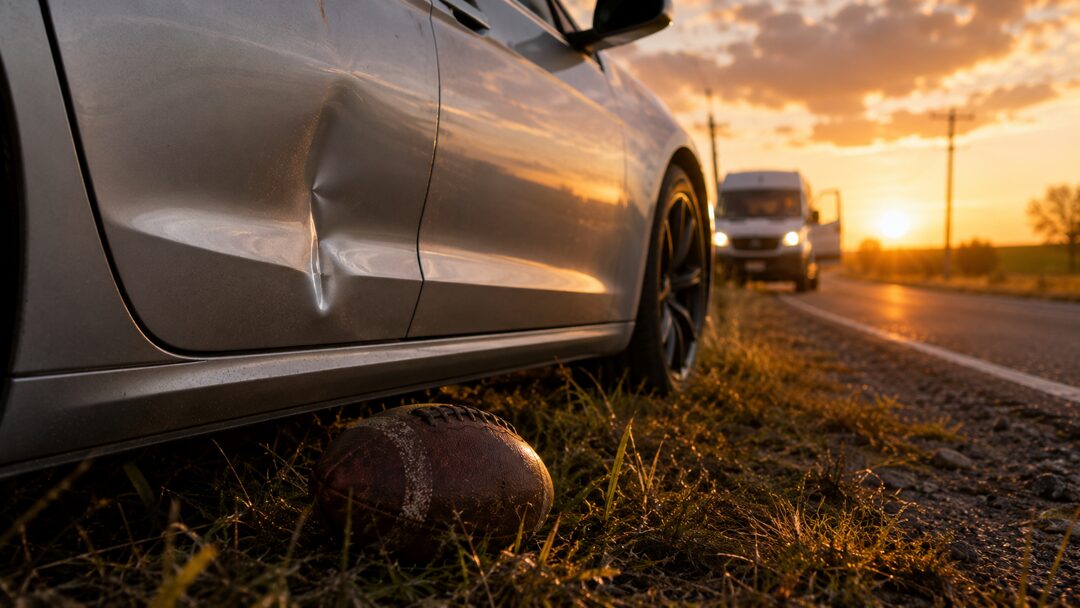
Randy had thrown it high, higher than he ever had, high enough that for one second it hung above the wheat field with the whole sky turning gold behind it. Then the wind caught it. The ball curved away from him, bounced once on the edge of the asphalt, and slammed into the driver’s door of a silver Tesla hard enough to make the car stop in the middle of the empty backroad.
Randy froze.
The sound seemed to stay in the air after the ball rolled into the grass.
The Tesla’s brake lights glowed red.
For a second, nobody moved.
Randy stood beside the road in his white T-shirt and black shorts, one sneaker half buried in dusty grass. His hands hung at his sides. His mouth opened, but no sound came out.
He knew two things at once.
The car was expensive.
And he had no way to pay for even the smallest part of it.
Across the road, near a white medical van parked beside the field, his mother was talking to one of the event volunteers. Her long brown hair was pulled back, and her white coat flashed in the low sun whenever she turned. She had told Randy to stay close. She had told him not to throw the ball near the road.
He had almost listened.
The Tesla door opened.
A man stepped out in a black suit.
At first Randy saw only the polished shoes, then the white shirt, then the face he knew from television, billboards, cereal boxes, and every Sunday afternoon when boys at school argued about who had the best arm in the league.
Mark Dawson.
Randy’s heart seemed to drop through his stomach.
Mark Dawson looked at the dent in the car door.
Then he looked at Randy.
The road felt suddenly too quiet.
The wheat moved in long waves behind him. A few people near the event van turned. One man lifted his phone, not fully recording yet, just ready.
Mark shut the car door carefully, as if slamming it would make the moment cheaper.
He walked toward Randy.
He was taller in real life. Wider too. Not angry in a loud way. Worse. Controlled. Used to people stepping aside before he had to ask.
“Hey,” Mark said. “Did you just hit my car?”
Randy swallowed. His voice came out thin.
“I’m sorry.”
Mark glanced back at the dent.
“Did you?”
“I didn’t mean to.” Randy’s eyes filled before he could stop them. “I’m sorry. I’m really sorry.”
Mark looked at the boy, then at the ball lying in the grass near the road. His jaw tightened.
“Where are your parents?”
Randy pointed toward the white van without taking his eyes off Mark.
“My mom’s over there.”
Mark followed the direction of his finger.
The woman in the white coat turned at the same moment.
For a second, the sunset hit her face.
Mark stopped.
It was barely a pause. Anyone else might have missed it.
Randy did not.
Because the man had looked angry a moment before.
Now he looked like he had seen something he wasn’t ready to remember.
Part II — The Ball in the Grass
Randy had carried that football everywhere for three years.
It was not new when his mother gave it to him. The leather was already worn soft at the seams. One side had a faded team logo from some old college championship. A dark smudge sat near the laces where a signature had half disappeared from use and weather and Randy’s own hands.
His name was written on one side in black marker.
RANDY.
His mother had written it carefully, pressing too hard on the Y.
“Don’t lose this,” she had told him.
“Because it’s expensive?”
“No.” She had smiled, but the smile had not reached her eyes. “Because it knows where you came from.”
He had not understood. He was six then. He thought balls knew things the way dogs knew roads home.
Now the ball lay in the grass between him and Mark Dawson.
Mark bent and picked it up.
Randy wanted to say, Be careful.
He did not dare.
Mark turned the ball once in his hands. His expression shifted from irritation to confusion. Then confusion tightened into something else.
Recognition.
He ran his thumb over the faded logo. Then over the smudged mark near the laces.
The phone near the van lifted higher.
Randy saw it and wanted to disappear.
Mark looked at the name written on the ball.
“Randy,” he said, not as a question, but like the word had reached into him.
“That’s me,” Randy whispered.
Mark’s eyes stayed on the ball. “Where did you get this?”
“My mom gave it to me.”
Mark’s fingers tightened around the leather.
The road behind him was empty. The Tesla sat with its dent catching the sunlight, bright and ugly. Randy expected Mark to talk about money, insurance, police, punishment. Adults always found the biggest words when they wanted a kid to feel small.
But Mark only stared at the ball.
“This can’t be real,” he said.
Randy did not know what that meant.
“It’s real,” he said quickly, afraid he had somehow made things worse. “I mean, it’s old, but it still works. I can throw it pretty far. I didn’t mean to hit your car.”
Mark looked at him then.
Not at the dent.
Not at the road.
At him.
“What’s your mom’s name?”
Randy hesitated. His mother had rules. Don’t talk to strangers. Don’t give people personal information. Stay where I can see you.
But Mark Dawson was not a stranger. Not really. Everybody knew him.
And the way he asked did not sound like a famous person asking a kid a question.
It sounded like someone standing at the edge of a cliff.
“Lauren,” Randy said.
Mark’s face went still.
The grass moved behind him. A bird lifted from a fencepost. Someone near the van whispered something Randy could not hear.
Mark lowered the ball slowly.
“Lauren what?”
Randy’s throat tightened. This was the part his mother never explained the same way twice.
Sometimes she said, “Your father is complicated.”
Sometimes she said, “One day, you’ll understand.”
Once, when Randy was half asleep in the backseat after a long drive, she thought he wasn’t listening and said, “He would have loved you if they’d let him know you existed.”
Randy had remembered that.
He remembered everything adults said when they thought kids were only background.
He looked up at Mark Dawson.
“My mom said you’re my dad.”
The world did not explode.
That was the strange part.
The wheat kept moving. The sky stayed gold. The Tesla’s engine hummed quietly. Somewhere far off, a truck passed on another road.
But Mark Dawson changed completely.
His mouth opened, then closed. His eyes flicked from Randy to the ball, from the ball to the woman in the white coat, from her back to Randy.
“No,” he said.
It was not denial exactly.
It was fear trying to become denial before anyone noticed.
Randy felt the word land in his chest.
No.
He took one step back.
Mark saw it and reached out, then stopped himself.
“Wait,” he said. “I didn’t mean—”
“Randy.”
His mother’s voice cut across the road.
Lauren stood near the medical van now, a blue clipboard pressed against her chest. Her face was pale. Her eyes were wet, but she was not crying the way Randy had seen her cry alone at the kitchen sink sometimes, with one hand over her mouth.
This was different.
This was a woman holding herself together because the whole road was watching.
“Come here,” she said.
Randy looked from her to Mark.
For the first time in his life, he did not know which adult to obey.
Part III — The Name She Kept
Lauren crossed the road slowly, as if any sudden movement might make the moment break into pieces.
Mark did not move toward her.
He held Randy’s football in both hands.
Randy noticed that. Not one hand, like it was trash or evidence.
Both hands.
A few people from the charity event had drifted closer from the parking strip near the field. Volunteers in polos. A photographer with a camera hanging from his neck. Two men from the roadside crew. Phones were up now.
Lauren saw them.
So did Mark.
His shoulders shifted, the smallest adjustment, but Randy felt the air change. Mark Dawson had played in stadiums filled with people. Cameras knew his face better than most families knew each other. But this was not a stadium.
This was too close.
This was a road with no tunnel to disappear into.
Lauren stopped beside Randy and placed one hand lightly on his shoulder.
He leaned into it, then hated that he did. He wanted to be brave. He wanted to be nine and not nine at the same time.
Mark looked at her.
“Lauren.”
She flinched at the sound of her name in his voice.
“Mark.”
The way she said it told Randy there had been a world before him.
He had always known that, of course. Everybody had a before. But this was the first time he had seen his mother’s before standing in front of her in a black suit beside a car Randy had dented.
Mark lifted the football slightly.
“Why does he have this?”
Lauren’s fingers tightened on Randy’s shoulder.
“Because it was his.”
“It was yours,” Mark said.
“It became his.”
Mark looked around at the watching faces. His jaw worked once.
“Did you plan this?”
Lauren’s face hardened.
Randy turned to look at her.
“What?”
Mark’s voice dropped. “The road. The ball. The van. Did you know I was coming through here?”
Lauren’s eyes flashed. “No.”
“You expect me to believe that?”
“I expected you not to call a child a setup.”
That sentence changed something.
One of the volunteers lowered his phone.
Mark heard it too. He looked at Randy, and shame crossed his face so quickly it almost vanished.
“I didn’t mean him.”
Lauren laughed once. It had no humor in it.
“That was always the trick, wasn’t it? You never mean the person who gets hurt.”
Mark took the words like a hit, but he did not step back.
“You disappeared.”
Lauren’s mouth trembled, then steadied. “I was moved out of the way.”
“I looked for you.”
“No,” she said. “You let other people look for reasons not to find me.”
The words were quiet. They still reached everyone.
Randy stared at the football in Mark’s hands.
“My ball,” he said.
Both adults looked at him.
Mark’s expression softened, but only for a second. He held the ball out.
Randy did not take it.
Not yet.
He was beginning to understand that the ball was not just a ball. That was the terrible part. It had been in his closet, under his bed, in the backseat, against his ribs when he slept through thunder. He had thrown it at fences and trees and once into a creek.
All that time, it had been carrying a story adults had folded small and handed to him.
Lauren crouched beside him.
“Randy,” she said, “I didn’t know he would be here.”
“Did you know I would say it?”
Her eyes filled.
She did not answer fast enough.
That was answer enough.
Randy looked away.
Mark saw it. So did Lauren. So did the phones.
The road had become a room with no walls.
Mark turned toward Lauren.
“You told him I was his father?”
“I told him the truth.”
“You told a kid something you couldn’t prove.”
Lauren lifted the blue clipboard.
“I can prove enough.”
Mark stared at it.
For the first time since he got out of the car, he looked less like a man whose property had been damaged and more like a man who had found a door in his own house that he did not remember locking.
“What is that?” he asked.
Lauren’s hand tightened around the board.
“The things your people said didn’t exist.”
Part IV — Paper and Silence
They moved toward the medical van because Lauren asked them to, and because even Mark Dawson seemed to understand that a boy should not have to stand in the road while adults pulled his life apart.
But private was impossible now.
The watchers stayed at a careful distance, close enough to see, far enough to pretend they were not intruding. The sunset was lowering. The Tesla sat half on the shoulder with its dent shining in the door.
Randy stood near the van’s open side door, holding the football again.
Mark had given it back without a word.
Lauren kept the clipboard against her chest. Mark kept glancing at it like it might speak first.
“You took money,” he said.
Lauren’s face went white.
Randy looked up.
“What money?”
Lauren shut her eyes for one second.
Mark noticed. His expression changed, not with triumph, but with the bitter relief of someone who had found one familiar piece of a terrible puzzle.
“You never told him that part?”
Lauren looked at Randy. “Not like this.”
Mark shook his head. “You left after you signed.”
“I left after your manager told me what my life would become if I didn’t.”
“I was twenty-four,” Mark said. “I didn’t even know—”
“You knew I was gone.”
The sentence was simple.
It pinned him.
Mark opened his mouth, then closed it.
Lauren stepped closer. “You knew I was gone, and you let your life continue because everyone around you told you that was maturity. Focus. Discipline. Protect the season. Protect the brand.”
Mark’s face tightened at brand, as if the word embarrassed him more than any accusation.
“I didn’t know you were pregnant.”
Lauren stared at him.
Randy held the football harder.
His mother had never said pregnant. She had always said, “Before you were born.” As if those months were a hallway she could describe without opening any doors.
Mark’s voice dropped. “I swear to you, I didn’t know.”
Lauren’s eyes searched his face, and for a second Randy saw how badly she wanted to believe him.
That hurt too.
Because wanting to believe someone was not the same as being able to.
She turned one page on the clipboard and pulled out a folded document. The top was covered in dense black type. Randy could not read it from where he stood. He did not want to.
“Your manager knew,” Lauren said.
Mark’s eyes flicked to the paper.
“Richard?”
Lauren nodded. “He came to my apartment two weeks after I told your assistant I needed to speak with you. He knew how far along I was. He knew where I worked. He knew my mother’s address.”
Mark took a step back.
“No.”
“There’s that word again,” Lauren said. “It didn’t stop anything the first time.”
Mark looked sick.
She handed him the document.
He did not take it.
“Read it,” she said.
“I don’t need to read some old threat from Richard.”
“It has your signature.”
That stopped him.
Randy watched Mark’s hand move, then freeze.
Finally, Mark took the paper.
His eyes moved over it quickly at first. Then slower. Then not at all.
“I signed packets every week,” he said. “Contracts, releases, charity approvals, brand documents. I didn’t read half of what they put in front of me.”
Lauren’s face broke for the first time.
Not loudly.
Just enough for Randy to see the years behind it.
“That’s exactly what they counted on.”
The paper shook in Mark’s hand.
“I didn’t know.”
Lauren nodded once. “Maybe not. But you were very well protected by what you didn’t know.”
Randy felt something cold and heavy settle inside him.
All his life, grown-ups had told him not to lie.
But here were adults standing in the open air, and somehow the worst thing between them was not one big lie. It was papers. Assistants. Silence. People who never asked the next question because the first answer was easier.
Mark looked at Randy.
Randy looked down at the football.
The name RANDY stared back at him in black marker, written by his mother’s hand.
He suddenly wished she had left the ball blank.
Part V — The Life Waiting Nearby
Emily arrived in a cream-colored dress and heels that were not made for roadside gravel.
She came from the direction of the charity event, escorted by a man with a headset who kept whispering uselessly into his phone. Her blonde hair was pulled back cleanly. A diamond ring flashed on her hand when she reached for Mark’s arm.
“Mark,” she said, and the name came out like a warning.
Mark did not move.
Emily looked at Lauren. Then at Randy. Then at the clipboard.
She understood faster than Randy expected.
Not everything. But enough.
Her face settled into a calm that did not belong to the road. It belonged to press conferences, hotel lobbies, donation dinners. A calm made for rooms where people pretended nothing was happening until someone official told them what to feel.
“We need to leave,” Emily said.
Lauren’s eyes narrowed.
Mark turned to her. “Emily.”
“Now,” she said. “We can handle this privately.”
Randy hated that word.
Privately.
It sounded like a place where truths went to become smaller.
Mark looked back toward the watchers. Phones. Faces. The event photographer pretending not to hold his camera ready.
Emily lowered her voice, but not enough.
“You don’t answer anything out here.”
Lauren laughed softly. “He hasn’t answered anything anywhere.”
Emily looked at her then.
“I’m not talking to you.”
The sentence was clean, controlled, and cruel without raising its voice.
Lauren absorbed it.
Randy stepped closer to his mother.
Mark saw that, and something in his face changed.
“Don’t talk to her like that,” he said.
Emily turned back to him, stunned.
For a second, Randy could see that she loved him. Not just the suits or the cars or the cameras. She loved the man she believed he was. And she was terrified that this road was making him into someone else.
“Do you understand what this becomes?” Emily asked. “A woman from your past, a kid, papers no one has reviewed, strangers filming—”
“A boy,” Mark said.
Emily stopped.
Mark’s voice was quiet, but it carried.
“He’s a boy. Not a problem.”
Randy looked at him.
The words should have made him feel better.
They almost did.
But then Emily’s eyes moved to Randy, and her expression flickered. Not hate. Not even anger.
Threat.
Randy had seen that look at school when kids picked teams and somebody realized choosing him meant losing someone better.
He looked down.
Mark saw that too.
Emily took Mark’s hand. Her fingers slid between his, familiar and polished.
“Please,” she said. “Come with me. We’ll figure out what’s true.”
Lauren’s mouth tightened. “Funny how truth only gets invited indoors after it embarrasses someone.”
Emily ignored her.
“Mark,” she said, softer now. “You owe it to your future not to answer in panic.”
There it was.
Your future.
Not the truth. Not the boy. Not the woman holding papers with shaking hands.
The future.
Randy clutched the football.
His chest felt tight. The road was full of adults, and every adult seemed to be deciding where he fit.
He looked at Mark Dawson, the man his mother had once said might have loved him if the world had been different.
He asked the question before fear could stop him.
“Do you want me to go?”
The words were small.
They cleared the road.
Mark looked at him.
Emily’s grip tightened on Mark’s hand.
Lauren made a sound like she had been struck, but she did not interrupt.
Randy kept his eyes on Mark. If the answer was yes, he wanted to hear it from him. Not from paperwork. Not from Emily. Not from some manager who wasn’t there anymore.
From him.
Mark looked at the football under Randy’s arm.
“Can I see it again?” he asked.
Randy hesitated.
Then he handed it over.
Part VI — After the Rain
Mark turned the football in his hands as the sun slipped lower behind the field.
He did not look at the name first this time. He looked at the seam near the old smudged mark. His thumb pressed into the worn leather. Something there caught under his nail.
A flap of loosened stitching lifted.
Under it, almost hidden, was a line written in faded silver ink.
For L — after the rain.
Mark stopped breathing.
The road disappeared for him.
For one second he was twenty-three again, standing under stadium lights after a storm delay, soaked to the skin, laughing because Lauren had refused to leave the bleachers even when everyone else ran for cover. She had been wearing a yellow raincoat and cheap sneakers. He had signed a ball for her after the game, but not with his name.
With that line.
For L — after the rain.
Because she had said storms made people honest.
He looked at Lauren.
She was crying now, silently.
“You kept it,” he said.
“I tried not to.”
“Why give it to him?”
Lauren wiped her cheek with the back of her hand. “Because I got tired of being the only person in his life carrying proof that he came from love.”
Emily stepped back.
The word love did what the documents had not. It made the past real.
Mark looked at Randy.
The boy stood with his hands half curled, trying not to look hopeful because hope was dangerous when adults were undecided.
Mark’s knees bent before he fully decided to move.
He lowered himself in front of Randy, right there on the roadside, black suit pants in the dust, the dented Tesla behind him, phones watching from every angle.
Emily whispered, “Mark, don’t.”
He heard her.
He did it anyway.
He held the football out.
Randy took it slowly.
Mark’s voice was unsteady, but clear.
“No,” he said. “I don’t want you to go.”
Randy’s face changed so quickly it hurt to see. He did not smile. It was not that simple. But the terror loosened. His shoulders dropped a little. His fingers tightened around the ball, not as a shield now, but as something returned.
Mark swallowed.
“I don’t know how to be what you need,” he said. “Not yet.”
Lauren shut her eyes.
Emily turned away.
Mark kept looking at Randy.
“But I’m not walking away from you because cameras are here.”
Randy’s eyes filled.
He nodded once.
Not forgiveness.
Not love.
A nod was all he had.
Mark stood and faced the road, the phones, Emily, Lauren, the dented car, all of it.
“The car doesn’t matter,” he said.
Emily’s face tightened.
Mark looked at the document still in his hand.
“These papers do.”
Nobody spoke.
Even the wheat seemed quieter.
Emily removed her hand from his arm.
“You understand what you’re choosing?” she asked.
Mark looked at her, and the pain in his face was real.
“I’m starting to.”
That was the closest thing to goodbye he could give her in front of everyone.
Emily waited a moment, as if he might correct himself.
He didn’t.
She turned and walked back toward the event lights without another word, her heels sinking slightly into the gravel. She did not look cruel then. She looked like someone watching a door close on the version of her life she had already furnished.
Lauren watched her go, then looked at Mark.
“Don’t make him a promise because you’re ashamed.”
Mark nodded.
“I won’t.”
“Don’t ask him to fix what you didn’t know.”
“I won’t.”
“Don’t confuse showing up once with being a father.”
That one landed hardest.
Mark looked at Randy.
“I won’t,” he said again, quieter.
Lauren looked down at her son.
“Randy,” she said, “you don’t have to talk to him tonight if you don’t want to.”
Randy held the football under his arm. He looked at the Tesla, then at the road, then at Mark’s polished shoes dusty from kneeling.
“You’ll still be here tomorrow?” he asked.
Mark’s face shifted.
It was the first real test.
Not a dramatic line. Not a public statement. Not a camera moment.
A child asking if an adult would remain after the big scene was over.
Mark took a breath.
“Yes,” he said.
Randy looked at his mother.
Lauren did not answer for him.
That mattered.
He looked back at Mark.
“Then we can talk somewhere else.”
Mark nodded.
The watchers began to lower their phones, disappointed that life did not wrap itself into a cleaner ending. No embrace. No perfect family shape. No music swelling from the wheat field.
Just a woman in a white coat, a famous man in a dusty suit, and a boy holding an old football that had carried too much for too long.
They walked toward the medical van together, not touching.
Behind them, the silver Tesla remained on the shoulder with the dent in its door catching the last light of sunset.
For once, nobody looked at the car.
Randy kept the football under his arm.
The ball was old, scuffed, and worn at the seam.
But it was still his.
And now, at least, the truth was walking beside him.