The Room Went Quiet
Part I — The Tray
Sarah Mitchell was already on the floor when the laughter hit its loudest point.
The metal tray spun in a bright circle beside her knee, clattering against the concrete like a coin that refused to fall flat. Mashed potatoes streaked down the front of her dark blue shirt. A cracked ID badge hung from its clip at her chest, half smeared white, half swinging loose.
Above her, Sergeant Mark Hayes laughed so hard his face turned red.
Not a small laugh.
Not the kind a man could pretend was accidental.
He bent over the table with one hand pressed to his stomach, his other hand pointing down at her as if she were the funniest thing he had ever seen in uniformed company.
Except Sarah was not in uniform.
That was the problem.
To Hayes, she was a woman in a button-up shirt with a badge. Administrative staff. Logistics. Contractor. Someone who belonged at a desk, not in the path between two rows of hungry soldiers.
Someone safe to mock.
“Careful,” Hayes said, wiping at one eye. “Mess hall floor’s got more rank than that badge.”
A few men laughed with him.
A few only watched.
Corporal David Carter did not laugh at all.
He stood three soldiers back, tray still in his hands, looking from Sarah’s badge to the way she had caught herself on one palm and one knee. Most people hit the floor and looked around to see who saw. Sarah did not.
She looked at the tray first.
Then the room.
Then Hayes.
That order bothered David.
Sarah planted both hands beneath her shoulders and pushed herself up. Slowly. Not weakly. Not dramatically. Just with the careful control of someone unwilling to waste motion on pain.
A lump of potato slid from her sleeve and dropped to the floor.
Hayes grinned wider.
“Need help with that, ma’am?”
Sarah looked at him.
The room kept making noise, but something around their table tightened. Men sensed tension before they understood it. Chairs shifted. Forks paused. Someone at the next table whispered, “Damn.”
Sarah wiped her left sleeve with two fingers. The fabric beneath the mess was stained.
She did not raise her voice.
“You just failed your first assessment.”
For half a second, Hayes stopped laughing.
Then he leaned back, delighted by the new joke.
“Oh, I did?” He looked around at his men as if asking permission to enjoy it. “What’s next? You writing me up for mess hall misconduct?”
More laughter.
David’s grip tightened around his tray.
Sarah did not answer right away. Her face was calm, but not empty. There was heat in her eyes, compressed so tightly it looked almost cold.
She looked at the men who laughed.
Then at the men who did not.
Then back at Hayes.
“Enjoy lunch, Sergeant.”
She turned and walked away with mashed potatoes drying on her shirt and her cracked badge tapping softly against her ribs.
No one blocked her path.
Even Hayes did not speak until she had passed through the double doors.
Then he snorted and shook his head.
“First assessment,” he repeated. “That’s cute.”
David set his tray down untouched.
Hayes noticed.
“What?”
David watched the doors swing shut behind her.
“Her badge wasn’t contractor blue.”
Hayes’s smile faded just enough to show the effort behind it.
“What are you, badge police now?”
“I’m saying it had an operations stripe.”
Hayes picked up his fork. “You saw potato and made it classified.”
The men laughed again, but less loudly this time.
David did not sit.
He had seen Sarah’s eyes.
Not embarrassed.
Not frightened.
Measuring.
That was the word.
Measuring.
And the worst part was that when she said assessment, she had not sounded like she was threatening Hayes.
She had sounded like she was recording a result.
Part II — The Order
The message came forty-two minutes later.
Not through Hayes’s company commander.
Not through the usual chain that gave bad news time to soften as it traveled.
It came from operations.
All members of Second Platoon were to report to Briefing Room Three in dress uniforms. Attendance mandatory. No substitutions. No delays.
Hayes read the order twice on the hallway screen, then laughed once through his nose.
“See?” he said. “Complaint hearing.”
David stood beside him, collar half buttoned, his dark hair still damp from a rushed change. “Operations doesn’t run complaint hearings.”
“They do if someone makes enough noise.”
“She didn’t make noise.”
That landed harder than David meant it to.
Hayes turned toward him.
“You got something you want to say?”
David looked past him to the hallway mirror where soldiers were straightening ties and smoothing jackets. Hayes looked perfect already. He always did before being judged. Polished shoes. Razor line haircut. Broad shoulders. The kind of man rooms gave space to before he had earned it.
David had followed him for eleven months because Hayes was brave. Because he moved fast when other men froze. Because when training got hard, Hayes went first.
But courage and contempt looked too similar in him sometimes.
David had never said that out loud.
“No,” David said.
Hayes stepped closer. “Good.”
The door to Briefing Room Three was guarded by two military police officers who did not joke, did not glance at names, and did not call anyone buddy.
That was the first sign Hayes could not laugh away.
The second was the map.
Grayline Sector filled the front wall in pale green and gray. Roads. Valleys. Villages. A thin border line running through the image like a barely healed cut.
Operation Quiet Mile appeared in the top corner.
Hayes stared at it.
Around him, the platoon settled into rows. Dress uniforms changed the room. Men who had been slouching in the mess hall sat straighter now, rank shining at their shoulders and chests. The laughter from lunch felt suddenly out of place, as if it belonged to boys they had left behind in another building.
David sat one seat behind Hayes.
He saw the empty podium.
He saw the sealed folders placed facedown at each station.
He saw Colonel Robert Grant standing at the side of the room, tall, gray-haired, expression unreadable.
Grant did not approach the podium.
That was the third sign.
Hayes leaned slightly toward David without turning his head.
“Who’s running this?”
David did not answer.
Because the door opened.
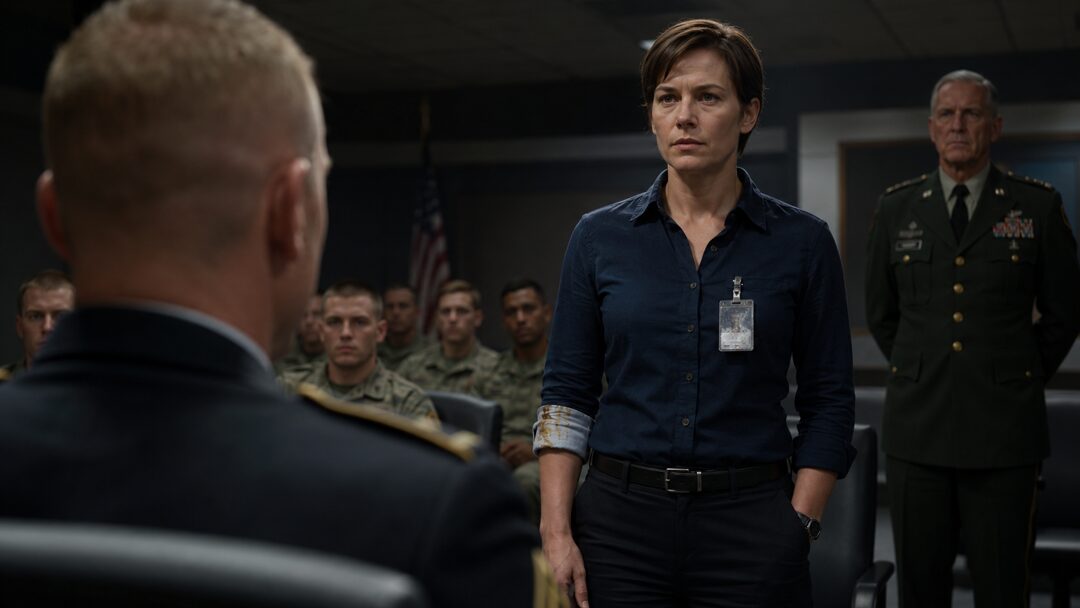
Sarah Mitchell walked in.
Clean now, mostly. Her short brown hair was dry. Her dark blue shirt had been changed, but not perfectly. A faint pale stain remained at the edge of her left cuff, almost invisible unless someone knew to look.
David knew.
Hayes saw it too.
His mouth curved.
Not fully. Just enough.
Sarah crossed to the front of the room carrying a black folder. She did not look at Hayes. She did not look away from him either. She simply included him in the room like any other object she had already assessed.
A few men shifted.
One whispered, “No way.”
Sarah placed the folder on the podium.
Colonel Grant moved behind her.
Behind her.
Not beside her.
Not in front of her.
Behind.
The room noticed.
Hayes noticed last.
Sarah let the silence stay long enough to become uncomfortable.
Then she said, “Second Platoon, you are here for final readiness evaluation connected to Operation Quiet Mile.”
Hayes’s smirk weakened.
Sarah continued. “This evaluation determines whether your unit is cleared for advisory deployment to Grayline Sector.”
A soldier in the back swallowed audibly.
David looked down at the folder in front of him but did not open it.
Nobody had told them this was today.
Nobody had said the final evaluation had already begun.
Sarah’s gaze moved across the room.
“You will be tested on decision-making under uncertainty, civilian contact pressure, casualty management, command discipline, and response to unreliable information.”
Her eyes stopped on Hayes.
“For some of you, that test began earlier than expected.”
Hayes’s face tightened.
A few men lowered their eyes.
Sarah reached for her left cuff.
The room went still.
Part III — The Circle
Sarah unbuttoned her cuff with slow, practical movements.
Not theatrical.
That made it worse.
Hayes watched her fingers fold the fabric once, then again, revealing the inside of her forearm.
A black circle appeared first.
Then the letters.
SF12.
No one spoke.
There were rumors attached to that mark. Every base had them. Men told them late, with coffee gone cold and bravado gone soft. Special reconnaissance. Grayline crossings. Teams that operated so far ahead of support they became radio ghosts. Some said SF12 was gone now. Some said it had never officially existed.
Hayes had once called it campfire garbage.
Now the mark was ten feet away from him.
On the arm of the woman he had laughed at.
David felt his stomach drop.
Sarah finished rolling her sleeve and rested both hands on the podium.
“My name is Major Sarah Mitchell,” she said. “Retired from field command. Former special reconnaissance officer. Currently lead evaluator for high-risk advisory deployments connected to unstable civilian corridors.”
No one moved.
Even Colonel Grant remained silent.
Sarah’s eyes found Hayes.
“You may breathe, Sergeant.”
A few men did.
Hayes’s jaw flexed.
He looked as if he wanted to apologize and fight at the same time.
That was the first honest thing his face had done all day.
Sarah turned to the screen. “Grayline Sector is operating under a collapsed ceasefire. Your unit’s assignment, if cleared, will not be to win glory. It will be to keep a fragile passage open long enough for civilians, local guides, and allied staff to move without creating a larger incident.”
She clicked a remote.
The map shifted closer to a village marked Harlan Crossing.
“A convoy stalls here. Communication is incomplete. Your interpreter is missing. One allied medic is wounded. Local reports conflict. A child approaches the school courtyard carrying a white cloth. You do not know if it is surrender, warning, signal, or bait.”
Hayes sat rigid.
Sarah looked at him.
“Sergeant Hayes. You have forward command in this simulation. What do you do?”
There it was.
Not punishment.
Worse.
Trust, placed like a blade on the table.
Hayes cleared his throat. “Secure the school perimeter. Move two teams to flank routes. Detain any unknown adults near the convoy. Push through before the crowd builds.”
Sarah’s expression did not change. “And the child?”
“Held back until identified.”
“How?”
“With force if needed.”
A few soldiers shifted.
Hayes heard them and doubled down.
“Ma’am, hesitation gets people hurt.”
Sarah clicked the remote again.
A red marker appeared near the school.
“Your medic is now losing time. Your interpreter is still missing. Crowd density has increased. A local guide says the eastern road is mined. Another source says the guide is compromised.”
“Detain the guide,” Hayes said too quickly. “Use western bypass.”
David leaned forward.
Hayes did not look at him.
Sarah did.
“Corporal Carter.”
David straightened.
“What is your concern?”
Hayes turned halfway. “Ma’am, Carter isn’t—”
“I asked Corporal Carter.”
The room held its breath.
David felt every eye on him. Hayes’s most of all.
“The western bypass runs close to the school wall,” David said carefully. “If the guide is telling the truth, detaining him removes the only person who knows the safer route. If he’s lying, pushing west still gives him what he wants.”
Sarah nodded once.
Hayes’s cheeks colored.
“So we stand around and debate?” Hayes said. “That your recommendation?”
David looked at him, then at Sarah.
“No. Verify before movement. Separate the guide from the crowd, don’t discard him. Send a small check team. Keep the child visible but don’t turn the courtyard into a panic point.”
Hayes gave a tight laugh. “That sounds great in a classroom.”
Sarah’s voice cut cleanly through the room.
“Most bad decisions sound decisive before they cost anyone anything.”
The sentence stayed there.
Hayes stared at her.
Then looked away first.
Sarah continued the simulation. Every answer Hayes gave came faster than the last. Every complication Sarah added made the room smaller.
A false radio report.
An allied officer down.
A civilian guide accused of betrayal.
A wounded man calling for extraction from inside the school.
Hayes kept choosing speed.
Sarah kept asking what speed was protecting.
The convoy?
The civilians?
His men?
Or his need to never look unsure?
At the forty-minute mark, Hayes snapped.
“With respect, ma’am, this scenario is built to fail.”
Sarah folded her hands.
“Is it?”
“Yes, ma’am. Every choice gets punished. Every source contradicts another source. You’re asking for perfect information in a situation where there isn’t any.”
“No,” Sarah said. “I’m asking what you do when certainty becomes a performance.”
Hayes sat back as if struck.
Sarah looked toward Colonel Grant.
For the first time, Grant stepped forward.
“The scenario is based on Grayline,” he said.
The word changed the air.
Sarah did not look at the map.
She looked at the floor for one brief second, then back at Hayes.
“Compressed,” she said. “Names removed. Terrain altered. Outcome preserved.”
No one asked what outcome.
No one needed to.
But Sarah gave them enough.
“Three of my people died in a school corridor because a young commander mistook silence for guilt, fear for cowardice, and delay for weakness.”
Her voice did not shake.
That somehow made it worse.
“One local guide was ignored because he was shaking too hard to speak clearly. A medic was moved too late. A child with a white cloth was treated as a threat until the courtyard turned against us.”
She stopped there.
No story. No plea. No performance.
Just facts with weight.
Colonel Grant’s face had gone harder.
“Major Mitchell carried two wounded personnel out of that building,” he said. “Then testified against the officer who altered the report.”
Sarah’s eyes did not leave Hayes.
“The report said the situation was unavoidable,” she said. “It wasn’t.”
Hayes’s mouth opened.
Nothing came out.
Sarah let him sit inside that.
Then she clicked the remote again.
A new map appeared.
“Final scenario.”
Part IV — Too Certain
The room no longer belonged to Hayes.
He felt it as clearly as if someone had taken the chair from under him. An hour ago, his men looked to him to decide whether something was funny.
Now they looked to Sarah to decide whether he was fit.
That was the part he hated first.
Then the shame caught up.
The tray.
The badge.
The way she had looked at the men who laughed and the men who did not.
He remembered David’s warning in the hallway.
Her badge wasn’t contractor blue.
Hayes had mocked that too.
He could feel David behind him now, quiet as a held breath.
Sarah pointed to the new map. “Extraction convoy delayed. Officer down. Communication partial. Civilian guide accused by two locals of giving false intelligence. Without him, your team loses the only confirmed route through the southern passage. With him, you risk trusting compromised information.”
Hayes stared at the screen.
It was the same question wearing another shape.
What do you do with someone who looks weak when everyone around you wants permission to throw them away?
Sarah’s voice was calm.
“Your team is watching. The crowd is watching. Time is moving. What do you do?”
The old answer rose fast.
Detain him. Move on. Control the visible threat.
It was clean.
It sounded strong.
It would have made him feel like himself again.
That was how he knew not to trust it.
Hayes glanced back.
David was looking at him.
Not accusing.
Waiting.
That felt worse.
Hayes turned forward. “Separate the guide from the crowd. Do not abandon him. Assign protection. Verify his route with a two-person check team before convoy movement.”
Sarah’s eyes narrowed. “That costs time.”
“Yes, ma’am.”
“Time you may not have.”
“Then we spend the smallest amount necessary to avoid spending lives later.”
A few men looked at one another.
Sarah stepped away from the podium.
“Who leads the check team?”
Hayes swallowed.
He could feel his pride reaching for the answer: I do.
Instead he said, “Carter.”
David’s head lifted.
Hayes kept looking at Sarah. “He saw the route problem before I did. He has authority to challenge my call if new information contradicts my assumption.”
Sarah watched him for a long moment.
“You’re giving a corporal permission to correct you in front of your men?”
Hayes’s throat tightened.
“Yes, ma’am.”
“Because you trust him?”
“Yes, ma’am.”
“Or because you’re trying to look teachable?”
That one hit the room like a door slammed shut.
Hayes’s face burned.
He wanted to defend himself. Wanted to say he had gotten the point. Wanted to ask how many times she needed to drag him over the same mistake.
But that would be another performance.
He looked at the map.
At the guide marker.
At the school.
At the invisible men who had not walked out of Sarah’s memory.
Then he said, “Both, maybe.”
The room did not move.
Hayes forced himself to continue.
“I want to look teachable because I know everyone is watching. But I also know Carter saw something I didn’t. And if I ignore that because I outrank him, that’s not command. That’s ego with paperwork.”
David looked down.
Sarah did not soften.
“Are you hesitating because you’re afraid to be wrong, Sergeant?”
Hayes shook his head.
“No, ma’am.”
“Then why?”
His answer came slower than all the others.
“Because I’m afraid of being certain too early.”
No one breathed for a second.
Sarah held his gaze.
There was no triumph in her face.
That surprised Hayes.
He had expected satisfaction. A small smile. Some sign that she had finally pinned him to the wall and enjoyed it.
Instead, she looked tired.
Not weak.
Tired the way stone was tired after weather.
Sarah returned to the podium.
“Continue.”
Hayes did.
This time, he did not race.
He asked where the medic was placed. He confirmed what the child could see. He ordered the crowd kept informed through any available local channel. He assigned David to verification and told another soldier to watch not only threats but panic.
He still made mistakes.
Sarah caught each one.
But the room changed.
The men stopped waiting for him to win against her.
They started watching him work.
That was a different kind of pressure.
And for the first time all day, Hayes did not laugh to get out from under it.
Part V — The Salute
When Sarah ended the evaluation, she did not announce a pass or fail.
She closed the folder.
That was all.
The room stayed seated until Colonel Grant said, “Dismissed to corridor. Hold outside.”
Chairs scraped. Men stood. Nobody spoke above a murmur.
Hayes moved like a man who had been awake for two days. David walked beside him but did not say anything. That silence was not punishment. It was space.
In the hallway, the platoon formed loose lines beneath fluorescent lights.
Hayes kept his eyes on the closed briefing room door.
One soldier behind him whispered, “Are we done?”
No one answered.
Then footsteps approached from the far end of the corridor.
Four senior officers came around the corner in formal green uniforms, moving in step without needing to look at one another. Their faces were unreadable. Their ribbons caught the light.
The platoon straightened automatically.
Hayes felt the old instinct return: rank enters, you brace.
The briefing room door opened.
Sarah stepped out first.
Sleeve still rolled.
SF12 still visible.
Colonel Grant followed behind her.
For one stupid second, Hayes thought the officers had come for Grant.
Everyone did.
Then the four officers stopped.
Turned toward Sarah.
And saluted.
Not casually.
Not as courtesy.
Sharp. Simultaneous. Unmistakable.
The hallway changed shape around that gesture.
Hayes heard a man behind him inhale.
Sarah returned the salute.
Her face did not alter. Her arm moved with clean restraint, held for exactly the right amount of time, then lowered.
The officers passed into the briefing room with Grant.
Sarah remained in the hall.
She looked at the platoon.
Not just Hayes.
All of them.
“Your deployment status will be reviewed,” she said. “Some of you performed well under pressure. Some of you performed honestly after pressure removed your costume.”
No one needed to ask who she meant.
Her eyes moved to Hayes.
“Honesty is not clearance. It is the beginning of work.”
Hayes nodded once.
“Yes, ma’am.”
Sarah’s gaze shifted to David.
“Corporal Carter.”
“Yes, ma’am.”
“Keep speaking before silence becomes agreement.”
David’s jaw tightened.
“Yes, ma’am.”
Then she rolled her sleeve down.
The tattoo disappeared.
Somehow that made the salute feel even heavier.
Hayes watched her walk toward the far doors, the same controlled stride she had used leaving the mess hall. Only now every man in the corridor made room for her before she reached them.
Respect moved faster than truth.
That thought hit Hayes so hard he almost stepped back.
Because Sarah had been the same woman on the floor.
The same woman with potato on her sleeve.
The same woman he had laughed at.
Only the room had changed.
Part VI — What Stayed
Hayes found the mop in the utility closet after dinner.
No one ordered him to do it.
That was why he almost didn’t.
The mess hall was nearly empty by then. Tables wiped down. Chairs stacked in uneven rows. The evening crew had cleaned the visible mess hours ago, but Hayes could still see the place where the tray had spun.
Memory kept better records than tile.
He filled a bucket, carried it to the spot, and started again.
David appeared in the doorway after a few minutes.
Hayes did not look up.
“You here to supervise?”
“No.”
“To tell me I’m late?”
David leaned against the doorframe. “No.”
Hayes dragged the mop across clean floor.
The sound was ugly in the quiet.
After a while, David said, “I should’ve said something earlier.”
Hayes stopped.
He looked over.
David’s face was still, but not easy.
“In the mess hall,” David said. “I saw it going bad. I knew it wasn’t right.”
Hayes looked back at the floor.
“That wasn’t on you.”
“Some of it was.”
Hayes wanted to let him off the hook.
For once, he didn’t.
“Yeah,” he said quietly. “Some of it was.”
David nodded.
It did not feel cruel.
It felt accurate.
A few minutes later, David left. Hayes kept mopping.
When the doors opened again, he knew before he turned who it was.
Sarah stood just inside the mess hall, sleeve down, badge replaced, shirt clean. Without the tattoo visible, she looked again like someone a careless man could underestimate.
Hayes straightened.
“Ma’am.”
Sarah’s eyes went to the mop, then the floor.
“Someone assigned you?”
“No, ma’am.”
“Trying to be seen doing it?”
Hayes almost smiled.
He deserved that.
“No, ma’am.”
She waited.
He placed the mop handle against the bucket.
“I’m sorry,” he said.
The words sounded too small for the room.
So he did not add more.
No excuse. No story about stress. No claim that he respected her now. That would have been another insult, dressed better.
Sarah watched him through the silence that followed.
Then she said, “Respect is not something you owe people after they prove enough.”
Hayes nodded.
“Yes, ma’am.”
“You owed it when you thought I had none of the things you respect.”
He swallowed.
“Yes, ma’am.”
Her face remained controlled, but something in her eyes shifted. Not forgiveness. Not warmth.
Recognition, maybe.
Of the work beginning.
Not completed.
Beginning.
Hayes stood at attention.
Sarah looked at him for a moment longer.
Then she turned to leave.
At the doors, she paused without looking back.
“Carter was right before you were.”
“I know.”
“Make that useful.”
“Yes, ma’am.”
She walked out.
The doors swung closed behind her.
Hayes remained standing until they settled.
Then he looked down at the clean floor, at the bucket, at the mop, at the place where he had thought power meant deciding who got laughed at.
Outside the mess hall, Sarah moved down the corridor alone.
Her sleeve was buttoned.
The circle on her arm was hidden.
She did not need it visible.
Not tonight.
Behind her, in the room where the laughter had started, Mark Hayes stood at attention long after no one was there to see it.