What Remained on the Table
Part I — The Old Jacket
Robert Hale knew he should not have worn the jacket.
He knew it before the transport plane came into view, before the young Marines at the ramp noticed him, before Captain Michael Grant saw the faded patch on his chest and broke into the kind of smile men saved for fathers, legends, and the dead.
The airfield was too bright for what Robert had brought with him.
Sun flashed off the gray body of the aircraft. Heat shimmered above the tarmac. Somewhere behind the hangars, an engine coughed awake and settled into a low, patient thunder.
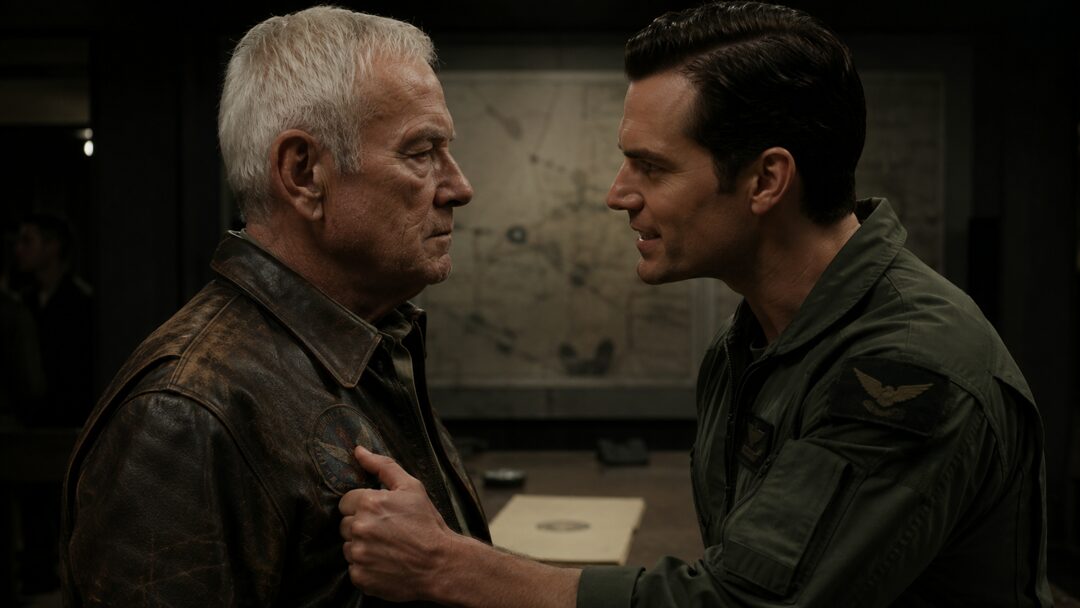
Robert stood beside one of the plane’s huge tires, his hands buried in the pockets of his brown leather flight jacket. The jacket was older than some of the men on the base. Its cuffs were cracked. The collar had darkened from years of rain, sweat, and storage.
On the left side, above his heart, was the patch.
OPERATION DAYBREAK.
The thread had faded from gold to dull yellow. A winged sun. A ring of stars. A motto no one used anymore except at ceremonies.
Michael Grant crossed the tarmac in a green flight suit, dark hair combed back, sunglasses in one hand, confidence in every step.
“Robert Hale,” he called, loud enough that the Marines near the ramp turned to look. “Still making everybody wait.”
Robert did not smile.
Michael did not seem to notice. Or maybe he noticed and chose not to.
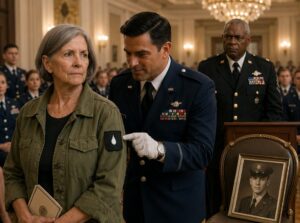
He reached Robert and put one hand flat against the old patch, friendly, familiar, almost boyish.
“You still wear it.”
For a second, Robert felt the pressure of that hand as if it were holding him in place.
Michael’s face had changed since the last time Robert saw him. The boy had sharpened into a man. His jaw was stronger now. His shoulders had learned command. But his eyes still carried the same hunger Robert remembered from years ago at a memorial picnic, when Michael was twelve and asked him the same question three different ways.
What was my father like?
Robert had answered each time with a version of the truth that did not require courage.
“He was brave.”
“He looked after his men.”
“He did what he had to do.”
Michael had grown up on sentences like that. Small, polished stones handed to him by men who could not bear to place the whole mountain in his lap.
Now he stood smiling in front of Robert, wearing rank, trust, and expectation.
Behind him, two young Marines in camouflage laughed near the aircraft ramp. One of them nudged the other and nodded toward Robert like he had spotted a celebrity.
Michael looked back at them, then at Robert.
“They’ve been waiting all morning to meet you,” he said. “Half the squadron joined because of Daybreak. The other half says they did.”
Robert’s mouth tightened.
Michael’s smile softened. “Come on. It’s a simple blessing. Five minutes. You tell them they’re ready, they’ll fly through a wall for me.”
“That’s what worries me,” Robert said.
The smile held, but something behind it paused.
Michael glanced at the old jacket again.
“Long flight in?”
“Long enough.”
“You okay?”
Robert looked past him to the aircraft, to the broad ramp, to the men moving equipment with the ordinary care of people who believed tomorrow was a thing already granted.
“No,” he said. “I need to see the board.”
Michael blinked once.
“The mission board?”
“Yes.”
“We’re wheels-up soon.”
“Then I need to see it now.”
For the first time, Michael’s hand dropped from the patch.
The air between them changed.
Not much. Not enough for the Marines by the ramp to stop laughing. Not enough for anyone else to notice.
But Michael noticed.
He lowered his voice. “Robert, command already signed off.”
“I didn’t ask who signed it.”
Michael studied him. A younger officer might have bristled. Michael only tilted his head and gave a quick, practiced smile.
“All right,” he said. “You always did like ruining a ceremony.”
Robert looked at the patch on his own chest and felt the old thread pull like a hook.
“I came here to stop one.”
Michael did not answer.
The engine behind them grew louder.
Part II — The Mission Board
The briefing room was too small for the aircraft painted on its walls.
Old squadron photos lined one side. A clock ticked above a locked cabinet. A long table sat beneath a screen filled with weather data, route marks, and a clean digital map labeled OPERATION LANTERN.
Robert stopped three steps inside the room.
Michael moved ahead of him with the ease of a man who belonged there. He tapped the screen, expanding the route.
“We’re extracting twelve aid workers, three local interpreters, and two of our own advisors from a temporary site near the coast,” Michael said. “Weather’s ugly, but the window opens just before dusk. We go in low, cut wide, avoid the main ridge, hit the pickup zone, and come out before the system closes.”
Robert said nothing.
Michael glanced back. “That’s the simple version.”
Robert stared at the line on the screen.
A red route. A narrow break in weather. A landing zone pressed between high ground and bad visibility.
His throat went dry.
He had seen that shape before.
Not this country. Not this coastline. Not these names. But the shape was the same. Men loved to rename old mistakes. It made them look newly planned.
Michael watched him closely now.
“What?” he asked.
Robert stepped nearer to the screen. “Who cleared the zone?”
“Recon package came through last night.”
“Last night.”
“Yes.”
“Who verified the weather shift?”
“Two models and on-site observation.”
“Observation from where?”
Michael’s jaw tightened. “Robert.”
“From where?”
Michael tapped another window open. “Offshore. Drone pass. Partial visual.”
Robert looked at him then. “Partial.”
“That’s not unusual.”
“It’s enough to make men feel informed without making them safe.”
Michael gave a short laugh with no humor in it. “You’ve been here ten minutes.”
“I’ve been here before.”
“No, you haven’t. Not this operation.”
Robert pointed at the route. “That route is not a plan. It’s a prayer with coordinates.”
Michael’s eyes hardened.
Outside, through the narrow window, the tarmac glared white.
In the old days, Robert might have softened the line. He might have told a story. He might have let Michael feel respected before telling him he was wrong.
But there was no time for tenderness disguised as manners.
“Delay it,” Robert said. “Change the insertion.”
Michael turned fully now. “We delay, they move the civilians. We change the route, we lose the window. We lose the window, people are trapped overnight with men who don’t care what flag is on a vest.”
“Then wait for better confirmation.”
“There may not be better confirmation.”
“There’s always more confirmation than a dead crew can use.”
The room went still.
Michael took a breath through his nose. When he spoke, his voice was lower.
“You’re here as an honored guest.”
“I know what I’m here as.”
“I asked you to speak to them. Not command them.”
“You asked me to bless a mistake because you thought I’d recognize it as courage.”
Michael’s eyes flashed.
The warmth was gone now. Not shattered yet. Withdrawn.
“You don’t get to walk in from retirement and tell me I’m playing dress-up with lives,” Michael said.
Robert looked at the mission board again. “Then don’t.”
Michael stepped closer. “Those people out there believe in this. They believe because of what you did. Because of Daybreak.”
Robert flinched.
Michael saw it.
That was the first crack.
He softened, just a little. “Sir. I mean that. You gave men a model. A way to go in when no one else would.”
Robert looked at him for a long moment.
“No,” he said. “They gave you a story.”
Michael stared.
A knock came at the door.
Before either man answered, it opened.
A young Marine corporal stepped in with a tablet tucked under his arm. Blond hair. Thin face. Nervous hands trying hard to be still.
“Captain Grant? Updated weather from station control.”
Michael did not look away from Robert. “Put it on the table, Brian.”
Corporal Brian Walker stepped in, sensed the temperature of the room, and stopped moving like a man who had entered a chapel during an argument.
Robert looked at him.
Too young, he thought.
They always were when the story was still clean.
Michael held out his hand for the tablet. Brian gave it to him.
“Thank you,” Michael said. “You can go.”
Brian turned.
Robert said, “Stay.”
Michael’s head snapped toward him.
“Excuse me?”
Robert kept his eyes on the corporal. “Stay.”
Brian froze, one hand near the door handle.
Michael’s voice sharpened. “Corporal, step outside.”
Brian opened the door.
Robert said, “Daybreak didn’t save everyone.”
Michael went still.
The door remained half-open.
Brian did not move.
Michael shut the door himself.
He did it quietly.
Then he faced Robert with an expression that was no longer embarrassed, no longer irritated.
Careful now.
Dangerously careful.
“I know Daybreak didn’t save everyone,” Michael said. “My father died there.”
Robert’s chest hurt.
“Yes,” he said. “He did.”
Michael’s mouth flattened. “Then don’t use him to win an argument.”
Robert’s voice dropped.
“No, Michael. You don’t know how he died.”
The room changed so completely that even the clock seemed louder.
Brian stood by the wall, eyes fixed on the floor, pretending not to breathe.
Michael’s confidence did not break yet.
It gathered itself into something colder.
“What did you say?”
Robert reached inside his jacket.
Michael took one quick step forward.
“What did you say?”
Robert pulled out a flat brown envelope sealed in plastic. It was worn at the corners. The kind of thing carried too long by a man who had practiced not opening it.
Michael looked at the envelope.
Then at Robert.
Then at the patch.
“No,” Michael said.
Robert placed the envelope on the table.
“Yes.”
Part III — The Version They Needed
Michael did not touch the envelope.
For three seconds, he only stared at it.
Then he laughed once, sharply, as if his body had mistaken panic for contempt.
“What is this?”
“A transcript.”
“Of what?”
“The flight recorder.”
Michael shook his head. “Daybreak’s recorder was destroyed.”
“That’s what the report said.”
“The report was classified.”
“Parts of it were.”
Michael’s eyes narrowed. “You kept evidence?”
Robert looked down at the envelope. “Thomas gave it to me.”
The name landed harder than the document.
Michael’s face changed in a way he could not control.
His father’s name still had that power. Robert had seen it before. At ceremonies. In speeches. On the anniversary plaque near the main gate. Thomas Grant, remembered in bronze because flesh had become too difficult.
Michael reached for the envelope, then stopped.
“You’re lying,” he said.
“I wish I were.”
“You’re doing this now? An hour before my people fly?”
“I’m doing it now because your people fly in an hour.”
Michael stepped closer, voice low and sharp. “Tell me what you think you know.”
Robert looked at Brian. The corporal stood rigid against the wall, face pale.
Michael noticed and snapped, “Out.”
Brian grabbed the door handle.
Robert said, “If he leaves, you’ll bury this again.”
Michael turned on him. “You don’t give orders in this room.”
“No,” Robert said. “I gave them in another one. That was enough.”
Silence.
Michael’s throat moved.
Brian remained at the door, waiting for the command that would save him from hearing whatever came next.
Michael’s face tightened with humiliation, anger, and something more frightened than both.
“Stay,” he said.
Brian let go of the handle.
Robert opened the envelope.
Inside was a folded transcript, copied and recopied until the paper had softened at the creases. Robert unfolded it carefully. His hands were steady. That surprised him. They had shaken that morning while tying his boots.
He set the pages on the table between them.
Michael still did not touch them.
“Daybreak was compromised before we lifted,” Robert said. “Command knew the landing zone had changed hands. They knew the weather was closing faster than forecast. They sent us anyway because canceling meant admitting the intelligence package was wrong.”
Michael’s eyes did not leave the paper.
Robert continued. “We were told the threat was light. It wasn’t. We were told visibility would hold. It didn’t. We were told there was still a safe approach. There wasn’t.”
Michael whispered, “My father was killed holding the west perimeter.”
“No.”
The word was plain.
It was also cruel.
Michael’s face hardened like he had been struck and decided to make the blow regret itself.
“No,” he said back.
Robert did not look away.
“Your father was inside the aircraft when we went down.”
Michael’s breath caught.
Brian looked up despite himself.
Robert saw the old room again. Not as memory exactly. More like heat trapped under skin. Red light. Smoke. A voice shouting names. Thomas Grant’s hand on Robert’s harness, yanking him free with a strength that should have belonged to a man who was not already hurt.
“He pulled four men out,” Robert said. “Went back for a fifth.”
Michael’s hands curled.
“The official report says—”
“I know what it says.”
“The official report says he led the advance.”
“The official report gave families something they could repeat at dinner tables.”
Michael’s jaw clenched so hard the muscle jumped.
Robert hated himself for the next sentence before he said it.
“It gave you something to become.”
Michael lunged forward and grabbed Robert’s forearm.
Not to hurt him.
To anchor himself.
The grip was hard enough that Robert felt the old bones in his wrist protest.
Michael’s face was inches from his now. His eyes were wide, furious, wet but refusing tears.
“You let me salute a lie.”
Robert did not pull away.
“I let you survive one.”
Michael’s mouth opened.
Nothing came out.
The room held them there: the young commander gripping the retired pilot, the patch between them, the transcript spread on the table, the corporal watching a legend lose its shape.
Michael released him as if suddenly ashamed of needing contact.
He backed away.
“You had years,” he said.
Robert nodded once.
“Years,” Michael repeated. “Every ceremony. Every letter. Every time my mother asked you to stand with us. Every time I told that story.”
“I know.”
“Don’t say you know.”
Robert took the words without defense.
Michael pointed at the transcript. “Why?”
Robert looked down at the pages.
Because he was a coward.
Because he was tired.
Because the first widow who thanked him for bringing meaning home had broken something in him.
Because Thomas had asked.
Only one answer mattered.
“Your father knew the report would be changed,” Robert said. “Not all of it. Enough.”
Michael’s voice went hollow. “He knew?”
Robert nodded.
“He was bleeding out. He made me promise not to let the men who came home feel like they had survived a mistake. He said families needed something they could carry.”
Michael turned away.
For a moment, he was not a captain, not a commander, not the man whose squadron watched him for certainty.
He was twelve again, maybe younger, hearing that his father had been brave in a way that made absence bearable.
Robert said, “Thomas thought the lie would end with us.”
Michael laughed softly, bitterly.
“It didn’t.”
“No.”
“It became doctrine.”
Robert closed his eyes.
“Yes.”
Part IV — The Hour Moved
The secure phone on the wall rang.
All three men looked at it.
No one moved for the first two rings.
On the third, Michael wiped one hand over his face, crossed the room, and picked up.
“Grant.”
He listened.
Robert watched him become Captain Grant again in pieces. Shoulders back. Voice level. Eyes dry.
“When?”
Another pause.
His face changed.
“Understood.”
He hung up.
Brian straightened as if the word had traveled through him before anyone spoke it.
Michael looked at the mission board.
“They’re moving the civilians earlier,” he said. “Command wants Lantern airborne within the hour.”
Robert’s gaze cut to the screen.
Michael tapped in the update. New timing flashed. The weather window narrowed. The route shifted only slightly, enough to make it worse while still allowing someone far away to call it acceptable.
Robert felt the past lean forward.
Michael saw it too now.
That was the terrible thing. Once truth entered the room, the map no longer looked brave. It looked familiar.
Brian swallowed. “Sir?”
Michael did not answer him.
The superior voice from the phone had left its pressure behind. The trapped civilians. The waiting squadron. The commanders watching from clean rooms. The men outside believing they were about to follow a legendary pattern.
Michael stared at the board as if he could force it to become innocent again.
Robert said, “That’s Daybreak.”
Michael snapped, “I can see it.”
The anger in his voice was not denial anymore.
It was terror with rank on top.
Brian’s eyes moved between them.
Michael pointed at the alternate route. “If we delay to the wider window, we lose daylight.”
“But you gain visibility.”
“If we take the outer approach, we add time.”
“You reduce exposure.”
“If we wait for full confirmation, we may lose the hostages.”
Robert’s voice stayed even. “If you don’t, you may lose everybody and give the next generation a better slogan.”
Michael flinched.
Brian looked down.
The room had no mercy left in it.
Michael turned on Robert. “So what do you want me to do? Cancel? Stand in front of my people and tell them the mission they trained for is built on a lie from before some of them were born?”
“No.”
“Then what?”
“Command.”
Michael stared at him.
Robert’s voice hardened. “Not perform. Not inherit. Command.”
The word struck where nothing else had.
Michael looked back to the map.
He had spent his life studying Daybreak because Daybreak had given him his father in usable form. A brave man. A clean death. A mission worth repeating. A shape to step into.
Now the shape had teeth.
His watch beeped once.
A reminder. Wheels-up timeline.
Michael silenced it.
Then he looked at Brian.
“Corporal.”
“Yes, sir.”
“You heard what you heard.”
Brian went stiff. “Sir, I didn’t—”
“Don’t lie to make this easier.”
Brian shut his mouth.
Michael took a breath. “You are not to repeat details of this conversation unless ordered through proper channels. But you are also not going to pretend truth belongs only to officers.”
Brian’s face changed, just slightly.
Robert saw it.
The boy had been given a burden and treated like a man in the same moment.
Michael turned back to Robert. “Did my father know what they were going to make of him?”
Robert’s chest tightened.
“He knew they would need a version.”
“That’s not what I asked.”
Robert held his gaze.
“No. He didn’t know they’d build a schoolhouse out of it.”
Michael looked at the transcript.
“He asked you to protect them.”
“Yes.”
“And you did.”
Robert said nothing.
Michael’s voice dropped. “You protected them until protecting them became protecting yourself.”
Robert did not move.
The words entered cleanly. They found the place waiting for them.
“Yes,” he said.
Michael looked almost disappointed that Robert did not fight back.
The room seemed smaller now, but not because of the walls.
Because the boy who had once asked what his father was like had finally asked the question under it.
What am I supposed to do with what you gave me?
Michael folded the transcript once, then again. He did not put it back in the envelope.
“Come with me,” he said.
Robert looked up.
Michael was already moving toward the door.
Brian stepped aside.
Michael stopped with his hand on the knob and looked back at the patch on Robert’s jacket.
This time, he did not touch it.
“Bring that too.”
Part V — The Warning
The squadron briefing room was full when Michael entered.
Men and women stood near tables, screens, gear bags, helmets. The air smelled of coffee, plastic, sweat, and the false calm that came before departure.
Conversations stopped when they saw Robert.
Some smiled. One young officer straightened. Someone near the back whispered his name.
Robert Hale.
Daybreak.
The old patch had arrived before he had.
Michael walked to the front without the easy grin he had worn outside. Robert followed two steps behind. Brian stayed near the side wall, visible but silent.
On the main screen, Operation Lantern waited in clean lines and official colors.
Michael faced his people.
For one heartbeat, Robert thought he might still give the ceremony. The version. The speech command expected. The one that would cost nothing immediately and everything later.
Michael set the folded transcript on the table.
No one knew what it was.
That made it heavier.
“Lantern has changed,” Michael said.
The room stiffened.
A major near the first row frowned. “Changed how?”
“We are delaying insertion to the wider visibility window. We are taking the outer approach. We wait for full confirmation before committing to the pickup zone.”
Murmurs rose.
The major stepped forward. “That costs us time.”
“Yes.”
“The civilians may be moved.”
“Yes.”
“You cleared the original plan.”
Michael looked at the screen. “I cleared what I thought I understood.”
The room went quiet again.
Robert watched faces shift. Confusion first. Then worry. Then the more dangerous thing: doubt searching for someone to blame.
Michael did not rush to soothe them.
He let command be uncomfortable.
A secure call came through on the room system before anyone else could speak.
The operations coordinator glanced at Michael. “Sir, regional command.”
Michael nodded.
The voice that filled the room was clipped and distant.
“Captain Grant, we show deviation from approved Lantern timeline. Confirm.”
Michael looked at his people, then at Robert.
“Confirmed.”
“Reason?”
“Updated risk assessment.”
“Captain, you are authorized and expected to proceed under original timing.”
Robert saw Michael’s fingers flex once at his side.
“The original timing is built on incomplete confirmation.”
“All rescue elements carry uncertainty.”
“Not this kind.”
A pause.
The voice cooled. “Captain, are you refusing mission authorization?”
“No,” Michael said. “I am refusing the version that makes failure look brave before it happens.”
The room held its breath.
Robert felt Brian look at him.
The voice on the speaker said, “Explain yourself.”
Michael’s eyes moved to the old patch.
He could have exposed everything. Named the report. Named the lie. Named Robert in front of them all and dropped thirty years of buried weight into a room already carrying the next hour.
He did not.
He chose the harder shape.
“Daybreak is not doctrine,” Michael said. “It is a warning.”
No one spoke.
Robert stepped forward.
Not because Michael had asked.
Because the moment had come, and if he let the younger man carry all of it, the lie would simply change shoulders.
Robert unzipped the old leather jacket.
His hands found the stitching around the patch. It had been loosened that morning with a pocketknife in his hotel room. He had told himself he might not use it.
Now he pulled.
The first threads gave with a small, ugly sound.
Every eye in the room moved to his chest.
He pulled again. The patch came free into his palm.
The jacket looked naked without it.
So did he.
Robert placed the faded Daybreak patch on the briefing table beside Michael’s folded transcript.
A symbol and its receipt.
He did not make a speech.
His voice, when it came, was rough but steady.
“Use the parts that kept men alive,” he said. “Bury the parts that only made us feel better.”
A woman near the front looked down.
The major who had challenged Michael said nothing.
On the speaker, regional command demanded, “Who is speaking?”
Michael reached over and muted the line.
Then he turned to his squadron.
“We go under revised plan,” he said. “Anyone who needs to question it can do that now.”
No one moved.
Not because they all agreed.
Robert knew better.
They were measuring the cost of disagreeing. They were measuring Michael. They were measuring the old man without the patch.
Finally, Brian stepped away from the wall.
Only one step.
But in a room that still, it sounded like a statement.
The major looked at him, then back at Michael.
“Outer approach increases fuel risk,” he said.
Michael nodded. “Then we plan for it.”
“Delay increases uncertainty.”
“Yes.”
The major held his gaze. “But visibility improves.”
“Yes.”
Another officer exhaled. Someone opened a laptop. A chair scraped. The room began moving again, not with the clean confidence of myth, but with the tense discipline of people who understood that uncertainty had not been defeated.
It had only been named.
Michael picked up the patch.
For a second, Robert thought he would hand it back.
Instead Michael turned it over once in his palm, then set it down again.
“Let’s work,” he said.
Part VI — What Remained
The revised mission left later than the first plan demanded.
That delay cost them.
The first extraction window closed before they reached the outer approach. The civilians were moved from the original site. For twenty-three minutes, the room lost contact with one of the ground teams. A medic cursed under her breath. Brian stood by the communications table with his hands locked behind him, jaw tight, eyes older than they had been that morning.
Robert stayed in the back.
No one asked him to leave.
No one asked him to speak.
That was better.
Michael commanded from the center of the room with a restraint that hurt to watch. He did not perform certainty. He made choices. He took reports. He absorbed consequences without spreading them around.
Twice, the original route would have been faster.
Twice, updated visuals showed movement along that route that made the room go silent.
The second time, Michael looked at Robert.
Only once.
Not for approval.
For recognition.
Robert gave him nothing but the truth of his face.
You saw it.
You changed it.
Now live with both.
Near midnight, the first aircraft returned.
Not all at once. Not cleanly. Not with the kind of timing that made good speeches easy.
But they came.
A mechanic clapped once when the first group stepped off the ramp, then stopped as if joy required permission. A woman wrapped in a gray blanket kissed the tarmac. A young interpreter carried a child’s backpack though no child had come with them. Two Marines helped a limping advisor toward the medical bay.
Most came home.
Not all.
The missing name stayed in the room longer than the rescued ones.
Michael stood near the hangar doors as reports came in. His face did not change when they confirmed who had not made the second move. He thanked the team. He signed what needed signing. He sent three people to call families and told them not to use phrases that made uncertainty sound noble.
Robert heard that and looked away.
Near dawn, the airfield cooled.
The transport plane sat where it had sat the day before, huge and gray and quiet, its tire black against the pale concrete.
Robert stood beside it in his leather jacket.
Without the patch, the left side looked wrong. A darker oval remained where the leather had not faded evenly. Proof of something removed too late.
He heard footsteps behind him and knew who it was before Michael spoke.
“You leaving?”
Robert kept his eyes on the horizon. “Soon.”
Michael came to stand beside him, not close enough to touch.
The sun had not fully risen. The world was gray-blue at the edges. Men moved in the distance with the slow exhaustion of people who had survived the night and were not yet ready to discuss what it meant.
Michael held the Daybreak patch in his right hand.
Robert saw it but said nothing.
For a while, neither man spoke.
Then Michael said, “My mother has that speech you gave at his memorial.”
Robert closed his eyes briefly.
“She kept it in a drawer with his watch,” Michael said. “I used to read it when I wanted to remember him.”
Robert’s voice was low. “He deserved better than my speech.”
Michael looked at him. “He deserved the truth.”
“Yes.”
“He also deserved for his son to have something.”
Robert turned then.
Michael’s face was tired in a way age could not explain. The anger was still there. So was grief. But it no longer looked like a fire trying to burn the whole room down.
It looked like something he would have to carry carefully.
“I don’t forgive you,” Michael said.
Robert nodded.
“I know.”
“I don’t know if I ever will.”
“I know that too.”
Michael looked down at the patch.
The thread caught the first light of morning and showed its old gold for a second.
Then the color dulled again.
“I don’t know what to do with this,” Michael said.
Robert looked at the faded winged sun in Michael’s palm.
“Neither did I.”
Michael’s fingers closed around it, not hard, not soft.
Behind them, the base began to wake into another day. Engines turned. Boots crossed concrete. Somewhere a voice called for a checklist. The world did what it always did after truth: continued, without making continuation feel clean.
Michael did not put a hand on Robert’s jacket this time.
He did not call him sir.
He did not ask for another story.
He only stood beside him as the sun came up over the airfield, holding the patch like a question no one had answered well enough.
Then he folded it once into his palm and walked back toward his people.