What the Room Remembered
Part I — The Refusal
“Sir, I said no more alcohol.”
Emily kept her voice low enough not to embarrass him and firm enough not to invite debate.
That was the balance the banquet demanded from her. Smile, but not too much. Serve, but do not hover. Notice everything, but pretend not to notice anything. Especially not the way Charles had been gripping his glass for the last half hour, lifting it before she even reached the table, as if the whole room existed to refill his hand.
He sat beneath the framed commendations on the north wall, in the best chair at the best table, with a gold pin on his lapel and a smile that had gone shiny at the edges. Around him, retired officers, donors, spouses, and club board members laughed too loudly at jokes that were no longer funny.
The private dining room had been arranged to look dignified: white linen, brass lamps, polished wood, crystal water glasses, folded programs with the name of the veterans’ rehabilitation fund embossed on the cover.
Honor was everywhere.
So was silence.
Charles looked up at Emily, his cheeks flushed, his dark suit perfect except for the bourbon he had already spilled near one cuff.
“You’re new,” he said.
“No, sir.”
“Then you know who I am.”
Emily held the empty bottle at her side. “I know this is your table. I also know you’ve had enough.”
The man to Charles’s left looked down at his plate. A woman across from him adjusted the pearl bracelet on her wrist. Someone gave a small, nervous laugh, then swallowed it when no one else joined.
Emily felt the room listening.
She had been trained to hear what people tried to hide. Breathing changes. Forks going still. Chairs shifting half an inch away from trouble.
In another life, she had listened for pain through dust and shouting. Here, under warm lights and portraits of men in uniform, she listened to rich people decide how much truth was convenient.
Charles’s smile thinned.
“You don’t tell me no.”
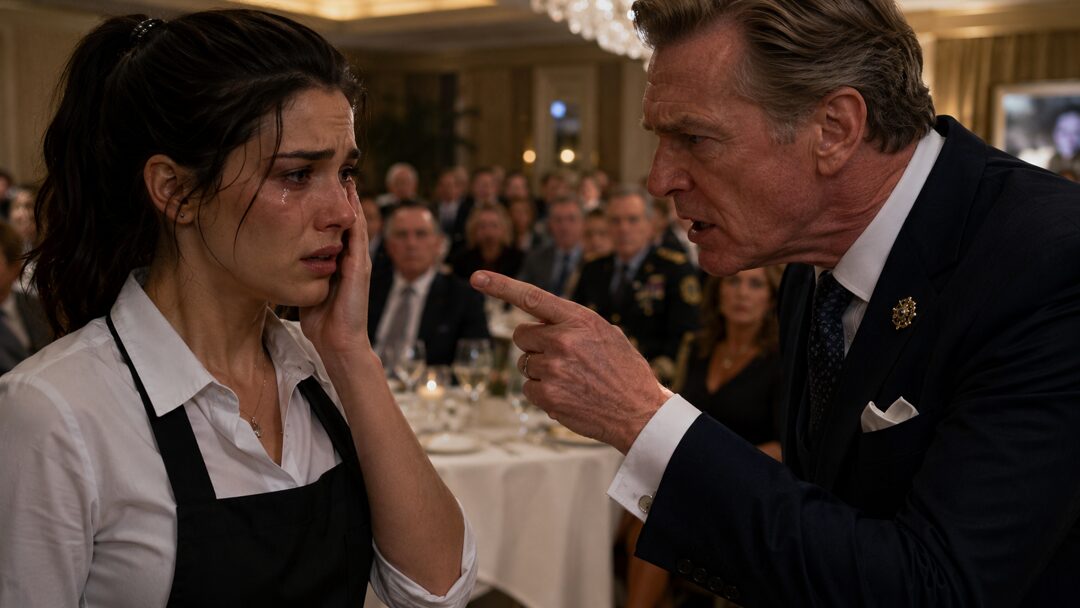
His hand moved so fast that Emily did not process it as danger until the sound had already cracked across the room.
The slap turned her face sideways. Her hip hit the edge of the service cart. A white plate slid, struck the floor, and broke in three clean pieces. Wine spread under her knee in a dark, widening shine.
For half a second, the room had no language.
Then Charles found his.
“She attacked me first.”
Emily was on one knee, one hand braced against the polished floor, the other pressed to her cheek. Heat bloomed under her palm. Her eyes watered before she wanted them to. Not because of the sting. She had known worse pain.
It was the way everyone looked at her.
Not like she was hurt.
Like she had become a problem.
Charles pushed back from the table, breathing hard, his chair legs scraping the wood.
“She came at me,” he said louder. “You all saw it.”
No one answered.
Emily looked at the broken plate. She looked at the wine on the floor. She looked at the ring of faces around her, each one arranging itself into caution.
A man with silver hair opened his mouth.
Charles turned his head toward him.
The man closed it.
Emily had seen bleeding men with more courage.
The banquet manager, a thin man named Andrew with a headset tucked under his collar, hurried across the room.
“Emily,” he whispered, bending toward her without quite touching her. “Let’s get you to the back.”
She stared at him. “He hit me.”
Andrew’s eyes flicked toward Charles, then toward the club president near the podium.
“I know,” he said, too softly to be useful. “But we need to keep this contained.”
Contained.
That was the word people used when they wanted the person on the floor to make the least noise.
Charles straightened his jacket. “I want her removed.”
Emily slowly stood. The room tilted for a second. She gripped the cart handle until the brass edge bit into her palm.
Andrew moved between her and the table, smiling at everyone as if a glass had tipped, as if nothing human had happened.
“Of course,” he said. “We’re handling it.”
Emily tasted copper where she had bitten the inside of her cheek.
“Handling me?” she asked.
Andrew did not answer.
Charles did. “You should be grateful I’m not pressing the issue.”
The words landed worse than the slap.
Because the room let them.
Part II — The Quiet That Chose Sides
Emily had worn the white collared shirt because Andrew said it made the staff look “clean and respectful.”
Now the collar felt too tight.
She could feel the red shape of Charles’s hand rising on her cheek. She could feel every eye pretending not to look at it. Her ponytail had loosened, strands of dark hair sticking to the damp corner of her mouth.
Andrew leaned closer. “Please. Just step into the kitchen.”
Charles lifted both hands in a show of exhausted patience. “See? She’s still being difficult.”
That got a few people to move.
Not toward Emily.
Toward their glasses.
A woman at table three whispered, “This is terrible,” but did not stand. A man who had spent the first course speaking about courage studied his dessert spoon as if it contained orders.
Charles was not the largest man in the room, but he had the largest permission.
He funded half the banners hanging near the entrance. His company logo was printed on the evening program. His name had been spoken from the podium twice before dinner, first with gratitude, then with applause.
Emily had listened from the service station with a tray under one arm, her face neutral.
Charles Whitman, decorated officer. Charles Whitman, benefactor. Charles Whitman, advocate for those who served.
She had wondered then if men like him ever got tired of being thanked for the version of themselves they sold.
Now he pointed at her again.
“I want her gone before the keynote.”
Emily turned toward the club president, a broad man named Daniel who stood near the microphone, one hand still resting on the podium. He looked older than he had ten minutes ago.
“Sir,” Emily said, “you saw what happened.”
Daniel’s mouth tightened.
That was all.
She understood then.
The slap had happened in public, but the decision would be private. It would pass from eyebrow to whisper to closed office to carefully worded report. By tomorrow, she would be emotional. Confused. Maybe aggressive. Definitely unfortunate.
The old machinery had already started.
Emily had once watched a commander write the wrong sentence into the first report and felt the truth shrink around it.
Her father had refused to sign that sentence.
Her father had come home with his name intact and his career gone.
She had spent years angry at him for the wreckage that followed. Angry at his silence. Angry at the way he filled their small house with discipline but not explanations. Angry that he loved her like a man guarding a door no one else could see.
Now, in a dining room full of polished shoes and framed bravery, Emily felt the same door closing.
Andrew touched her elbow.
She pulled away.
“Don’t.”
His hand dropped.
Charles laughed once. “There it is.”
Emily’s throat tightened. She wanted to speak with the calm she had used at the table. She wanted to make the sentence clean. He hit me because I said no. He lied because he knew you would let him.
But her body betrayed her. Her cheek throbbed. Her hands shook. Tears slipped out before she could stop them, and she hated that more than anything.
Charles saw them.
His face softened into something almost satisfied.
“Maybe next time,” he said, “you’ll remember where you are.”
The room’s main doors opened behind him.
A cold draft crossed the floor.
Not much. Just enough to stir the paper programs on the nearest table.
Emily did not turn right away. She saw the shift first in everyone else.
Eyes lifted.
Shoulders tightened.
Conversation died completely, not all at once but like lights going out down a hall.
Then she heard the faint metal sound of a working harness.
Ranger entered before Robert did.
The Belgian Malinois was older now, his muzzle gray, one ear scarred, his back leg stiff from weather and age. But his head was high. His eyes moved across the room with a focus that made people remember they were animals too.
Robert followed him in a worn brown field jacket, close-cropped gray hair, weathered face, and the careful limp he tried to hide when Emily was watching.
He had come to pick her up after her shift.
He stopped three steps inside the room.
He saw the broken plate first.
Then the spilled wine.
Then Emily.
His face did not change quickly. That was what made it worse.
A loud man would have been easier. A shouting father would have given the room something to condemn.
Robert went still.
Ranger’s body tightened beside him.
Emily’s chest hurt.
No.
Not here.
Not him.
Robert’s eyes moved from her cheek to Charles, then to Andrew, then across every silent table.
He did not ask what happened.
He did not ask anyone who had already failed her.
He looked only at Emily.
“Emily,” he said.
His voice carried without effort.
“Who touched you?”
The question broke something in her.
Not because it was loud.
Because it made her real again.
Emily pressed her hand harder to her cheek. She had been a medic. A server. A problem. An accusation. A thing to be contained.
Then her father said her name, and she was his daughter.
“Dad,” she whispered.
Robert stepped forward.
Ranger moved with him.
Charles’s smile faltered for the first time.
Part III — Old Names
“Back off,” Robert said.
The words were quiet, but every table heard them.
Charles recovered quickly. Men like him always did when they recognized an audience.
“This isn’t your concern,” he said.
Robert did not look away from him. “She’s my daughter.”
A small, foolish sound moved through the room. Not surprise exactly. Calculation.
The story had changed shape. A staff problem had become a family matter. A family matter could be moved outside. Outside could be managed.
Charles looked from Emily to Robert, and something sharpened in his eyes.
Recognition.
Then pleasure.
“Well,” Charles said. “Robert Hayes.”
Emily felt her stomach drop.
Robert’s hand tightened once on Ranger’s harness, then relaxed.
Charles leaned back against the edge of his table as if this were suddenly an old social call. “I thought you’d stopped coming around rooms with standards.”
A few people looked confused. Others did not.
The ones who understood looked down faster.
Emily watched her father’s profile. The scar near his jaw. The gray in his hair. The mouth that had never been good at defending itself.
Robert had told her very little about the extraction. Only fragments, usually when exhaustion weakened him.
A bad road. A missing hour. A report that made failure look clean. Names arranged so the right men stayed useful and the wrong men carried the weight.
Charles had been there.
Emily knew that now before anyone said it.
Charles tapped the rim of his empty glass. “Still dramatic, I see. Still bringing the dog to make up for what your record can’t.”
Ranger’s lips lifted.
A low growl moved through him, deep enough that the crystal on the table seemed to feel it.
Robert gave one small command. “Easy.”
Ranger stopped.
Instantly.
That silence hit the room harder than the growl.
Charles noticed it too. His jaw moved.
Robert took another step, not toward Charles but toward Emily. He positioned himself close enough to reach her, not close enough to block her from view.
That small choice almost undid her.
He had always stood in front of her when she was young. In doorways. At school meetings. Beside hospital beds when her mother was dying. He believed love meant becoming a wall.
But walls cast shadows.
Tonight, he stood beside her.
“Emily,” he said again, softer now. “Did he hit you?”
Charles laughed sharply. “Careful, Robert. You’ve always had trouble with statements.”
Emily turned her head enough to look at Charles.
There it was.
Not drunkenness. Not loss of control.
Habit.
He had lied so quickly because the path was familiar. Hurt first. Speak first. Make the person on the ground defend themselves from the floor.
Emily lowered her hand from her cheek.
The air stung against the swelling.
“Yes,” she said.
The word was small.
It did not feel small.
Charles spread his hands. “This is absurd. She lunged at me. Ask anyone.”
No one spoke.
Robert looked around the room.
Not angry.
Worse.
Disappointed in a way that made men shift in their chairs.
“You heard him,” Robert said. “He says you saw.”
Still nothing.
Emily’s heart beat hard in her throat.
Her father’s history stood in the room with them. Every person who had heard the old version. Every person who had repeated it because it was easier. Every person who had never asked why the K9 handler with the cleanest record in his unit vanished from official dinners and medal ceremonies.
Charles smiled again, but it had lost some polish.
“Don’t start a scene,” he said.
Robert looked at the broken plate. “He already did.”
Andrew stepped forward, sweating now. “Mr. Hayes, maybe we can all take a breath. Emily, why don’t you come with me and we’ll document—”
“No,” Emily said.
Andrew blinked.
Her own voice surprised her. So did the steadiness in it.
“No,” she repeated. “Not in the back.”
The word returned to the room like it belonged there.
Charles’s face hardened.
Robert’s eyes stayed on Emily. For the first time that night, he waited for her.
She understood what that cost him.
Charles pointed at Ranger. “This is intimidation.”
Robert said nothing.
Charles looked at Daniel near the podium. “Are you going to let this man bring an animal into a formal event and threaten a guest?”
Daniel cleared his throat. “Robert. Perhaps it would be best if—”
“If what?” Emily asked.
The president looked at her then. Really looked.
Her cheek. Her shaking hand. Her white shirt stained at the cuff where wine had splashed. The broken plate still at her feet because no one had thought to clean it up.
His gaze slid away.
That was when Emily knew she had to say it before the room swallowed it again.
“He hit me because I refused to serve him more alcohol.”
The words went out clean.
No tremor.
No apology.
Just the truth standing where she had been told to disappear.
Part IV — What People Let Happen
The first witness was not brave.
He was tired.
That was what Emily thought later. Not brave. Not heroic. Just too tired of pretending.
He sat two tables away, a retired colonel with a napkin folded neatly beside his plate and one hand curled around his water glass. He had been looking at nothing since the slap.
Now he lifted his head.
“That’s what happened,” he said.
Charles turned on him. “Excuse me?”
The colonel swallowed. “She told you no more. You struck her.”
The room changed.
Not enough to become safe.
Enough to become unstable.
Charles stared as if he had discovered a chair could speak. “You must be mistaken.”
“I’m not.”
A woman near the aisle put one hand over her mouth. Another man muttered something to his wife. Andrew’s headset crackled softly, an absurd little sound in the quiet.
Emily felt Robert beside her, still as a post.
Ranger stood at his knee, eyes locked on Charles.
Charles looked around, searching for the old shape of the room, the one where his version arrived first and everyone made space for it.
It was not entirely gone.
But it had cracked.
Daniel stepped away from the podium. “Let’s not escalate this further.”
Robert looked at him. “Further than what?”
The question landed with no raised voice.
Daniel’s face reddened. “This is a private club event. We have procedures.”
Charles seized on that. “Exactly. Procedure. Not some personal vendetta from a disgraced handler and his dog.”
There it was.
The old word, dressed differently.
Disgraced.
Emily felt it hit her father. Not visibly. Robert did not flinch. But she knew the tension that entered his shoulder, the fraction of space between breath and response.
She had seen that word follow him into grocery stores, reunion invitations, hospital fundraisers, job interviews that ended politely and went nowhere.
She had once hated him for not fighting it harder.
Now she understood something worse.
He had been fighting it every day by not becoming what it said.
Charles stepped closer.
“Tell them, Robert. Tell them how you always need someone else to blame. Then. Now. Always.”
Ranger growled again.
Robert’s hand moved once.
“Down.”
Ranger lowered his chest slightly but did not take his eyes off Charles.
A murmur moved through the room.
Not fear this time.
Recognition.
Emily saw it happen. The difference between a man who threatened and a man who commanded himself first.
Charles saw it too, and hated it.
“Still hiding behind a dog?” he said.
Robert’s jaw tightened.
Emily turned toward him, just enough that only he could see her face fully.
Don’t.
She did not say it.
She did not have to.
Robert looked at her cheek, then her eyes.
Something passed between them that had taken years to learn.
When Emily was sixteen, she had shouted that his silence had ruined their family.
When she was twenty-two, leaving for deployment, she had told him not to wait up like she was still a child.
When she came home, unable to sleep through fireworks or crowded rooms, he had sat outside her bedroom door with Ranger beside him and never once asked her to explain what she could not say.
Love had not made them gentle.
It had made them stubborn in the same direction.
Robert turned back to Charles.
“You want me angry,” he said.
Charles snorted. “I want you removed.”
“No,” Robert said. “You want me angry because angry men are easier to write up.”
The room went still again, but differently now.
Charles’s face lost color beneath the flush.
Emily felt the past enter the present like a door opening.
Robert did not explain the extraction. He did not say names. He did not defend his record.
He only said, “You used the first report then too.”
Charles’s mouth tightened. “Watch yourself.”
“Why?” Robert asked. “Are you going to say I attacked you first?”
A few people inhaled sharply.
Daniel looked at Charles.
For the first time, truly looked.
Charles forced a laugh, but it cracked at the end. “This is pathetic.”
Emily stepped forward before Robert could.
Not behind him.
Beside him.
“He hit me,” she said again. “I want an incident report.”
Andrew looked trapped. “Emily—”
“Now.”
Her voice did not rise.
That made it harder to dismiss.
Charles pointed at her. “You think anyone here is going to ruin this evening over a waitress?”
Robert moved half a step.
Emily touched his sleeve.
It was not much. Two fingers against worn canvas.
He stopped.
That was the moment Charles should have been afraid.
Not when the dog growled.
Not when Robert entered.
When Robert stopped.
Because Emily asked him to.
Part V — The Line No One Could Carry
Charles tried to leave before the room fully turned.
He grabbed his jacket from the back of his chair, knocking a folded program to the floor. His polished shoe stepped into the edge of the spilled wine. For the first time all night, he looked ordinary.
“I won’t be treated like this,” he said. “Not after everything I’ve done for this place.”
Daniel moved toward him. “Charles, let’s take a moment in my office.”
Emily almost laughed.
There it was again. The soft room. The closed door. The place where statements became summaries.
Robert spoke before she could.
“He made it public when he put her on the floor.”
Daniel stopped.
The sentence did not leave room for politeness.
Charles turned back. His eyes were bright now, mean with panic. “She is manipulating this. Both of them are. This is what he does.”
He gestured toward Robert.
“A quiet act, a wounded face, a loyal animal, and suddenly the whole room is supposed to forget who has actually served it.”
Emily felt the words trying to rearrange things. He was good. Even cornered, he could build a hallway out of smoke.
But fewer people were willing to walk down it now.
The retired colonel pushed back his chair and stood.
“I’ll provide a statement,” he said.
Another voice followed, female, from the table near the wall. “So will I.”
Andrew’s mouth opened.
Emily looked at him.
Not pleading.
Waiting.
He swallowed. “I’ll get the form.”
Charles stared at him. “You work here.”
Andrew’s face was pale. “Yes, sir.”
“And you know who pays for nights like this.”
Andrew’s eyes flicked to Emily’s cheek, then away, then back.
“Yes,” he said. “I do.”
It was not a speech.
It was not enough to erase his first instinct.
But it was something.
Charles stepped toward Emily.
Just one step.
A step meant to make her body remember the floor.
Ranger moved before Robert spoke.
The dog lunged to the end of the harness with a sharp bark that cracked through the room. Chairs scraped back. Glasses jumped. Charles froze, his hand half-raised, his face suddenly stripped of performance.
Robert held the harness.
Ranger did not reach him.
He was all force and no contact.
Controlled fury.
A warning with a boundary.
Robert’s voice cut through the ringing silence.
“Back off.”
Charles’s chest rose and fell. His eyes darted from Ranger’s teeth to Robert’s hand to Emily standing beside him.
The old arrogance tried to climb back into his face and failed halfway.
“This isn’t your business,” he snapped.
Robert looked at Emily’s red cheek.
Then at the broken plate.
Then at the room that had waited for permission to tell the truth.
When he spoke, his voice was low enough to make people lean toward it.
“It is now.”
No one moved.
Not even Charles.
The line did not sound like a threat. That was why it held.
It sounded like a door closing behind a lie.
Charles looked around once more, searching for rescue.
The club president did not offer it.
The donors did not smile.
The colonel remained standing.
Andrew returned with a clipboard, and his hand shook as he held it out to Emily.
She took it.
Charles laughed once, but there was no shape to it. “This is ridiculous.”
A security attendant appeared near the doorway, uncertain until Daniel nodded.
“Charles,” Daniel said, voice heavy, “you should go.”
Charles stared at him as if betrayal had finally become real only when it happened to him.
“You’ll regret this,” he said.
Nobody answered.
That was the first silence of the night that did not belong to him.
He walked out past Robert, past Ranger, past Emily.
Ranger watched him go without another sound.
At the door, Charles looked back once.
His eyes met Emily’s.
There was fear in them now.
Not enough to make him sorry.
Enough to prove he understood the room no longer belonged to his version.
Then he was gone.
Part VI — What Stayed
Afterward, people tried to become kind.
That was almost harder.
A woman offered Emily a napkin as if the redness on her cheek could be folded away. Someone said, “I’m so sorry,” with the same voice people used at receptions and memorial services. Daniel asked if she wanted to sit down.
Emily said no.
She stood in the dining room with the clipboard against her palm and wrote what happened.
Her handwriting was uneven at first. Then it steadied.
Robert waited beside her, one hand resting on Ranger’s harness.
He did not tell her what to write.
He did not correct the order.
He did not say, Make sure you include this.
He just stayed.
That was harder for him than speaking. Emily knew that. His whole body was built to intervene, to step in, to take impact. Tonight, he let her hand move across the page while his own remained still.
Andrew stood nearby, silent and ashamed.
When Emily finished, she signed her name.
Not server.
Not daughter.
Not problem.
Emily Hayes.
The retired colonel signed beneath his witness statement. Then the woman from the wall table. Then another guest who had not spoken but had seen enough. Each signature landed quietly, but Emily felt them.
Not as rescue.
As weight added to the truth until it could not be carried away.
Daniel accepted the clipboard with both hands.
“I’ll make sure this is handled properly,” he said.
Emily looked at him for a long second.
“Properly started,” she said.
His face changed.
He nodded once. “Properly started.”
That was all she could ask of the room.
Not healing. Not fairness in full. Not the repair of every old report or every closed office where power had learned to speak first.
Only this: the first sentence would be true.
She went to the kitchen long enough to get her coat.
No one followed.
In the narrow staff hallway, she leaned against the wall and let one breath break. Just one. Her cheek pulsed. Her knees felt hollow. She stared at the tile floor until the tears stopped threatening to become sound.
Then Ranger’s nails clicked softly behind her.
Robert stood at the hallway entrance but did not come closer.
“Ready?” he asked.
Emily wiped under one eye with the heel of her hand. “No.”
A faint sadness moved through his face.
Then she said, “But I’m coming.”
Outside, the night air was cold and clean. The club’s front steps overlooked a gravel drive, a row of trimmed hedges, and the bronze plaque by the entrance with names carved into it under words like service and sacrifice.
The building glowed behind them.
It looked noble from a distance.
Ranger lowered himself carefully onto the top step with an old dog’s sigh. Emily crouched beside him and ran her fingers over the gray around his muzzle.
“You scared him,” she whispered.
Ranger leaned into her palm.
Robert stood a step below, not quite facing her, his hand in the pocket of his field jacket.
Emily looked at him. At the limp he pretended was nothing. At the jacket he wore because it was warm, not because it proved anything. At the man she had blamed for being too quiet, and feared for being too angry, and loved in ways that had never been simple.
“You came in like you used to,” she said.
Robert looked toward the dark parking lot.
For a moment she thought he would give one of his old answers. Something clipped. Something practical. Let’s get you home. Put ice on that.
Instead he said, “No.”
His voice was rough.
“This time I stopped.”
Emily’s hand stilled on Ranger’s head.
The words opened something in her that did not feel like forgiveness exactly. Not the clean kind people liked in stories. Not the kind that erased years.
Something smaller.
Stronger.
A place to stand.
She rose and stepped down beside him.
For a while, neither of them moved toward the truck.
Behind them, the banquet continued in a quieter room, under framed commendations and careful lights. Forms would be filed. Calls would be made. Some people would tell themselves they had done the right thing as soon as they understood what it was.
Emily could still feel Charles’s hand on her cheek.
She could also feel the pen in her own.
Robert opened the passenger door for her, then paused as Ranger climbed stiffly into the back.
Emily looked at her father across the open door.
“Dad.”
He turned.
She did not say thank you.
Not because she wasn’t grateful.
Because the bigger truth did not fit inside it.
So she reached out and touched the sleeve of his field jacket, the same place she had touched him inside when he had almost stepped too far.
Robert looked down at her hand.
Then he covered it once with his own.
The gesture lasted only a second.
But it held.
Then Emily got into the truck, Ranger settled behind her, and Robert closed the door gently, as if gentleness were also something he had chosen.