The Line She Kept
Part I — The Black Case
Captain Michael Harris stepped into Sarah Mitchell’s sunlight and told her to move like the whole airfield belonged to his shadow.
Sarah did not look up.
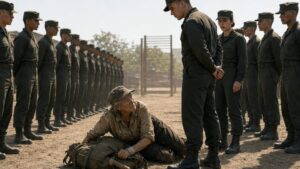
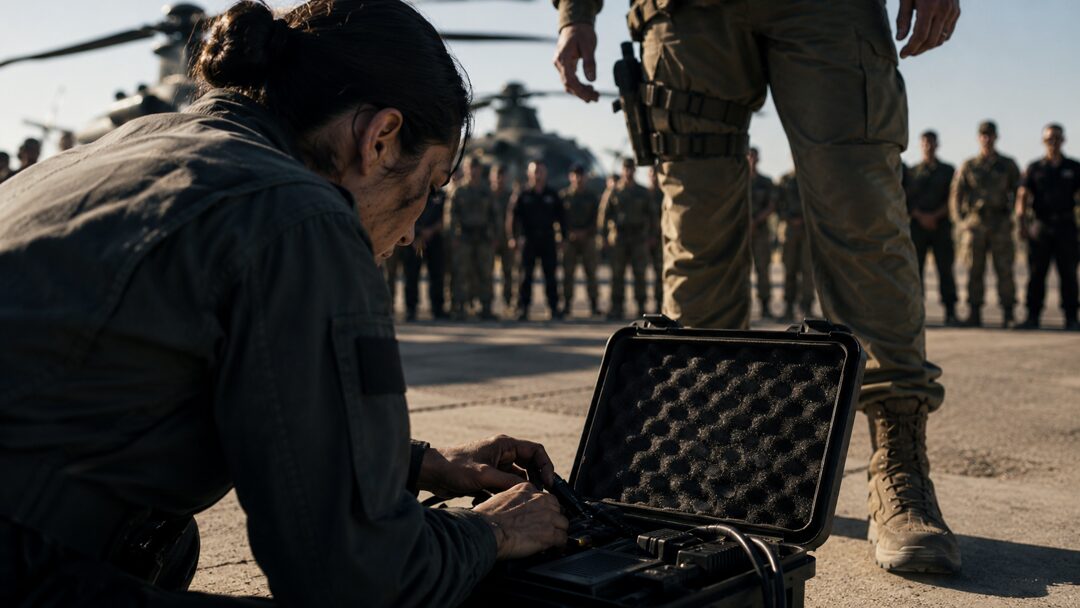
Her hands stayed buried inside the open black relay case on the tarmac, fingers working between clipped wires and heat-softened connectors while the helicopter behind her beat dust against her neck. A row of soldiers stood twenty yards away in rigid formation, eyes forward, pretending not to watch.
Everyone was watching.
“Move now, Sergeant,” Harris snapped. “You’re in my way.”
Sarah tightened a copper contact with the edge of her thumb. Grease had collected under her nails. Sweat ran down the side of her face. The relay indicator flickered once, weak and amber, then died again.
“Interrupt this,” she said, “you lose the entire line.”
Harris laughed once, not because anything was funny.
He was tall enough to make most people step back without thinking. Broad shoulders. Fresh scar cutting pale across one cheek. Flag patch bright on his tactical vest. He had the kind of posture some men built after surviving danger and deciding it made them right forever.
Behind him, Specialist Emily Carter stood at the end of the formation with a notebook tucked inside her vest and her helmet slightly crooked. She saw Harris’s jaw tighten. She saw Sarah’s hands continue moving.
That scared her more than if Sarah had shouted.
The airfield had been arranged to impress inspectors who were not here yet. Transport crews lined up near aircraft. Command staff moved in crisp diagonals between shade tents. A polished command uplink tower stood near Harris’s station, too clean for the dust around it, its antenna tilted like a salute.
Sarah had complained about that tower at 0600.
No one had wanted to hear it.
“Priority draw is unstable,” she had told the duty officer. “If they keep feeding that uplink, the corridor relay will dip under load.”
The duty officer had looked over her shoulder toward Harris and said, “Captain wants the command feed clean for the ceasefire review.”
Sarah had said, “The convoy needs the line clean more.”
The duty officer had looked away.
Now Harris was standing over her as if the failure had crawled out of her case instead of his vanity.
“I said move,” he repeated, louder. “You are delaying my launch window.”
“My repair is your launch window.”
That got a ripple through the formation. Not sound. The absence of sound. A tightening. A shared breath held too long.
Harris leaned closer.
Sarah could smell coffee on him, mint gum, and the hot plastic scent of his vest baking in the sun.
“You think because you know wires, you know command?”
Sarah slid a small tool between two contacts and held them steady. The relay light pulsed. Amber again.
“Right now,” she said, “command is wires.”
His face changed.
Not much. Enough.
Emily had seen that look before on officers who believed correction was disrespect. It was not anger first. It was embarrassment. Anger came after, because anger had more dignity.
Harris turned slightly, making sure the formation could hear.
“Sergeant Mitchell, you are ordered to clear this position.”
Sarah finally looked up.
She was smaller than him by a head. Compact, steady, in a dark gray flight-line jumpsuit streaked with dust. Her hair was pulled tight at the back of her head. Nothing about her face asked for mercy. Nothing about it offered a fight.
She only looked tired of the wrong thing happening again.
“Captain,” she said, “there is a convoy beyond Ridge Seven moving on this relay. If I close this case before the line stabilizes, they lose clearance updates, medic routing, and identification sync.”
Harris’s eyes narrowed.
“That convoy is not on this tarmac.”
“No,” Sarah said. “That is why the line matters.”
The helicopter rotors kept turning behind them, lazy and loud. Dust skated across the concrete. A loose strap on the relay case fluttered against Sarah’s wrist like a warning.
Harris lowered his voice, which somehow made it carry farther.
“You are making a scene.”
Sarah looked back into the case.
“You started one.”
Emily felt the words land in her own throat. She wanted to look at the ground. She could not.
Harris took one step closer.
“I’m in command.”
Sarah’s fingers stopped.
For the first time since he arrived, the repair paused.
She turned her face up to him slowly.
“Then act like one.”
The silence after that was so complete even the rotor wash seemed to pull back.
Harris stared at her, and for one dangerous second Emily thought he might simply walk away. He could have. He could have snapped at someone else, issued some order, saved his face by pretending the exchange had been beneath him.
Instead, he reached down toward the case.
Not toward Sarah.
Toward the relay cable.
Sarah moved before his fingers closed.
It was not wild. It was not dramatic. It was faster than drama.
Her left hand caught his wrist. Her right shoulder turned under his reach. One boot shifted, one hip cut across his balance, and Captain Michael Harris hit the concrete on his back with a hard, flat sound that made the whole formation flinch.
The relay case did not move.
The cable stayed connected.
Sarah stood over him, breathing once through her nose, her hand already releasing him.
For a moment, Harris looked less like an officer than a man who had fallen through a floor he believed was solid.
Then his humiliation found its voice.
“You just made the biggest mistake of your life.”
Sarah did not answer.
A different voice cut across the tarmac.
“No,” Colonel James Walker said. “He did.”
Part II — Stand Down
Colonel Walker did not hurry. He never did.
That was what made men hurry around him.
He crossed the tarmac in his dress uniform, gray hair neat despite the heat, medals catching sun in brief hard flashes. The soldiers in formation straightened so sharply Emily heard boots scrape concrete.
Harris pushed himself halfway up, face red beneath the scar.
“Sir, this sergeant assaulted—”
“Stand down,” Walker said.
Harris blinked.
“Sir?”
Walker stopped beside the black case and looked down at him.
“That is command, Captain. Not whatever this was.”
Harris’s mouth opened. Closed.
The public correction hit harder than the fall. Emily saw it. So did every soldier pretending not to.
Sarah had already crouched again.
That was the part Emily would remember later.
Not the takedown. Not Harris on the ground. Not even Walker’s voice slicing through the heat.
Sarah went back to the case.
Her hands returned to the connectors as if dignity could wait but the line could not.
Walker looked at her. “Status, Sergeant Mitchell.”
“Relay is unstable but recoverable,” Sarah said. “If I get sixty uninterrupted seconds, we may hold long enough for convoy handoff.”
“Take them.”
Harris got to his feet. Dust clung to the back of his vest. His eyes moved over the formation, counting witnesses like injuries.
“She disobeyed a direct order.”
Walker did not look away from Sarah’s hands.
“You gave an order that endangered an active corridor.”
“I was not briefed that the repair had priority.”
Sarah’s jaw tightened. It was the only sign.
Walker turned then.
“Were you briefed that touching live relay equipment during a corridor movement was unwise?”
Harris said nothing.
The amber light inside the black case flickered again. Sarah adjusted the contact and held it.
“Come on,” she whispered.
Only Emily was close enough to hear.
The light turned green.
Not steady. But green.
A voice crackled from the field speaker clipped to Sarah’s case. “Base relay, this is Ridge Seven lead. We have intermittent signal. Confirm route update.”
Sarah pressed the transmit key.
“Ridge Seven lead, base relay. Signal restored. Hold current pace. Update packet incoming.”
The voice answered through static. “Copy. We have wounded aboard. Need clean routing.”
Sarah’s eyes flicked once to the polished uplink tower near Harris’s station.
Then back to her instruments.
“Working it.”
Walker heard the voice. So did Harris. So did everyone.
The word wounded did something to the air.
It stripped the scene of performance.
Harris stepped back, but not in surrender. In calculation.
Walker faced him fully. “Captain Harris, you will remove yourself from this station until I determine whether your judgment can be trusted near it.”
Harris’s cheek twitched.
“With respect, sir, I am assigned command of this launch.”
“Not anymore.”
“Sir, the inspection team—”
“Can inspect my decision.”
Harris looked at Sarah.
There was no respect there yet. Only a promise delayed.
Walker saw it.
“Captain,” he said quietly, “do not make me repeat myself in front of your unit.”
Harris saluted. Too sharp. Too late.
Then he turned and walked toward the command tent with the stiff, controlled stride of a man trying not to limp in public.
Emily let out a breath she had not meant to hold.
Sarah did not.
She reached into the case’s side pocket for a smaller tool. As she did, something metal shifted beneath a folded strip of cloth. A worn field tag, dulled by years of touch, slipped half into view.
Sarah’s fingers paused on it.
Only a second.
Then she pushed it back into the pocket and kept working.
Emily looked away before Sarah could catch her seeing.
But Sarah had already seen everything.
“Carter,” Sarah said without turning.
Emily stiffened. “Sergeant?”
“Stop staring and bring me the blue diagnostic lead from the rear kit.”
Emily moved so fast she nearly tripped.
Behind her, the formation remained still, but something had changed in it. Not rebellion. Not even relief.
A question.
If command could be wrong in public, what else had they been pretending not to know?
Emily found the blue lead, returned, and knelt beside Sarah without being told. The tarmac burned through the fabric at her knees.
Sarah took the lead. “Clip it to the secondary port. Don’t cross the red line.”
Emily obeyed. Her hands shook once.
Sarah noticed.
“Breathe through your nose,” she said.
Emily did.
The relay tone steadied.
From the command tent, Harris watched them.
He touched the dust on the back of his vest, rubbed it between his fingers, and looked at the stain it left.
Part III — The Name in the Pocket
The convoy beyond Ridge Seven was twenty-eight minutes from the corridor split when the line stabilized enough to carry full packets.
Twenty-eight minutes was a lifetime if the system held.
It was nothing if it didn’t.
Sarah stayed on the tarmac because the relay case behaved better in open signal than inside the comms shelter. That was the official reason.
The true reason was simpler.
She did not trust anyone else to touch it.
Emily sat beside her with the diagnostic board balanced across her knees, reading numbers she understood only because Sarah translated them into consequences.
“Signal margin?” Sarah asked.
“Fourteen percent.”
“Too low.”
“Is fourteen bad?”
“For a birthday cake, no. For a corridor line carrying wounded people through a ceasefire zone, yes.”
Emily swallowed and checked again.
Sarah almost softened. Almost.
Instead, she said, “Say the numbers like they matter. Because they do.”
Emily nodded. “Signal margin fourteen percent. Power fluctuation at three-second intervals. Packet loss down to six.”
“Better.”
Walker returned from the command tent with his cap tucked under one arm. Up close, his face looked older than it had from across the tarmac.
“Sergeant,” he said, “I need your incident statement when this is over.”
Sarah kept her eyes on the board. “Yes, sir.”
“That does not mean I disagree with what you did.”
“No, sir.”
“It means Captain Harris will file before sundown if I don’t.”
That made Sarah look up.
Walker’s voice stayed low. “He has friends. He has a record. He also has an ego large enough to mistake witnesses for enemies.”
Sarah returned to the relay. “I’m familiar with the type.”
“I imagine you are.”
The words were gentle, but they pressed too close.
Sarah reached for the side pocket again.
Her fingers found the field tag before the tool. The metal was warm from the sun. Its edges had worn smooth against canvas, against skin, against years of being carried from one repair to the next.
D. MITCHELL.
No rank visible now. The engraving had faded. She did not need it.
Corporal Daniel Mitchell had been twenty-six forever.
He had once sent her a photo of a relay case held together with tape and prayer, his grin bright under dust, one hand making a thumbs-up like the whole world was repairable if you had enough wire.
Two weeks later, his convoy reported dirty signal.
Daniel warned them.
Command told him to maintain pace.
He warned them again.
The official report said communications degradation contributed to delayed rerouting.
Sarah had read that sentence until it stopped looking like English.
Communications degradation.
Not ignored warning.
Not preventable loss.
Not your brother kept the line as long as he could, and nobody listened.
“Sergeant?”
Walker’s voice pulled her back.
Sarah removed her hand from the pocket. Empty.
“Yes, sir.”
Walker looked at the case, then at her face. He had seen too many soldiers speak to objects like they were graves.
“I reviewed your personnel file.”
“That seems fast.”
“I read fast.”
Sarah said nothing.
“Your brother was with the Marlow convoy.”
Emily’s eyes moved before she could stop them.
Sarah’s did not.
“Yes, sir.”
“His warning should have changed their route.”
Sarah pressed a contact until the green light steadied again.
“Yes, sir.”
Walker waited. Maybe for anger. Maybe for grief. Maybe for the version of pain that made other people feel forgiven for noticing it.
Sarah gave him none of that.
“Ridge Seven lead,” she said into the mic. “Base relay confirming packet stability. Send passenger count update.”
Static snapped back.
“Base relay, Ridge Seven lead. Forty-two total. Nine litter. Three critical. Two civilian minors.”
Emily’s pen stopped.
Sarah’s face did not change, but her voice sharpened.
“Copy, Ridge Seven. Maintain current pace. You are not to outrun the line.”
Walker heard it.
So did Emily.
You are not to outrun the line.
It sounded like an instruction.
It sounded like a plea.
From the command tent, Harris emerged again.
He had cleaned the dust from his vest. That somehow made him look worse.
He approached with two junior officers behind him and a tablet in hand, as if paperwork could restore height.
“Colonel,” Harris said, “I need to resume operational control.”
Walker did not turn. “No.”
“Sir, with respect, the relay is active. The immediate issue appears resolved.”
Sarah’s eyes went to the diagnostic board.
Power fluctuation: three seconds.
Three seconds.
Three seconds.
Like a pulse with something wrong beneath it.
She looked past Harris toward the polished uplink tower.
Its status lights glowed clean and proud.
Too proud.
“What did you route through your command uplink?” Sarah asked.
Harris looked at her as if a tool had spoken.
“Excuse me?”
“The uplink near your station. What is it carrying?”
Harris’s mouth tightened. “Command visibility feed. Inspection archive. Ceasefire compliance channel.”
“Priority level?”
“That is not your concern.”
Sarah turned back to the board.
“It became my concern when it started starving the corridor relay.”
Harris gave a thin smile.
“There it is. The excuse.”
Emily looked down at the board. The fluctuation had dipped again.
Sarah saw her see it.
“Read it,” Sarah said.
Emily hesitated.
Harris was watching.
Sarah did not raise her voice. “Carter. Read it.”
Emily swallowed. “Power fluctuation increasing. Signal margin down to eleven percent.”
Sarah pointed to the uplink tower. “Every third second.”
Walker’s face hardened.
Harris said, “That equipment was cleared.”
“By whom?” Sarah asked.
“By command.”
“Then command cleared the wrong thing.”
The line was quiet. Not loud enough to be insubordination. Too true to ignore.
Harris stepped closer again.
This time, he did not reach for the case.
He had learned that much.
But his voice dropped into something sharper than volume.
“You are very confident for someone under review.”
Sarah looked up at him.
“No,” she said. “I’m busy.”
Part IV — Ninety Seconds
The relay failed at 1437.
Not all at once.
That would have been kinder.
First the green light blinked to amber. Then the field speaker spat half a word and swallowed the rest. Emily tapped the diagnostic board as if touch could persuade numbers to behave.
Signal margin: eight percent.
Then five.
Then nothing stable enough to trust.
Sarah’s hands moved so fast Emily could barely follow.
“Base relay,” Ridge Seven crackled. “We are losing you. Repeat, losing you.”
Sarah pressed transmit. “Ridge Seven, reduce speed and hold at marker six.”
Static.
“Ridge Seven, acknowledge.”
A burst of sound came back, broken into fragments.
“—obstruction ahead—medical—need routing—”
Emily’s face went pale.
Sarah pointed. “Secondary channel.”
Emily switched it.
Nothing.
“Try narrowband.”
Emily tried.
The speaker hissed.
Harris arrived on the third failed call like he had been waiting for the sound of collapse.
“What happened?” he demanded.
Sarah did not look at him. “The line is overloaded.”
“I thought you fixed it.”
“I fixed the relay. The relay is being starved.”
“Convenient.”
Walker was not there. He had been pulled into the ceasefire call ten minutes earlier, sealed inside the command tent with two allied observers and a screen full of people too far away to smell the dust.
Harris knew that.
Everyone knew that.
The tarmac had become a stage again.
Only now there were people beyond the ridge who could not see the performance.
Harris turned to the junior officers behind him. “Log current status. Relay failure under Sergeant Mitchell’s repair supervision.”
Emily’s head snapped up.
Sarah’s hand stopped only long enough to point at the diagnostic board.
“Carter, read the draw pattern.”
Emily froze.
Harris looked at her. Not shouting. Worse.
Waiting.
Her mouth went dry.
Sarah’s voice cut through the fear, calm as a hand on the back of her neck.
“Numbers don’t care who outranks them.”
Emily looked down.
“Priority draw spike every three seconds,” she said. “Matching command uplink cycle.”
Harris’s eyes moved to the tower.
Only for a fraction of a second.
Sarah saw it.
So did Emily.
So did one of the junior officers, who suddenly became very interested in his tablet.
Sarah pulled the blue lead free and clipped it into a bypass port.
“If we cut the uplink, I can reroute power through the relay and hold Ridge Seven to the split.”
Harris’s voice flattened. “No.”
Sarah looked at him.
“We need authorization.”
“No.”
“Captain.”
“That uplink is carrying command visibility for the ceasefire inspection.”
“It is choking the active corridor.”
“It was cleared.”
“It was wrong.”
His face hardened. “You don’t get to decide that.”
The speaker coughed.
“Base relay, this is Ridge Seven. We have two critical dropping. Route update needed now.”
The word now seemed to hit the concrete and stay there.
Sarah stood.
Slowly.
The last time she had stood in front of Harris, he had fallen.
This time, she kept both hands open at her sides.
No one breathed easy.
“Harris,” she said.
His eyes flashed at the absence of rank.
She did not correct herself.
“You have the authorization code for the uplink.”
“I have operational discretion.”
“You have ninety seconds before they outrun our last stable packet.”
“That’s your estimate.”
“That’s math.”
His jaw worked.
She stepped closer, not into him, not like he had done to her, but close enough that he could not pretend she was only a voice from below.
“You can protect your record,” Sarah said. “Or you can protect the people beyond that ridge.”
Harris stared at her.
For one second, the scar on his cheek seemed less like proof of courage than evidence that fear could leave marks too.
Emily saw something break across his face and vanish.
He knew.
He had known since Sarah named the uplink.
Maybe before.
Maybe since morning, when he had insisted the inspection feed run priority because inspectors liked clean pictures and commanders liked being seen clearly.
His voice came low.
“You don’t understand what it means to have every mistake become the only thing people remember.”
Sarah’s expression changed then.
Not soft.
Worse. Understanding.
“My brother understood,” she said.
Harris blinked.
Sarah did not explain. She did not give him Daniel’s report, Daniel’s age, Daniel’s last message, Daniel’s name in her pocket.
She gave him only the part that mattered.
“He warned them. They waited. Then there was no line left to save.”
The speaker snapped again.
“Base—please advise—”
Emily looked at the board.
“Sixty seconds,” she whispered.
Sarah kept her eyes on Harris.
“Act like one.”
This time, the words did not strike like defiance.
They landed like a door.
Harris could walk through or stay exactly what he was.
His throat moved.
The whole formation watched him. The junior officers. Emily. The crews near the aircraft. The command tent guards pretending they were not listening. Every person who had seen him on his back and every person he had hoped would forget it.
He reached for his shoulder mic.
Then stopped.
Sarah shook her head once.
“Shared channel,” she said.
His eyes sharpened.
That was the price.
Not just authorizing it. Owning it.
Making the correction official.
Making it witnessed.
Harris looked toward the command tent.
Walker was not coming to save him from the choice.
No one was.
Emily’s voice cracked. “Forty-five.”
Harris pressed the shared channel key.
“This is Captain Harris,” he said.
His voice carried across every open speaker on the tarmac.
“I am authorizing shutdown of command uplink Bravo. Reroute priority power to corridor relay. Authorization code Harris-seven-two-Delta.”
Sarah was already moving before the last syllable left him.
“Carter, cut Bravo on my mark.”
Emily’s hands flew to the board.
Sarah clipped the bypass, locked the contact, and drove the relay switch down with the heel of her hand.
“Mark.”
Emily cut the uplink.
The polished tower went dark.
For one terrible second, the relay did too.
Sarah heard Daniel’s voice from years ago, laughing through static in a message she had never deleted.
Relax, Sarah. Lines come back if someone keeps holding.
The green light blinked.
Once.
Twice.
Then held.
Sarah pressed transmit.
“Ridge Seven, base relay. New route packet incoming. Turn south at split marker. Repeat, south at split marker. Medical priority lane is clear.”
Static.
Then a voice, thin but alive.
“Base relay, Ridge Seven copies. South at split. We have you clean.”
Emily covered her mouth.
Sarah closed her eyes for less than a second.
Harris lowered his hand from the mic.
No one cheered.
That would have made it smaller.
Part V — What Stayed
Colonel Walker came out of the command tent three minutes after the convoy cleared the split and found an airfield that looked the same from a distance.
Rows of soldiers. Aircraft waiting. Dust moving low across concrete. A dark uplink tower standing useless near Harris’s station.
But the silence was different.
It had learned something.
Walker walked first to Sarah.
“Report.”
Sarah’s voice was steady. “Ridge Seven cleared the corridor split. Medical routing restored. Relay holding at twenty-two percent margin.”
Walker looked at Emily.
Emily straightened. “Confirmed, sir.”
Then Walker looked at Harris.
Harris stood with both hands at his sides. No tablet. No junior officers flanking him now. The scar on his cheek looked stark in the late light.
“Captain,” Walker said, “you are relieved pending review.”
Harris nodded once.
No protest.
That was not redemption. Sarah did not mistake it for that.
One right choice did not erase the wrong ones that had made it necessary.
But it had been a choice.
And people were alive on the other side of it.
Walker turned slightly so the nearest soldiers could hear.
“Let the record show Sergeant Mitchell identified the relay conflict, preserved corridor communication, and prevented loss of routing during active movement.”
Sarah stared at the case.
Harris flinched at the word record.
Walker saw that too.
“Let it also show,” the colonel continued, “that Captain Harris authorized corrective action on the shared channel.”
There it was.
Consequence without theater.
Accountability without applause.
Harris looked at Sarah then.
For a moment, he seemed ready to say something. An apology, maybe. A defense. A sentence that would ask her to carry a little of his shame so he would not have to hold all of it himself.
Sarah did not give him a place to put it.
She crouched by the relay case and began disconnecting the emergency bypass.
Emily knelt beside her.
This time her hands did not shake.
“Blue lead?” Sarah asked.
Emily passed it over.
“Contact cap?”
Emily had it ready.
Sarah glanced at her. “Good.”
Emily’s face changed at the word. She tried not to smile and failed just enough to be young again for one second.
The field speaker crackled.
“Base relay, Ridge Seven lead. Corridor clear. All passengers accounted for.”
Sarah’s hand stopped over the cable.
All passengers accounted for.
The words moved through her like something too bright to look at directly.
Walker heard them. His face softened, then disciplined itself back into command.
“Copy, Ridge Seven,” Sarah said. “Maintain channel until handoff.”
Her voice almost held.
Almost.
The sun had dropped low enough to turn the tarmac gold. The inspection banners near the command tent hung limp in the heat. The dark uplink tower no longer looked proud. Just unnecessary.
Sarah packed the tools one by one.
Red lead. Blue lead. Crimper. Contact key. Spare fuse.
Then she opened the side pocket.
Daniel’s field tag lay beneath the folded cloth where it had waited through every repair, every warning, every time Sarah had told herself that if she kept one more line alive, the past might finally change shape.
She touched the tag with two fingers.
For years, that had been the ritual.
Touch the name.
Fix the line.
Do not think past the next signal.
Emily saw the metal edge and looked away this time, giving privacy where curiosity had once been.
Sarah lifted the tag from the pocket.
It felt too light for what it had carried.
Walker stepped close but did not speak.
Sarah rubbed her thumb across the faded engraving.
D. MITCHELL.
Her brother’s name had almost disappeared from the metal, but not from her. Never from her.
She did not put it back in the case.
Instead, she opened the breast pocket of her jumpsuit and slid the tag inside.
Close to her heart.
Not inside the machine.
The difference was small enough that no one else would understand it.
Large enough that Sarah had to breathe carefully after.
Emily looked at the sealed pocket, then at the relay case.
“Sergeant?” she asked quietly.
Sarah closed the black lid and latched it.
The sound was soft. Final.
“Yes, Carter.”
“When you said not to outrun the line…”
Sarah waited.
Emily’s voice lowered. “You weren’t only talking to them, were you?”
For a long moment, Sarah watched the last helicopter lift from the far end of the tarmac. Dust rose beneath it. The soldiers in formation broke at last, moving into tasks, murmurs, life.
Harris was escorted toward the command tent by a major who did not touch him. Walker stayed beside the case, silent as stone.
Sarah looked toward Ridge Seven, though there was nothing to see from here but heat, distance, and the place where the signal had almost vanished.
“No,” she said.
Emily nodded as if that answer had given her more than a longer one could.
Walker picked up the black relay case before Sarah could.
She almost objected.
Then she let him carry it.
They walked across the tarmac together: the colonel with the case, the young specialist with the diagnostic board, and Sarah with both hands empty for the first time all day.
At the edge of the flight line, the speaker on Emily’s board crackled once more.
“Base relay,” Ridge Seven said, clearer now. “Tell whoever held the line—thank you.”
Emily looked at Sarah.
Walker did too.
Sarah kept walking.
But her hand rose to her breast pocket and rested there, over the small worn tag that no longer had to live among wires and emergency tools.
This time, someone had listened.
This time, the line had held.
And for the first time in years, Sarah let the past remain behind her without leaving it behind.