What She Carried
Part I — The Purple Case
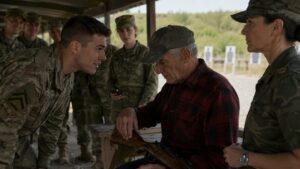
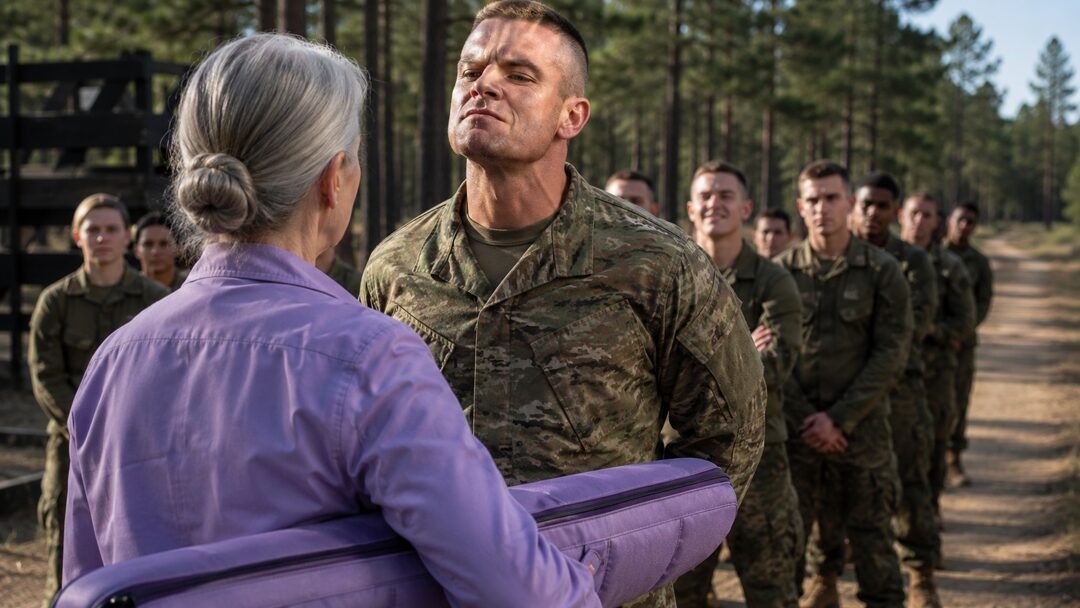
Staff Sergeant Ryan Miller saw the older woman before he saw the case, and that was his first mistake.
She was walking up the dirt path like she had all morning to get there, silver hair pinned low, lavender windbreaker catching the Georgia light, boots clean enough to make every soldier nearby notice. Under one arm she carried a long purple case, soft-sided and bright as a spring flower, the kind of thing Ryan might have expected to see at a music lesson, not outside a marksmanship range.
Behind him, three trainees stopped pretending not to stare.
Ryan stepped into her path.
“Ma’am,” he said, with a smile that made the younger soldiers grin before he even finished. “You lost?”
The woman looked at him as if she had heard worse weather.
“No.”
Her voice was calm. Not offended. Not nervous.
That made Ryan’s smile sharpen.
The morning range had been clean until she arrived. Pine trees. Red dirt. Dust on boots. Men in camouflage moving with purpose. The distant metal clack of targets being reset. Then this woman in lavender appeared as if she had taken a wrong turn from a garden club.
Ryan glanced at the case.
Then he looked back at her.
“Do you even know how much a rifle weighs?”
The trainees behind him laughed softly.
Not loud. Not enough to get corrected.
Just enough.
The woman’s eyes moved past Ryan to the young soldiers watching from the shade. She took in their amusement, one face at a time, like she was memorizing evidence.
Then she lowered the purple case to the dirt.
Ryan’s smile stayed in place, but something inside it paused.
She knelt with the smoothness of someone who knew exactly how far the ground was. Her hands were slim, brown-spotted, steady. She pulled the zipper around the case in one long, clean motion.
No one laughed after that.
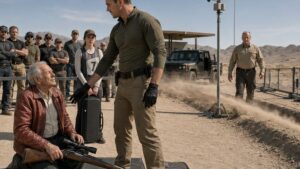
Inside the black foam lay a precision rifle finished in the same shade of lavender as her jacket. Not painted for a joke. Not decorated for attention. Built, tuned, cared for. Scope. stock. barrel. every surface clean enough to catch the light.
The color made it strange.
The condition made it serious.
Ryan’s eyes dropped to the stock.
Near the rear, just above where her cheek would rest, was a small engraving.
ASH 17.
His breath caught before he could stop it.
The woman noticed.
Of course she noticed.
She stood, leaving the case open between them.
“You should have asked who I am first,” she said.
The words were not loud, but they landed all the way down the path.
One trainee swallowed. Another straightened so fast his boots scraped dirt.
Ryan stared at the engraving as if it had reached out of the past and touched him.
Before he could speak, a woman’s voice cut through the silence.
“Master Sergeant Hart.”
Captain Emily Carter came down from the range office, cap low, expression controlled. She did not hurry, but everybody knew she had seen enough.
Ryan turned.
Emily’s eyes moved from the open case to Ryan’s face. Nothing in her expression changed, which somehow made it worse.
“Staff Sergeant Miller,” she said, “I see you’ve met our evaluator.”
The air seemed to thin.
Ryan’s smile finally died.
The older woman reached down, closed the case, and zipped it without looking at him again.
“Captain,” she said.
Emily gave her a short nod. Not friendly. Not ceremonial.
Respectful.
The trainees saw it.
That was the part Ryan felt most. Not the mistake. Not the rifle. Not even the engraving.
They saw Captain Emily Carter acknowledge the woman he had just mocked.
And suddenly every laugh behind him belonged to him.
Part II — A Cleaner Record
Ryan tried to recover by becoming sharper than usual.
That was another mistake.
By ten hundred hours, the trainees stood on the firing line under a white sun, sweating through their uniforms while Kathleen Hart watched from behind them with a clipboard she barely used. The purple case rested beside a bench near her boots.
Closed.
Still somehow louder than everything else.
Ryan moved down the line, correcting elbows, shoulders, cheek welds, breathing. He was good at it. That was what made him dangerous. He knew weapons. He knew safety. He knew how to make frightened recruits look brave for eight seconds at a time.
“Brooks,” Ryan snapped. “You’re dragging the trigger like it owes you money.”
Private Samuel Brooks flushed behind his eye protection. He was lean, young, too careful with everything he touched. He adjusted his grip.
Ryan stepped closer. “Don’t adjust like you’re asking permission. Fix it.”
“Yes, Staff Sergeant.”
Kathleen said nothing.
That irritated Ryan more than criticism would have.
He could feel her watching. Not just his hands, not just the line, but the space between what he said and what happened to the person hearing it.
After the first drill, she finally spoke.
“Why did you correct his grip after his breathing changed?”
Ryan turned. “Because his grip was wrong.”
“It became wrong after his breathing changed.”
A few trainees stared straight ahead with sudden religious devotion.
Ryan kept his jaw still. “Breathing, grip, sight picture. It all matters.”
“Yes,” Kathleen said. “That’s why order matters.”
It was not a scolding. That made it worse. She said it as if she were pointing out weather.
Ryan forced a short nod. “Noted.”
Emily stood ten yards back, arms folded. She heard it all. Of course she did.
They ran the next drill timed.
The trainees had to step to position, settle, aim, and fire on command. It was basic pressure. Nothing dramatic. Nothing Ryan considered worth discussing like it was a spiritual event.
Samuel Brooks froze on his second round.
His rifle stayed pointed safely downrange, but his shoulders locked. His breathing went high and thin. The countdown kept moving.
“Brooks,” Ryan barked. “Send it.”
Samuel blinked.
“Brooks.”
The kid’s finger hovered, then lifted away.
The timer buzzed.
Ryan stepped in fast. “What was that?”
Samuel’s throat worked. “I—”
“No. Don’t give me a story. You had a target. You had time. You had a command.”
Samuel looked smaller without moving.
Ryan felt the old anger rise. Not at Samuel exactly. At the hesitation. At the gap between instruction and action. At the terrible little pause where lives disappeared.
Then Kathleen stepped beside Samuel.
She did not touch him.
“Private Brooks,” she said. “Look at the dirt past your left boot.”
Samuel obeyed, confused.
“Breathe in for four. Hold for two. Out for six.”
Ryan almost laughed. He stopped himself because Emily was watching.
Samuel breathed.
“Again,” Kathleen said.
He did it again.
“Now tell me one thing you can feel.”
Samuel swallowed. “My hand.”
“Which hand?”
“Right.”
“What is it doing?”
“Shaking.”
“Good,” Kathleen said. “Now you know where it is.”
Ryan stared at her.
Good?
Kathleen looked at Samuel’s rifle, then back to his face.
“Shaking is information. Don’t argue with it. Use it. Reset. Then work.”
Samuel nodded once.
Ryan wanted to cut in. He wanted his line back. His range back.
But Kathleen stepped away and gave Samuel space.
“Run him again,” she said.
It should not have worked.
Samuel stepped up. His hand still shook, but less. He breathed the way she had told him. The first shot clipped low. The second hit center mass. The third landed clean.
Nobody cheered.
They all looked at Ryan.
He turned away first.
Later, inside Emily’s office, he shut the door harder than necessary.
“She’s undermining cadre authority.”
Emily did not look up from the evaluation schedule. “No. She’s observing it.”
“You know what I mean.”
“I do,” Emily said. “And I’m trying to decide if you do.”
Ryan stared at her.
The office smelled like dust, coffee, and old paper. On the wall behind Emily hung framed certifications Ryan had helped earn. His name was on one of them. He looked at it because it was easier than looking at her.
“She doesn’t know these trainees,” he said.
“She knows fear.”
“So do I.”
Emily’s face changed by almost nothing.
“That might be the problem.”
Ryan gave a short laugh, empty and sharp. “You’re serious.”
“Master Sergeant Hart has authority to fail this review.”
“She’s retired.”
“She’s Kathleen Hart.”
The name sat there.
Ryan had heard versions of it, maybe. Half-rumors. Range stories. The kind soldiers told when they wanted a legend but not the burden of facts.
He looked toward the window.
Outside, he could see Kathleen on the range path, speaking quietly to Samuel Brooks. The purple case was in her hand again.
Ryan said, “Where has she been, then? If she’s such a legend.”
Emily took too long to answer.
“Some records are cleaner than the lives behind them.”
Ryan turned back. “What does that mean?”
“It means don’t make the next forty-eight hours about your pride.”
But it was already too late for that.
That evening, Ryan heard two trainees whispering near the water station.
“Looks like a joke until she holds it,” one said.
The other lowered his voice. “My uncle told me about a woman with a purple rifle. Mountain pass somewhere. Saved a whole patrol and nobody ever named her.”
Ryan stopped behind the wall.
His hand curled around the edge of his canteen.
ASH 17.
The letters had been buried somewhere in him for years.
He had not known they were still alive.
Part III — The Sound in the Trees
The night evaluation was Kathleen’s request.
Ryan argued against it for almost twenty minutes.
Emily approved it in two.
By twenty-one hundred, the pines were dark columns against a low moon. The trainees moved through the navigation course in pairs, then broke into individual stress-fire stations marked by dim lamps and reflective tape. Blank rounds cracked at irregular intervals. Instructors called commands from unseen positions. It was controlled confusion, designed to feel just messy enough.
Ryan hated that Kathleen had asked for it.
He hated more that it was useful.
She stood beside Emily near the first station, lavender windbreaker dull in the dark, hair silver under the range lights. The purple case sat closed at her feet.
Ryan could feel it without looking.
Samuel Brooks came through the trees breathing hard.
“Station three,” Ryan called. “Move.”
Samuel moved.
A blank round cracked somewhere behind him.
It was not louder than the others. It was not closer.
But Samuel dropped.
Not fully. Not dramatically. One knee hit dirt, and his rifle dipped before he caught himself.
Ryan crossed the space in three strides.
“Up.”
Samuel’s face was pale under the dim light.
“Up, Brooks.”
“I’m trying—”
Ryan grabbed the front of Samuel’s vest and hauled him halfway to his feet. “Trying is not a position.”
Samuel’s eyes went wide.
Kathleen’s voice cut through the trees.
“Let him go.”
Ryan did not.
For half a second, nobody moved.
Then Emily said, “Staff Sergeant.”
Ryan released Samuel.
Kathleen stepped between them. She was shorter than Ryan by several inches, older by thirty years, and somehow he was the one who felt blocked.
“You’re training him like fear is disobedience,” she said.
Ryan’s chest rose once.
“Fear gets people killed.”
“So does pretending you don’t feel it.”
The words did not hit like an insult.
They hit like recognition.
Ryan looked past her into the trees, but the dark shifted. For a second, it was not Georgia. It was rock. Heat. Dust. Radio static. Men breathing too loudly because silence had become dangerous.
A voice in his ear: Hold. Hold. Hold.
Then the sound that broke the world.
He blinked hard.
Kathleen was still watching him.
Not accusing.
Reading.
That was what he could not stand.
“Reset the station,” Emily said, voice quiet.
The trainees moved. Nobody spoke unless ordered.
Samuel stood with both hands on his rifle and shame all over his face.
Kathleen turned to him.
“You still know where your hands are?”
Samuel nodded.
“Good. Start there.”
Ryan looked away.
After the exercise, he found Kathleen near the benches, packing her notes into a small canvas bag. The range lights hummed overhead. Most of the trainees had gone back toward the barracks. Emily was speaking with another instructor near the office.
The purple case lay on the bench between them.
Ryan stopped on the other side of it.
“You enjoyed that?”
Kathleen zipped the bag. “No.”
“You came here with that case, that color, that whole act, and I’m supposed to believe you don’t enjoy making people feel small?”
Her eyes lifted.
“You did not need my help feeling small, Staff Sergeant.”
The line was quiet enough to be private.
It still burned.
Ryan pointed at the case. “ASH 17. What is that to you?”
For the first time all day, Kathleen’s face changed.
Only slightly.
But he saw it.
“An old place,” she said.
“No,” Ryan said. “It was not just a place.”
Her hand rested on the case.
He heard himself continue before he could stop.
“My unit was there.”
The night seemed to hold still.
Kathleen said nothing.
“We were pinned for forty-six minutes,” Ryan said. The words came out flat, memorized by a part of him that never slept. “Radio cut in and out. Lieutenant Gray kept saying higher had eyes on the ridge. Then somebody took out the position above us. One round. Everyone said it was impossible.”
Kathleen’s fingers tightened once on the handle.
Ryan leaned closer.
“Were you there?”
She looked at the trees.
In the dark, the lavender case looked almost gray.
“Yes.”
The answer was too small for what it opened.
Ryan’s mouth went dry.
“All these years,” he said, “men told that story like a miracle.”
“It was not a miracle.”
“You saved us.”
“I saved some of you.”
That stopped him.
Kathleen’s voice remained steady, but there was something underneath it now. Not weakness. Weight.
“There were three men I could not reach,” she said. “There was a boy in the open I still see when the weather changes. There was a radio call that came seven minutes too late. People prefer the clean version.”
Ryan remembered the clean version. He had lived inside it.
One impossible round. One unnamed shooter. One patrol that got to go home.
He had never asked who did not.
“Why didn’t you claim it?” he asked.
A humorless softness crossed her face.
“Claim what? The men who lived? The men who didn’t? The story people needed more than the truth?”
Ryan had no answer.
Kathleen lifted the case from the bench.
“The Army likes a symbol when the symbol stands still,” she said. “I preferred silence.”
“Silence made you disappear.”
She looked at him then.
“No,” she said. “It let me stay human.”
Ryan watched her walk toward the small guest quarters near the range office.
For the first time since the purple case opened, he did not feel embarrassed.
He felt worse.
He felt grateful.
And he hated her for giving him nowhere clean to put it.
Part IV — The Wrong Contest
By morning, Ryan knew the evaluation was going badly.
He knew before Emily said it.
Kathleen had watched enough. Written enough. Asked enough of the wrong simple questions.
Why did you raise your voice there?
What did he learn from that correction?
Would he repeat the task under pressure, or only remember being ashamed?
Ryan stood in Emily’s office while sunlight cut across the desk.
Emily folded her hands. “Master Sergeant Hart is recommending conditional recertification.”
The words landed like a demotion before the paperwork existed.
“Conditional,” Ryan repeated.
“You would remain on cadre, but not as lead instructor until retraining is complete.”
He laughed once. “Retraining.”
Emily’s face stayed still.
“You’re lucky she isn’t recommending full failure.”
Ryan looked through the window. Kathleen was outside near the range benches, checking something in her case. Samuel Brooks walked past her and gave an awkward nod. She nodded back.
The sight irritated him more than it should have.
“She thinks softness is leadership,” Ryan said.
“No,” Emily said. “She thinks fear is part of the job.”
“She humiliated me on my own range.”
Emily’s voice sharpened.
“You humiliated yourself before she opened the case.”
He turned.
For a moment, Captain Carter was not mediator, not careful, not tired. She was command.
“You made a stranger prove she deserved respect,” she said. “Then you spent a day proving you didn’t know what to do with it.”
Ryan’s jaw tightened.
He heard the truth in it.
He refused it anyway.
“Set up a demonstration.”
Emily stared at him. “What?”
“A demonstration. In front of the trainees. If she’s going to decide whether I can instruct, let them see both of us work.”
“This is not a theater.”
“Then she won’t mind.”
Emily stood. “Ryan.”
He heard the use of his first name and knew it was a warning.
He ignored it.
“I’m not asking to embarrass her.”
“Yes,” Emily said. “You are.”
Outside, Kathleen closed the purple case.
Ryan looked at it and saw every trainee’s shocked face again. Every laugh that had turned against him. Every version of the story already forming without his permission.
He said, “I’m asking for the chance to prove I belong here.”
Emily studied him for a long moment.
“You are asking the wrong question.”
But she let him walk out.
The trainees gathered at the range thirty minutes later, drawn by rumor faster than any official order. Word traveled cleanly when embarrassment fed it.
Ryan stood at the firing line with his rifle ready.
Kathleen arrived last.
She carried the purple case in one hand, clipboard in the other. She did not look surprised.
Ryan hated that too.
He addressed the line, voice steady.
“Master Sergeant Hart and I will run a demonstration. Same distance. Same conditions. Best performance speaks for itself.”
A murmur moved through the trainees.
Kathleen set the case down.
“No,” she said.
The word was gentle.
It still stopped everything.
Ryan turned. “No?”
“No.”
“You don’t want to demonstrate?”
“I do.”
She looked at Samuel Brooks.
Samuel went still.
Kathleen continued, “Private Brooks will run the pressure drill. You and I will coach. Neither of us touches the rifle.”
Ryan’s face hardened. “That’s not the same thing.”
“No,” Kathleen said. “It’s harder.”
The trainees looked from her to him.
Ryan felt the trap close.
If he refused, he looked afraid.
If he accepted, he played by her rules.
Emily stood near the back, saying nothing.
Ryan looked at Samuel.
The young man’s face had already gone pale.
“This is unnecessary,” Ryan said.
Kathleen’s voice remained even. “So was asking me what a rifle weighs.”
A ripple passed through the line.
Not laughter this time.
Memory.
Ryan stepped closer, lowering his voice.
“You’re making him a prop.”
Kathleen looked at Samuel, then back to Ryan.
“No. You did that yesterday when his fear became your performance.”
Ryan had no clean place to stand.
That was becoming familiar.
He turned to Samuel. “Get on the line.”
Samuel moved like a man walking toward bad news.
Part V — What Fear Knows
Samuel’s hands started shaking before the timer began.
Ryan saw it immediately and felt irritation rise out of habit. Then, under it, something else.
Recognition.
Samuel checked his safety. Adjusted his stance. Adjusted again. Too much. His breathing climbed.
Ryan stepped beside him.
“Feet shoulder width. Don’t crowd the stock. Watch your—”
“Staff Sergeant,” Kathleen said.
Ryan stopped.
She stood several feet away with the purple case closed beside her. Her arms were relaxed. Her face gave him nothing.
“Coaching is not command performance,” she said.
Ryan almost snapped.
He could feel the trainees watching. The same watching as yesterday. The same heat at the back of his neck. The same urge to become louder than doubt.
Samuel’s fingers tightened around the rifle.
And suddenly Ryan saw his own hands years ago, coated in dust, shaking so badly he had wedged them under his vest so no one would see.
He remembered telling himself afterward that fear had been something he survived by killing.
He had never considered that maybe he had only buried it alive.
Samuel whispered, “Staff Sergeant?”
The title sounded like a request.
Not for orders.
For help.
Ryan lowered himself beside Samuel instead of standing over him.
The whole range seemed to notice.
Ryan kept his voice low.
“You’re scared.”
Samuel’s mouth opened, then shut.
Ryan nodded once. “Good.”
Samuel looked at him like he had misheard.
“That means your body knows the moment matters,” Ryan said. The words felt awkward. Borrowed. True anyway. “Don’t fight the shaking. Find it.”
Kathleen’s face did not change.
But Emily’s did.
Samuel breathed in.
Ryan saw his shoulders lift too high.
“Not like that,” Ryan said, then caught himself before the bite came back. He tried again. “Slow. In for four. Hold for two. Out for six.”
Samuel did it.
The trainees were silent.
Ryan felt exposed in a way he had not felt on any firing line. Not weak. Seen.
“Tell me one thing you can feel,” he said.
Samuel swallowed. “My right hand.”
“What is it doing?”
“Shaking.”
“Then you know where it is.”
Kathleen looked down at the dirt.
Maybe to hide something.
Maybe not.
The timer began.
Samuel raised the rifle.
First target.
He fired.
Miss.
His whole body flinched after the sound, shame flooding his face before the casing hit dirt.
Ryan felt the old instinct surge.
Fix it. Crush it. Make the mistake afraid to happen again.
Instead, he said, “Reset.”
Samuel blinked.
“Again,” Ryan said. “You’re still here. Reset.”
Samuel breathed.
Second target.
Hit.
A small sound moved through the trainees, not quite a cheer, not yet.
Third target.
Samuel’s shoulder tightened.
Ryan said, “Don’t chase the last one. Work the one in front of you.”
Samuel exhaled.
Fired.
Hit.
The timer ended.
For a second, no one moved.
Then Samuel lowered the rifle slowly, like he did not trust the world to remain steady if he moved too fast.
He turned to Ryan.
Ryan gave him one nod.
Not approval as reward.
Recognition.
Samuel’s face changed.
Only a little.
Enough.
The range stayed quiet. The silence had weight now, but it was not the same weight as before. It did not crush. It held.
Ryan stood.
Kathleen was watching him.
He walked to her while the trainees remained where they were, unsure whether they had witnessed a victory or a correction.
Maybe both.
Ryan stopped close enough that his voice would not carry far.
“I should have asked who you were.”
Kathleen looked at him for a long moment.
“No,” she said. “You should have asked what he needed.”
The sentence entered him cleanly.
No drama. No mercy. No cruelty.
Just the truth, arriving late.
Ryan looked back at Samuel, who was clearing his rifle with hands that still shook, but less.
For the first time, Ryan did not want the shaking to disappear.
He wanted the kid to know he could work with it.
Part VI — The Weight
Kathleen finished her report in Emily Carter’s office with the door open.
Ryan saw that before he saw the envelope.
Open door. No secrecy. No theater.
He stood outside with his cap in his hand while Emily read. Kathleen waited by the window, lavender jacket folded over one arm, purple case upright beside her leg.
Emily’s eyes moved line by line.
Ryan did not ask what it said.
He had spent enough of the last two days asking the wrong things.
Finally Emily looked up.
“Conditional recertification,” she said.
Ryan nodded once.
“You’ll remain on cadre,” Emily continued. “You will not remain lead instructor during the retraining period.”
The words still stung.
They were also less than he deserved.
Kathleen did not look at him as if she had spared him. That helped. Pity would have been worse.
Emily signed the last page.
“Master Sergeant Hart also recommended keeping you in the program.”
Ryan looked at Kathleen then.
She picked up the purple case.
“I recommended that Captain Carter stop letting usefulness excuse damage,” Kathleen said. “What she does with that is command business.”
Emily accepted it without flinching.
That was the thing Ryan noticed. Nobody escaped the report clean.
Not him.
Not Emily.
Not even Kathleen, who had written it.
Outside, the day had brightened into the same clean sun that had lit the first insult. The pine path looked unchanged. That felt almost offensive.
Kathleen walked toward a dusty blue truck parked beyond the range office. Ryan followed at a distance, then caught up before she reached it.
“Master Sergeant.”
She stopped.
He held himself straighter, then let some of it go.
“Does it really weigh as much as people say?”
Kathleen looked at the case in her hand.
For a moment, he thought she might smile.
She didn’t.
“The rifle?” she asked.
Ryan nodded.
She opened the back door of the truck and laid the purple case carefully across the seat.
“No,” she said. “The rifle is not the heavy part.”
Ryan had no answer.
He was learning that silence could be an answer if a man did not rush to fill it.
Kathleen closed the truck door.
“Staff Sergeant Miller,” she said.
“Yes, Master Sergeant.”
“Do not turn me into the lesson.”
He met her eyes.
“What should I turn into the lesson?”
She looked past him toward the range, where Samuel Brooks sat on a bench cleaning his rifle slowly, carefully, like he was no longer apologizing to it.
Kathleen said, “The next person who shakes.”
Then she got into the truck.
Ryan stepped back as she started the engine. Dust curled around the tires. The lavender case was visible for a second through the rear window, bright and strange and impossible to dismiss.
Then she drove down the pine path and disappeared between the trees.
Ryan stood there until the dust settled.
Behind him, the range returned to sound. Low voices. Gear moving. A laugh that did not feel cruel. A magazine clicked into place somewhere, then out again.
He walked back.
Samuel was still on the bench, working a cloth along the rifle’s receiver. His movements were steadier now, but he paused twice at the same place.
Ryan stopped beside him.
The old version of him knew exactly what to say.
Too slow.
Do it right.
Again.
Samuel looked up, bracing for it.
Ryan sat down beside him instead.
Samuel’s eyes widened.
Ryan pointed, not touching the rifle.
“Show me where it catches.”
Samuel hesitated.
Then he turned the rifle slightly so Ryan could see.
For a while, neither of them said anything.
The pine trees moved in the heat. The road stayed empty. Somewhere beyond it, Kathleen Hart carried her silence with her, but not all of it.
Some of it remained on the range.
Not as a legend.
As a different way to stand next to someone who was still learning how to hold steady.