The Name Beneath the Glass
Part I — The Salute
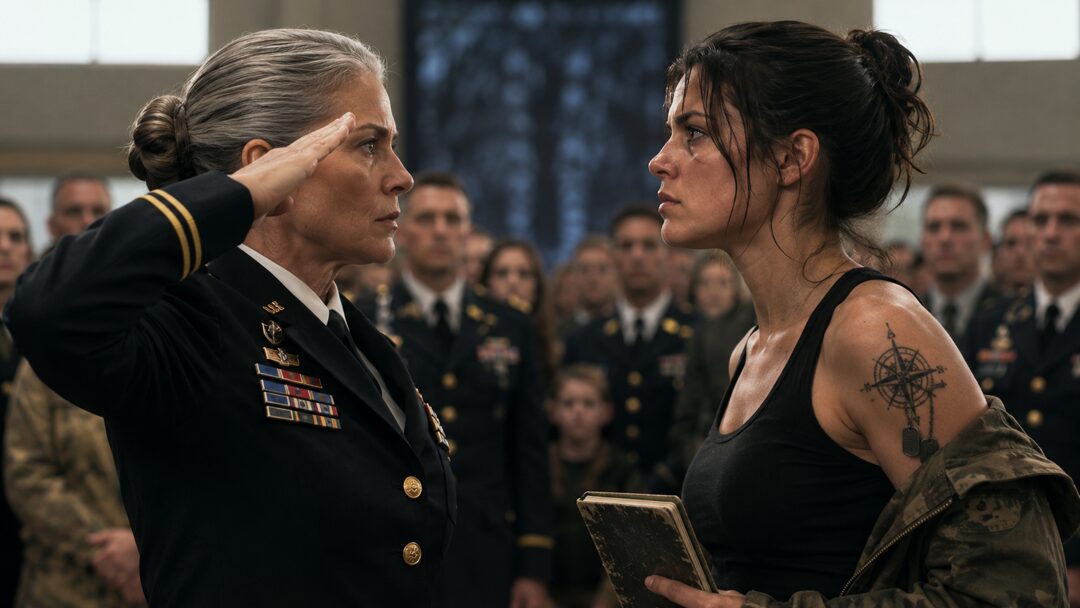
Colonel Patricia Hayes stepped off the stage in the middle of the ceremony, crossed the polished floor in front of two hundred silent people, and saluted the young woman who was not standing at attention.
The salute should have meant honor.
It did not look like honor.
It looked like a warning.
Emily Carter stood near the center aisle of Fort Mason’s intake hall with one shoulder bare, her camouflage jacket slipping down her arm, her black tank top showing the tattoo spread across her upper back. Broken dog tags. A field compass. Three words in dark ink beneath them.
BRING HIM HOME.
Around her, new recruits in pressed uniforms stared straight ahead with the stiff terror of people who had been trained not to stare. Families sat in folding chairs beneath banners of gold and blue. At the front of the hall, a covered memorial display waited under a dark cloth.
Colonel Hayes held her salute for one second too long.
Her silver hair was pinned into a severe knot. Her dark dress uniform was immaculate. Every ribbon on her chest sat in its exact place. Her face was the kind of face that had taught men twice her size to stop speaking.
Emily did not salute back.
She did not even straighten.
The room felt the insult before anyone understood it.
Hayes lowered her hand.
“Put your jacket on,” she said.
Her voice was quiet. That made it worse.
Emily looked at her. “I was told families were allowed.”
“Families are allowed,” Hayes said. “Accusations are not.”
The first row shifted. A woman clutched a program to her chest. Somewhere behind Emily, a recruit swallowed too loudly.
Emily’s jacket slid another inch down her arm.
The tattoo caught the overhead light.
“Then don’t call it a memorial wall,” Emily said, “if you’re afraid of names.”
The silence changed shape.
It was not confusion anymore. It was fear.
Hayes moved closer, close enough that Emily could see the faint line at the corner of her mouth, the place where control had to hold back something older than anger.
“You are interrupting a formal ceremony,” Hayes said. “You will step outside.”
“No.”
It was not loud.
That was why everyone heard it.
Hayes’s eyes flicked once to the tattoo, then back to Emily’s face. “This is your last warning.”
Emily’s throat tightened, but she did not move. She had imagined this room for three years and hated every version of herself inside it. In some versions she cried. In some she screamed. In some she turned around at the gate and drove home before anyone saw her.
But none of those versions had survived the envelope Sarah Miller mailed her.
None of them had survived the notebook.
At the front of the hall, behind the covered display, were twelve names.
One of them was Sergeant Michael Carter.
Her father.
The man everyone thanked her for losing.
The man nobody would describe correctly.
Emily looked past Hayes to the covered memorial. “Unveil it.”
Hayes’s jaw tightened. “Not like this.”
“Exactly like this.”
A staff officer near the stage began walking toward them. He had a slight limp and a face Emily recognized from old photos, though he looked older now, cleaner, polished by rank and distance. Major Daniel Knox.
He stopped when he saw her eyes on him.
Good, Emily thought.
Remember me.
Remember him.
Hayes turned slightly, just enough to make him halt without speaking.
That was the thing about her. She did not need volume. She had built a life out of gestures that stopped rooms.
Emily had built hers out of questions that no one answered.
“Miss Carter,” Hayes said, careful now, because the last name had entered the air, “you need to leave before this becomes something you cannot take back.”
Emily almost laughed.
There were so many things no one could take back.
A folded flag.
A closed report.
A sentence printed beneath a man’s name.
She stepped around Hayes and walked toward the display.
Hayes caught her by the arm.
Not hard. Not enough to bruise. Just enough to remind the room which one of them had authority.
Emily looked down at the colonel’s hand.
Then she looked up.
“Take your hand off me.”
Hayes released her.
Slowly.
The intake hall held its breath.
Emily reached the memorial display and pulled the cloth aside before anyone could stop her.
The glass gleamed. The names were clean and centered. Each had a short citation beneath it, phrased in the polished language of official grief.
She found her father’s name in the second column.
SERGEANT MICHAEL CARTER
Died during a hostile convoy strike while serving in Operation Stonebridge.
Emily read it once.
Then again.
As if the words might become less small if she gave them another chance.
Hayes came to stand behind her.
“That is the approved citation,” the colonel said.
Emily touched the glass, just beneath her father’s name.
“No,” she said. “That is the sentence you chose.”
Part II — The Closed Line
A murmur moved through the families.
Hayes turned her head.
The murmur died.
Major Knox stood near the stage, frozen in the useless posture of a man waiting for someone else to decide what kind of truth the room could survive.
Emily kept her fingers on the glass.
Her father had written her postcards from every base. Bad drawings. Worse jokes. Promises he tried not to make too big.
One had said, Be good for your mother, kiddo. And don’t let anybody tell you a compass only points north. Sometimes it points home.
She was thirteen when two officers came to the house.
Not Hayes. Never Hayes.
Two men she had never seen before, with soft voices and shoes too clean for the rain outside. They gave her mother the folded flag. They said words like honor and hostile action and sacrifice.
Emily had waited for them to say what her father did.
They never did.
For nine years, strangers had said, “Your dad was a hero.”
And for nine years, no one could tell her the shape of it.
Hayes stepped beside her, angling her body between Emily and the audience. “You have made your point.”
“I haven’t started.”
“You are not entitled to rewrite a military record because grief needs a different sentence.”
Emily turned. “You closed it.”
Hayes’s expression did not change.
But something behind it moved.
Emily saw it. A small fracture. A door under a door.
“You were a child,” Hayes said.
“I was old enough to know when grown people were lying.”
“That report was reviewed.”
“By people who wanted it clean.”
Hayes’s voice dropped. “Enough.”
Emily reached into the inside pocket of the jacket hanging from her elbow.
Two soldiers near the side wall shifted forward.
Hayes lifted one hand without looking at them.
They stopped.
Emily pulled out a small, worn notebook wrapped in a clear plastic sleeve. Its edges were softened from handling. Its cover was stained with old dust and age. On the front, in black marker, was her father’s blocky handwriting.
CARTER, M.
A sound escaped Major Knox before he could stop it.
It was hardly anything. A breath. A mistake.
Emily looked at him. “You remember this.”
His face went gray.
Hayes did not look at him. “Where did you get that?”
“From Sarah Miller.”
Now Knox closed his eyes.
Emily held the notebook up, not high, not dramatic, just enough for Hayes to see it fully.
“She said she should have sent it years ago.”
Hayes’s voice sharpened. “Sergeant Miller had no authority to remove operational material.”
“She didn’t remove a file,” Emily said. “She kept what was left of him.”
The words landed harder than she meant them to.
For one second, Hayes looked not angry, but struck.
Then control returned.
“Miss Carter, listen carefully. You do not understand the context of that day.”
Emily laughed once. It sounded ugly in the clean hall.
“I understand being thirteen years old and watching officers fold a flag over a story they knew was incomplete.”
A woman in the second row covered her mouth.
A recruit blinked hard.
Major Knox took half a step forward, then stopped again.
Emily opened the plastic sleeve and took out the notebook. Her fingers shook now. She hated that. She had promised herself they would not.
She flipped to the page she had read so many times the creases knew her hands.
A rough sketch of a checkpoint. A convoy line. A collapsed wall. Three names circled.
MILLER. KNOX. REED.
And underneath, written in a pressure so hard the pen had torn the paper:
HAYES GAVE THE ORDER.
DAD WENT BACK ANYWAY.
The same line appeared again below it.
And once more at the bottom of the page.
Hayes stared at the words.
For the first time, her face did not know what to do.
Emily lowered the notebook.
“Hostile convoy strike,” she said. “That’s what you gave us. That’s what you put under his name. Like he just happened to be there when the sky fell.”
Hayes’s nostrils flared slightly.
“He was there because he chose to be,” Emily said. “Wasn’t he?”
The hall was no longer pretending not to listen.
Every uniform had become a witness.
Hayes looked over Emily’s shoulder, toward the families, the recruits, the covered flags, the half-unveiled memorial.
Then she stepped in close.
“You want to have this conversation?” Hayes said. “Fine. Not in front of them.”
Emily held her ground.
Hayes leaned closer.
“You think this room is on your side because they are quiet,” she said. “They are quiet because they are watching someone break in public.”
Emily’s face burned.
Hayes had found the place to cut. Not with cruelty. With accuracy.
Emily looked at the memorial glass again.
Her father’s name sat there, clean and trapped.
“I’ve been breaking in private for nine years,” she said. “You don’t get to complain because I finally brought it here.”
Hayes stared at her.
Then she turned and pointed to the side corridor.
“Now.”
Part III — What Clean Words Hide
The corridor outside the intake hall had glass walls on one side, so the privacy was a lie.
Everyone could still see them.
That felt right to Emily.
Hayes walked ahead with controlled steps, then stopped beside a row of framed unit photographs. Younger faces behind glass. Older ghosts wearing newer uniforms.
Emily followed, clutching the notebook.
Behind them, the ceremony did not resume. It waited. The whole building seemed to wait.
Hayes faced her.
“Your father was one of the finest noncommissioned officers I ever commanded,” she said.
Emily hated how easily the words hit.
She had not come here for praise.
Praise was the cheapest thing the Army had ever given her.
“Then say what he did.”
Hayes’s lips pressed together.
“He left the convoy line after a withdrawal order.”
Emily’s breath caught.
There it was.
Nine years of closed doors, phone calls, returned requests, missing records, polite condolences.
One sentence in a corridor.
Hayes continued, each word measured. “The checkpoint was collapsing. We had wounded. We had incoming fire. We had thirty-seven personnel exposed and a command channel telling me air support was not coming. I ordered the convoy out.”
“And my father went back.”
“Yes.”
Hayes’s voice was flat.
But her hands were not. One thumb pressed against the seam of her trouser leg.
“He went back for Miller and Knox,” Emily said.
“And Reed.”
Emily blinked.
Hayes looked away.
“Private Thomas Reed,” Hayes said. “He was still alive when your father moved.”
Emily swallowed. “His name isn’t in the citation.”
“No.”
“Why?”
“Because Reed did not survive, and because the official action centered on the convoy strike.”
“That’s not an answer.”
“It is the answer that exists.”
Emily stepped closer. “You mean it’s the answer you could live with.”
Hayes turned back sharply. “Do not mistake pain for knowledge.”
“Do not mistake rank for truth.”
For a second, the corridor seemed too narrow for both of them.
Through the glass, Emily saw faces turned toward them. Families whispering. Recruits staring at fixed points on the wall as if discipline could make them invisible.
Major Knox stood just inside the hall, watching.
Watching again.
Hayes noticed.
Her expression hardened, but not at Emily this time.
“You think calling it disobedience would have honored him?” Hayes asked. “You think putting that word beside his name would have served his family?”
Emily’s grip tightened around the notebook.
“He chose to save people.”
“He broke an order.”
“He saved people.”
“He could have lost the convoy.”
“But he didn’t.”
“You know that because you are standing here with the privilege of hindsight.”
Emily felt the words hit, then hated that they made sense.
Hayes saw it and pressed on.
“If I put the truth in the report the way you want it, your father becomes a problem in a doctrine review. A cautionary note. An exception. A man who compromised command integrity under pressure.”
Emily’s eyes stung.
“No.”
“Yes,” Hayes said, and for the first time there was heat in her voice. “That is what clean institutions do with messy courage. They file it under risk.”
Emily stared at her.
Hayes looked almost sick after saying it.
“You didn’t protect him,” Emily said.
Hayes’s face tightened.
“You made him smaller.”
The words stayed between them.
Inside the hall, someone spoke into a microphone and then stopped. A feedback whine rose and died.
Hayes closed her eyes once.
When she opened them, she looked older.
“I wrote the report I believed would preserve his honor.”
Emily shook her head. “You wrote the report that preserved your order.”
Hayes flinched.
Just barely.
But Emily saw it.
And suddenly the fight changed.
Until that moment, Hayes had been a wall. Now Emily could see the room behind it. Dark. Locked. Full of things no one had moved in years.
Before either of them could speak, a woman’s voice came from the end of the corridor.
“Emily.”
Emily turned.
Sarah Miller stood near the entrance, wearing jeans, boots, and an old green field jacket faded at the elbows. She looked smaller than Emily expected. Tired in a way sleep could not repair. Her short hair framed a face that had spent years refusing to fully rest.
Hayes went still.
“Sergeant Miller,” she said.
Sarah looked at her. “Not anymore.”
Part IV — The Witness
Sarah walked toward them slowly, as if every step had to ask permission from an old memory.
Emily’s anger faltered when she saw Sarah’s hands.
They moved slightly at her sides, fingers flexing, touching thumb to forefinger, like she was counting pulses no one else could feel.
“You came,” Emily said.
“I almost didn’t.”
Sarah’s eyes went to the notebook.
Then to Hayes.
Then to the glass wall, where half the hall could see them.
“I should have come sooner,” she said.
Hayes’s voice returned to steel. “This is not the place.”
Sarah gave a small, humorless smile. “That’s what we always say right before we make silence official.”
Hayes looked away.
Emily opened the notebook to the checkpoint sketch. “Tell her.”
Sarah’s face tightened.
“Emily—”
“Tell her what happened.”
Sarah looked at Hayes, not for permission, but because some part of her was still trained to check the commanding officer before stepping into danger.
Hayes did not move.
So Sarah spoke.
“The west wall came down first,” she said. “Reed was pinned near the gate. Knox had shrapnel in his leg. I was trying to drag him behind the engine block when the second call came through.”
Emily looked from Sarah to Hayes.
“What call?”
Hayes answered before Sarah could. “Withdrawal.”
Sarah nodded. “They were losing the route. If the convoy stayed, more people were going to be trapped.”
Emily hated the relief she felt hearing that. Hated the complexity. Hated that her clean anger had been easier to carry.
“So she left him,” Emily said.
Sarah’s eyes filled, but her voice stayed steady. “She ordered the convoy out.”
“That’s the same thing.”
“No,” Sarah said. “It isn’t.”
Emily recoiled slightly.
Sarah’s pain sharpened. “Don’t make it simple just because simple hurts better.”
Emily went quiet.
Hayes stared at Sarah.
There was something in Hayes’s face Emily had not seen before.
Not command. Not defense.
Recognition.
Sarah continued. “Colonel Hayes tried to delay. She requested cover twice. They denied it twice. Then command told her if she held position another minute, they’d relieve her and send the convoy without her.”
Emily looked at Hayes.
Hayes said nothing.
Sarah’s voice thinned. “Your father heard the order. We all did. He looked at me. Then at Knox. Then at Reed. He said, ‘Not yet.’”
Emily pressed the notebook to her chest.
Not yet.
That sounded like him.
That sounded exactly like him.
Sarah swallowed.
“He moved before anyone could stop him. Hayes shouted his name. He didn’t turn around.”
Hayes’s eyes lowered.
Emily saw her hand close once, then open.
Sarah looked at Emily now. “He got to Knox first. Dragged him far enough that two others could pull him in. Then he went for Reed.”
“Did he reach him?” Emily whispered.
Sarah did not answer fast enough.
That was the answer.
Emily looked away.
The hall blurred behind the glass.
For years she had imagined one perfect version of courage. Her father running into danger. Her father saving everyone. Her father proving that the official story had stolen a clean, shining truth.
But the truth had edges.
Sarah was alive.
Knox was alive.
Reed was not.
Her father was not.
Hayes had given the order.
Her father had broken it.
Both of those things were true, and neither one healed the other.
A door opened behind them.
Major Daniel Knox entered the corridor.
He looked at Sarah first.
Then Hayes.
Then Emily.
“I asked them not to put my name in it,” he said.
Emily stared at him.
His voice was low. “The review. The citation. Any of it. I told them I didn’t want to be used to complicate his record.”
Emily’s mouth went dry.
“You were alive because of him.”
Knox nodded.
“Yes.”
“And you let them erase why.”
He took the sentence without defending himself.
“Yes.”
Sarah closed her eyes.
Hayes turned on him. “Major.”
Knox’s shoulders stiffened automatically.
But he did not retreat.
“I thought private guilt was loyalty,” he said. “It isn’t.”
Emily looked at him for a long moment.
He had the kind of face people trusted in hallways. A clean face. A promoted face. A face that had learned how to keep surviving.
She wanted to hate him.
Some part of her still did.
But he looked so tired that hatred had nowhere clean to land.
Emily opened the notebook to the last page.
Her fingers found the fold.
“I want you to read this,” she said to Hayes.
Hayes looked at the page and did not take it.
“No.”
“Yes.”
“No.”
The refusal was too fast. Too raw.
Emily understood then that Hayes knew what page it was.
Or feared it.
“Read it in there,” Emily said. “In front of them.”
Hayes’s face closed. “I will not turn your father’s last words into theater.”
“You already turned them into silence.”
Hayes’s eyes flashed.
Emily thrust the notebook toward her.
Hayes did not move.
So Emily looked down and began reading it herself.
“If you had to pull them out—”
Her voice broke immediately.
She hated that most of all.
She tried again.
“If you had to pull them out, you did right.”
The corridor went completely still.
Hayes looked as if the sentence had found the one place her uniform could not protect.
Emily forced the next words out.
“I saw Miller and Knox still breathing. I had to try.”
She stopped.
There was more, but she could not read it. The letters moved under her eyes.
Sarah stepped closer.
Knox bowed his head.
Hayes took the notebook at last, but not like evidence. Like something hot.
She stared at the page.
Emily watched her read the final line silently.
Please tell Emily the compass still points home.
Hayes closed the notebook.
For a long moment, no one spoke.
Then from inside the hall, a senior officer’s voice carried through the glass.
“Colonel Hayes. The general is waiting.”
Part V — The Second Salute
The ceremony wanted to continue.
That was the worst part.
Not the anger. Not the silence. Not even the lie.
The worst part was that the room could still move on.
Programs could still be smoothed. Microphones adjusted. Families guided back into reverent posture. The cloth could be lifted from the display, the approved words spoken, the incomplete sentence sealed beneath glass.
A senior officer entered the corridor. Brigadier General Robert Ellis had a pleasant face trained for public grief.
His eyes moved over Emily’s bare shoulder, the tattoo, the notebook in Hayes’s hand, and then settled on Hayes.
“Colonel,” he said softly. “We need to proceed.”
Hayes said nothing.
Ellis’s smile did not reach his eyes. “This can be addressed afterward.”
Emily almost laughed again.
Afterward was where truth went to starve.
Hayes looked at the hall.
The recruits. The families. The flags. The memorial.
Then at Emily.
Emily felt suddenly exhausted. The anger that had carried her into the building had burned through its own fuel. What remained was heavier.
“I didn’t come for revenge,” she said.
Hayes watched her.
“I came because every year people thank me for my father’s sacrifice,” Emily said, “and they don’t know what he sacrificed.”
Her jacket hung from her elbow. She could feel the air on her tattoo, the weight of everyone pretending not to look.
“My mother stopped coming to these things,” Emily said. “She said the words got smaller every year.”
Sarah made a small sound behind her.
Emily did not look back.
“I put his name on my skin because you wouldn’t put the truth under it.”
Hayes’s eyes went to the tattoo again.
Broken dog tags. Compass. Bring him home.
For the first time, Emily did not feel exposed.
She felt seen.
That was worse in some ways. Softer. More dangerous.
Ellis stepped closer to Hayes and lowered his voice, though everyone in the corridor could hear. “Patricia. Not here.”
Hayes looked at him.
Emily saw the whole machine in that exchange. Not evil. Not even cowardice in the simple sense. Just pressure. Habit. The old instinct to keep the structure standing even if people disappeared inside it.
Hayes opened the notebook again.
Her thumb rested on the last page.
Then she closed it.
“No,” she said.
Ellis blinked. “Excuse me?”
Hayes walked past him.
Back into the hall.
For a second, no one followed.
Then Sarah moved.
Knox moved.
Emily moved last.
When they entered, every head turned.
Hayes walked to the front of the room and took the microphone from the stand. Her posture was perfect. Her face was calm.
That calm frightened Emily more than the anger had.
“At attention,” Hayes said.
Every uniform in the hall straightened.
Even Knox.
Even Sarah, though she was no longer required to.
Emily remained where she was, halfway down the aisle, jacket loose, notebook pressed to her side.
Hayes looked at the memorial display.
Then at the audience.
“Before this display is formally dedicated,” she said, “a correction must be made.”
General Ellis moved toward her.
Hayes did not look at him.
“The citation for Sergeant Michael Carter is incomplete.”
A sound moved through the room, not quite a gasp.
Hayes continued before anyone could interrupt.
“Sergeant Carter died after leaving the convoy line during the final withdrawal from the Stonebridge checkpoint. The withdrawal order was mine.”
Emily’s chest tightened.
Hayes’s voice stayed clear.
“He left that line to retrieve wounded personnel whose names were omitted from the approved account. Specialist Sarah Miller. Major Daniel Knox, then a lieutenant. Private Thomas Reed.”
Sarah’s eyes filled.
Knox stared straight ahead, jaw tight.
Hayes looked down once, then back up.
“Miller and Knox survived. Reed did not. Carter did not.”
General Ellis reached the stage.
“Colonel,” he said quietly.
Hayes turned her head.
“Sir,” she said, still into the microphone, “both truths belong in the record.”
The room went still in a way Emily had never felt before.
Not silent because of authority.
Silent because something had entered and no one knew how to push it back out.
Hayes stepped away from the microphone.
For a moment, Emily thought it was over.
Then Hayes walked down from the stage.
The same path as before.
Across the polished floor.
Past the families.
Past the recruits.
Past Major Knox, whose eyes were wet now, though he did not wipe them.
She stopped in front of Emily.
This time, there was no anger in her face.
No weapon in her posture.
Only something disciplined and devastated.
Hayes lifted her hand.
And saluted.
The first salute had trapped Emily in the room.
This one released her.
Emily did not salute back.
She was not a soldier. She was not under Hayes’s command. She did not owe the room the shape it expected.
Instead, she lifted her jacket from her elbow and pulled it back over her shoulders.
Slowly.
Not hiding.
Choosing.
Her father’s words sat between them, unread aloud but present.
Please tell Emily the compass still points home.
Hayes held the salute until Emily’s jacket was settled.
Then she lowered her hand.
No one clapped.
Thank God, Emily thought.
Some things did not need applause.
Part VI — What Stayed
After the ceremony, people moved around Emily as if she were a candle they were afraid of blowing out.
Some thanked her.
Some avoided her.
One older woman touched Emily’s sleeve and said, “My son’s name is on the other side,” then walked away before Emily could answer.
Major Knox came to her near the memorial display.
He stood with both hands clasped in front of him, formal even without meaning to be.
“I should have found you,” he said.
Emily looked at his reflection in the glass rather than his face.
“Yes.”
He nodded once. Accepted it.
“I’ll submit a statement.”
“You should have done that years ago.”
“I know.”
The simplicity of it took some of the force out of her anger.
That annoyed her.
Knox looked at Michael Carter’s name.
“He carried me by the back of my vest,” he said. “I remember being angry because it hurt. That’s what I remember most clearly. Not bravery. Not fear. Just being furious that he was dragging me wrong.”
A laugh rose in Emily’s throat and broke before it became sound.
Knox’s eyes shone.
“Then I woke up two days later and he was gone.”
Emily said nothing.
Knox nodded again, as if she had answered.
Then he stepped away.
Sarah came next.
She stood beside Emily without touching her.
For a while, they looked at the names together.
“My dad would have liked you,” Emily said.
Sarah huffed softly. “Your dad yelled at me for losing a roll of tape.”
“That sounds like him.”
“He would have hated the tattoo.”
Emily turned.
Sarah’s mouth trembled.
“And loved why you got it.”
Emily laughed then.
Once.
Small and painful and real.
It surprised her so much she covered her mouth.
Sarah smiled, but her eyes were wet.
Across the room, Hayes spoke with General Ellis. The conversation was quiet. It did not look easy. Ellis’s face had lost its public warmth. Hayes stood straight through all of it, accepting whatever came without looking toward Emily for rescue or approval.
Later, when the hall had mostly emptied, Hayes approached with a folder in one hand.
Emily did not step back.
Hayes stopped at a respectful distance.
“I filed an amended citation request,” she said.
She held out the folder.
Emily took it.
The papers inside were clipped, stamped, official. Still only a beginning. Still vulnerable to review, challenge, delay, disappearance.
Hayes knew it too.
“It may be contested,” she said.
Emily looked at the memorial glass.
At the name that had waited nine years for a fuller sentence.
“Then contest it loudly,” she said.
Hayes almost smiled.
Almost.
“I can do that.”
Emily looked at her then.
There were things Hayes had not said. I am sorry. Forgive me. I should have done this sooner.
Maybe she would say them someday.
Maybe she would not.
Emily found she did not need them in that moment. Not because forgiveness had arrived, but because something else had.
The truth had become harder to bury.
Hayes glanced at the notebook in Emily’s hand. “He wrote one more line.”
“I know.”
Hayes nodded.
“I should have delivered it.”
“Yes,” Emily said.
Hayes took that too.
No defense. No explanation.
Just the weight of it.
Then she stepped back.
Sarah waited near the doors. Knox stood farther away, speaking to the mother of Private Reed. General Ellis was nowhere in sight.
Emily turned to the memorial.
She touched the glass beneath her father’s name.
It was cool under her fingers.
For years, she had thought bringing him home meant finding the right person to blame. Then it meant correcting a record. Then naming what had happened. Then making people look.
Now, standing in the thinning light of the intake hall, she understood it meant something quieter and less complete.
It meant refusing to let a clean sentence replace a complicated life.
It meant carrying what was true without letting it make her cruel.
It meant leaving before the institution decided whether she was allowed to heal.
Emily lowered her hand.
Her father’s name remained beneath the glass.
The words under it were still wrong.
For now.
But the room had heard the fuller version. Hayes had spoken it. Sarah had stood beside it. Knox would write it. And Emily no longer had to hold the whole truth alone on her skin.
She pulled her jacket tighter around her shoulders and walked toward the doors.
Behind her, the memorial reflected the emptying hall.
Ahead of her, the afternoon waited, bright and ordinary and impossible.
Emily did not look back.
The compass had already turned.