What She Carried Into the Room
Part I — The Bracelet on the Table
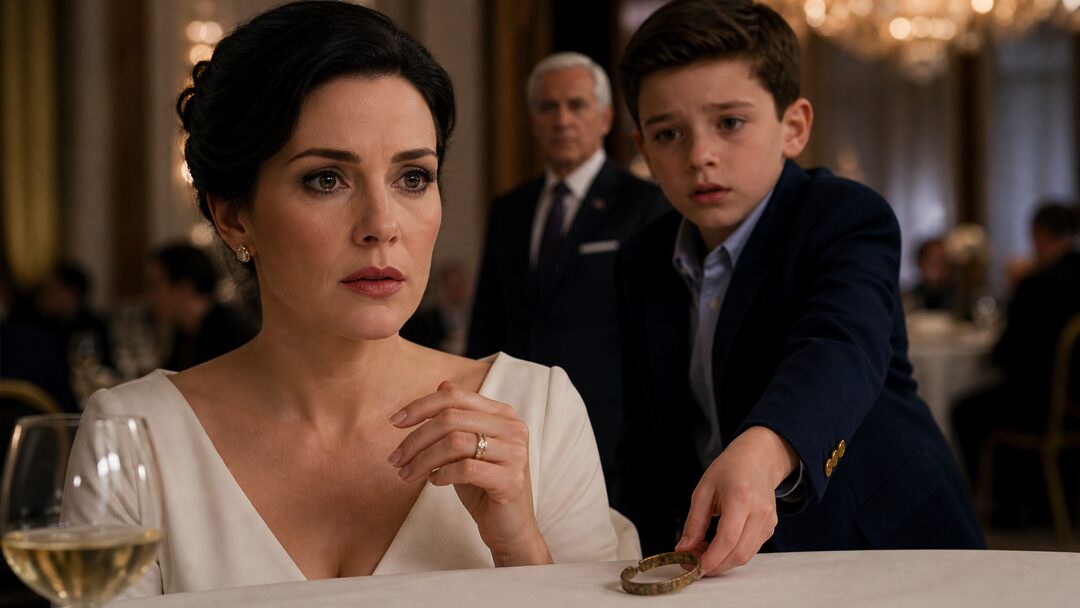
The boy appeared beside Emily Carter’s table just as she lifted her wine glass, and the first thing she noticed was not his face, but his hands.
They were shaking.
He was eleven, maybe twelve, dressed in a navy blazer that looked like someone had bought it for a day he was supposed to remember. His hair was combed too neatly. His shoes were polished but scuffed at the toes. He stood between Emily and the white linen tablecloth as if he had crossed a line and knew every adult in the room would punish him for it.
“Ma’am,” he said, breathless. “I think this belongs to you.”
Before Emily could answer, he placed a bracelet beside her glass.
Not gold. Not silver. Not delicate.
A worn metal service bracelet, dulled at the edges, engraved with a name she had trained herself not to touch in public.
Daniel Carter.
For one second, the restaurant vanished.
The clink of crystal glasses faded. The low conversation near the bar thinned into nothing. The string quartet warming up beyond the ballroom doors became a sound from very far away.
Emily did not pick it up.
Her hand stayed in the air around the stem of her wine glass, graceful and useless.
“That isn’t mine,” she said.
The boy looked at the bracelet, then at her wedding ring.
“Yes, ma’am,” he whispered. “It is.”
Across the hotel restaurant, men in dark suits and women in formal dresses were beginning to glance over. The reunion gala had not officially started yet, but everyone important had arrived early. Officers. Widows. donors. People who knew how to lower their voices around grief and raise them around service.
Emily had come because she was expected to.
She wore an ivory dress because Daniel had once told her she looked calm in ivory. She had pinned her hair back. She had put on the pearl earrings his mother gave her. She had practiced smiling in the mirror until the expression looked like dignity instead of exhaustion.
And now a child had brought her husband back on a strip of cold metal.
“Where did you get this?” she asked.
The boy swallowed.
“It fell out of her purse.”
Emily’s mouth went dry.
“Whose purse?”
He turned his head slightly, but not enough to point. Children knew when adults were dangerous. They just didn’t always know which ones.
Emily followed his eyes.
At the far side of the restaurant, near the entrance to the ballroom, Colonel Michael Harris stood with one hand resting near his lapel pin. He had the same polished stillness Emily remembered from Daniel’s memorial: silver hair, straight shoulders, a face built for difficult announcements. He was speaking to a woman in a black dress.
The woman was elegant, quiet, older than Emily by a few years. She had one hand around a small black clutch, the other curled against her side as if she had just realized something was missing.
Then Michael looked over.
His eyes found the bracelet first.
Not Emily.
The bracelet.
And his face changed so quickly that anyone else might have missed it. The smile remained. The posture remained. But his throat moved once, and the hand near his lapel dropped.
Emily’s heart began to hammer with a slow, humiliating force.
The boy leaned closer.
“She was wearing it earlier,” he said. “On her wrist. I saw the name.”
Emily finally touched the bracelet.
It was colder than it should have been.
Daniel had worn it through his last deployment. Not as regulation. Not as jewelry. It had been something private between them, a piece of metal she gave him because she hated the idea of him leaving with nothing of hers except a photograph tucked into a pocket.
“When you miss me,” she had told him, fastening it around his wrist, “you can be annoyed at me from another continent.”
He had laughed and kissed her knuckles.
“I’ll be annoyed every day.”
After his death, the bracelet had been listed with his effects. Emily remembered the inventory sheet. She remembered signing where the young officer pointed. She remembered refusing the box because she knew if she opened it in that room, she would not stand up again.
Later, she was told some items had been retained as part of the official review.
Retained.
That was the word they used when they took the last things.
Now it sat beside her wine glass at a hotel restaurant, returned not by the Army, not by Daniel, not by anyone who owed her the truth, but by a boy whose eyes were too serious for his age.
“What’s your name?” Emily asked.
“Joshua.”
“Joshua what?”
He hesitated. “Miller.”
The name struck something, but not hard enough to break through. Miller. She knew it from a folded program, maybe. From a list of names read aloud while flags stood still.
Before she could ask more, a shadow fell across the table.
“Mrs. Carter.”
Michael Harris’s voice was warm enough to be heard by others and low enough to warn her.
Emily closed her fingers around the bracelet.
“Colonel.”
He smiled gently. The smile said grief was welcome here, but only in approved amounts.
“I see there’s been some confusion.”
The woman in black stood behind him, pale under the hotel lights. She did not look at Emily directly. She looked at the bracelet in Emily’s hand with the expression of someone watching a door open that she had spent years holding shut.
Emily looked from the woman to Michael.
“What confusion?”
Michael’s gaze shifted briefly to Joshua.
“Young man,” he said, still kind, still controlled, “your mother is looking for you.”
Joshua took one step back.
Emily heard the command beneath the courtesy.
“Stay,” she said.
The boy froze.
Michael’s smile thinned.
Emily stood slowly, the bracelet pressed into her palm.
Around them, the restaurant became quieter by degrees. Not silent. Never silent. People like this did not stare openly. They watched through reflections, through water glasses, through the polished blade of a dessert knife.
Emily looked past Michael at the woman in black.
“Were you wearing my husband’s bracelet?”
The woman’s lips parted.
Michael answered for her.
“It was part of a memorial display.”
Emily turned back to him.
“At the bar?”
A flush rose faintly along his collar.
“Mrs. Carter, this isn’t the place.”
That almost made her laugh.
Because men like Michael Harris always chose the place. The chapel. The hearing room. The reception line. The ballroom. The folded flag in her lap. The version of Daniel she was allowed to keep.
Emily lifted the bracelet between them.
“Then where is the place for this?”
The woman in black finally looked at her.
And Emily saw it there.
Not victory. Not guilt from an affair. Not the smug pity of someone who had taken what belonged to another woman.
Fear.
“I’m sorry,” the woman said softly.
Emily’s grip tightened.
“For what?”
The ballroom doors opened behind them, releasing a wash of light, applause, and music. Someone announced that guests should begin taking their seats.
Michael leaned closer.
“For your husband’s memory,” he said quietly, “I would advise you to let me handle this.”
The bracelet cut into Emily’s palm.
And for the first time since Daniel’s funeral, she wondered whether the thing she had called dignity had only been obedience wearing better clothes.
Part II — The Woman in Black
Emily did not follow Michael into the ballroom.
She walked instead toward the hallway beside the restaurant, where the carpet softened every footstep and framed photographs of past ceremonies lined the walls. Her hand was still closed around the bracelet. It left a crescent-shaped pressure mark in her skin.
Joshua followed her.
So did the woman in black.
Michael did not.
Not immediately.
That was the first thing that frightened Emily.
Men with nothing to hide did not pause to calculate witnesses.
The hallway bent toward a quiet alcove near the coat check. Emily stopped there beneath a photograph of a previous gala. Michael was in it, younger, smiling beside men who had not yet become names on plaques.
The woman in black stood a few feet away, clutch held against her stomach.
Emily looked at her dress. Her neat hair. The bare wrist.
“What’s your name?”
“Rebecca Hayes.”
The name meant nothing. That made it worse.
“Did you know Daniel?”
Rebecca’s eyes moved to Joshua, then back to Emily.
“Yes.”
The word landed too softly.
“How?”
Rebecca took too long to answer.
Emily felt the old humiliation rising now, not hot but icy. She had imagined many forms of betrayal in the first years after Daniel’s death because grief did that. It opened locked rooms and put monsters in them. She had imagined Daniel afraid. Daniel in pain. Daniel calling for her. Daniel angry at orders he could not refuse.
She had not imagined Daniel giving her bracelet to another woman.
“Don’t soften it,” Emily said. “If you knew my husband, say how.”
Rebecca flinched.
“I was assigned to analysis support for his final operation.”
Emily stared at her.
“You were military?”
“Civilian defense analyst.”
“Then why did you have this?”
Rebecca’s eyes filled, but she did not let the tears fall.
“Because he gave it to me.”
The hallway seemed to tilt.
Joshua looked down at his shoes.
Emily nodded once, slowly, as if her body had decided to behave even though her mind had not.
“When?”
“Two days before he died.”
The sentence moved through Emily with surgical precision.
Two days.
Two days before the notification officers arrived at her door. Two days before Michael Harris stood in her living room and said Daniel had served with courage. Two days before Emily watched the shape of her life become a folded flag.
She lifted the bracelet.
“He gave you my name.”
Rebecca shook her head.
“No. He gave me proof.”
Michael’s voice cut in from the hallway.
“That’s enough.”
He had arrived without rushing. Men like him never rushed in public. He walked toward them as if this were still a room he owned.
Rebecca’s shoulders tightened.
Emily did not turn away from her.
“What proof?”
Michael stopped beside them.
“Mrs. Carter,” he said, “you are being pulled into matters that were reviewed thoroughly years ago.”
Emily looked at him then.
“Reviewed by whom?”
His eyes hardened by a fraction.
“By people with the clearance and responsibility to understand them.”
There it was.
The wall.
Emily knew that wall. She had lived against it for four years.
Classified. Operationally sensitive. Under review. Necessary. Unavoidable.
Words that sounded official enough to bury a person under.
Rebecca whispered, “Daniel found out the route had been compromised.”
Michael’s head snapped toward her.
Emily went still.
Rebecca’s voice shook now, but she kept speaking.
“He believed the team was being sent through a corridor that had already been flagged. He tried to delay movement. He was overruled.”
“Rebecca,” Michael said.
She looked at him, and for the first time, Emily saw anger under the fear.
“No. You don’t get to use my silence twice.”
Michael’s jaw worked once.
Joshua’s face had gone pale.
Emily looked at the boy. “Why are you here?”
He swallowed.
“My mom works events sometimes. She’s helping with flowers tonight.” His voice cracked but did not break. “I saw the bracelet fall. I saw his name. Carter. My dad was with him.”
Miller.
Now Emily remembered.
Sergeant Thomas Miller.
The name read after Daniel’s. The family seated two rows behind her. A woman crying without sound. A boy asleep against someone’s shoulder because children could only survive ceremony by leaving it.
Joshua looked at Michael.
“They said my dad caused it.”
Michael’s face changed again, but this time not with fear.
With irritation.
Not at the boy’s grief.
At its timing.
Emily felt something inside her steady.
“What did they say he did?”
Joshua looked ashamed, as if he had committed the act by repeating it.
“That he missed the warning. That he led them wrong.”
Rebecca closed her eyes.
Emily turned to Michael.
“Did he?”
Michael exhaled slowly.
“The findings were more complex than a child can understand.”
Joshua’s cheeks burned.
Emily stepped between them before she knew she had moved.
“Then explain it to me.”
Michael looked at her, and the softness was gone now. What remained was the commander beneath the condolence voice.
“Your husband died protecting his men. Do not let grief turn that into suspicion.”
Emily almost folded then.
Because that was the one thing she had protected.
Daniel’s goodness.
Daniel’s courage.
Daniel’s last clean shape in her mind.
If she pulled at the story, what came loose? His judgment? His loyalty? The way he had smiled at her through a screen and told her not to worry? The last message she had saved but never replayed after the funeral because his voice still sounded alive in it?
Rebecca spoke quietly.
“He wasn’t suspicious. He was right.”
Emily looked at her.
Rebecca opened her clutch and removed a folded slip of paper, worn soft at the creases.
“I kept this with the bracelet. I didn’t know if I would ever have the courage to give it to you.”
Michael stepped forward.
Emily took the paper first.
His hand stopped in midair.
For a second, all three adults stared at that small stopped hand.
Emily unfolded the paper.
The writing was Daniel’s.
Not the formal signature from official documents. Not the block letters from deployment forms. His real handwriting, quick and slightly slanted, the way he wrote grocery lists and birthday cards.
If this reaches Emily, tell her I tried to bring them home.
That was all.
No confession. No explanation. No goodbye.
Just one sentence with her name in it.
Emily pressed the paper against the bracelet.
Her breath came out unevenly.
Michael said, very softly, “He was under pressure. Men write many things under pressure.”
Emily looked at him.
“So do widows.”
The words surprised her. They surprised Michael too.
For four years she had written thank-you notes. Memorial statements. Donation acknowledgments. Acceptable grief. Controlled grief. Grief that made other people comfortable.
She had never written the sentence she wanted.
You took him from me and then told me what to call it.
Rebecca stepped closer.
“Emily, I didn’t come tonight to start this in public.”
“Then why did you come?”
Rebecca looked through the hallway toward the ballroom doors, where applause rose again.
“Because he’s being honored tonight for that operation.”
Emily felt the bracelet grow heavier.
Michael said, “For his career of service.”
Rebecca looked at him.
“For the story you kept.”
The air between them sharpened.
Emily understood then that the gala was not background. It was a deadline.
Inside that ballroom, Michael Harris was minutes away from being applauded into history.
And Emily was standing in the hallway holding the one object that did not know how to lie.
Part III — The Names They Kept Quiet
Joshua’s mother found them before Emily could ask the next question.
Sarah Miller came quickly down the hallway, still wearing the black apron from the floral team over a plain navy dress. She had the look of a woman who had spent years making herself useful in rooms where people did not want her grief.
“Joshua,” she said.
The boy stepped back as if he expected punishment.
Sarah stopped when she saw the bracelet in Emily’s hand.
For a moment, her face did what Emily’s had done at the table. It tried to remain itself and failed.
“Where did you get that?” Sarah asked.
Joshua’s voice was small. “It fell from her purse.”
Sarah looked at Rebecca, then Michael, then Emily.
The recognition moved through her slowly.
“You’re Daniel Carter’s wife.”
Emily nodded.
Sarah’s eyes lowered to the bracelet.
“My husband was Thomas Miller.”
“I remember his name,” Emily said.
Sarah’s mouth trembled once.
It was the first mercy Emily had given her without knowing it.
Michael shifted, recovering command.
“Mrs. Miller, this is not a suitable conversation for your son.”
Sarah did not look at him.
“Most of the unsuitable conversations about my son’s father happened without us in the room.”
Joshua stared at his mother.
Emily saw something pass between them: years of half-answers, doors closing when the boy came near, adults saying later and then never returning to the subject.
Rebecca held the clutch with both hands now.
Sarah noticed her.
“You had something of theirs?”
Rebecca nodded.
“Daniel gave it to me before the operation.”
“My husband’s name was in it too?”
Rebecca hesitated.
Michael said, “No operational details will be discussed here.”
Sarah turned to him then, and her voice did not rise. That made it worse.
“You discussed enough to let people think Thomas failed them.”
Michael’s expression tightened.
“The report did not assign blame in the way you’re suggesting.”
Sarah laughed once.
It contained no humor.
“You didn’t need the report to say it. You let the whispers do it.”
Joshua looked at the floor.
Emily’s anger changed shape.
Until that moment, she had thought of truth as something owed to her. Now she saw the larger cruelty. Her grief had been polished and displayed. Sarah’s had been quietly contaminated.
Emily was the honored widow.
Sarah was the wife of the man people lowered their voices around.
Both of them had been managed.
Rebecca looked at Sarah.
“Thomas didn’t miss the warning,” she said.
Joshua’s head lifted.
Michael’s voice dropped. “Stop.”
Rebecca kept going.
“He sent it twice. Daniel confirmed it. The route was flagged before they moved.”
Sarah covered her mouth.
Joshua stared at Rebecca like she had opened a window in a room where he had been suffocating for years.
“Then why did they say it was Dad?”
No one answered fast enough.
That silence did the damage.
Emily turned the bracelet over in her palm. Daniel’s name on one side. The metal worn smoother on the underside, where it had touched skin.
“What happened after Daniel gave this to you?” she asked Rebecca.
Rebecca’s eyes flicked toward Michael.
“He asked me to get the communication logs out if he didn’t come back.”
“And did you?”
“I tried.”
Michael said, “She violated protocol and nearly compromised an ongoing review.”
Rebecca turned on him.
“No. I got scared.”
The admission cut through the hallway more cleanly than any accusation.
Rebecca looked at Emily, then Sarah.
“I was told releasing anything would damage the families. That the public story would protect the men. That reopening it would make their deaths political.” Her voice shook. “And I believed that maybe silence was kinder.”
Sarah’s eyes filled.
“To whom?”
Rebecca had no answer.
Emily did.
“To the living who didn’t want consequences.”
Michael’s face hardened.
“You think consequence is simple because you never had to send men anywhere.”
Emily stepped closer to him.
“No. I think grief is complicated because men like you keep handing us edited versions of it.”
For the first time, Michael looked tired.
Not guilty enough.
But tired.
“You want a villain,” he said. “That makes this easier for you.”
Emily thought of Daniel teaching her to make coffee in a motel room the week before their wedding because he said every marriage needed one practical vow. She thought of his last video call, the screen freezing while he smiled. She thought of the folded flag. She thought of Michael’s hand over his heart while he told her Daniel’s sacrifice had protected others.
“I wanted my husband,” she said. “You gave me a ceremony instead.”
The sentence made Sarah close her eyes.
From the ballroom, a burst of applause rose.
Then a voice over the microphone.
“Ladies and gentlemen, if you’ll please take your seats as we prepare to recognize Colonel Michael Harris for a lifetime of distinguished service…”
Michael looked toward the sound.
There was the fear again.
Not loud. Not obvious.
But real.
Emily saw it and understood the power had shifted.
He could handle tears. He could handle questions in private. He could handle widows seated politely beneath chandeliers.
He could not handle the bracelet walking into that room.
Michael turned back to Emily.
“If you do this tonight, you will not get what you think you want.”
“What do I want?”
“To feel that the loss meant something.”
The cruelty of it was how gently he said it.
Emily’s throat tightened.
Michael continued, softer now.
“It did. Your husband’s life mattered. Miller’s life mattered. All of them mattered. But dragging half-understood fragments into a public room will not bring them honor.”
Rebecca looked at him with grief and disgust.
“You still think honor is something you can arrange.”
Michael’s eyes flashed.
“And you think truth without context is virtue.”
Joshua stepped forward.
“My dad had context.”
Everyone looked at him.
He was pale, trembling, too young for the room and too old for the lie.
“He had us.”
Sarah put a hand on his shoulder.
Emily looked at the bracelet again.
For four years, she had believed that if she held herself together, she was protecting Daniel.
Now she wondered whether she had only been protecting the people who survived him.
She walked toward the ballroom.
Michael said her name, but not with authority this time.
With warning.
“Emily.”
She stopped at the doors and turned.
Rebecca stood behind her. Sarah and Joshua beside the wall. Michael alone beneath the framed photographs.
Emily held out her hand to Rebecca.
Rebecca stared at it.
“The paper,” Emily said.
Rebecca gave it to her.
Then Emily opened the ballroom door.
Part IV — A Room Full of Applause
The ballroom was beautiful in the way expensive rooms became beautiful when they wanted grief to behave.
Round tables covered in white linen. Tall centerpieces. Gold-rimmed plates. A stage washed in warm light. Flags arranged with ceremonial precision behind the podium.
Emily entered from the side, not the main doors, but enough heads turned.
She felt the attention move over her ivory dress first, then her face, then the bracelet in her hand.
A few people smiled with sympathy. A few looked away quickly. Widows were welcome in rooms like this as long as they confirmed the room’s goodness.
Rebecca came in behind her.
That changed the temperature.
Then Sarah entered with Joshua.
That changed it again.
Michael followed last.
By then, the announcer had paused.
Onstage, the man at the microphone smiled uncertainly.
“Colonel Harris,” he said, trying to recover, “we were just about to invite you up.”
Michael adjusted his jacket.
The room gave him space without being asked.
That was power, Emily realized. Not commands. Not rank. The room moving before you spoke.
He walked toward the stage.
Emily walked too.
A murmur passed through the tables.
Someone whispered her name.
Mrs. Carter.
She hated the pity in it. She hated that it still worked on her. She hated that part of her wanted to sit down, fold the bracelet in a napkin, and let Michael make everything smooth again.
Because smooth was survivable.
Truth had edges.
Michael reached the steps to the stage and turned slightly, as if granting Emily a private moment to reconsider.
Instead, she stopped in front of the first table.
Close enough for the stage microphone to catch her if she spoke clearly.
She did not raise her voice.
“Colonel Harris.”
The room quieted.
Michael looked at her with a face arranged for concern.
“Yes, Mrs. Carter?”
Emily opened her hand.
The bracelet lay across her palm.
Several people in the front row leaned forward.
“Why did my husband give this to Rebecca Hayes two days before he died?”
The question did not explode.
It entered the room gently.
That made it worse.
Michael’s face remained composed, but the pause after her question was too long.
The announcer reached for the microphone.
Michael lifted one hand to stop him.
“Mrs. Carter is understandably emotional,” he said.
Emily nodded once.
“Yes.”
The simple agreement caught him off guard.
She looked at the room.
“I am emotional. My husband died. So did Thomas Miller. So did the men whose names you printed on tonight’s program.”
Several faces turned toward Sarah.
Sarah gripped Joshua’s shoulder.
Emily looked back at Michael.
“But this is not emotion.”
She lifted the bracelet.
“This is Daniel’s.”
The room was fully silent now.
Michael descended one step.
“That item was part of a classified review.”
Rebecca stepped forward.
“No, it wasn’t.”
Every head turned to her.
Emily saw Rebecca’s hands shaking.
But she kept walking until she stood beside Emily.
“Daniel Carter gave it to me because he believed the official account would be changed after he died. He was afraid Sergeant Thomas Miller would be blamed for a warning command ignored.”
A sharp whisper moved through the room.
Michael’s voice cut cold.
“Ms. Hayes is a former analyst whose judgment at the time was compromised by proximity to the incident.”
Rebecca looked at him.
“My judgment was compromised by fear of you.”
The line landed hard.
Michael’s polished expression cracked.
Only for a second.
But in a room trained to read ceremony, one second was enough.
Emily unfolded Daniel’s paper.
Her fingers wanted to tremble. She refused them.
She read the sentence once to herself before she gave it to the room.
“If this reaches Emily, tell her I tried to bring them home.”
No one moved.
The words were too plain to argue with.
That was their power.
Emily did not explain them. She did not tell them what kind of husband Daniel had been. She did not describe the nights she woke reaching for someone who was no longer there. She did not say she had worn her wedding ring so long it had become less a symbol than a scar she refused to name.
She let Daniel’s sentence stand.
Michael looked older.
“Daniel was a brave man,” he said.
Emily looked at him.
“Then stop using his bravery to cover your silence.”
A woman at one of the tables began to cry quietly.
Sarah stepped forward then, bringing Joshua with her.
“My husband was Thomas Miller,” she said. Her voice was not strong at first. Then it became strong because it had to. “For four years, my son has heard versions of his father’s name that made him ashamed to ask questions. If there is a truth in this room, we are owed it too.”
Joshua did not hide behind her.
Emily saw Michael look at the boy.
Something almost human moved across his face. Pain, maybe. Or memory. Or the recognition that the people left behind had grown faces he could no longer manage as a category.
Then it passed.
“I made decisions with the information available,” he said.
Rebecca answered, “You had the warning.”
Michael’s mouth tightened.
“The warning was unverified.”
“Thomas sent it twice.”
“The field was unstable.”
“Daniel confirmed it.”
“Delay carried its own risks.”
Emily heard it then. Not confession. Not apology. Something worse.
A man still defending the shape of the lie because the truth had no version in which he remained untouched.
She stepped closer.
“Did Daniel know?”
Michael looked at her.
“Did he know you sent them anyway?”
The room held its breath.
Michael did not answer.
He did not have to.
Emily closed her eyes.
For one moment, she was not in the ballroom. She was in her kitchen four years earlier, standing barefoot while Daniel’s last message played on her phone.
Hey, Em. Long day. Don’t worry if I’m quiet for a bit. I love you. Also, I still hate that bracelet. It pinches when I sweat.
She had laughed when she first heard it.
Later, she had hated herself for laughing.
Now she understood why his voice had sounded strange.
Not afraid.
Resolved.
Emily opened her eyes.
Michael stood before her, surrounded by the room that had come to praise him.
She could have screamed. She could have accused. She could have demanded every file, every name, every minute of those final hours.
Instead, she held out the bracelet.
Not to Michael.
To the room.
“This was not a decoration,” she said. “It was not part of a display. It was not a symbol for your program.”
Her voice nearly broke.
She let it.
“It was the last thing my husband used to tell the truth.”
No one applauded.
That was the first honest thing the room had done all night.
A man from the organizing committee approached Michael and whispered something. Another followed. Michael listened, face pale, eyes fixed somewhere beyond Emily.
Then he stepped away from the stage.
Not removed dramatically. Not dragged. Not ruined in the way stories liked to make men ruined.
Simply moved aside.
For the first time all evening, he was not the center of the room.
Emily looked down at the bracelet in her hand.
She had thought truth would feel like fire.
It felt heavier than that.
Part V — What Remained
The ceremony did not continue the way it had been planned.
There were quiet conversations near the stage. A woman from the foundation guided guests toward coffee. Someone lowered the music. Someone else removed Michael’s name card from the front table as discreetly as possible, which made the act impossible not to see.
No official truth arrived that night.
No clean justice entered through the ballroom doors.
There were only faces. Whispers. Phone calls made in corners. Men who had once praised Michael now using careful words like review and concern and appropriate channels.
Emily did not stay to hear them.
She walked back into the hallway with Rebecca, Sarah, and Joshua. The restaurant was nearly empty now. Her wine glass still sat on the table where she had left it. Beside it was the small damp circle where the bracelet had first rested.
The mark looked ordinary.
That nearly undid her.
Rebecca stood a few feet away.
“I should have come sooner,” she said.
Emily looked at her.
“Yes.”
Rebecca accepted it.
No defense. No tears arranged for forgiveness.
Just yes.
“I told myself I was protecting the families,” Rebecca said.
Emily folded Daniel’s note carefully.
“You were protecting the silence.”
Rebecca nodded.
Sarah sat in the chair opposite Emily’s abandoned place setting. She looked suddenly exhausted, like someone who had carried a box for years and only now realized it had cut into her hands.
Joshua stood beside her, watching the bracelet.
Emily saw the want in his face.
Not greed. Not curiosity.
Hunger.
For proof. For permission. For one object in the world that said his father had not been the story they gave him.
Emily sat down at the table again.
The chair was cold.
For a moment, she pressed the bracelet between both palms.
She thought of Daniel’s wrist. Of him pretending to hate it. Of him keeping it on anyway. Of him giving it away when he must have known he might not get another chance to give her anything.
Her grief shifted.
It did not lessen.
It made room.
“Joshua,” she said.
The boy looked at his mother first.
Sarah nodded.
He came closer.
Emily placed the bracelet on the table between them.
“My husband wore this,” she said. “But I don’t think he meant it only for me.”
Joshua stared at it.
Emily’s voice softened.
“He wrote that he tried to bring them home. That means your father too.”
The boy’s face crumpled, but he fought it with the fierce embarrassment of a child surrounded by adults.
Emily understood that kind of fighting.
She had done it in better shoes.
“Was my dad bad?” Joshua asked.
Sarah made a sound like a breath breaking.
Emily looked at the boy and did not give him comfort she could not prove.
“I don’t know everything yet,” she said. “But I know this. Your father deserved the truth before people decided what to call him.”
Joshua wiped his face with his sleeve.
Emily picked up the bracelet and placed it in his hand.
His fingers closed around it carefully, as if it were alive.
Sarah whispered, “Emily, you don’t have to—”
“Yes,” Emily said. “I do.”
Because keeping it would have been easy to understand. Widow keeps last object. Widow returns home. Widow sleeps beside a smaller version of the same absence.
But Daniel had not used the bracelet to come back to her.
He had used it to reach forward.
Joshua held it against his chest.
Rebecca turned away, crying silently now.
Emily did not comfort her. Not yet. Maybe not ever. Some guilt had to remain useful before it deserved peace.
At the end of the hallway, Michael Harris stood alone near the ballroom doors.
His service pin was still on his lapel.
No one stood beside him.
For a second, Emily thought he might come over. Apologize. Explain. Offer one final arrangement of words.
He did not.
Maybe that was the closest he could come to honesty.
Emily picked up Daniel’s note and slipped it into her small ivory purse. The paper belonged with her. The bracelet no longer did.
Outside the hotel, the night air was cool. Guests were leaving in clusters, their voices hushed, their certainty disturbed. The city moved on around them, careless and bright.
Sarah and Joshua waited near the curb for their ride. Rebecca stood apart, making a phone call Emily did not try to overhear. Inside, the institution was already beginning its slow work of protecting itself from what it had just heard.
Emily knew better than to expect morning to fix anything.
There would be statements. Requests. Denials. Men who remembered differently. Files that appeared incomplete. People who said she had been brave and people who wished she had been quieter.
But for the first time in four years, Daniel’s memory did not feel sealed behind glass.
It had weight.
It had a witness.
It had moved from her hand to a boy’s, and in that movement, it had stopped being only a relic of what she lost.
Joshua looked back once before getting into the car.
He lifted his hand, the bracelet looped around his fingers.
Emily nodded.
Not a smile. Not closure.
Something steadier.
Then she turned and walked down the hotel steps alone, her ivory dress catching the streetlight, her wedding ring still on her hand, Daniel’s final sentence folded close to her heart.
The truth had not given him back.
But it had given back the part of him they had tried to keep.