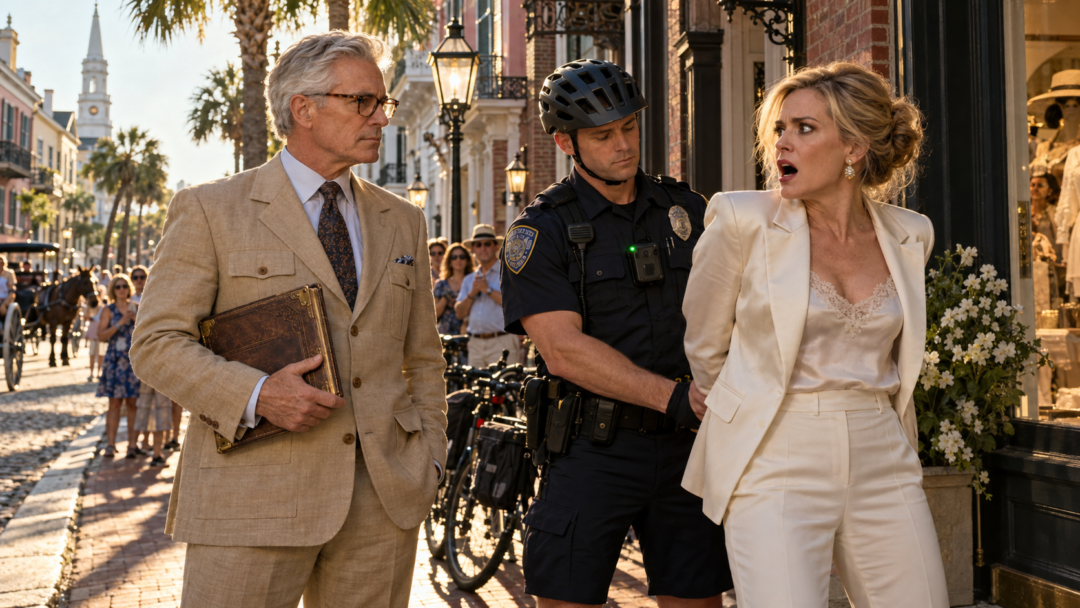
The Antique Ledger On The Brick Sidewalk And The Chief Counsel
CHAPTER 3: THE VAULT IN THE FRENCH QUARTER
Ten minutes later, the bright, sun-drenched sidewalk of Church Street had been closed off by four marked police cruisers, their low-profile amber light bars pulsing quietly against the historic brick walls. A growing crowd of neighborhood residents and shopkeepers stood behind yellow police tape, watching the unfoldment of the investigation with rapt attention.
Inside the rear restoration studio of Vance Heritage Antiques, deep within the heart of the historic French Quarter, the atmosphere was completely transformed. The public showroom with its polished mahogany sideboards, crystal chandeliers, and displays of silver teapots gave way to a dimly lit, narrow workshop that smelled heavily of acetone, hydrochloric acid, and jeweler’s rouge. The floor was rough heart-pine, stained with dark chemical washes, and the walls were lined with heavy steel workbenches cluttered with specialized tools.
Raymond Thorne walked through the workshop doorway, his blackthorn cane in his right hand, his linen safari jacket unbuttoned. Beside him walked Officer Davis, who had completely abandoned his former deference to Victoria Vance, holding an official police evidence log in his hand.
Behind them, guarded closely by Officer Miller, sat Victoria Vance. She had collapsed onto a low wooden stool beside a jeweler’s workbench, her silk blazer stained with black polishing paste, her platinum hair unraveled and hanging in damp strands across her pale, sweating cheeks. She stared at the floorboards in petrified silence, her designer sunglasses lying cracked on the work table.
“Look at this equipment, Director Thorne,” Clara Bennett said, pointing a tactical flashlight at an industrial-grade micro-laser engraving machine concealed inside a heavy soundproof cabinet beneath the bench. “This isn’t restoration gear. This is a five-axis fiber-laser engraver used in high-security metallurgical manufacturing.”
Clara lifted a small wooden tray of polished silver hallmarks—tiny hardened steel punches bearing the counterfeit stamps of famous nineteenth-century American silversmiths, including Gorham, Tiffany, and the historic Charleston guild masters.
“For ten years, Victoria has been purchasing inexpensive, unmarked Victorian silver from scrap dealers in Pennsylvania,” Clara explained, her voice steady and clear as she laid out the evidence. “Her technicians use this laser to vaporize modern maker’s marks, burn in forged nineteenth-century coastal family hallmarks, and age the metal using chemical sulfur baths. Then she lists the pieces in her luxury catalogs as ‘recently discovered heirlooms from ruined Lowcountry estates,’ selling them to wealthy northern collectors for thirty times their actual value.”
Raymond Thorne leaned over the workbench, adjusting his tortoiseshell reading glasses. With the tip of his brass mechanical pencil, he lifted a heavy silver soup ladle from a velvet tray.
Under the harsh white glare of the jeweler’s magnifier, the forged hallmark was unmistakable: the edges of the anchor stamp were too sharp, cut with the mechanical precision of a computer-controlled laser rather than the soft, irregular impression of a hand-struck steel die.
“And the provenance documentation?” Thorne asked quietly, his eyes sweeping the cluttered shelves of the studio.
Clara walked to a heavy steel filing cabinet set into the brick chimney breast. She pulled open the bottom drawer, withdrawing a stack of thick, water-stained parchment sheets bearing the forged signatures of deceased county probate judges and estate executors.
“She buys blank, unwritten nineteenth-century legal parchment at antique book auctions in London,” Clara said, handing the documents to Thorne. “Then she uses iron-gall ink and antique steel-nib pens to forge probate consignments dating back to eighteen-seventy. She was preparing to fence seventy-two pieces of our family’s estate silver at an exclusive private preview in her garden courtyard this evening.”
Thorne examined the forged parchment, his fingers feeling the brittle, chemically treated edges. His jaw hardened, the muscles along his temples tightening with absolute, crushing resolve.
“This is not merely commercial fraud, Officer Davis,” Thorne said, looking up at the young patrolman. “This is systematic heritage theft, mail fraud, and the criminal falsification of sovereign public records.”
Thorne turned the page of the forged probate certificate, his eyes narrowing as he read the embossed seal and notarized certification on the bottom right corner. The signature was inked in bold, florid fountain-pen script: Harrison Croft, Esq., Chairman of the Municipal Historic Preservation Board and Senior Partner at Croft & Vance Maritime Law.
Thorne looked down at Victoria Vance, his voice dropping into a razor-sharp whisper:
“Your partner Harrison Croft is not just legal counsel for your boutique. He is using his sovereign seat on the municipal preservation board to certify fake provenance for stolen heritage across the entire Eastern seaboard.”