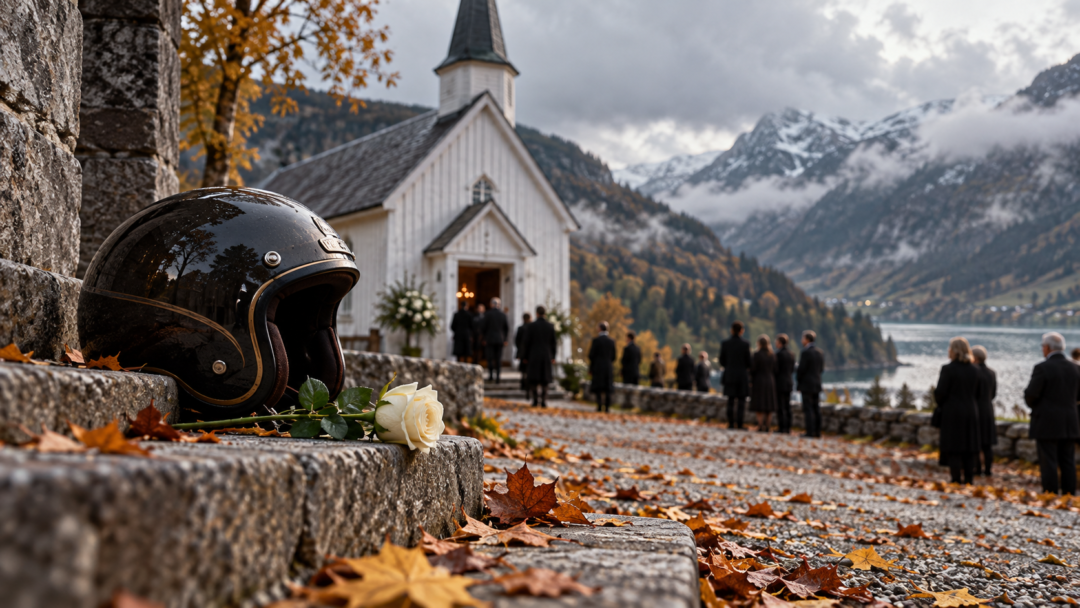
The Biker At The Chapel And The Sins Of Blackwood Creek
CHAPTER 2: THE EMBALMER’S CLOCK
The chapel courtyard descended into chaos as the first raindrops began to patter against the mahogany casket. The mourners huddled under black umbrellas, whispering behind gloved hands as Richard stood frozen in the center of the crushed gravel drive, the birth certificate trembling in his fist like an autumn leaf.
Before Hammer could answer, the heavy double doors of a black Cadillac hearse slammed shut near the chapel portico. Two mortuary attendants in dark suits were already sliding the mahogany casket onto the hydraulic rollers of the hearse bed. Standing beside the driver’s door, checking a gold pocket watch with anxious impatience, was Judge Vance Colter.
Colter was sixty-five, a titan of Virginia politics, dressed in an immaculate charcoal cashmere coat with a silver silk tie. His hair was thick and silver, his face possessed of that smooth, polished southern charm that had secured him thirty years on the county bench and made him the frontrunner for lieutenant governor in the upcoming November election.
“Richard, my boy,” Colter called out, his deep baritone projecting an aura of benevolent authority. “We must conclude the service. The weather is turning severely against us, and the mortuary directors in Roanoke have the cremation retorts preheated. We must adhere strictly to your late father’s estate instructions.”
Hammer’s head snapped toward the hearse. His white goatee bristled as his jaw clenched into granite.
“Cremation?” Hammer growled, stepping past Richard with long, menacing strides. “James was a devout elder of this parish for forty years. He bought a double family burial plot on the north knoll when Margaret died. He swore an oath he would never allow his bones to be burned.”
Colter’s benevolent smile vanished, replaced by the chilling, haughty disdain of an aristocrat confronted by a stray dog. “This is a private family matter, Sullivan. You are a convicted felon with a lengthy record in the timber strikes. You have no legal standing here. Sheriff Wilkes, remove this individual from the chapel grounds immediately.”
From behind the hearse, County Sheriff Donald Wilkes stepped forward, his hand resting conspicuously on the retention snap of his service sidearm.
Richard’s legal mind, honed by seven years of ruthless corporate courtroom battles, suddenly kicked into overdrive through the shock of his identity crisis. He looked at Colter’s nervous twitch toward his watch, then down at the birth certificate, and finally at the hearse door.
“Hold the vehicle,” Richard commanded. His voice had lost its aristocratic polish; it was raw, jagged, and cold.
“Richard, please,” Colter said smoothly, reaching out to pat Richard’s shoulder with a manicured hand. “You are under immense emotional duress. The discovery of old family correspondence can be deeply disorienting. We can review James’s personal effects at my estate this evening over bourbon.”
“I said hold the damn car!” Richard roared, stepping directly between the hearse bumper and the cemetery road. “My father’s will named me as the sole executor of his bodily remains. I gave no authorization for an immediate cremation in Roanoke. Why is the body leaving the county before the formal wake?”
“It was in the codicil,” Colter said, his eyes narrowing to slits. “Executed forty-eight hours before his heart failure.”
“James didn’t have heart failure,” Hammer said, his deep voice carrying over the rising mountain wind. “James could split an oak log with a four-pound splitting maul last month. He called me from his study on Tuesday night, Vance. He told me you had brought him a bottle of twenty-year-old bourbon to celebrate the closing of the Blackwood Creek mineral transfer. By Wednesday morning, he couldn’t draw breath.”
Sheriff Wilkes unsnapped his holster. “Sullivan, step back or you’re going down on the asphalt.”
Richard stepped directly in front of the sheriff’s gun hand. “Touch your weapon, Sheriff, and I’ll have a federal writ of habeas corpus and an emergency injunction served on your dispatch before the hour is out. As the legal executor, I am formally demanding an independent forensic autopsy by the state medical examiner in Charlottesville.”
Colter’s face drained of color for a fraction of a second—a fleeting micro-expression of sheer panic that did not escape Richard’s trained observation.
“Very well, Richard,” Colter said, his voice dropping into a razor-thin veneer of icy menace. “If you wish to desecrate your father’s memory with gruesome procedural delays, that is your prerogative. But you will find that the law in this valley does not bend to the delusions of an outlaw biker.”
Two hours later, inside the cold stainless-steel examination bay of the district hospital in Lynchburg, an independent pathologist whom Richard had retained from the medical school inserted a large-gauge aspiration needle beneath the collarbone of James Sterling’s corpse.
Richard stood behind the observation glass, Hammer’s massive frame standing right beside him like a silent sentinel.
The young pathologist looked up through the glass, his brow furrowed in profound confusion. He picked up an ultraviolet surgical lamp and illuminated the left side of James Sterling’s neck, just below the thyroid cartilage.
Under the blacklight, a tiny, bruised puncture mark glowed faintly against the pale skin—surrounded by a localized halo of petechial hemorrhaging that had been expertly concealed beneath mortuary cosmetic wax.
“This wasn’t cardiac arrest,” the doctor whispered through the intercom speaker, his voice trembling. “Someone administered a massive intravenous bolus of concentrated digitoxin directly into his carotid artery while he was unconscious. It mimics a fatal heart attack perfectly within forty minutes, and breaks down completely if the tissue is subjected to cremation heat.”