The Biomechanical Bull Lock And The Sabotaged Rodeo Syndicate Secret
CHAPTER 2: THE CERVICAL LOCK
The physics of a charging fifteen-hundred-pound animal are terrifying to anyone who does not understand the structural architecture of the mammalian skeleton. Black Diablo was accelerating at twenty miles per hour, his massive horned head bobbing low, his shoulder muscles rolling like black iron hills, his front hooves pounding the arena dirt with the rhythmic impact of a pile driver.
Every instinct in a modern, inexperienced stockman screams to stand directly in front of the beast with a waving hat, or to attempt a direct head-on collision. Both maneuvers are suicidal.
Jackson Callahan did neither.
As the charging black titan closed the distance—ten yards, five yards, two yards—Jackson did not step backward. He waited until the bull’s massive black brow was four feet from his chest, at the exact instant the animal lowered its head to execute an upward goring hook.
In that fractional second, Jackson stepped diagonally to his left.
The maneuver was executed with the lightning-fast, economical footwork of a championship steer wrestler. Jackson stepped cleanly inside the bull’s turning radius, slipping into the biological blind spot created by the animal’s lateral eye placement and wide horns. The bull’s massive right shoulder brushed Jackson’s chaps, a glancing rush of heat and brute momentum that would have flattened an unbalanced man, but Jackson absorbed the impact by flexing his knees, anchoring his center of gravity three inches above the dirt.
Before the bull could complete its charge and pivot its mass, Jackson struck.
His bare left hand—wide, calloused, and hardened by fifty years of ironwork—shot out like an industrial steel claw, clamping down directly over the heavy, solid-brass nose-ring pierced through the bull’s nasal septum.
The nasal septum of a bovine is packed with hundreds of thousands of microscopic nociceptors and sensory nerve endings, functioning as the primary neural steering conduit of the beast. The instant Jackson’s fingers locked onto that brass ring, the animal’s forward momentum was subjected to an acute, agonizing neurological brake.
Simultaneously, Jackson’s right hand reached high over the animal’s poll, clamping down around the sharp, tapered tip of the bull’s heavy left horn.
Now came the masterstroke of frontier biomechanics.
A bull’s colossal strength is entirely dependent on the straight alignment of its cervical spine and thoracic vertebrae. If the neck is kept straight, the massive trapezius and rhomboideus muscles can deadlift two thousand pounds with ease. But if the head is rotated laterally past forty-five degrees toward the shoulder, the cervical atlas and axis joints lock.
The mammalian nervous system is hardwired with an involuntary survival reflex: the motor centers of the brain stem automatically disengage the forward drive of the leg extensors to prevent the spinal cord from severing under rotational torque.
Jackson did not try to lift the bull. He used the animal’s own forward kinetic energy against itself.
Pivoting his right hip with explosive, rotational torque, Jackson wrenched the brass nose-ring upward and to the left, while driving the horn tip downward and backward toward the bull’s shoulder blade.
SNAP-TWIST.
The bull’s massive, muscular neck folded backward like a coiled spring. The animal’s muzzle was forced completely around until it was pointing straight toward its own ribcage.
In less than three seconds, the biological catastrophe occurred for Black Diablo.
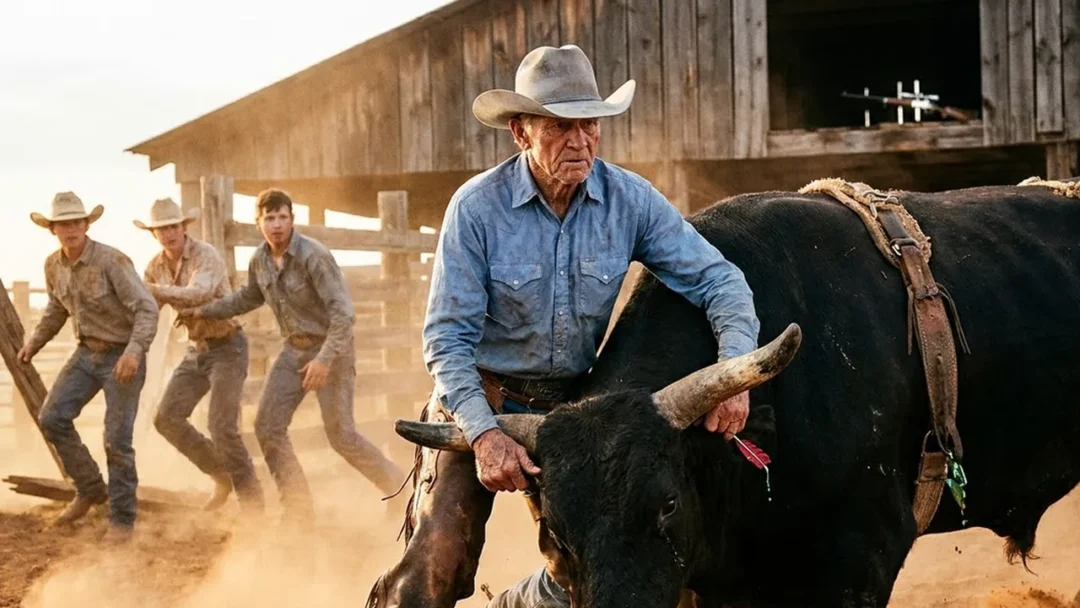
Deprived of all spinal alignment, the bull’s massive front legs buckled beneath its fifteen-hundred-pound bulk. With a deafening, wet thud that shook the arena dirt and kicked up a blinding plume of caliche dust, Black Diablo slammed heavily onto his front knees in the dust, completely immobilized.
Jackson dropped his left knee squarely onto the bull’s pinned neck, maintaining unyielding downward pressure on the horn with his right hand, his breathing deep, steady, and nasal.
The terrifying beast that had just pulverized a six-inch timber fence was pinned flat to the earth, panting heavily, unable to rise, neutralized entirely by fifty pounds of rotational leverage applied to the cervical spine.
Thirty yards away, Cody Callahan and the two young ranch hands scrambled out of the dust, their jaws dropping to their chests in absolute, stunned disbelief.
“Sweet mother of God…” Cody whispered, his hands trembling as he stared at his grandfather kneeling calmly atop a ton of snorting beef. “You… you wrestled Diablo onto his knees barehanded? Without a rope?!”
“Never pull straight, Cody,” Jackson said calmly, his voice cutting through the swirling dust. “When you pull straight, you give him his spine. Turn the head, lock the neck, and his own weight drops him.”
Jackson reached down with his free left hand to soothe the trembling beast’s flank.
As his fingers slid along the heavy leather saddle cinch beneath the bull’s brisket, his calloused fingertips brushed against an unnatural, razor-sharp obstruction hidden beneath the sheepskin padding.
Jackson’s eyes narrowed into two freezing chips of grey flint.
He parted the sheepskin fleece. Embedded deep into the bull’s vascular flank tissue was a miniature, red-anodized aluminum feather-dart, its hollow needle leaking a bright, fluorescent-green synthetic fluid directly into the animal’s bloodstream.
And high in the dark, shadowed hayloft of the timber barn three hundred yards across the arena, a sharp, momentary optical reflection—the unmistakable flash of sun on a rifle scope lens—winked through the dusty heat.
“Cody,” Jackson said, his voice dropping into a deadly, freezing rasp that silenced the arena. “He wasn’t crazy. Someone shot him with adrenaline from the barn.”
The historical development of steer wrestling—historically referred to across the American West as ‘bulldogging’—was pioneered in the early nineteen-hundreds by legendary African-American cowboy and ranch hand Bill Pickett. Performing at wild west shows and roundups across Texas, Pickett discovered that an unruly steer could be neutralized without ropes, horses, or firearms by utilizing the animal’s own nasal leverage. By biting or clamping down on the sensitive upper lip or nasal septum and twisting the horns in a sharp counter-clockwise rotation, Pickett demonstrated that even an aggressive twelve-hundred-pound Texas longhorn could be brought cleanly to the earth in less than ten seconds. While modern rodeo sports evolved into a timed athletic contest involving two mounted riders and explosive arena drops, the ancient frontier technique of standalone, dismounted ground leverage remained a closely guarded discipline practiced only by master stockmen who understood that leverage, velocity, and neurological timing are infinitely superior to brute muscular force.
The rotational physics of the human-bovine collision on the arena floor had been calculated by Jackson over thousands of live encounters in the wild brush of the Nueces Strip. When an animal of fifteen hundred pounds charges at twenty miles per hour, its linear kinetic energy exceeds twenty-five thousand Joules. Attempting to oppose that kinetic energy with a stationary mass is a fatal error. But by slipping into the rotational vortex of the bull’s turn, an experienced steer wrestler acts as a dynamic fulcrum, converting the animal’s linear velocity into angular momentum. By applying vertical torque to the nose-ring while pinning the horn tip against the lateral ribcage, the bull’s own momentum acts as the primary force that drives its front shoulders downward into the caliche dirt, using the animal’s colossal mass to defeat its own stability.