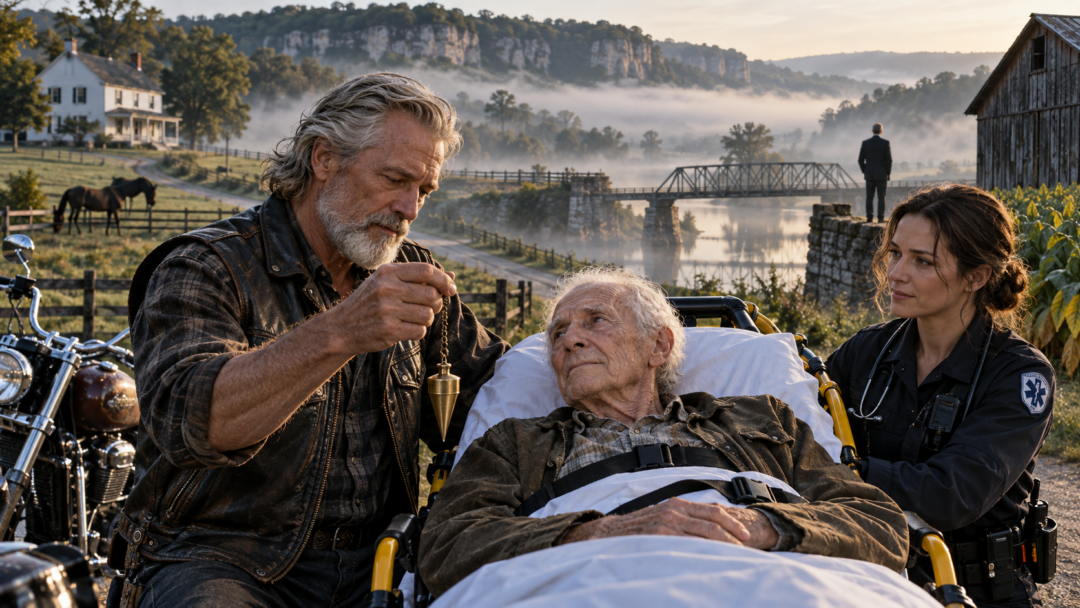
The Broken Promise Of Blackwood Farm And The Old Rider’s Debt
CHAPTER 2: THE WHISPERED GAUGE
“St. Jude hospice is forty miles away across county lines,” Cole snapped, his voice cutting like a cold, hardened chisel through the humid porch air. “Bardstown Memorial Hospital has a certified, state-of-the-art Level Two trauma ICU seven minutes down Highway 31. You take him to Bardstown right now.”
The lead paramedic looked at the laminated DNR document fluttering in Julian’s trembling hand, then looked directly into Cole Mercer’s eyes. The six-foot-one veteran biker didn’t move an inch. His massive, leather-clad frame stood squarely between the gurney and the ambulance doors, radiating thirty years of uncompromising, ironclad authority that made the younger deputy on the gravel shift his boots nervously.
“Sir,” the paramedic said cautiously, gesturing toward the open ambulance interior. “County EMS protocol strictly requires transport to the nearest qualified emergency department for acute metabolic stabilization when the field glucose is unreadable on the digital meter. We are transporting directly to Bardstown Memorial.”
Julian’s face twisted into an ugly, livid grimace, his hands shaking with sudden, violent agitation as he shoved the laminated papers back into his leather portfolio. “I am his court-appointed healthcare surrogate under an executed power of attorney! If you deviate from the documented care directive, my legal counsel will have your state licenses and emergency certifications revoked by sunrise tomorrow!”
“Take him to Bardstown,” Cole commanded the paramedic, ignoring Julian completely as if the man were no more than a buzzing horsefly. “I’m riding fifty feet off your bumper. If anybody tries to divert this rig, they deal with me.”
The paramedic nodded once—a quick, solemn gesture of mutual understanding. The Stryker gurney locked into the floor tracks with a sharp, heavy mechanical click, the dual rear ambulance doors slammed shut with a concussive thud, and the heavy emergency vehicle lurched down the red-dirt lane, its siren screaming into the quiet hills as its ruby-red strobes painted the cedar fence lines in rhythmic, warning flashes.
Cole turned his back on Julian Vance and slowly descended the porch steps. Barnaby trotted faithfully beside him, his wet nose sniffing the fresh tire tracks left in the crushed limestone gravel by the departing ambulance.
Before Cole reached his motorcycle, something Elias had whispered in that final, dying breath echoed through his memory with crystal clarity. It hadn’t been just Cole’s name. As the gurney had cleared the porch threshold, the old man’s calloused fingers had dug with surprising, desperate strength into Cole’s wrist, his raspy voice hissing two distinct syllables beneath the hiss of the oxygen cannula:
“…brass gauge… beneath… South Bend…”
Cole stopped at the edge of the gravel drive. He turned his head and looked past the main stone house toward the dark, weathered timber walls of the machine shop.
Julian Vance had not followed the ambulance down the lane. He had remained on the front porch, pulling a sleek black smartphone from his pocket, dialing rapidly while pacing the cedar planks like a cornered fox. His back was turned toward the rear yard, his shoulders hunched as he argued frantically into the receiver, gesturing with his free hand toward the woods.
Cole didn’t hesitate. He slipped around the side of the stone milkhouse, using the dense, overgrown growth of heirloom lilac bushes to shield his movements from the porch, and crossed the seventy feet of red clay toward the machine shop’s side entrance.
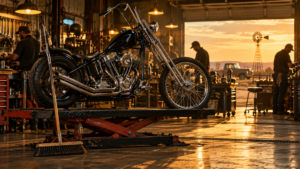
The shop smelled of cold fifty-weight cutting oil, kerosene cleaning solvent, and the sharp, mineral tang of freshly shaved cast iron. Shafts of morning sunlight cut through the grimy wire-glass windows, illuminating rows of vintage American machine tools that Elias had meticulously maintained for over half a century: a massive 1948 Cincinnati universal milling machine, a heavy hydraulic surface grinder, and in the center of the main service bay, an eighteen-inch South Bend gear-head lathe with an eight-foot bed.
Cole approached the lathe. The machine was pristine. Elias kept the ground steel ways coated in a protective film of light spindle oil, completely free of rust, dust, or machining slag.
Cole dropped to his knees on the worn heart-pine floorboards beneath the heavy cast-iron chip pan. He clicked on a small tactical penlight, shining the narrow white beam into the dark recess between the machine’s heavy pedestal legs.
Bolted beneath the headstock casting, hidden completely from view unless an operator lay flat on the floorboards, was a vintage dovetailed oak instrument box—a master machinist’s Starrett inspection kit that Elias had carried home from the naval shipyard in Norfolk in 1954.
Cole reached up, unlatched the tarnished brass hasps, and lowered the heavy wooden lid.
Inside, resting in fitted green velvet recesses, lay a polished six-inch brass Vernier height gauge. Tucked beneath the velvet tray sat an unsealed manila envelope from an independent medical pathology laboratory in Lexington, Kentucky, date-stamped six days prior.
Cole pulled out the documents, his heart thudding against his ribs.
The first page was a comprehensive toxicological blood screening requested personally by Elias Boone after he had noticed recurring tremors in his hands. Highlighted in bold red ink by the testing pathologist was an extreme serum concentration of Glimepiride—a potent, second-generation oral sulfonylurea medication prescribed exclusively for advanced type-two diabetes that works by violently forcing the pancreas to flood the bloodstream with synthetic insulin.
Attached to the laboratory report was a handwritten note in Elias’s sharp, mechanical lettering, penned with a draftsman’s ruling pen:
Julian has been grinding these white tablets into my morning oatmeal and coffee since late July. I found three empty blister packs hidden inside the wellhouse pump filter behind the pressure tank. He thinks my mind is failing and that the doctors will call it senile delirium. If I die of sudden heart stoppage or diabetic shock, do not let him bury me without a formal state autopsy. The 1952 original quarry deed is welded inside the hollow column of the Cincinnati mill. Julian signed a secret option to sell the limestone ridge to Apex Aggregates for six million dollars. Don’t let him break my shop, Cole. You are the only son I ever had.
A sudden crunch of gravel outside the shop window caused Cole’s muscles to freeze in place.
Cole slipped the manila envelope into the inner pocket of his leather cut, zipped the heavy brass zipper shut, and eased the oak instrument box back into its hidden bracket. Through the dusty window glass, he saw Julian Vance walking swiftly down the garden path from the house, accompanied by two men in dark civilian work shirts carrying two heavy five-gallon plastic jerrycans of kerosene.