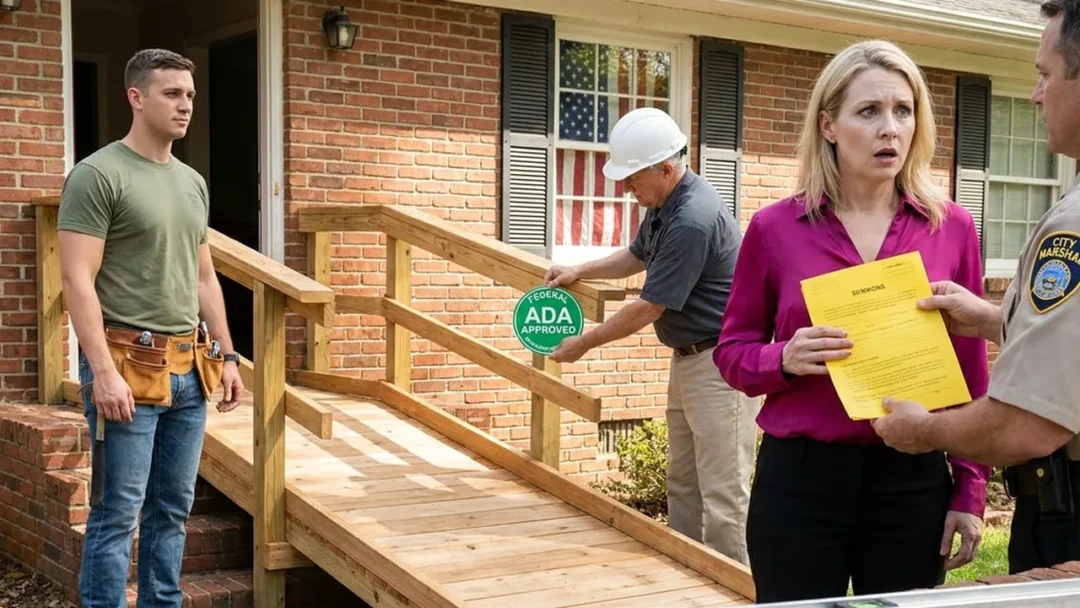
The Cedar Wheelchair Ramp And The Federal Approval Seal
CHAPTER 6: THE FEDERAL ARRAIGNMENT IN ATLANTAAt nine-thirty on Monday morning, Courtroom 4A of the Richard B. Russell Federal Building in downtown Atlanta was filled to capacity. Over eighty residents of Briarwood Glen, representatives from veterans’ advocacy groups, and journalists from across the state packed the oak gallery benches.
Sitting at the defense table, wearing bright orange federal detention jumpsuits and heavy leg shackles, were Gregory Sterling and Pamela Sterling. Flanking them were two court-appointed federal public defenders, their private corporate attorneys having withdrawn from representation following the freezing of all corporate assets by the Department of Justice.
Behind the elevated mahogany bench sat United States District Judge Evelyn Hayes, a formidable jurist known for her unyielding enforcement of civil rights protections and public integrity.
“Mr. and Mrs. Sterling,” Judge Hayes began, her voice cold and cutting through the silent courtroom like a diamond blade. She reviewed the extensive stack of forensic financial reports, wiretapped phone recordings, and federal building inspection logs presented by Assistant United States Attorney Marcus Diaz. “In my twenty-nine years on the federal bench, I have rarely seen a more egregious, predatory abuse of private authority.”
Judge Hayes leaned forward, her sharp gaze burning into the defense table.
“You took an instrument of neighborhood governance—a homeowners association designed to foster community harmony—and transformed it into an extortion syndicate to terrorize disabled veterans, strip equity from elderly pensioners, and destroy the basic human dignity of your neighbors. You attempted to destroy a federally protected wheelchair ramp built with love by an American soldier for his paralyzed father, simply because it offended your aesthetic pretensions and obstructed a commercial land grab.”
Judge Hayes lifted a certified decree submitted jointly by the Department of Justice and the Gwinnett County District Attorney’s Office.
“Under the emergency authority of this court, I am issuing a summary permanent injunction immediately dissolving the Briarwood Glen Homeowners Association Architectural Control Committee. All pending architectural fines, special assessments, and property liens levied against every resident over the past six years are declared fraudulent and vacated with prejudice.”
A collective, emotional gasp of relief swept through the gallery, followed by muted applause that Judge Hayes allowed to linger for a moment before gently tapping her gavel.
“Furthermore,” Judge Hayes continued, “under the provisions of the federal Racketeer Influenced and Corrupt Organizations Act, all personal and commercial assets of Gregory Sterling, Pamela Sterling, and Sterling Apex Holdings LLC are frozen and placed into a federal restitution receivership. A restitution fund of five million dollars is established immediately to restore full title to the eighteen displaced families, repair all damaged properties, and award statutory civil damages.”
Judge Hayes turned her gaze directly upon Gregory Sterling.
“As for the criminal charges: bail for both defendants is denied. You will remain in federal custody pending trial. You are looking at a minimum statutory guideline sentence of twenty-five years in federal prison.”
Judge Hayes raised her heavy walnut gavel.
“This court stands adjourned.”
CRACK!
The concussive strike of the gavel echoed through the cavernous courtroom like an artillery shot, sealing the permanent destruction of the Sterling real estate dynasty.
Across the courtroom, Lucas Mercer stood beside Senior Inspector Frank Caldwell and Marshal Marcus Vance. Lucas felt the knot of tension that had lived in his chest for weeks finally dissolve.
Caldwell smiled, clapping Lucas on the shoulder with his heavy hand. “The law held, Lucas. Now let’s get down to the transit station. Your father’s convoy is arriving in two hours.”
Assistant United States Attorney Marcus Diaz addressed the bench with solemn, unwavering gravity: “Your Honor, this case touches the very foundation of what it means to live in a civilized society governed by law. The Fair Housing Act was not enacted as a mere administrative guideline; it was forged through decades of civil rights struggles to ensure that no citizen—regardless of age, physical ability, or military sacrifice—could be driven from their home by the arbitrary whims of private autocrats. The defendants before you treated federal civil rights laws as minor business expenses, confident that their wealth and political connections would insulate them from accountability. Today, the rule of law has proven that no private enclave stands above the federal constitution.”