The Cedar Wheelchair Ramp And The Federal Approval Seal
CHAPTER 2: THE SEAL OF THE LAW
Senior Building Inspector Frank Caldwell didn’t acknowledge Pamela Sterling’s grandstanding. He walked past her with slow, deliberate steps, his steel-toed work boots crunching softly over the scattered brass screws on the brick walkway.
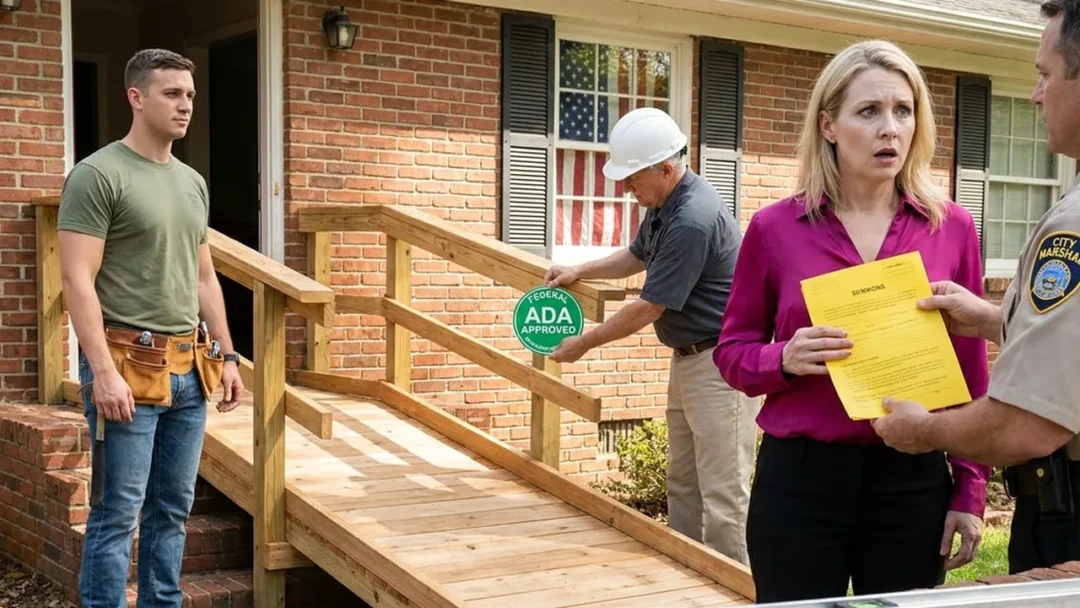
Caldwell stopped at the base of the porch, looking up at the freshly built cedar wheelchair ramp. His experienced, professional eyes swept over the structure: the double two-by-eight floor joists anchored to the brick foundation with three-quarter-inch galvanized wedge anchors; the continuous, smooth cedar handrail sanded to thirty-six inches above the deck; the five-foot level turning platform at the front door; and the anti-slip abrasive aluminum treads countersunk flush into the timber decking.
Caldwell looked up from the wood to Lucas Mercer standing calmly on the porch apron.
Caldwell’s eyes drifted to the faded 101st Airborne crest on Lucas’s green t-shirt, then shifted to the triangular flag box resting in the bay window behind him.
Caldwell took off his white hard hat. A look of profound, solemn recognition softened his weathered face. He reached out his right hand, gripping Lucas’s hand with a firm, iron-hard shake.
“Specialist Mercer,” Caldwell said, his voice deep and resonant. “I’m Frank Caldwell. Senior Chief Warrant Officer Three, 20th Engineer Brigade, retired. Your father, Master Sergeant David Mercer, commanded the heavy combat bridge team at Fallujah in 2004. He pulled four men out of a burning armored carrier on the Euphrates bridge. There isn’t a better soldier or a better engineer in this nation.”
Lucas smiled faintly, feeling the sudden warmth of brotherhood settle over the tense porch. “Thank you, sir. Dad speaks highly of your brigade.”
Pamela Sterling marched up the brick steps, her face twisted into an expression of raw, outraged fury. “Inspector Caldwell! What in heaven’s name are you doing? I called you here to execute an emergency municipal demolition notice! This ramp has zero HOA architectural clearance! It violates Section 4 of our master bylaws! Stop fraternizing with the violator and pull his building permit!”
Caldwell turned around slowly, putting his hard hat back on. His expression transformed into a mask of cold, uncompromising authority.
“Mrs. Sterling,” Caldwell said, his voice cutting through the humid afternoon air like a circular saw through pine. “Under Title VIII of the Civil Rights Act of 1968, commonly known as the federal Fair Housing Act, and Section 504 of the Rehabilitation Act, any individual with a mobility disability is granted the absolute, non-derogable legal right to make reasonable architectural modifications to their private residence to ensure full, unhindered accessibility.”
Caldwell pulled a heavy, laminated green inspection decal from his leather ledger, peeling off the adhesive backing. With a firm, resounding press of his hand, Caldwell slapped the green seal squarely onto the center of the cedar handrail post at the foot of the ramp:
OFFICIAL APPROVAL – UNITED STATES DEPARTMENT OF HOUSING & URBAN DEVELOPMENT – COMPLIANT ACCESSIBILITY STRUCTURE – UNRESTRICTED PERMIT #GA-ADA-2026-088.
Caldwell tapped the green seal with a calloused forefinger.
“This ramp meets every requirement of the International Residential Code and the Americans with Disabilities Act Accessibility Guidelines. Its slope is one-to-twelve. Its load rating exceeds nine hundred pounds. Under federal supremacy doctrine, this ramp is one hundred percent exempt from any local ordinance, zoning restriction, or private homeowners association bylaw.”
Pamela gasped, backing away as if the green seal were burning hot. “Exempt? That’s impossible! Our private association has an ironclad architectural contract!”
“Private contracts that violate federal civil rights statutes are null, void, and criminally unenforceable, Mrs. Sterling,” Caldwell said coldly.
He turned his gaze toward City Marshal Marcus Vance, who was standing on the brick walkway with his citation book open.
“Marshal Vance,” Caldwell commanded. “Under Title 42 of the United States Code, Section 3617, it is a federal crime to coerce, intimidate, threaten, or interfere with any person in the exercise or enjoyment of their rights under fair housing laws. Mrs. Sterling just kicked this veteran’s tools off his porch and openly attempted to block an approved accessibility accommodation.”
Marshal Vance stepped forward, holding a bright yellow legal document printed on heavy cardstock:
UNITED STATES DISTRICT COURT – CIVIL RIGHTS INTERFERENCE SUMMONS – SECTION 3617 MANDATORY CIVIL PENALTY: $10,000.00.
Marshal Vance pressed the yellow document directly into Pamela Sterling’s trembling hands.
“Pamela Sterling,” Vance said, his voice stern and official. “You are hereby served with a mandatory ten-thousand-dollar federal civil rights interference citation. You have twenty-one days to file a response with the United States District Court for the Northern District of Georgia. This penalty is assessed against you personally and cannot be paid or reimbursed using homeowners association funds.”
Pamela stared at the bold black lettering at the top of the yellow summons: $10,000 CIVIL PENALTY.
All the color drained from her face until she was as pale as a bedsheet. Her pearl necklace rattled against her silk blouse as her hands shook uncontrollably.
“Ten… ten thousand dollars?!” Pamela gasped, her voice cracking into a shrill, hysterical wail. “Wait! You can’t fine me personally! I was acting on behalf of the board! The HOA will pay this! Gregory will handle this!”
“The HOA insurance carrier will not indemnify intentional violations of federal civil rights laws, Mrs. Sterling,” Marshal Vance replied with zero sympathy. “Have a good afternoon.”
Pamela spun around, stumbling over the brass screws on the walkway as she fled toward her luxury sedan parked across the street.
Lucas looked down at the green seal on the cedar post, then looked at Inspector Caldwell.
“Thank you, Inspector,” Lucas said quietly.
Caldwell adjusted his white hard hat, looking across the street at the Sterlings’ massive five-thousand-square-foot brick estate. “Don’t thank me yet, Lucas. Gregory Sterling didn’t make forty million dollars in commercial real estate by rolling over. Watch your perimeter this weekend. He isn’t going to let this go.”