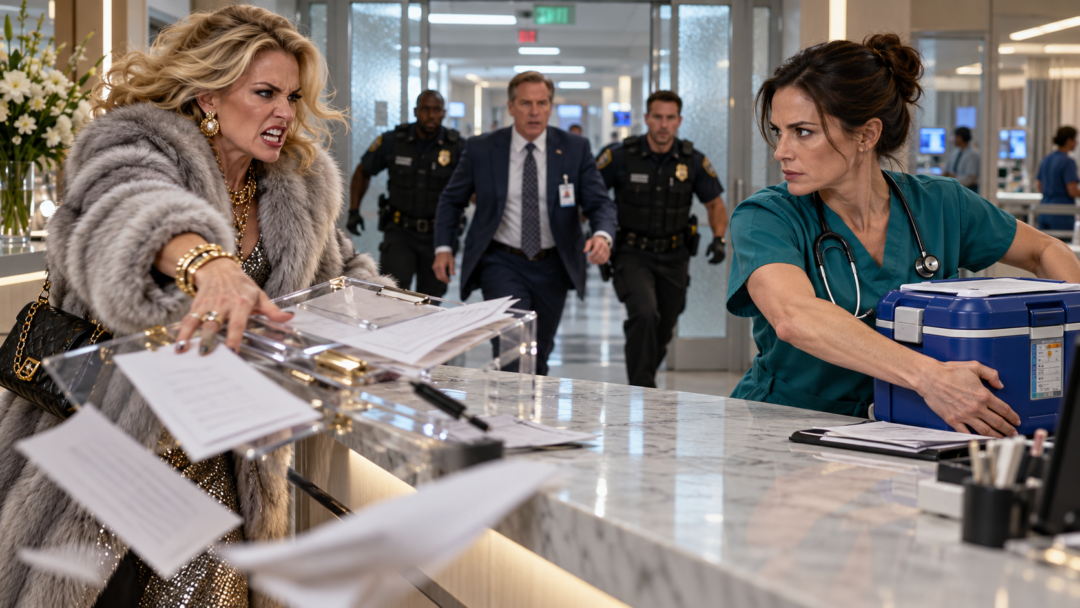
The Emergency Serum Container And The Hospital VIP Wing
CHAPTER 7: THE RHYTHM OF THE MONITOR
The atmosphere inside Operating Room 4 was a masterclass in clinical discipline, where human mortality was fought back with steel, science, and collective will. The bright overhead surgical lamps illuminated the sterile field in brilliant, shadowless white light, where a dedicated team of anesthesiologists, perfusionists, surgical scrub nurses, and senior fellows moved with synchronized, practiced precision.
At the center of the room lay eight-year-old Maya Jenkins, her tiny chest exposed beneath green sterile drapes, her vitals monitored by the rhythmic, urgent beep of the cardiac telemetry screen. Maya had been struck by a hit-and-run driver on the FDR Drive two hours earlier, suffering a catastrophic tear to her descending aorta and massive internal hemorrhaging. Her blood pressure was precariously low, hovering at the razor’s edge of irreversible hemorrhagic shock, her heart rate spiking as the emergency bypass pump struggled to maintain cerebral perfusion.
Dr. Vivienne Sterling stepped up to the scrub sink, washed her hands with surgical iodine for the full three minutes, and allowed the scrub nurse to gown and glove her in sterile blue garments.
“Initiate the cold-chain thaw sequence immediately,” Dr. Sterling commanded calmly as she stepped to the operating table, her voice cutting through the mechanical hum of the room with absolute authority.
The blue container was unlocked, and the vials of autologous vascular clotting factor were drawn into sterile micro-infusion syringes. Within ninety seconds, the advanced biological compound was infused directly into the damaged vascular graft.
What followed was two hours of sheer surgical mastery that few surgeons in the world could replicate. With hands as steady as granite and fingers as delicate as a master watchmaker’s, Dr. Vivienne Sterling reconstructed the shattered artery, placing seventy-two microscopic polypropylene sutures along the paper-thin vessel wall of the child’s aorta. Every movement was economical, every stitch placed with sub-millimeter precision under high-magnification surgical loupes.
As the vascular cross-clamps were finally released, the warm arterial blood surged through the newly repaired vessel. The synthetic biological scaffold held flawlessly, the cellular clotting factors sealing every micro-fissure without a single drop of leakage.
On the overhead telemetry monitor, the erratic, rapid alarm tones smoothed into a strong, rhythmic, beautiful cadence: Beep… beep… beep…
“Blood pressure is stabilizing, Dr. Sterling,” the chief anesthesiologist announced, his voice thick with awe and uncontainable relief. “One hundred over sixty-five. Cerebral oxygenation is one hundred percent. The graft is completely secure. The hemorrhage has stopped.”
A collective, quiet sigh of triumph and tears of relief swept through the operating theater.
Dr. Sterling stepped back from the table, lowered her surgical mask with gloved fingers, and looked down at the peaceful, stabilized face of the sleeping child. A warm, exhausted smile touched her lips, washing away the fatigue of the long night.
Four hours later, the rain had completely stopped over Manhattan, and the early morning sun broke through the autumn clouds, painting the East River in shimmering ribbons of rose, silver, and gold.
In the surgical waiting room, Maya Jenkins’s parents sat huddled together on vinyl chairs, their faces pale with agony, exhaustion, and grief, clutching each other’s trembling hands. When the double doors hissed open and Dr. Vivienne Sterling walked into the room, still wearing her faded, sweat-stained teal scrubs, the parents rose to their feet in sheer terror, bracing themselves for the worst news of their lives.
Dr. Sterling took both of the mother’s hands in her own, her voice warm, gentle, and deeply reassuring. “Maya is going to be fine. The vascular repair was a complete success. She is waking up in post-op, her vitals are perfect, and she is going to make a full, unrestricted recovery.”
The mother collapsed into tears of overwhelming joy, burying her face in Dr. Sterling’s shoulder, sobbing uncontrollable thanks, while the father wept openly, wrapping his arms around both of them and thanking God and the surgeon over and over again.
Standing by the panoramic windows of the main lobby, Dr. Richard Hayes watched the scene with profound pride and deep humility. The Board of Trustees had already met in an emergency dawn session: Ronald Vance had been unanimously stripped of his seat and expelled from the hospital council, Cecelia Vance faced multiple felony indictments without bail, and the hospital’s luxury concierge suites were being permanently converted into free pediatric trauma recovery rooms endowed by the Sterling Foundation.
Dr. Vivienne Sterling walked over to the glass, looking out over the waking city as the morning sunlight illuminated the brass letters of the Ruth & Harold Sterling Pavilion high above York Avenue.
She took a deep, clean breath of the morning air. In the sacred halls of healing, wealth, arrogance, and entitlement had tried to conquer truth, but in the end, it was love, clinical dedication, and the unyielding oath of medicine that had triumphed.