The Torn Archival Folio In The Gothic University Library
CHAPTER 1: THE SANCTUARY OF SHADOWS
The high Gothic clerestory windows of Hawthorne Memorial Library rose like towering stone ribs toward the vaulted ceiling, filtering the crisp New England morning sunlight into rich shafts of amber, cobalt, and cathedral gold. Outside, across the historic brick quadrangle of St. Jude University, ancient sugar maples shed their scarlet and bronze autumn leaves in the brisk Connecticut breeze. The library had stood at the heart of the campus since 1784, a monument of heavy granite blocks, hand-carved gargoyles, and leaded stained-glass panels gifted by generations of scholars. Inside the central reading nave, the atmosphere was steeped in an almost religious stillness, broken only by the muffled ticking of an eight-foot mahogany grandfather clock in the south transept and the delicate whisper of turned vellum pages echoing off centuries-old stone walls.
Tucked into the secluded northern alcove, beneath a soaring stained-glass depiction of medieval philosophers and Renaissance astronomers, sat Dr. Elena Zhao. At twenty-six, Elena looked considerably younger than her years, her petite frame swathed in an oversized, heather-grey fleece hoodie and faded black corduroy trousers. Her long, ink-black hair was pinned back with a simple tortoise-shell clip, and round, wire-rimmed reading spectacles sat slightly down the bridge of her nose. To an outside observer glancing down the shadowed colonnade, she resembled an exhausted first-year undergraduate cramming for a difficult organic chemistry midterm. She wore no jewelry, carried no designer accessories, and preferred the solitary comfort of raw academic inquiry to the bustling social clubs that dominated campus life.
Nobody would guess that beneath the casual, unassuming collegiate attire was the youngest tenured research chair in the three-hundred-year history of St. Jude University—a prodigy in computational neuro-biology whose synthetic bio-neural scaffold patent had recently revolutionized clinical pediatric nerve regeneration. Her breakthrough algorithms allowed severed motor neurons to bridge micro-cellular gaps, restoring movement to children once deemed permanently paralyzed. The global medical patent, held in trust by the university foundation, had licensed for tens of millions of dollars, yet Elena continued to work in the quiet corners of the library, verifying historical clinical baselines with her own eyes.
Spread across the massive quarter-sawn English oak desk before her were several heavy volumes of archival laboratory records dating back to 1912. Elena dipped a brass dip pen into archival black ink, carefully transcribing a sequence of historical molecular binding observations into a bound linen notebook. Beside her notebook sat an official engraved brass placard bolted directly into the oak tabletop: Reserved Exclusively for Doctoral Research Fellow – Department of Biomedical Engineering. The desk had been designated by the university provost as a federally certified archival workstation, equipped with precision optical sensors to monitor light exposure and temperature for fragile documents.
The sacred silence of the reading nave was suddenly shattered by the sharp, rhythmic clatter of high-heeled designer boots echoing off the polished marble aisle like gunfire.
“Girls, look! That’s the exact alcove from the alumni architectural magazine!”
A loud, piercing voice cut through the cathedral quiet, accompanied by the high-pitched giggle of an entourage. Elena paused, her pen hovering a fraction of an inch above the pristine paper, her brow furrowing slightly at the acoustic intrusion. In Hawthorne Library, speaking above a whisper was strictly prohibited by university statutes dating back to the nineteenth century.
Marching into the private alcove was Victoria Sterling, flanked by three sorority sisters dressed in matching cashmere trench coats and carrying gold-ringed smartphone tripods. Victoria was twenty-one, the president of the elite Alpha Theta sorority, dressed in a tailored houndstooth blazer, leather leggings, and knee-high stiletto boots. Her blonde hair fell in cascading, salon-styled waves, and her lips were painted in aggressive crimson gloss. Tucked in the crook of her arm was an oversized quilted Chanel handbag that she swung with casual, haughty disregard for the historic space and the scholars working nearby.
Without breaking stride, Victoria reached Elena’s desk, lifted her heavy leather handbag, and slammed it down with violent force directly onto the corner of Elena’s open 1912 archival ledger.
The heavy brass hardware of the purse gouged the fragile edge of the leather binding, scattering several loose reference note cards and handwritten clinical charts across the oak table.
Elena lifted her head slowly. Behind her wire-rimmed lenses, her dark eyes were completely still, measuring the intrusion with the quiet detachment of a surgeon examining an unexpected incision in an operating theater.
“Excuse me,” Elena said softly, her voice cool, measured, and devoid of fear. “This desk is reserved for doctoral research. Please remove your bag from the archival material immediately.”
Victoria scoffed, letting out a sharp, theatrical laugh that echoed through the vaulted ceiling, drawing alarmed, disapproving glances from graduate students thirty yards away.
“Doctoral research?” Victoria sneered, leaning her manicured hands on the table and towering over Elena with practiced condescension. “Sweetheart, I don’t care if you’re writing a middle-school book report or curing hiccups. My sorority booked this library wing for our homecoming philanthropy media shoot. Move your backpack, grab your cheap pens, and find a beanbag chair in the basement where people like you belong.”
“This table cannot be reserved for photoshoots,” Elena replied, her voice remaining low, steady, and unbothered. She gestured toward the brass placard firmly secured to the oak. “This alcove contains active clinical trial reference folios under environmental climate control. The sign is clear.”
Victoria’s blue eyes narrowed into cruel slits. She leaned closer, her heavy designer perfume overwhelming the faint, comforting scent of antique cedar, aged vellum, and iron-gall ink.
“Let me educate you on how this campus works, scholarship beggar,” Victoria hissed, her voice vibrating with venom. “My father is Bradley Sterling. He sits on the University Board of Regents, and his private equity firm just pledged ten million dollars toward the new athletic complex. My family literally buys and sells the chairs you sit on. When a Sterling tells you to move, you don’t read brass signs—you pack your charity-case backpack and run before you find your enrollment terminated!”
Elena did not move an inch. She calmly capped her brass dip pen, folded her hands atop her linen notebook, and looked directly into Victoria’s furious gaze.
“Wealth does not confer the right to desecrate historical property, Miss Sterling,” Elena said with razor-sharp precision. “And your father’s pledge does not purchase this desk.”
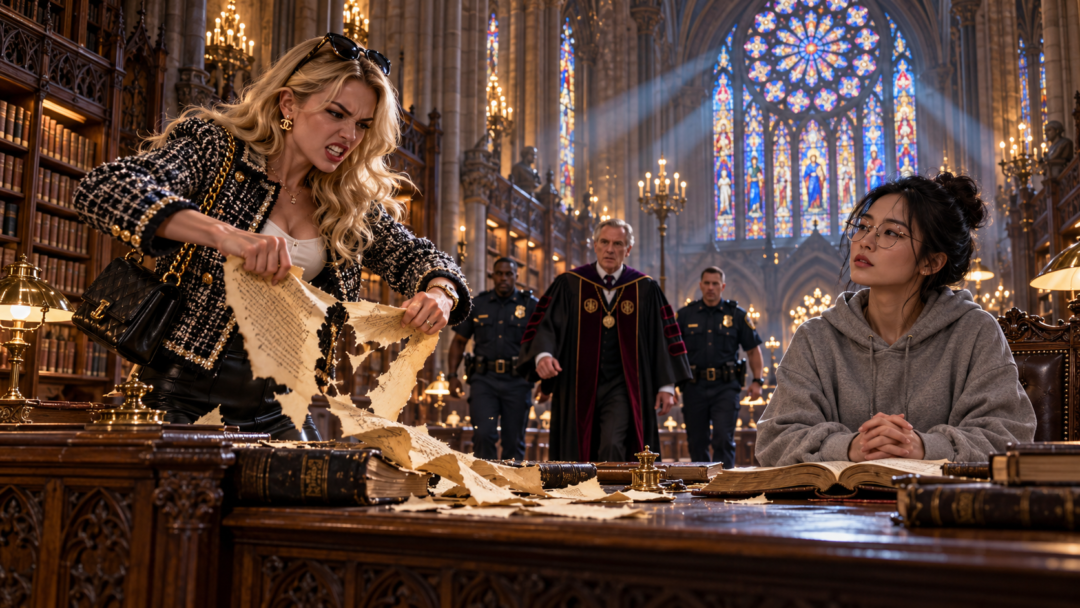
Victoria’s face flushed crimson beneath her bronzer. Trembling with uncontrolled rage at being defied, she reached across the table, grabbed the hundred-year-old leather-bound neuro-surgical folio with both hands, and violently ripped three ancient parchment pages completely out of the spine.
The sickening sound of tearing antique paper echoed through the cathedral nave like a gunshot.
Victoria threw the torn, yellowed fragments into the air, letting them flutter contemptuously down onto the dusty floorboards. “There! Now your little book is ruined! Complain to the librarians, charity case, and my father will have you expelled before sundown!”
Elena looked down at the torn fragments resting on the dark oak floor. Instead of panicking or crying, her expression shifted into a chilling, absolute stillness. She leaned forward, calmly noted the red-ink classification code stamped on the bottom of the torn margin, and glanced up at Victoria with an icy, unblinking stare.
The stamped classification code read: National Science Foundation / Department of Defense Priority Research Archive – Asset Classification Alpha-One.