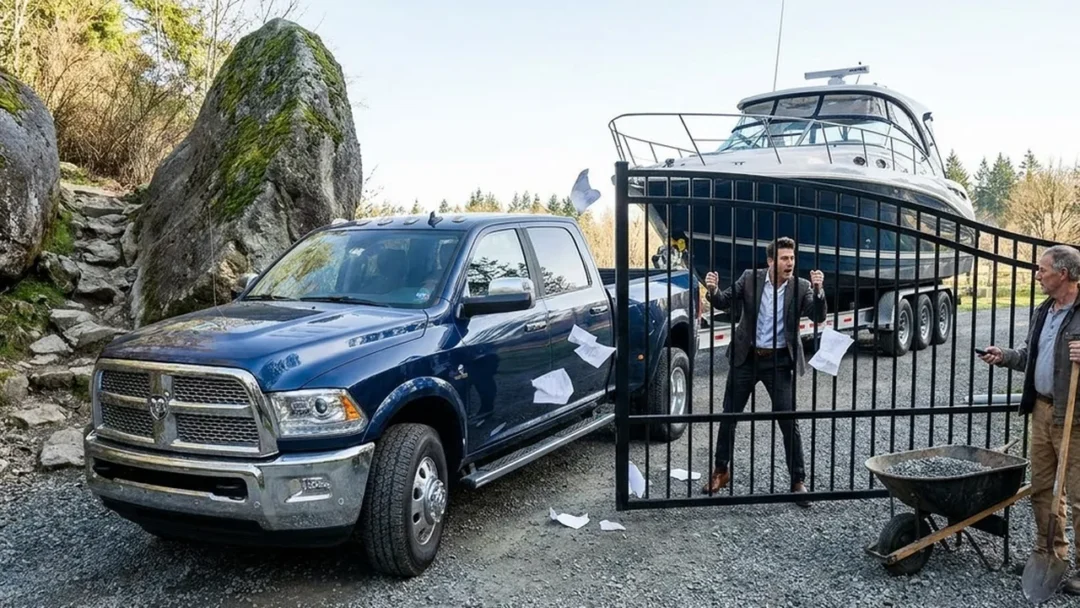
The Heavy Iron Gate Across The Lake Mountain Switchback Road
CHAPTER 4: WATER IN THE BEDROCK
While Deputy Martinez was conducting his vehicle inspection on the asphalt apron, a white Bonner County Building & Planning Division pickup truck crested the ridge, its tires crunching over the loose shale of the access road.
Martha Cole, the senior county code enforcement director for northern Idaho, stepped out of the truck carrying an electronic distance meter, a soil compaction penetrometer, and a thick blue binder containing the approved construction blueprints for the Sunrise Ridge subdivision.
At fifty, Martha was a formidable, sharp-eyed civil engineer who had spent twenty-five years inspecting cliffside foundations around Lake Pend Oreille. She knew that in mountain terrain, water was a living, destructive force; any developer who cut corners on drainage risked bringing hundred-ton mudslides down onto the homes below.
“Afternoon, Deputy. Sean,” Martha said, nodding to the officer and the landowner. She turned her cold, analytical gaze toward Chad Hollister, who stood flanked by his truck, looking completely disoriented.
“Mr. Hollister,” Martha said, unrolling a set of large-scale architectural elevation drawings across the hood of her county truck. “Our department received an urgent geotechnical notification from the state Department of Water Resources this morning. Last week, during the unseasonable autumn rainstorm, significant subterranean silt displacement was recorded along the western bedrock shelf supporting your new residence.”
Hollister blinked, wiping the cold sweat from his forehead with his sleeve. “What does that have to do with my driveway?”
“It has everything to do with this driveway, Mr. Hollister,” Martha replied, pointing her pen at the cross-sectional grading diagram. “When you purchased the spec-mansion on Lot 4 from Mountain Crest Developers three months ago, the certified site plan required the installation of an engineered, eighty-thousand-dollar subterranean stormwater retention vault to collect and dissipate the roof runoff from your twelve-thousand-square-foot structure.”
Martha looked up from the prints, her voice dropping into a stern, unforgiving cadence.
“Yesterday afternoon, county inspectors inspected the drainage outfall behind your retaining wall. You never built the retention vault. To save forty thousand dollars in civil excavation costs, your contractor ran a secret six-inch corrugated PVC drainpipe along your property line, burying it twelve inches beneath the surface, and discharged the entire roof drainage directly into the roadbed ditch above Sean Callahan’s private driveway.”
Sean stepped forward, his jaw tightening as he looked at the county prints. “That explains why the lower blacktop culvert started boiling with gray clay silt two days ago. The roadbed subgrade was completely saturated from underneath.”
“Exactly, Sean,” Martha confirmed. “Mr. Hollister’s illegal drainage bypass washed out the aggregate sub-base beneath forty feet of your paved driveway. If heavy equipment—such as a sixteen-ton boat trailer—had rolled across that asphalt today, the roadbed would have collapsed into the ravine, taking the trailer, the truck, and the driver down with it.”
Hollister’s breath hitched in his throat. He looked at the smooth asphalt surface of the driveway, then at the sheer two-hundred-foot drop into the canyon below.
“I… I didn’t know,” Hollister stammered, his arrogance completely evaporating into a desperate, hollow whimper. “The developer told me the drainage was certified… he said it was signed off by the county…”
“The developer forged the civil engineer’s stamp on the final occupancy affidavit, Mr. Hollister,” Martha said, pulling a bright orange legal placard from her binder and slapping it firmly onto the driver’s window of Hollister’s pickup.
Printed across the placard in bold black block letters were the words: STOP-WORK ORDER & CERTIFICATE OF OCCUPANCY REVOCATION — PROPERTY DEEMED GEOTECHNICALLY UNSTABLE.
“Your residence is red-tagged as an active erosion hazard,” Martha declared. “You cannot inhabit the premises, you cannot operate heavy machinery on this ridge, and until an engineered retaining system is installed, no commercial transport vehicles may move across this mountain shelf.”
Across the road, Hollister’s phone chimed with a loud, final chime.
He opened the screen. It was an email from the marine broker in Coeur d’Alene:
“Mr. Hollister: The prospective buyer waited forty-five minutes at the Hope Marina. You failed to appear. The cash purchase offer has been withdrawn, and the buyer has executed an option on an alternative vessel in Spokane. Your listing agreement is canceled.”
Hollister let his phone slip from his fingers. It tumbled down onto the black asphalt, cracking its glass screen against the very gravel he had refused to pay for.