The Heavy Iron Gate Across The Lake Mountain Switchback Road
CHAPTER 6: THE CRANE ON THE RIDGE
By Saturday morning, the weather on Sunrise Ridge had turned bitterly cold. A dusting of powdery snow coated the dark boughs of the Douglas firs, and a gray, leaden sky hung low over the icy waters of Lake Pend Oreille.
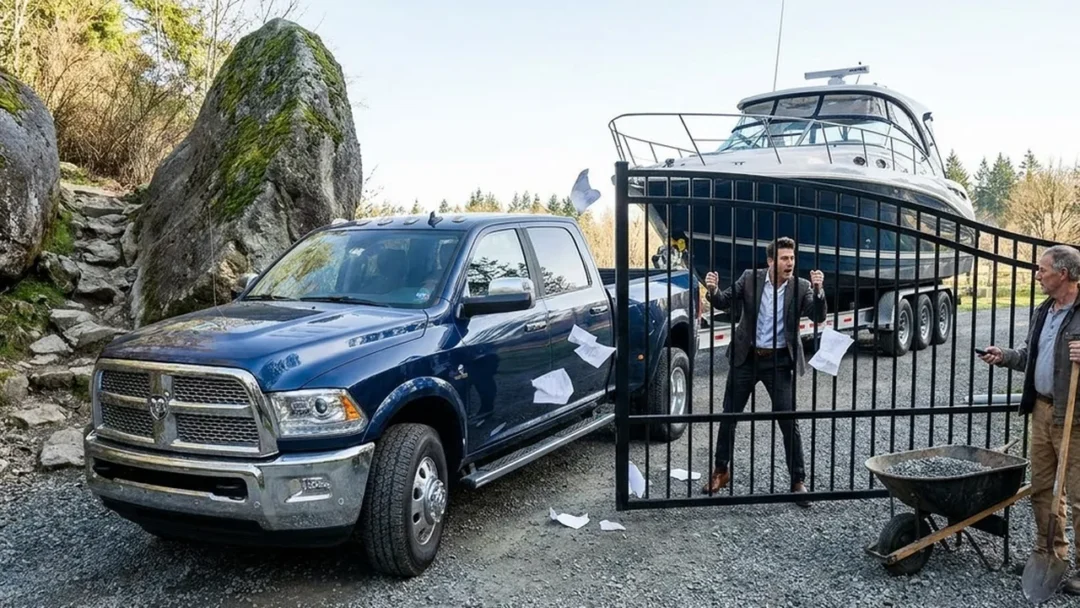
At the fork in the mountain road, Chad Hollister’s luxury Ford F-450 and thirty-six-foot boat trailer were still parked exactly where they had stopped four days earlier, trapped on the narrow strip of asphalt before the locked iron gate. The trailer tires were dusted with frost, and a thin sheet of clear ice coated the pristine fiberglass deck of the cabin-cruiser.
Idling behind the trailer was a massive, four-axle all-terrain commercial recovery crane belonging to North Idaho Heavy Haul & Rigging. The diesel exhaust from the crane’s turbocharged engine rose in thick, white plumes into the freezing air, its heavy hydraulic outriggers resting on four-inch oak timber cribbing laid carefully across the rock shoulder.
Wyatt Vance, the crane master, stood beside the control console, wearing insulated Carhartt coveralls, heavy steel-toed boots, and a hard hat with reflective yellow safety stripes. Beside him, two rigging technicians were wrapping thirty-foot nylon lifting slings around the structural lifting eyes of the boat trailer’s chassis.
Chad Hollister leaned against the side of his truck, shivering violently in a light windbreaker, his face gaunt, his eyes sunken from four sleepless nights spent in a cheap motel room in Sandpoint.
“Wyatt, please, be careful with the hull,” Hollister pleaded, his teeth chattering in the cold. “That gelcoat is custom three-stage metallic flake. If a sling rubs the rub-rail, it will cost ten thousand dollars to repair.”
Wyatt didn’t even turn his head. He pulled a digital work-order terminal from his pocket and held it out toward Hollister.
“Mr. Hollister,” Wyatt said, his voice rough and uncompromising. “Before my operator touches the hydraulic boom levers, we need to settle the mobilization charge. Forty-eight hundred dollars for the mobile crane, eight hundred for the certified rigging crew, and seven hundred for the county road-closure permits. Total: six thousand three hundred dollars. Certified funds or cashier’s check only.”
Hollister pulled out a platinum business credit card with trembling fingers, handing it to Wyatt. “Run it on the card. Run it right now.”
Wyatt inserted the card into the mobile satellite terminal mounted on the crane chassis. The device beeped twice, contacted the banking network in Boise, and flashed a bright crimson error message across the screen: TRANSACTION DECLINED: ACCOUNT FROZEN BY ISSUER.
Hollister stared at the screen in utter horror. “What? That’s impossible! I have a five-hundred-thousand-dollar credit line on that account!”
“Try another card, Mr. Hollister,” Wyatt said calmly. “Because in fifteen minutes, my drive-time clock expires, and my crew rolls back to the yard in Bonners Ferry.”
Hollister frantically pulled two personal cards from his wallet, sliding them through the terminal one after the other.
DECLINED.
DECLINED.
A sickening wave of nausea washed over Hollister. He pulled out his phone, clicking into his commercial banking portal. Across the top of his corporate account was a formal judicial freeze notice from the Spokane Superior Court:
NOTICE OF ATTACHMENT: ALL ASSETS FROZEN PENDING GEOTECHNICAL REMEDIATION LAWSUIT AND FRAUD INVESTIGATION REGARDING LOT 4 SUNRISE RIDGE.
“My bank accounts…” Hollister choked out, sinking to his knees on the frozen gravel. “The title company filed a freeze order… I’m wiped out…”
Wyatt Vance looked down at the broken speculator, then walked across the road toward Sean Callahan’s house.
Sean was standing beside his woodpile, splitting seasoned larch logs with an eight-pound maul, his movements rhythmic and steady in the crisp morning chill.
“Sean,” Wyatt called out, leaning on the cedar fence. “The guy’s broke. All his plastic is locked down by the courts. My crane isn’t lifting an ounce of steel without payment.”
Sean set his maul down against a log, took a slow breath of the cold mountain air, and walked over to the fence.
“Wyatt,” Sean said quietly. “If that trailer stays on that roadbed through the winter, the snowplows can’t clear the switchback, and the weight will shear the frost-heaved shoulder into the creek.”
“I know it, Sean,” Wyatt said with a grim nod.
“How much to lift the rig onto a transport flatbed and haul it straight to the county impound yard in Sandpoint?” Sean asked.
“For you, Sean? Five thousand flat,” Wyatt replied. “I’ll take your personal check on the Sandpoint bank.”
Sean pulled an old leather checkbook from his jacket pocket, uncapped a worn ballpoint pen, and wrote out the check without hesitation.
“Hook the crane, Wyatt,” Sean said, handing the paper across the cedar rail. “Let’s clear the road.”