The Leaking Hull In The Newport Slip And The Harbor Queen
CHAPTER 2: THE APPRENTICE IN THE CEDAR SHED
Three hours before the confrontation at Slip Four, the rain had been nothing more than a steady, gray drizzle sweeping off Narragansett Bay, misting the rusted iron roofs of the Cross Point Marine Yard. The shipyard sat on a low spit of shale at the northern mouth of the harbor, a collection of historic weathered-cedar workshops, open-air dry docks, and massive gantry cranes that had repaired wooden schooners during the whaling boom and coastal minesweepers during the second world war.
Inside Workshop Number Three, the air smelled richly of white oak sawdust, boiled linseed oil, and old iron. The floor was packed earth covered with generations of cedar shavings. In the center of the bay, rested upon heavy white-oak keel blocks, sat the thirty-foot mahogany tender to the Aegis.
Eleanor Cross stood at a heavy workbench fashioned from a single timber of coastal fir, a pair of steel dial calipers in her hand. She was examining a bronze sea-valve assembly that had been removed from the tender’s cooling line. Beside her, working under the yellow cone of an incandescent drop-light, stood Thomas Bennett.
Thomas was twenty-four, with grease-stained knuckles, broad working-class shoulders, and the restless, haunted eyes of a young man who had seen something he wished he hadn’t. His grandfather had served as master carpenter under Eleanor’s father forty years ago, and Thomas had shown the same rare, intuitive genius for naval mechanics—the kind of shipwright who could place his palm against an idling diesel block and tell you within three cylinders where the bearing was wearing thin.
“Look at the machining on that bypass flange, Eleanor,” Thomas said quietly, his voice competing with the rhythmic drum of rain against the corrugated roof. He pointed a blackened fingernail at the interior throat of the bronze valve. “That’s not factory spec. Sea Ray and Northern Marine use standard three-bolt flanged fittings with neoprene gaskets. This thing has an internal solenoid sleeve machined from nickel-aluminum bronze. It’s an electronically actuated dump valve.”
Eleanor held the bronze casting up to the light, sighting down the bore. Her experienced eyes picked out the fine, spiraled tool marks of a high-precision CNC lathe. “Where did this come from, Thomas?”
“The secondary bilge circuit on the mothership,” Thomas whispered, glancing nervously toward the workshop’s sliding double doors, where the wind rattled the heavy iron hasp. “Sterling’s captain brought the tender in yesterday for an electrical fault on the navigation console. But while I was tracing the harness in the transom locker, I found the umbilical junction that ties into the main yacht’s telemetry.”
He reached beneath the bench and pulled out a water-damaged spiral notebook with grease-smeared cardboard covers. He flipped past pages of handwritten torque values until he reached a folded schematic drawn in blue ink.
“Sterling hired me three weeks ago to do private wiring on the Aegis while she was berthed at the outer slip,” Thomas said, his fingers trembling slightly as he flattened the paper against the fir bench. “He told me it was an experimental auxiliary graywater recycler. Said he was testing a closed-loop filtration system for green certification. But when I traced the secondary manifold, it didn’t connect to any filtration holding tank. It runs straight through the double-bottom fuel ballast voids and exits through an unmarked three-inch thru-hull fitting below the rudder post.”
Eleanor set the calipers down on the fir bench with a quiet, solid click. Her gaze hardened. “He’s using the ballast tanks as chemical holding cells.”
“Worse than that,” Thomas said, swallowing hard. “Last Thursday night, around two in the morning, a private tanker truck from Sterling Chemical Logistics backed down the service slip with its running lights killed. They pumped four thousand gallons of industrial degreaser into the Aegis‘s midship tanks. I saw the hazmat placards on the tanker’s bumper—Class 6 toxic corrosive. When I confronted the captain the next morning, he handed me a sealed envelope with five thousand dollars in cash and told me that if I ever mentioned the bypass line to the Harbor Authority, my apprenticeship papers would be burned, and I’d be facing a grand jury for grand larceny on marine components.”
Eleanor looked at the young man, noting the pale exhaustion etched around his eyes. “Where is the envelope now, Thomas?”
“In my locker at the marina,” Thomas said. “I didn’t spend a dime of it. I wanted to come to you right away, Eleanor, but Sterling’s family sits on the state maritime licensing board. My father’s pension from the dockers’ union is tied to the municipal terminal. If Sterling pulls his strings, my whole family gets cut off at the knees.”
Eleanor reached out, placing a firm, calloused hand on the young man’s shoulder. Her grip was steady, reassuring as an anchor dropped in heavy sand. “Your grandfather built ships in this yard that weathered hurricanes off Cape Hatteras, Thomas. He never bowed his head to an arrogant checkbook, and you won’t either. As long as Cross Point stands on this point, no one touches your family.”
She took the spiral notebook, folded it carefully, and slid it into the water-sealed pocket inside her foul-weather coat. Then she picked up her handheld ultrasonic scanner and her master key set.
“Where are you going?” Thomas asked, stepping after her as she moved toward the workshop door.
“To Slip Four,” Eleanor said, pulling her yellow hood up and fastening the storm flap beneath her chin. “I’m going to run a formal acoustic density scan on that thru-hull fitting. If he’s venting solvent while berthed at the pier, the telemetry will lock into the harbor system before he even knows what hit him.”
“Eleanor, wait,” Thomas pleaded, grabbing a heavy brass override wrench from the rack. “Sterling’s son is at the boat. He’s got two private guards watching the gangway. They’re looking for an excuse to cause trouble.”
“Let them look,” Eleanor said calmly, pushing open the heavy wooden door into the howling nor’easter. “The harbor belongs to the commonwealth, Thomas. Not to Julian Sterling.”
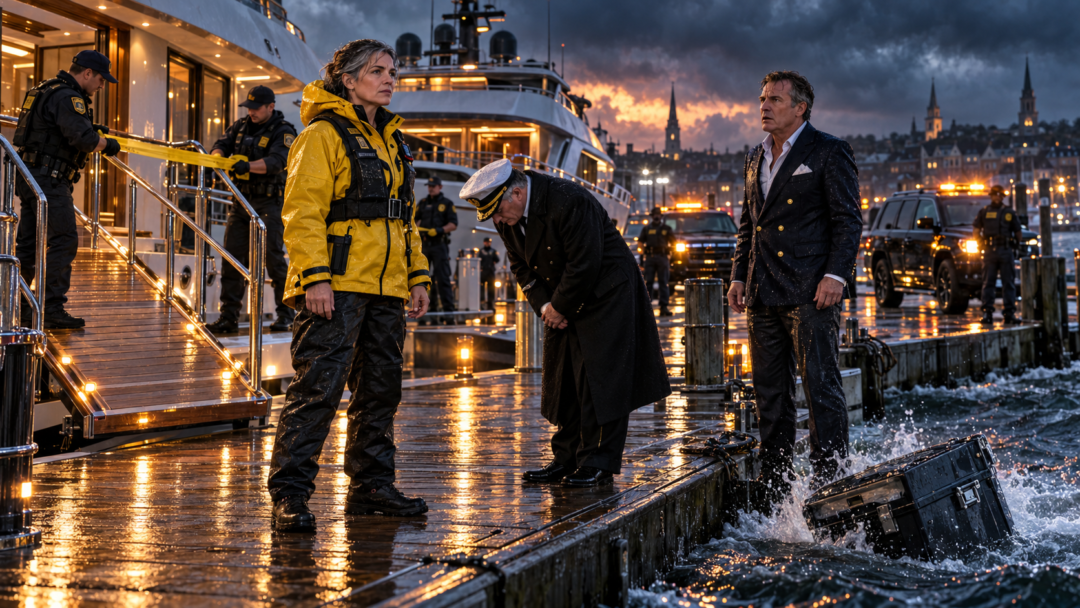
Now, standing on the pitching pier three hours later with her tool chest at the bottom of the bay and the emergency lights strobing in her eyes, Eleanor felt the rough paper of Thomas’s notebook pressing against her ribs. The boy had risked his entire future to document the truth. She had no intention of letting him down.