The Leaking Hull In The Newport Slip And The Harbor Queen
CHAPTER 3: THE SLUICE BENEATH THE TIDE
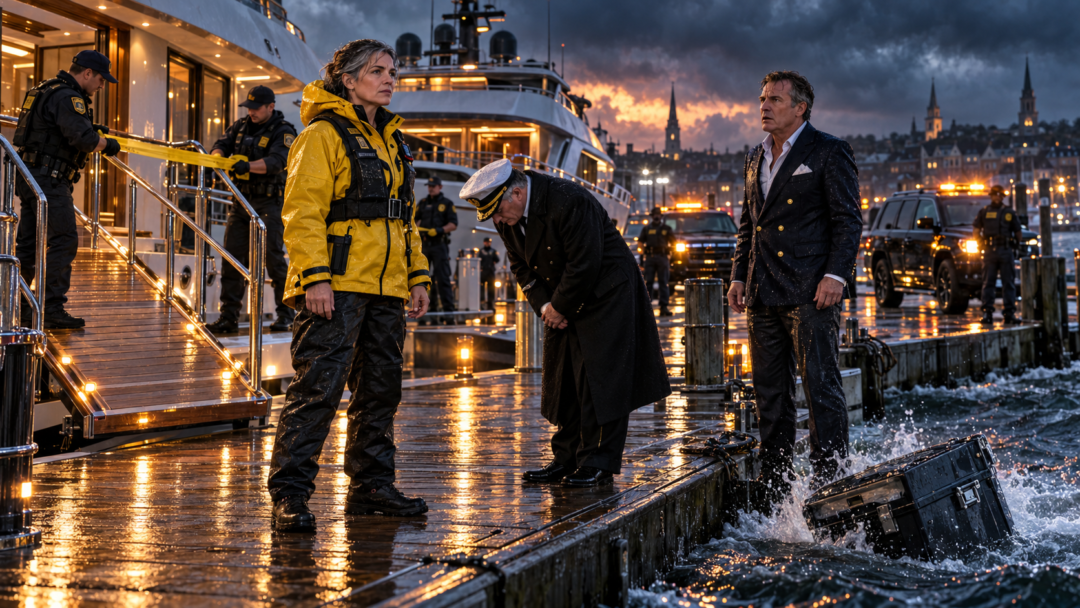
The black executive SUV and the green harbor patrol truck idled at the head of Slip Four, their heavy diesel engines rumbling in low harmony with the crashing breakers against the outer breakwater. Julian Sterling stood tall on the rain-swept pier, his hands resting casually on the pockets of his technical sailing jacket, an arrogant smirk curling his thin lips.
“Director Bradley,” Sterling called out in a smooth, carrying voice as the driver’s door of the black SUV swung open. “I’m glad your dispatch acted so swiftly. We have an unauthorized vagrant tampering with private vessels on the executive dock. She’s already damaged my gangway fittings and threatened my son.”
A tall, broad-shouldered man in a heavy dark wool overcoat and an official gold-braided maritime service cap stepped out of the vehicle. It was Regional Harbor Director Walter Bradley. At fifty-eight, Bradley was a veteran of thirty-five years of coastal administration, his face carved into deep lines by decades of salt wind and bureaucratic infighting. Behind him stepped four uniformed officers of the Regional Harbor Security Division, their tactical flashlights cutting through the driving rain.
Director Bradley did not look at Sterling. He didn’t acknowledge the younger man’s greeting, nor did he slow his stride as he marched down the wet cedar planks toward the yacht’s stern. His polished leather boots moved with deliberate, heavy authority, splashing through the pools of rainwater collecting around the iron mooring cleats.
Sterling’s smile flickered, a faint shadow of uncertainty crossing his aristocratic features. “Walter? Did you hear me? I want this woman off my pier immediately.”
Director Bradley stopped directly in front of Eleanor Cross. He took off his gold-braided cap, letting the freezing rain soak his cropped gray hair, and delivered a formal, respectful nod.
“Good evening, Inspector Cross,” Bradley said, his voice deep and resonant, cutting through the howl of the storm. “We received your high-priority acoustic telemetry at headquarters five minutes ago. Your emergency transmission logged an unmonitored chemical discharge in the outer basin.”
Eleanor nodded calmly, gesturing with her thumb toward the dark water beneath the yacht’s counter stern. “Slip Four is contaminated, Director. We have a continuous discharge of fluorocarbon solvent originating from the auxiliary cooling circuit of the Aegis. The owner just kicked my primary diagnostic receiver into thirty feet of water to suppress the evidence.”
Julian Sterling’s face turned from smug satisfaction to an unreadable, sickly gray. His eyes darted between Bradley and Eleanor, his mouth opening and closing before finding his voice. “Wait… Walter, what is this nonsense? Inspector? This woman is a yard mechanic! She runs a bankrupt boatyard on the north point!”
Director Bradley slowly turned his head to look at Sterling. His dark eyes were cold, devoid of the polite deference he usually offered wealthy donors at marina galas. “Mr. Sterling, you are addressing Eleanor Cross, Senior Chief Maritime Inspector for the Commonwealth’s Coastal Waters, and majority trustee of the Cross Point Marine Yard—which holds the historic charter for every commercial and private slip in this basin.”
“That’s impossible,” Sterling Junior stammered from behind his father, his voice cracking with sudden panic. “She was on her knees with a wrench! She looks like a harbor vagrant!”
“She looks like someone who knows how to inspect a vessel, son,” Director Bradley replied coldly. “Which is more than I can say for your legal counsel.”
Bradley turned back to Eleanor, stepping closer as the harbor security officers formed a semicircle around the yacht’s gangway, cutting off the Sterlings’ path back aboard their vessel. “Inspector, what are your findings?”
Eleanor pulled the water-sealed leather folder from her coat, withdrawing her digital tablet and the folded blue schematic Thomas Bennett had provided. “Two hours ago, acoustic telemetry confirmed an unauthorized three-inch thru-hull discharge port active beneath the rudder post. But that’s only half of it. The Aegis isn’t just dumping its own waste. She’s being used as a mobile siphon platform.”
Sterling lunged forward, his voice rising in hysterical fury. “That’s slander! That’s an unverified fabrication! You don’t have authority to board my vessel without a municipal court order!”
“I don’t need a court order, Mr. Sterling,” Eleanor said, her voice dropping into a register of icy, absolute finality. “Under Chapter Ninety-Eight of the 1928 State Maritime Trust Charter, the Chief Inspector holds absolute sovereign jurisdiction over any vessel berthed within five hundred yards of the municipal granite seawall that poses an imminent hazard to navigation or public water systems.”
She tapped the screen of her tablet, projecting a high-contrast sonar rendering across the illuminated display. “Beneath where your yacht sits right now lies the historic North Sluice—the subterranean gravity drainage channel built in 1890 to divert overflow from the municipal reservoir into the bay. You didn’t just hook up an auxiliary dump on your yacht, Sterling. You had your divers run a flexible high-pressure hose from your bilge tanks directly into the mouth of the city sluice.”
The two private marina security guards stepped back, completely removing themselves from the confrontation. Director Bradley’s jaw tightened until the muscles bunched beneath his beard. He looked at Sterling with pure contempt.
“You tied chemical effluent into the municipal drainage channel?” Bradley asked, his voice shaking with restrained fury. “The city intake for the regional cooling plant is two hundred yards downstream from that sluice.”
“It’s a lie,” Sterling whispered, though his eyes were wide, darting frantically toward his yacht’s boarding ramp. “She has no proof. Her equipment is at the bottom of the harbor.”
“My equipment is waterproof to fifty atmospheres, Mr. Sterling,” Eleanor said calmly. “And it’s currently transmitting its live data log to the state environmental registry via acoustic ping. But if you’d like physical confirmation, we don’t have to wait for the divers.”
She looked out toward the mouth of Slip Four, where the dark silhouette of a ninety-foot port recovery tug was already rounding the inner lighthouse, its massive rubber bow fenders slicing through the stormy swell.