The Midnight Cornfield Patrol And The Parliament Of Barn Owls
CHAPTER 2: THE PARABOLIC TOWERS
Garrett spent the next thirty-six hours without sleep, the interior of his heavy timber carpentry shop glowing under high-output fluorescent tubes while the relentless scream of the table saw and the rhythmic thud of the pneumatic nail gun echoed across the yard.
If he could not use chemical poison to stop the subterranean army, he would have to recruit the most lethal, highly specialized nocturnal predators that nature had ever engineered: Tyto alba—the native North American Barn Owl.
On the long assembly benches in the center of the shop, Garrett laid out twenty custom-engineered raptor nesting boxes, constructed entirely from rough-sawn, two-inch-thick aromatic native red cedar. Unlike cheap plywood boxes sold in farm supply catalogs, Garrett had engineered these habitats with the precision of an acoustic technician. The front face of each box featured a wide, elliptical entrance baffle designed to exclude raccoons and feral cats, while beneath the opening, he had steam-bent a twelve-inch parabolic cedar horn. The horn acted as a mechanical acoustic amplifier, capturing the faint subterranean rustling of burrowing rodents in the dirt eighty yards away and funneling the sound directly into the nesting chamber.
In his carpentry shop, Garrett worked with seasoned heartwood cedar logs that he had milled himself on his bandsaw mill three years earlier. He avoided modern synthetic wood glues that outgassed volatile chemical compounds, which could deter sensitive avian olfactory senses. Instead, he joined the corners using traditional blind mortise-and-tenon joints, secured with hand-carved white oak trunnels that expanded in humid air, locking the boxes permanently tight against rain, driving sleet, and nesting parasites.
At four o’clock on Wednesday afternoon, the sound of an approaching station wagon broke the quiet. A mud-splattered Subaru Outback pulled into the gravel drive, towing a specialized ventilated wildlife transport trailer.
Dr. Clara Mitchell stepped down from the vehicle, adjusting the strap of a heavy leather handling gauntlet on her left arm. Clara was thirty-four, an associate professor of raptor ecology at Indiana University, with sharp hazel eyes, dark hair tied back in a practical braided knot, and a pair of high-magnification field binoculars slung over her shoulder.
“You’re Garrett Ross?” Clara asked, walking into the shop and running her fingers along the smooth, beveled cedar rim of the nearest nesting box. She paused, her eyes widening in genuine appreciation. “This is extraordinary craftsmanship, Garrett. The parabolic acoustic baffle… you’re using the wood’s resonant frequency to enhance directional hearing.”
The acoustic engineering behind the nesting boxes was grounded in rigorous biomechanical research. In natural forest ecosystems, ancient hollow sycamores and dead red oaks provided natural acoustic echo chambers where hunting raptors could roost during daylight hours while monitoring subterranean prey activity across vast clearings. By using thick, quarter-sawn red cedar boards rather than resonant plywood, Garrett ensured that high-frequency wind noise and foliage rustling were dampened, while the low-frequency vibrations of claws scraping against root fibers—typically occurring between two hundred and eight hundred Hertz—were mechanically amplified by the parabolic wooden curve. It was a centuries-old principle borrowed from Stradivarius violins, applied to ecological pest suppression.
“A barn owl hunts with its ears, not its eyes,” Garrett said, setting down his framing hammer. “If they can hear the tunneling through the corn canopy from their perches, they can strike before the stalks get pulled down.”
Clara’s research at the university had demonstrated that Barn Owl populations in the Midwest had plummeted by more than eighty percent since the mid-nineteen-seventies, primarily driven by the demolition of historic timber barns and the widespread adoption of modern metal pole buildings that offered zero nesting cavities. By providing structurally sound, insulated cedar cavities that mimicked the thermal buffering of ancient tree hollows, farmers could establish permanent resident breeding colonies that returned to the same territory year after year. The birds were not temporary biological interventions; they were permanent ecological partners that integrated seamlessly into the farm’s seasonal cycle.
“More than that,” Clara said, turning toward the trailer. “A single mature breeding pair of barn owls, along with their fledglings, will consume more than three thousand rodents in a single twelve-week nesting cycle. They don’t store food; they hunt continuously from dusk until dawn. And I brought you the best strike team in the Midwest.”
Clara opened the rear doors of the trailer. Inside, secured in darkened, climate-controlled wooden travel mews, were eight rehabilitated adult barn owls—magnificent, pristine birds with heart-shaped white facial discs, mottled tawny-gold and ash-gray wing coverts, and dark, obsidian eyes that possessed three times the light-gathering capacity of a human eye. They had been rescued as orphaned chicks from dilapidated grain silos across southern Indiana, raised in wild flight aviaries, and trained to hunt live agricultural pests without human imprint.
Working with frantic speed as the afternoon shadows lengthened, Garrett and Clara loaded the twenty cedar nesting boxes and the raptor crates onto the bed of the farm’s flatbed tractor.
Using an eighteen-foot telescoping utility pole mounted on the tractor’s hydraulic front-end loader, they hoisted the boxes high into the canopy of the ancient burr oaks and shagbark hickories that lined the perimeter of the sweet-corn field. Each box was positioned facing north-northeast, away from prevailing summer storms, with a clear, unobstructed flight corridor leading directly over the infested corn rows.
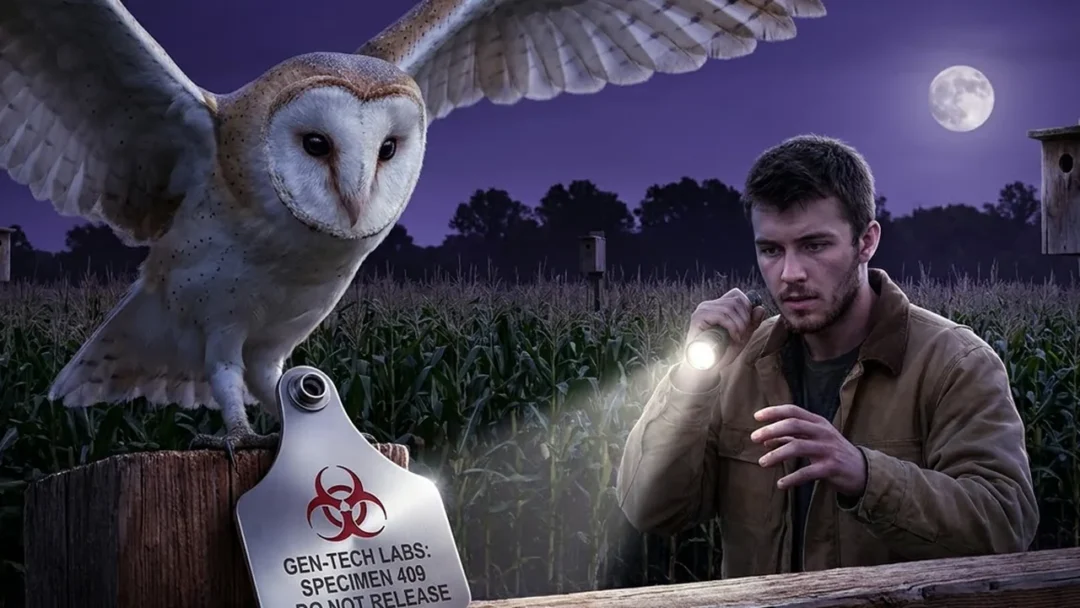
At 7:45 PM, as the blood-red sun dipped behind the western ridge of the Wabash Valley, Garrett ascended the ladder to the central tower box at the edge of row eighteen. He reached out with his heavy leather gauntlet, unlatched the transport gate, and gently stepped back.
From the dark interior of the cedar box, the alpha male owl stepped onto the outer perch.
The bird stood sixteen inches tall, its plumage glowing like polished bone in the violet twilight. It did not make a sound. It rotated its head a full two hundred and seventy degrees, its magnificent heart-shaped facial disc tilting slightly downward toward the corn canopy. Beneath the bird’s perch, forty yards out in the rows, a single corn leaf rustled as a giant rodent emerged from a fresh tunnel.
The owl’s dark eyes locked onto the spot. It spread its four-foot wingspan, leaned into the gathering dark, and dropped into the sky like a falling white spear.