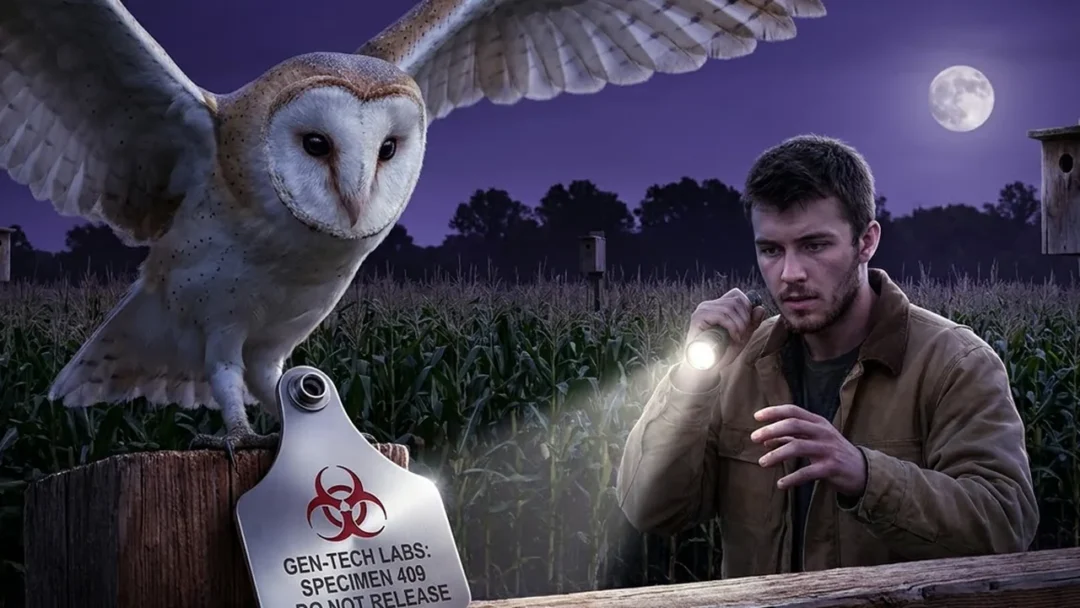
The Midnight Cornfield Patrol And The Parliament Of Barn Owls
CHAPTER 1: THE DISAPPEARING FURROWS
The late July sun over the Wabash Valley beat down with a thick, humid intensity that made the heavy loam of Cedar Ridge Basin smell of damp river mud and wild spearmint. Garrett Ross walked slowly down the central service lane of his family’s eighty-acre organic sweet-corn parcel, his leather work boots leaving deep impressions in the powdery gray silt. On either side of the lane, the corn stood eight feet tall—a dense, emerald-green jungle of broad, rustling leaves and heavy golden tassels swaying gently in the summer breeze. Every single stalk was loaded with two, sometimes three, swollen ears of heirloom Silver Queen and Peaches & Cream corn, just seven days away from the peak sugar harvest.
The geology of the Cedar Ridge Basin was an intricate tapestry of ancient post-glacial river terraces and rich Mollisol soils. For five generations, the Ross family had stewarded these river bottoms without resorting to heavy synthetic chemical cocktails or prophylactic pesticides. Garrett’s grandfather had understood that the soil was not merely a medium for holding up cornstalks; it was an immensely complex biological web of mycorrhizal fungi, earthworms, beneficial nematodes, and burrowing insects that took generations of careful crop rotation to cultivate. To introduce persistent organophosphates or heavy anticoagulant rodenticides into this delicate balance was an unthinkable betrayal of the land’s living memory.
If the crop came off the stalks unblemished and passed the regional organic certification inspection on Friday morning, the Ross family farm would finally clear the five-year agricultural transition loan that had kept Garrett awake at night since his grandfather’s stroke. The wholesale contract with the Great Lakes Regional Organic Co-op was worth one hundred and eighty thousand dollars—enough to replace the cracked concrete floor in the packing barn, install solar-powered well pumps, and secure seed stock for another five seasons.
Then, without a breath of wind to explain it, the earth beneath Garrett’s left boot gave way with a soft, hollow crunch.
Garrett stumbled, catching his balance against a sturdy wooden irrigation riser. He looked down into the furrow.
Thirty feet ahead of him, in row eighteen, a bizarre and terrifying spectacle unfolded in broad daylight. A towering eight-foot-tall green cornstalk suddenly shuddered violently, as if an invisible iron cable had hooked its root ball. The stalk jerked downward once, twice, and then—with a sickening, tearing sound of severed vascular fibers—the entire eight-foot plant was pulled straight down into the dirt like a stage prop vanishing through a trapdoor. Three seconds later, the stalk next to it trembled and collapsed into the widening subterranean void, followed by four more in rapid, terrifying succession.
“What in God’s name…” Garrett breathed, breaking into an immediate sprint down the furrow.
When he reached the collapse zone, the ground was a nightmare of collapsed tunnels. The top six inches of rich, crumbly loam had completely given way, exposing an intricate, honeycombed labyrinth of smooth, circular burrows three inches in diameter that honeycombed the root zone like an underground anthill. Scattered across the collapsed dirt lay dozens of half-eaten, immature ears of sweet corn, their golden husks shredded to ribbons, the milky kernels scraped cleanly from the cobs by sharp, chisel-like incisors.
The Silver Queen sweet corn cultivar was legendary throughout the Wabash bottoms for its tender white kernels, crisp texture, and exceptionally high sucrose content that melted on the tongue like confectioner’s sugar. But unlike modern industrial field corn bred for rigid cellulose stalks and mechanical harvesting, heritage sweet corn had delicate cellular walls that were exquisitely vulnerable to root damage. If a rodent severed the taproots even forty-eight hours before harvest, the ears would immediately stop translocating sugars, converting sweet sucrose into starchy, mealy cellulose that rendered the entire crop unsellable to gourmet regional markets.
Garrett knelt in the dirt, driving his fingers into the burrow entrance. The soil was warm, reeking of a strange, musky rodent odor that smelled far stronger and more pungent than any native field vole or meadow mouse he had ever encountered.
Suddenly, from the darkness of a freshly dug side tunnel four inches down, a pair of dark, beady eyes peered out at him.
It was a rat. But it was unlike any common Rattus norvegicus Garrett had ever seen. The creature was colossal—easily fourteen inches long from its blunt snout to the base of its naked, scaly tail, with broad, muscular forearms equipped with unnaturally long, hardened claws designed for rapid subterranean excavation. Its coarse gray pelt was marked by odd, irregular patches of hairless, scarred tissue, and its blunt head was nearly the size of a teacup. The animal did not flee. It stared directly into Garrett’s face, baring two pairs of elongated, yellowed incisors, and let out a vicious, raspy hiss before ducking backward into the subterranean maze.
“Told you so, boy! I told you two weeks ago this bottom land was turning into a damn cesspool!”
The harsh, mocking voice came from the boundary fence line. Garrett turned to see Warren Finch leaning against the rusted steel gate, watching him with a smug, self-satisfied grin. Finch was fifty-eight years old, with a sunburned neck, a stained baseball cap advertising commercial agricultural chemicals, and a heavy belly that pressed against the waistband of his denim work jeans. In the bed of Finch’s flatbed pickup sat six large fifty-pound plastic buckets molded from bright, warning-blue polyethylene.
Finch hoisted one of the blue buckets onto the top rail of the fence with a loud plastic thud. He popped the seal off the lid, revealing thousands of dark blue, waxy extruded pellets that smelled of synthetic molasses and rancid petroleum.
“Second-generation brodifacoum anticoagulant rodenticide,” Finch said, scooping up a handful of the blue pellets and letting them rattle back into the pail like plastic dice. “One bite, and their blood thins out until they bleed to death internally within forty-eight hours. Dump two of these buckets down those holes tonight, Garrett, or by Friday morning you won’t have a single ear of sweet corn left to sell to those fancy organic hippies in Chicago.”
Garrett stood up, wiping the dark loam from his palms. “Brodifacoum is a persistent bio-accumulative toxin, Warren. It takes six months to break down in soil, it leaches into the shallow water table, and every red-tailed hawk, barn owl, and farm dog that catches a poisoned rat bleeds to death from secondary exposure. It’s illegal on certified organic acreage, and you know it.”
Finch scowled, his friendly veneer vanishing in an instant. “Then watch your farm get eaten alive from the roots up! Those aren’t ordinary field mice, Ross. Whatever they are, they’ve tunneled through three hundred yards of my ditch banks and they’re eating ten bushels of seed corn a night. You have until Friday before the bank’s field inspector comes out. If your acreage is collapsed, your certification is revoked and your loan goes into default!”
Finch slammed the lid back onto the bucket, climbed into his truck, and sped away in a cloud of dust. Garrett stood alone in the collapsing furrow, his heart pounding in his chest. As he stared at the honeycombed dirt, four more cornstalks in row nineteen trembled, snapped at the root crowns, and disappeared into the earth.