The Midnight Cornfield Patrol And The Parliament Of Barn Owls
CHAPTER 3: THE GHOST PATROL
Night fell over Cedar Ridge Basin with the sudden, suffocating darkness of a midwestern thunderstorm, even though the sky above remained cloudless and ablaze with the light of a swollen summer full moon.
Garrett sat on the hood of his truck at the edge of the access road, looking through a set of military-grade thermal night-vision goggles. Beside him on the grass, Clara had set up an array of sensitive parabolic acoustic microphones mounted on lightweight tripods, their digital output cables running into a glowing spectrum analyzer on her laptop.
“Listen to this, Garrett,” Clara whispered, adjusting her circumaural monitor headphones.
Garrett pulled one headphone cup back from his ear. Out in the vast, moonlit expanse of the eighty-acre cornfield, the world seemed utterly devoid of human life. The soft night wind stirred the upper leaves of the corn, creating a gentle, ocean-like sigh that masked the subterranean terror below. But through the thermal goggles, the field was an active, high-stakes battleground.
The optical architecture of Tyto alba complemented its acoustic radar with extraordinary precision. Unlike human eyes, which were spherical, an owl’s eyes were elongated tubes held rigidly in place by bony structures known as sclerotic rings. While this anatomical constraint meant the bird could not roll its eyes within their sockets, requiring the famous two-hundred-and-seventy-degree head rotation to survey its surroundings, it provided an immense focal length that concentrated every photon of available moonlight directly onto a retina densely packed with sensitive rod cells. To a hunting barn owl, the moonlit sweet-corn canopy was illuminated as clearly as an open stadium under halogen floodlights.
Across the rows, hundreds of heat signatures—small, glowing white embers indicating thousands of giant burrowing rodents—were crawling along the root zones. They moved with aggressive, unnatural confidence, emerging from the tunnel mouths to gnaw on the base of the stalks.
And then, high above the canopy, the ghosts appeared.
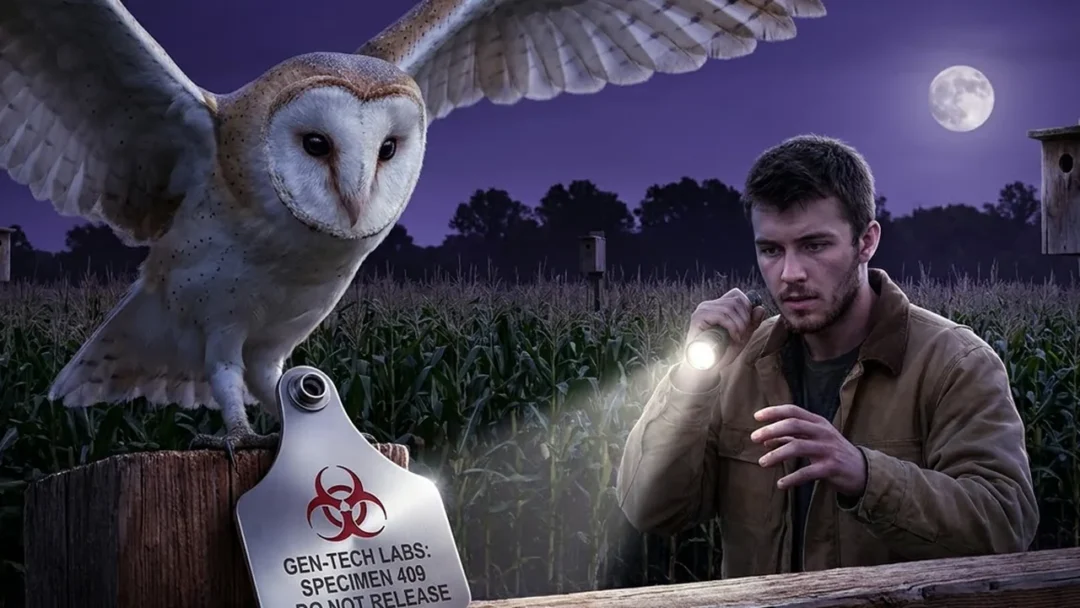
Through the night-vision optics, Garrett watched three white barn owls glide across the tops of the corn tassels. They were flying less than four feet above the vegetation, their broad, rounded wings holding them suspended in the air like kites hovering in a gentle thermal draft.
What made the hair on Garrett’s arms stand on end was the absolute, unnatural silence of their flight.
A mallard duck or a pheasant flying through the night sounded like a flurry of leather whips beating the air. Even a red-tailed hawk or an eagle generated a distinct, audible whoosh as its primary flight feathers compressed the atmosphere. But the barn owls made no sound whatsoever. Not a whisper. Not a rustle. Not a single decibel of displaced air.
The sensory neurology of Tyto alba was unmatched in the animal kingdom. Unlike mammalian predators that relied heavily on olfactory tracking or visual motion cues, a barn owl’s brain was dominated by an immense auditory processing center. The heart-shaped facial disc acted like a pair of biological satellite dishes, composed of dense, stiff feathers with curved shafts that channeled ambient sound waves directly into the pre-aural flaps. By tilting its head minutely in three-dimensional space, an owl could resolve the exact elevation and azimuth of a moving rodent with an angular resolution finer than that of human military sonar arrays.
“It’s the micro-serrations on the leading edge of their primary flight feathers,” Clara murmured, watching the green audio waveforms on her laptop screen remain completely flat, hovering at an absolute baseline of zero. “In any other bird, air rushing over the wing forms turbulent, churning vortexes that create acoustic noise. A barn owl’s feathers have microscopic, comb-like fringes that break those large vortices into thousands of tiny, microscopic eddies. The sound is shifted out of the audible spectrum. To an animal on the ground, they are literally invisible until the talons strike.”
Through the goggles, Garrett watched the alpha male owl fold its wings in mid-air.
The bird did not swoop in a long, predictable curve. It plummeted vertically, feet-first, its long, muscular legs extending downward through the green corn canopy like spring-loaded calipers. Its needle-sharp black talons—curved like forged steel fishhooks—drove four inches straight into the crumbly silt of the furrow.
Thud.
A muffled squeak choked off instantly in the dark.
Two seconds later, the owl rose into the moonlight with a single effortless stroke of its four-foot wings. Clutched firmly in its right foot was an enormous, fourteen-inch gray rodent, its spine snapped instantly by the crushing kinetic force of the bird’s grip. The owl banked smoothly, carried the prey to the nearest hickory perch, and swallowed the head whole before dropping back into the patrol pattern.
The behavioral dynamics of the parliament of owls exhibited a sophisticated territorial partitioning. Rather than competing over the same central rows, the mated pairs established distinct hunting radii that fanned out from the treeline in interlocking concentric arcs. When one owl initiated a stoop on a subterranean burrow, the neighboring birds hovered in flanking positions along the perimeter furrows, cutting off any panic-stricken rodents attempting to bolt across the clear drainage lanes.
Along row twenty-four, where the rodents had concentrated their primary tunneling front, three female owls were hunting in a synchronized triangular formation. As the burrowing pests attempted to flee across the open service lane, the owls intercepted them like low-flying interceptor drones. Snap. Strike. Lift. In less than twenty minutes, Garrett counted forty-seven kills along that single fifty-yard corridor.
The rodents, accustomed to operating with total impunity beneath the soil, began to panic. The subterranean vibration of their tunnels, which had previously allowed them to communicate and coordinate their feeding, was now their death warrant. The owls’ asymmetrical ear openings—one positioned slightly higher on the left side of the skull, the other lower on the right—triangulated the sound of claws scraping against soil with an accuracy down to one single degree of arc. The owls did not need to see the rats; they were hearing their heartbeats through six inches of compacted earth.
“They’re clearing row twenty!” Garrett whispered, his hands tightening on the binoculars. “Look at the western flank, Clara! The rodents are breaking! They’re retreating toward the boundary fence!”
Before Clara could answer, a sharp beam of yellow light flashed along the southern tree line. A rusted all-terrain vehicle was crawling through the brush near the boundary ditch with its headlights blacked out with electrical tape, carrying two large plastic drums in the rear cargo rack.