The Neon Racing Bicycle Beyond Barnaby’s Electric Fence
CHAPTER 2: THE CAMERA IN THE SYCAMORE
The kitchen of the Juniper Vale ranch house was quiet save for the rhythmic hiss of the cast-iron kettle on the wood stove. The room smelled of dark-roast coffee, linseed oil, and the sharp tang of clean cedar sawdust. Outside, the autumn wind rustled the dry leaves of the massive sycamore tree that had guarded the farm’s front gate since the Civil War.
Jonah Bell plugged the wildlife camera’s SD card into Mae’s rugged field laptop on the pine harvest table. The high-resolution trail camera had captured forty-two minutes of continuous, crystal-clear footage from its hidden perch among the sycamore leaves.
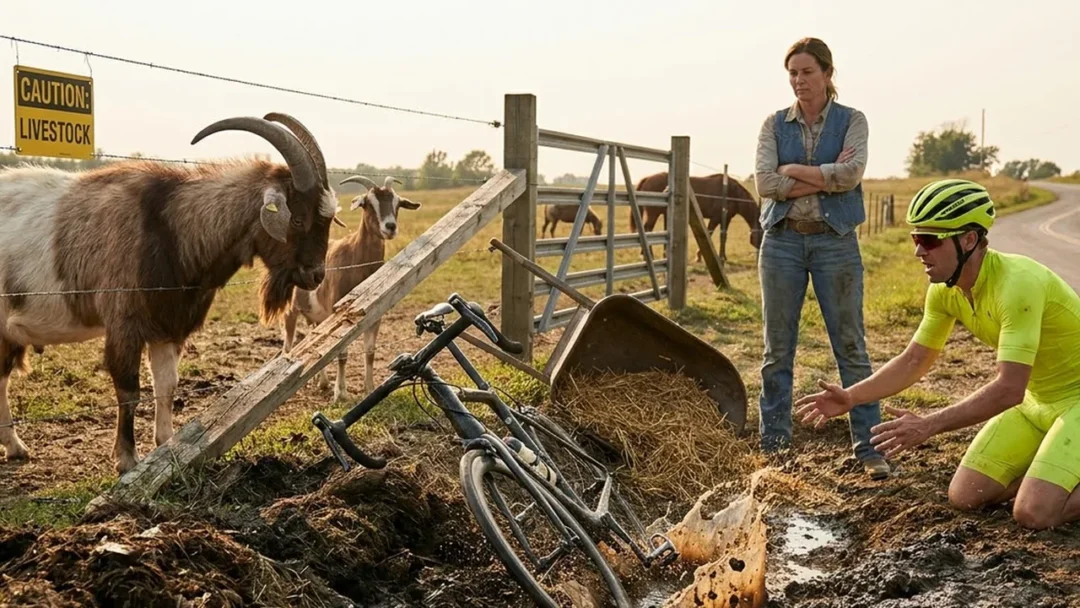
Mae leaned over Jonah’s shoulder, watching the video unfold. The wide-angle lens captured the entire roadside scene with forensic clarity. The timestamp read 8:41 AM. It showed Adrian Cross rounding the bend, aggressively braking, dismounting, and screaming at Mae. The built-in stereo microphone picked up every syllable: Adrian’s demands that she clear the state asphalt, his boast about the cost of his tires, his arrogant declaration that he would have code enforcement condemn the farm, his two-handed heave that overturned the iron wheelbarrow, and his deliberate act of propping his bicycle against the marked electric wire.
“There’s no ambiguity here,” Jonah said, tapping the spacebar to freeze the image. “The Virginia Agricultural Code clearly states that an owner of registered livestock is immune from civil liability for damage to personal property placed unlawfully against an agricultural enclosure, provided the enclosure is properly marked with visible warnings. We have the yellow placard right in the center of the frame.”
“Look closer at the moment he dropped his bike computer on the grass,” Mae said.
Jonah zoomed in on the two-inch color screen of the Wahoo cycling computer lying in the clover before the van driver picked it up. The display showed an active topographic routing overlay. Instead of following the state highway around the mountain spur, a bright red dashed line sliced straight across the private pastures of Juniper Vale Ranch. The route entered Mae’s front pasture by the sycamore, cut through the goat nursery, crossed the spring-fed creek, and connected directly to an abandoned railroad grade leading through the mountain gap.
Above the route, a digital data tag read: Stage 3 Technical Shortcut—Acquisition Pending County Easement 44-B.
“He wasn’t an innocent cyclist,” Mae said, her voice dropping into a hard, cold register. “He was surveying our ground for the Blue Ridge Gran Fondo.”
“The commercial race next weekend?” Jonah asked, turning from the screen.
“Tessa Grant, the head of Blue Ridge Sports Group, has been calling me three times a week since early summer,” Mae explained, pouring two mugs of black coffee. “Her race promotion company sold broadcasting rights to an international sports syndicate. To qualify as an official world-tier endurance event, the course has to meet strict international standards for road width and emergency vehicle access. The state highway along our front pasture narrows to eighteen feet between the rock bluff and our fence line. The state Department of Transportation told Tessa she couldn’t run four hundred racers through that bottleneck without a sixty-foot buffer for support cars and medical vans.”
“So she tried to buy the land from us,” Jonah said.
“She offered twenty-five thousand dollars for a sixty-foot permanent easement along our entire front pasture,” Mae nodded. “I told her that sixty feet includes our only natural spring box and the livestock retention pond. If we surrender that strip, we lose the water supply that keeps the herd alive during the August drought. She told me I was being obstinate, and that progress always finds a way through stubborn dirt.”
A heavy siren sounded out on Route 618. A white county utility truck with amber emergency lights rolled up the gravel drive, followed immediately by a dark green sedan bearing the official gold seal of the Blue Ridge County Department of Code Compliance.
Officer Dale Pritchard stepped out of the green sedan. He was a barrel-chested man in his fifties with a thick gray mustache, heavy jowls, and a gold badge pinned to the pocket of his stiff khaki uniform shirt. Behind him, two municipal maintenance workers in bright orange safety vests began pulling wooden surveyor stakes and rolls of wide red plastic barrier tape from the bed of the utility truck.
Mae wiped her hands on a clean towel and stepped out onto the wide front porch. Jonah followed closely behind, keeping his hands jammed deep into his canvas jacket pockets.
“Morning, Dale,” Mae said, keeping her tone strictly formal. “What brings the county out to private gravel on a Saturday morning?”
Pritchard did not offer a greeting. He unclipped a thick aluminum clipboard from his passenger visor and walked up the gravel walk with heavy, authoritative strides.
“We have an active public safety emergency, Mae,” Pritchard said, tapping the tip of a ballpoint pen against a pink multi-part citation form. “I received a sworn emergency complaint and notice of critical hazard from Adrian Cross’s legal counsel forty-five minutes ago.”
“Adrian Cross shoved my wheelbarrow and leaned his personal property against my marked fence,” Mae said evenly. “He was trespassing on my boundary.”
“That is not how the sworn affidavit reads,” Pritchard countered, his voice flat with unyielding bureaucratic weight. “The complaint alleges an unpermitted, lethal high-voltage hazard operating within twenty-four inches of a designated state recreational corridor. It further cites an aggressive, uncontrolled livestock menace that caused severe emotional trauma, physical shock, and twelve thousand dollars in verified property destruction to a registered international athlete.”
“The charger is a six-volt Gallagher solar pulse unit,” Mae said coldly. “It produces half an amp of intermittent current to deter predators. It’s certified by the Virginia Department of Agriculture and installed according to county building code. The warning sign is posted every fifty feet.”
“The Department of Agriculture doesn’t govern public safety easements along county recreation corridors, Mae; I do,” Pritchard declared, thrusting the clipboard toward her. “Under County Emergency Ordinance 88-C, any agricultural perimeter bordering a municipal thoroughfare that exhibits an unmitigated threat to public travel is subject to immediate provisional condemnation.”
Pritchard turned toward the workers in orange vests and waved his arm along the pasture road. “Stake off the sixty-foot strip from the sycamore bluff to the lower culvert. Post the red condemnation tape. No livestock within sixty feet of the state road until the county zoning appeals board convenes on Tuesday.”
“Tuesday is three days after the Gran Fondo,” Jonah spoke up, stepping forward onto the porch rail. “You’re clearing our pasture so Tessa Grant can run her bike race!”
Pritchard’s gaze swung toward Jonah, hardening into a menacing glare. “Mind your mouth, son, or I will cite this farm for obstructing an officer in the performance of municipal duties.”
“You want to see what really happened, Dale?” Mae asked, holding out a black thumb drive. “We have high-definition 4K footage from a camera in the sycamore. It shows Cross destroying our equipment, screaming profanities, and kicking his bike against the wire.”
Pritchard did not reach for the drive. He smiled faintly under his gray mustache, a patronizing, greasy smirk that made Mae’s jaw tighten.
“Private trail cameras are uncalibrated and inadmissible in municipal administrative hearings, Mae,” Pritchard said, slapping the bright pink citation slip against the porch timber. “Unless you have a certified engineering survey and a court-ordered telemetry audit, my condemnation order stands. The strip is closed. If that goat crosses the red tape before Tuesday, animal control impounds him for public destruction. Have a good weekend.”