The Overfilled Garbage Cans And The Three Day Curbside Trap
CHAPTER 3: THE NIGHTTIME MEDICAL VAN
By ten o’clock that evening, an uneasy, watchful silence settled over Whispering Pines Lane. Across the street from the Sterling estate, the lights in Rachel Evans’s living room were turned low. Rachel and her son Sam sat by the second-story study window, looking out through the branches of the birch tree toward the darkened driveway of 1404 Whispering Pines.
Sam had his school astronomy telescope mounted on a wooden tripod, aimed through the glass toward the rear service apron of Veronica’s home. Beside the telescope lay an open spiral notebook where Sam had logged the movements of vehicles over the past three weeks.
“Mom,” Sam whispered, adjusting the fine-focus knob on the telescope lens. “Look down by the walk-out basement door. The motion lights just clicked on.”
Rachel leaned over her son’s shoulder, looking through the optical eyepiece.
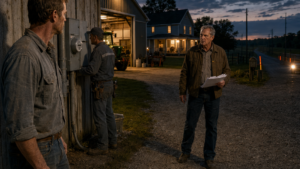
In the crisp, magnified circle of light, the rear basement door of Veronica’s house swung open. Dr. Arthur Sterling emerged, wearing blue surgical scrubs beneath an unzipped leather jacket. He looked nervously in both directions before waving his arm toward the private alleyway that bordered the rear property line.
A sleek, unmarked white Mercedes Sprinter van backed slowly down the service lane, its headlights extinguished. The van had tinted windows, no commercial logos on its side panels, and commercial transport plates from Cook County.
The rear doors of the van opened. A young man wearing a gray technician’s jacket hopped out, rolling a heavy industrial stainless steel cart toward the basement entrance. On the cart were several large, pressurized blue gas cylinders labeled Nitrous Oxide – Medical Grade USP, along with three heavy cardboard cartons stamped with the logo of an offshore pharmaceutical supplier in Mexico.
“Write down the license plate, Sam,” Rachel said, her voice tight and focused.
Sam quickly jotted the letters and numbers into his notebook: Illinois Commercial 44-921-X.
As the delivery technician rolled the cylinders into the basement, Dr. Arthur Sterling handed him a thick white envelope, which the technician stuffed into his jacket pocket with a nod. Then, working together, the two men hauled two heavy, sealed cardboard boxes out of the basement and slid them into the back of the van. Through the open basement door, illuminated by blinding, overhead surgical lights, Rachel caught a brief, unmistakable glimpse of the interior: stainless steel operating tables, surgical instrument trays, digital anesthesia monitoring machines, and a recovery cot with clean hospital sheets.
“They built a complete surgical operating suite in their basement,” Rachel breathed, watching the doors close. “An unpermitted, unlicensed underground cosmetic surgery clinic.”
Five minutes later, the van pulled away down the dark alley without headlights. Rachel immediately picked up her phone and dialed Detective Mark Callahan’s direct cellular line.
“Callahan,” the detective answered on the second ring.
“Mark, it’s Rachel,” she said, her voice steady and clear. “The unmarked courier just left Veronica’s service drive. License plate Illinois Commercial 44-921-X. They delivered three tanks of medical nitrous oxide and imported pharmaceuticals, and hauled out two sealed boxes. And Mark… through the walk-out basement door, I saw a full surgical operating theater with adjustable halogen lamps and an anesthesia machine.”
There was a brief, stunned silence on the other end of the line, followed by the sound of Callahan grabbing his keys from his desk. “A subterranean cosmetic surgery mill. That explains the biohazard bags in the garbage can. They were running an illegal, cash-only surgical practice out of their basement to evade state regulatory oversight and taxes, and using the municipal trash bins to avoid paying commercial hazardous waste incineration fees.”
“How dangerous is an unpermitted clinic like that?” Sam asked, looking up at his mother.
“Without hospital backup, emergency generators, or licensed anesthesiologists, it’s lethal,” Rachel replied, looking at her son with grave seriousness. “If a patient experiences an allergic reaction or an airway collapse during surgery in a residential basement, they have zero emergency equipment to save them. It is medical malpractice on a catastrophic scale.”
“Keep your doors locked, Rachel,” Callahan said over the phone. “I’m contacting the Illinois Department of Public Health and the state attorney general’s office. We’re taking this operation down before someone dies.”
Detective Callahan sat in his unmarked vehicle at the end of the cul-de-sac, running the vehicle identification number of the white Mercedes Sprinter van through the National Crime Information Center database. The results were immediate and damning: the vehicle was registered to an unlisted medical transport entity in Cicero that had been cited twice for transporting hazardous biological waste without state Department of Transportation hazardous materials endorsements. ‘They were running a shadow logistics pipeline,’ Callahan told Rachel over the phone. ‘They avoided licensed medical courier services because legitimate companies require detailed manifest tracking from point of origin to licensed incineration facilities. By using an off-the-books courier and dumping the surplus waste in household trash, they were saving forty thousand dollars a year in disposal fees while putting the entire neighborhood at risk.’ Rachel felt a cold fury knowing that children were riding bicycles past those very bins every morning.