The Overfilled Garbage Cans And The Three Day Curbside Trap
CHAPTER 5: THE RAID ON THE SUBTERRANEAN SUITE
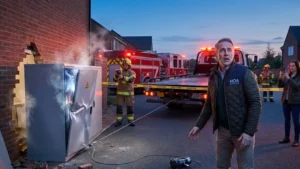
By nine o’clock that evening, Whispering Pines Lane was illuminated by the flashing red and blue strobe lights of six Naperville police cruisers, an Illinois Department of Public Health mobile laboratory, and an environmental hazardous materials containment truck. Yellow crime scene tape stretched across Veronica’s circular cobblestone driveway, sealing off the entire perimeter of the four-million-dollar estate.
Detective Mark Callahan and Inspector Laura Vance, accompanied by four armed tactical officers and two state medical board investigators, walked up the rear service drive to the walk-out basement entrance. Callahan raised a thirty-pound hydraulic door ram, positioned the wedge against the reinforced steel deadbolt, and threw his weight against the lever.
With a loud, metallic crack, the heavy steel door swung inward.
The tactical officers pushed through the threshold with weapons drawn, sweeping the interior with high-output tactical flashlights. “Police department! Search warrant! Everyone stay where you are!”
The basement had been completely transformed into a clandestine, high-end medical clinic. The floors were laid with clinical white seamless epoxy, the walls were covered with washable antimicrobial panels, and the air smelled heavily of isopropyl alcohol, ozone, and surgical cautery smoke.
Standing beside an operating table in the central procedure room was Dr. Arthur Sterling. He wore blue surgical scrubs, sterile rubber gloves, and a surgical mask, holding an electric cautery pen in his right hand. Lying on the operating table, draped in blue surgical paper and sedated under intravenous propofol, was a forty-year-old female patient undergoing a facial cosmetic procedure. An uncertified medical assistant was monitoring a digital heart rate screen in the corner.
“Step away from the table, Doctor!” Callahan ordered, his voice echoing off the sterile walls. “Drop the instruments and step back against the wall with your hands visible!”
Dr. Sterling dropped the cautery pen onto the stainless steel instrument tray with a trembling clatter, slowly raising his gloved hands into the air, his eyes wide with terrified shock. “Please… the patient is under anesthesia… she needs to be monitored…”
A team of certified paramedics from Naperville Fire stepped into the operating theater, taking over the patient’s airway and vital monitoring, safely reversing the sedation and preparing her for emergency transport to Central DuPage Hospital for evaluation.
State medical board investigator David Miller walked through the procedure rooms, meticulously logging the staggering array of illegal medical equipment. Along the rear hallway was an uninspected pharmacy vault stocked with controlled substances, including fentanyl, ketamine, and unlicensed imported botulinum toxin from overseas suppliers.
In the corner of the prep room, Detective Callahan opened a steel storage cabinet. Inside were six heavy black contractor trash bags stuffed with red biohazard liners, identical to the ones discovered on the street curb forty-eight hours earlier.
“Look at this,” Callahan said, pointing his flashlight at the bags. “They were generating twenty pounds of clinical biohazard waste per procedure. Rather than contracting with a licensed medical waste disposal firm—which would have created a paper trail that alerted state regulatory agencies to their unlicensed clinic—they simply shoved the surgical waste into household trash bags and had Veronica drag them out to the street with the weekly garbage.”
Upstairs in the circular driveway, Veronica was escorted from the front door in steel handcuffs, her designer tennis outfit replaced by the cold reality of criminal custody. As the police cruiser doors slammed shut, neighbors watched from across the street in stunned disbelief as the dark, illegal operation that had lurked beneath their manicured cul-de-sac was dragged into the light.
Inside the clandestine subterranean surgical suite, the hazardous materials containment team moved through the rooms with methodical precision, logging each piece of equipment onto the state evidence registry. State Investigator David Miller examined the central anesthesia machine, checking the calibration tags on the vaporizer manifold. ‘This unit hasn’t been certified or pressure-tested in five years,’ Miller stated grimly. ‘The oxygen sensor is degraded, and the backup battery is completely dead. If the power had blinked during a surgical procedure, the patient on that table would have suffocated within ninety seconds. Operating this equipment in a private residential basement without hospital-grade emergency generator backup is criminal reckless endangerment.’ Paramedics carefully wheeled the sedated patient out through the walk-out basement doors to the waiting ambulance, her vital signs stabilized under proper medical care.