The Presidential Sleeper Car And The Silent Rail Chairman
CHAPTER 3: THE VAULT BENEATH THE GREAT HALL
Ten minutes later, deep beneath the roaring passenger concourses of Union Station, the world of luxury travel gave way to the subterranean, mechanical nervous system of the American railroad.
Sixty feet below the street level, beneath the foundations of the 1925 terminal building, lay Central Signal Vault Three. The room was fifty yards long, carved from native limestone bedrock, with damp brick barrel-vaulted ceilings dripping with mineral condensation. The air was cool, smelling intensely of ozone, machine oil, and heated copper wiring. Long banks of heavy electromechanical relays clicked and clattered in continuous, hypnotic patterns, their glass cases housing brass contacts that switched the 750-volt direct-current track circuits guiding two hundred trains a day into the metropolitan terminal.
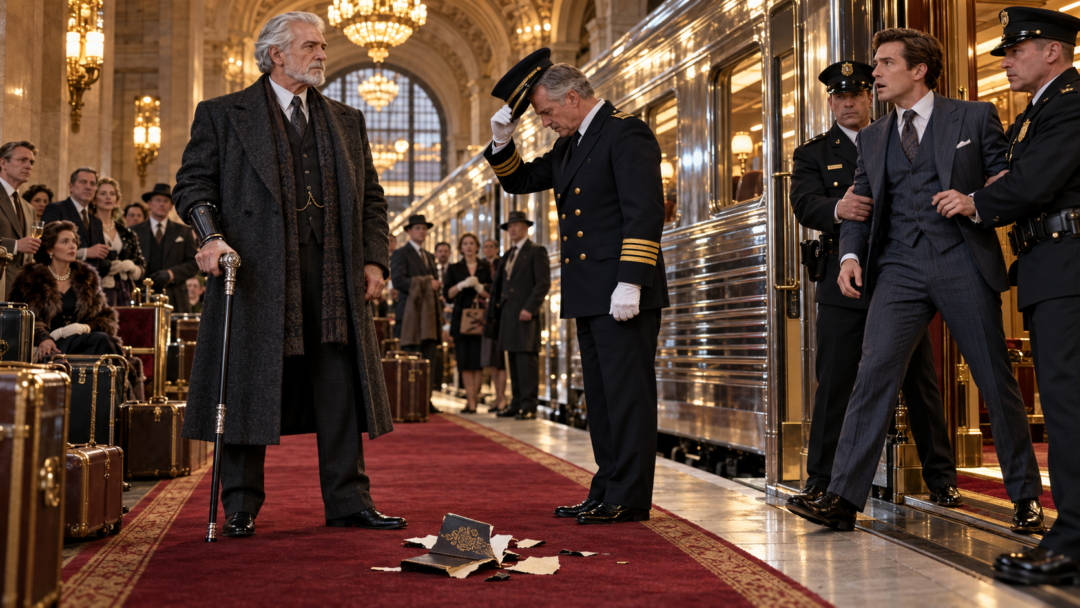
Chairman Thomas Sterling walked down the center aisle of the vault, his blackthorn cane tapping rhythmically against the damp concrete floorboards. Beside him walked Chief Conductor Arthur Vance and Dispatch Superintendent Sarah Lin—a sharp-eyed, forty-four-year-old rail engineer in a blue technical jacket with three computer tablets strapped into a canvas field harness.
Behind them, guarded closely by Transit Officer David Brody, walked Julian Croft. The hedge fund partner had lost his haughty swagger; his silk tie was loosened at his throat, his expensive oxfords were smudged with brake dust, and his alligator attaché case was clutched against his ribs like a shield.
“Show me the Joliet telemetry bypass, Sarah,” Chairman Sterling said, stopping before Master Relay Rack Nine.
Superintendent Lin stepped forward, unlatching the wire-mesh gate of the relay cabinet. She directed the beam of a high-intensity flashlight into the maze of braided cloth-insulated wires.
“Look right here, Chairman,” Lin said, pointing to a small, modern black plastic module roughly the size of a cigarette pack, spliced directly between the track occupancy sensors and the automated fail-safe line. “This isn’t railway issue. It’s an unlicensed digital frequency shunt, manufactured by a telecommunications firm in Delaware owned by Croft Holdings.”
She traced the wire with an insulated probe. “When a mechanical switch develops a fracture or fails to lock into alignment, the track circuit drops its voltage to zero, triggering an automated red signal that forces incoming trains to an emergency stop forty seconds before the switch. What this shunt does is inject an artificial five-volt carrier wave back into the line. It tells the central computer in Chicago that the track is green, clear, and locked, even while the rail head is physically bowing under the train’s weight.”
Chairman Sterling’s jaw hardened, his hand tightening around the eagle’s-head pommel of his cane until his knuckles turned white.
“Why would anyone install an electronic shunt to blind the automated safety system, Sarah?” Sterling asked, though his voice was terrifyingly calm.
“To eliminate passenger delay penalties,” Lin answered, turning around to look directly into Croft’s pale, sweating face. “Under the private operating contract Croft’s group signed with the state, if an express train is delayed by more than ten minutes due to maintenance slow-orders, Croft’s firm forfeits fifteen thousand dollars per train in performance bonuses. By blinding the automated signal system, they kept the high-speed expresses running at ninety miles an hour over broken switches, saving themselves four hundred thousand dollars a month in late-arrival penalties.”
“That’s an engineering test module!” Croft pleaded, his voice echoing off the damp limestone walls of the vault. “Our subcontractors were running predictive maintenance simulations! It wasn’t meant to override emergency braking!”
“Predictive maintenance doesn’t require a covert soldered bypass on an active electrified mainline, Counselor Croft,” Chief Conductor Vance said, his booming voice vibrating the glass relay cases. “Forty-two years I’ve run this division. When a rail breaks, a man stands on the ballast with a red lantern to protect human life. You boys sitting in glass towers in Manhattan thought you could hide cracked steel behind microchips so your stock options wouldn’t drop a quarter point!”
Chairman Sterling reached into his coat and pulled out an encrypted satellite phone. He dialed a four-digit extension.
“Director Miller,” Sterling spoke into the handset. “This is the Executive Director. Initiate an immediate emergency slow-order across the entire Joliet division. Cap all passenger and freight movements at twenty-five miles an hour effective immediately. Deploy three manual track inspection teams to verify every switch point between Milepost Thirty and Milepost Fifty.”
“Chairman, wait!” Croft cried out, lunging forward a step before Officer Brody’s hand caught his shoulder with an iron grip. “If you drop the corridor to twenty-five miles an hour right now, the entire Midwest logistics network collapses! Forty freight trains carrying priority intermodal cargo will be stranded in the sidings! The financial markets will open in six hours—my consortium has fifty million dollars in syndicated debt tied to those delivery windows!”
Sterling lowered the phone, looking at Julian Croft with a steady, quiet gaze that carried the weight of a judge passing sentence.
“A freight train can sit on a siding for twenty-four hours, Mr. Croft,” Sterling said softly. “A train full of human beings that derails into a bridge abutment at ninety miles an hour doesn’t get a second chance. You spent your life believing that speed and capital were the only two gods in the universe. Tonight, you’re going to learn what happens when they run head-first into the law.”
Sterling turned back to Conductor Vance. “Arthur, have the Pacific Starlight brought up to Track Nineteen. We depart for Joliet in twenty minutes. And bring Mr. Croft along. I want him in the observation car where he can watch every mile of steel his money tried to buy.”