The Presidential Sleeper Car And The Silent Rail Chairman
CHAPTER 5: THE SHUNT AT MILEPOST FORTY
The panic inside Car Ten was instantaneous and absolute.
The four investors leaped from their chairs, shouting in terror, knocking over dining tables as wine glasses shattered across the carpet and silver flatware clattered against the walls. Outside the forward windows, the massive red reflective markers on the rear container car of the stalled freight train grew larger by the second, rushing toward them with the speed of an oncoming missile.
Julian Croft collapsed back into his leather armchair, his arms flailing, his voice reduced to a high, hysterical shriek of raw, animal terror: “We’re going to crash! The automated brakes aren’t holding! The train isn’t stopping!”
“Quiet down, son!” Chief Conductor Arthur Vance roared, his voice cutting through the panic like an artillery shell.
In the center of the car, surrounded by flying china and shouting men, Senior Chairman Thomas Sterling stood as calm and immovable as a granite monument. His hand never left the silver pommel of his blackthorn cane. His gray eyes were locked onto the forward tracks, calculating distance, speed, and deceleration with the cold, instinctive precision of an artillery officer who had spent forty years commanding mechanical systems under fire.
“Arthur!” Sterling commanded, his voice sharp and clear. “The electronic signal shunt in Vault Three has blinded the cab’s automated automatic train stop receiver. The locomotive’s computer thinks the block is green. The engineer doesn’t have emergency pneumatic pressure.”
“I’m on it, Chairman!” Conductor Vance bellowed, lunging toward the rear vestibule of the car where the manual emergency conductor’s brake valve was housed inside a red steel wall cabinet.
Vance smashed the glass front of the cabinet with his gloved elbow, grabbed the heavy brass emergency valve handle, and hauled it downward with all the strength of his six-foot-two frame.
A deafening, concussive roar of escaping compressed air erupted beneath the floorboards.
The train’s main brake pipe pressure dumped instantly from ninety pounds per square inch to zero. Beneath the sixteen passenger cars, sixty-four heavy composite brake shoes clamped down upon the spinning steel wheels with thirty thousand pounds of hydraulic force.
A blinding shower of white-hot sparks erupted from beneath the train, spraying twenty feet into the dark prairie night like twin streams of fireworks. The Pacific Starlight shuddered violently, its steel frame groaning under the immense decelerating load as every passenger car pitched forward on its springs.
Inside the lounge, Julian Croft was thrown violently from his chair, tumbling across the carpet and crashing into the base of the mahogany sideboard, his alligator case bursting open to scatter corporate prospectuses across the floor.
“It’s not enough!” Marcus Miller shouted, clutching the window frame as he stared out at the stalled freight cars. “We were doing seventy when the valve popped! At this rate of deceleration, we’re going to hit the rear container at thirty miles an hour!”
Through the forward windows, fifteen hundred yards ahead, a small, blinking amber beacon appeared beside the tracks at the Joliet crossover switch.
A track maintenance truck—a heavy four-wheel-drive Ford fitted with retractable steel rail gear—had pulled onto the siding parallel to the crossover. Standing on the ballast beside the switch stand, illuminated by the truck’s work lights, were two local union track mechanics who had received Chairman Sterling’s emergency slow-order twenty minutes earlier.
Seeing the sparks flying from the approaching passenger express, the lead mechanic sprinted across the ties. In his hand, he swung a heavy five-foot steel lining bar.
With a desperate, heroic sweep of his arms, the mechanic jammed the bar into the broken crossover frog, using his entire body weight to force the fractured switch point against the stock rail, kicking the mechanical safety wedge into place with his steel-toed boot.
The heavy steel switch locked into the diverging siding with a concussive metallic clang.
Two seconds later, the locomotive of the Pacific Starlight hit the crossover.
The train took the diverging switch with a violent, rolling lurch that threw every man in the lounge car against the right-hand bulkhead. The steel wheels shrieked against the curved rail, grinding through the switch with a shower of orange sparks, and guided the three-hundred-ton express safely onto the clear industrial bypass track.
The train slowed: forty miles an hour, thirty, twenty, ten.
With a final, gentle hiss of its pneumatic air dryers and the deep, heavy groan of its brakes, the Pacific Starlight came to a complete, absolute dead stop.
The front coupler of the passenger locomotive rested forty feet from the rear bumper of the stalled freight train.
Inside the lounge car, absolute silence descended. The only sound was the heavy, ragged breathing of the men and the distant, rhythmic ticking of the cooling brake drums beneath the floor.
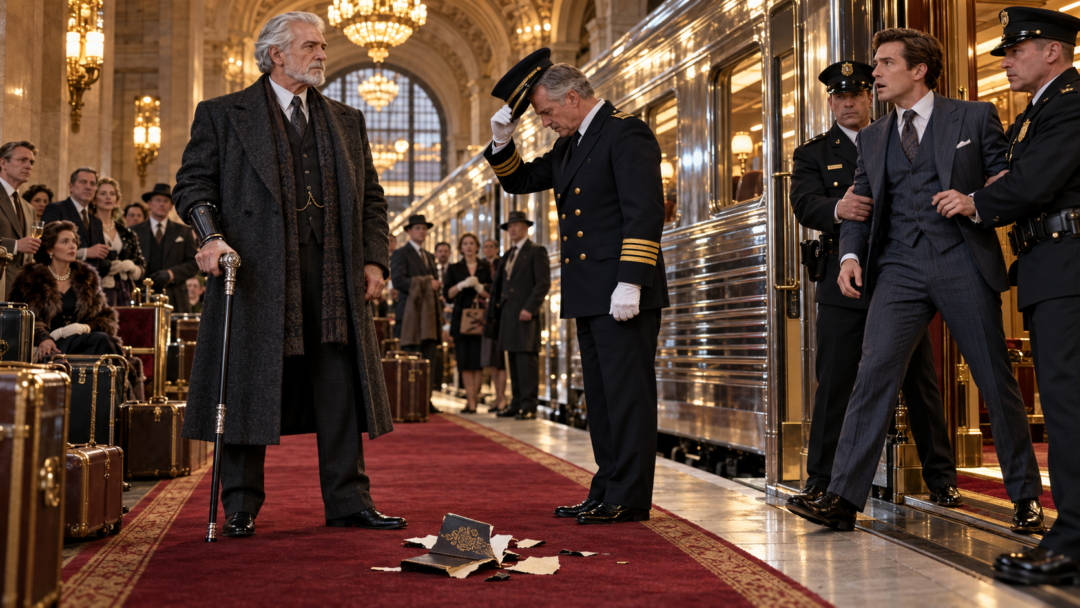
Chairman Thomas Sterling stood in the center of the car, his balance unbroken, his dark uniform immaculate, his cane resting firmly upon the carpet. He reached up with his prosthetic hand, straightened the gold-embroidered eagle on his lapel, and looked down at Julian Croft, who was curled in a fetal position against the mahogany wall, weeping uncontrollably in terror.
“Three hundred and fifty people are alive tonight, Mr. Croft,” Chairman Sterling said softly, his voice trembling with righteous, unyielding majesty. “Not because of your capital. Not because of your hedge fund. But because a working man earning twenty-eight dollars an hour stood in the dark with an iron bar and did his duty.”
Sterling turned to Officer Brody. “Take him, Officer. And put the steel on him.”