The Presidential Sleeper Car And The Silent Rail Chairman
CHAPTER 4: THE DINNER IN THE STARLIGHT LOUNGE
At seven o’clock that evening, the Pacific Starlight was cruising westward through the dark, cold expanse of the northern Illinois prairie. Outside the heavy double-paned windows of Car Ten—the private Starlight Observation Lounge—the flat farmland was an ocean of blackness, punctuated only by the distant yellow lights of isolated farmhouses and the rhythmic, mesmerizing flash of reflective highway signs whipping past in the dark.
Inside the lounge car, the atmosphere was luxurious, refined, and suffocating with tension. The car featured curving panoramic glass ceilings, mahogany-paneled walls decorated with silver art-deco bas-reliefs of steam locomotives, deep velvet armchairs, and linen-draped dining tables set with fine bone china and heavy silver flatware.
Seated around the central dining table, sipping twenty-year-old bourbon and dining on prime rib, were four high-tier institutional investors from New York and Chicago whom Julian Croft had invited aboard for what was supposed to be a celebratory closing dinner.
At the head of the table sat Julian Croft. He had attempted to regain his composure, having washed his face and smoothed his silk tie in the restroom, but the cold sweat shining on his forehead and the frantic, erratic way his hands shook as he cut his meat betrayed the terror consuming him.
Beside the doorway leading to the vestibule stood Chief Conductor Arthur Vance, his arms crossed over his gold-braided chest, his eyes never leaving Croft’s back.
“Gentlemen,” Croft said, his voice forced, thin, and stretched like a piano wire ready to snap. “As I was explaining before we departed Union Station, the privatization model we are closing tonight will deliver an unprecedented twenty-two percent return on invested capital. By streamlining the redundant track maintenance workforce and implementing automated telemetry monitoring, we’ve reduced operating expenditures by thirty-eight million dollars annually.”
“And what about the federal safety certification, Julian?” an older investment banker from Boston asked, setting down his wine glass and frowning out into the dark. “There are rumors on the street that the National Transit Authority has been conducting unannounced field audits on the high-speed switches.”
“Baseless bureaucratic posturing!” Croft lied, forcing a brittle laugh as he took a large gulp of his bourbon. “The National Transit Authority is an obsolete administrative shell. Their inspectors haven’t updated their diagnostic protocols in thirty years. Our private engineering consultants have certified every mile of track between here and Omaha as Category-One compliant.”
The heavy sliding pocket doors at the front of the observation car parted with a smooth, pneumatic hiss.
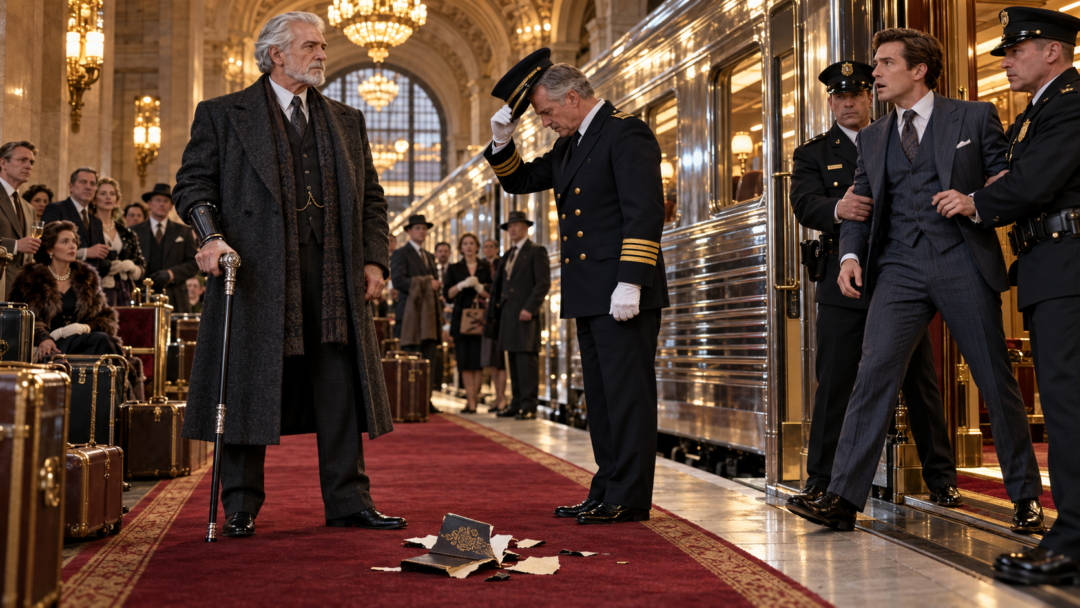
Walking into the lounge, moving with slow, dignified authority that immediately commanded every eye in the car, came Senior Chairman Thomas Sterling.
He was no longer wearing his civilian overcoat. He was dressed in his full formal service dress uniform—a crisp, dark navy four-star executive tunic bearing the gold embroidered eagles of the National Transit Authority on his shoulder boards, a row of military service ribbons pinned across his chest above a Purple Heart, and his blackthorn cane held firmly in his right hand.
Beside him walked Marcus Miller, carrying a heavy steel tray upon which rested three fractured metal cross-sections taken from the Joliet switch.
Every investor at the table stopped chewing. The older banker from Boston set his fork down with a sharp clatter, his eyes widening in immediate recognition as he stood up from his chair.
“General Sterling?” the banker whispered, bowing his head with instinctive deference. “Thomas? Good lord, what are you doing aboard the Starlight tonight?”
“Good evening, Robert,” Sterling said calmly, walking to the head of the table. “I am here to ensure that this train and its passengers reach the Mississippi River alive.”
Sterling gestured to Marcus Miller, who set the heavy steel tray directly in the center of the linen-draped table, between the silver candelabras and the vintage wine bottles.
“What is this, Thomas?” the banker asked, looking at the dark, pitted iron fragments.
“That, Robert, is the ‘Category-One compliant’ engineering your friend Mr. Croft has been selling you,” Sterling said, his voice ringing through the quiet car with devastating clarity. “Those are fractured track frogs recovered from the Joliet crossover. Cast from industrial scrap iron, filled with epoxy, and fitted with illegal electronic signal bypasses to blind our emergency brake systems.”
The investors stared in horror at the crumbling metal on the tray.
“Julian,” the banker hissed, turning on Croft with cold, furious eyes. “Is this true? Did you install uncertified iron on a high-speed passenger line?”
Before Croft could stammer a denial, the train’s emergency alarm sounded—a high-pitched, warbling siren that cut through the ceiling speakers with frantic urgency. At the same instant, the interior lights of the lounge car flickered, and the steady, rhythmic rumble of the diesel engines shifted violently into reverse throttle.
Through the forward observation windows, two miles ahead in the darkness of Milepost Forty, a terrifying sight appeared:
A heavy, seventy-car intermodal freight train was stalled diagonally across the crossover switch, its container cars blocking both the eastbound and westbound mainlines.
And the Pacific Starlight, carrying three hundred and fifty passengers, was bearing down upon the stalled wreckage at seventy miles an hour.