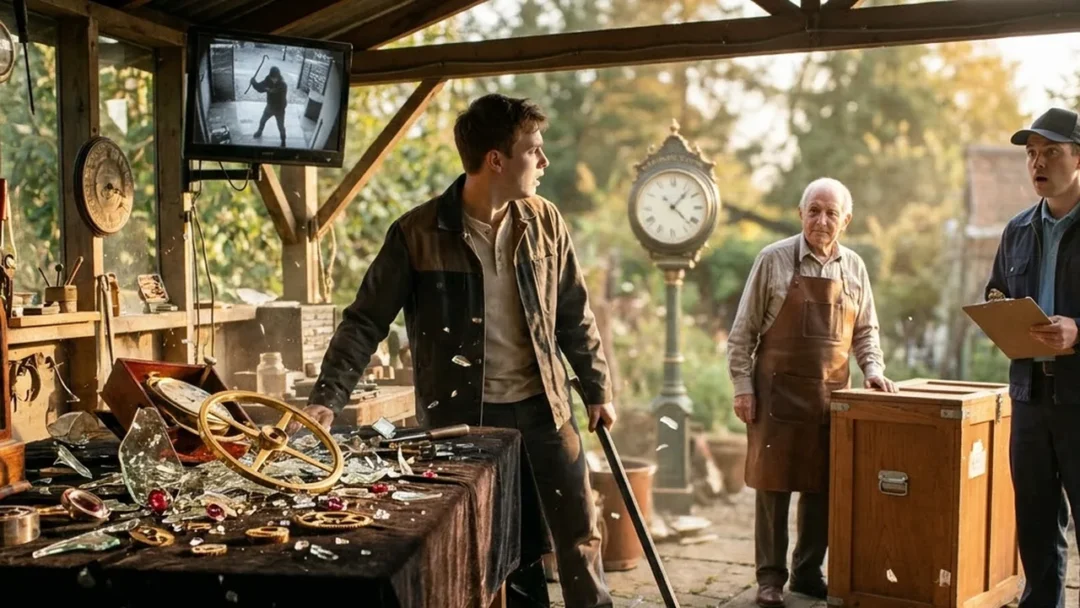
The Smashed Marine Chronometer And The Untouched Garden Chime Clock
CHAPTER 4: The Strike Outside the Door
Derek Thorne’s arrogant smirk instantly vanished. His eyes blinked rapidly in confusion, his chest hitching as he tried to catch his breath.
“What?” Derek spat, clutching the heavy crowbar awkwardly against his right thigh. “What the hell kind of lie is that? It’s a clock! It’s sitting right here in front of me, covered in brass gears, winding keys, and a silver clock face! I just smashed it to pieces!”
“It was an astronomical marine chronometer,” Julian replied, his voice calm, flat, and chillingly precise. “It was built in London in 1848 by Edward Dent, the royal clockmaker who designed the Great Clock of Westminster. Marine chronometers were manufactured exclusively for celestial navigation. They had to keep the absolute time of Greenwich across months at sea so that navigators could calculate astronomical longitude. Adding a chime, a gong, or a striking train would have created mechanical drag, burned mainspring energy, and introduced timing errors that would have wrecked sailing ships on ocean reefs. In one hundred and seventy-eight years of continuous service, that instrument never possessed a striking train. It never produced a single chime in its entire existence.”
Derek stared at Julian, his jaw working soundlessly as his mind struggled to process the words. “You’re lying,” Derek said, his voice rising in high-pitched, defensive desperation. “You’re just trying to psych me out! You’re trying to bluff your way out of this! You think you can play mind games with me? I know what I heard! I heard the bell coming from right here!”
Derek never finished the accusation.
From outside the open workshop doorway, exactly fourteen feet behind Derek’s right shoulder, a bright, resonant metallic strike rang out through the fresh seaside air.
CLANG-TONG.
The chime was clear, musical, and unmistakably acoustic. It came from ten feet up on the exterior cedar garden arbor, where Julian’s antique 1882 Seth Thomas tavern bracket clock was mounted among climbing white wisteria vines. The external bronze hammer lifted and struck the polished bronze bell, sending its warm, melodic two-tone chime reverberating across the flagstones, through the open timber doorway, and straight into the silent workshop.
CLANG-TONG.
It was three o’clock on the dot. The untouched outdoor garden clock was executing its programmed hourly strike with effortless, cheerful perfection. It was completely intact, completely undamaged, and tolling with absolute crystalline clarity.
Derek froze as if struck by lightning. Every drop of blood drained from his face within two seconds, leaving his skin the color of damp, unpainted sheetrock. His knees wobbled beneath him. Slowly, horrifyingly, his neck turned, his eyes tracking the vibrant sound out into the bright afternoon garden, locking onto the small wooden clock perched safely on the cedar arbor twenty feet away. He looked back at the horrific heap of mangled brass, twisted steel wire, and crushed ruby dust on Julian’s bench, then back to the singing garden clock outside.
The brutal reality crashed down upon Derek Thorne with the weight of a collapsing skyscraper: he had just committed armed home invasion and destroyed a priceless historical masterpiece, and the sound he hated was still singing happily in the sunlit breeze.
Before Derek could utter a sound, the firm, rhythmic crunch of leather dress shoes sounded on the gravel and flagstone path.
A tall, distinguished man in his early forties, wearing an immaculate navy-blue tailored blazer and carrying a reinforced titanium-edged flight case and a leather-bound consignment portfolio, stepped up to the shattered screened doorway. On the left breast pocket of his blazer was a gold-embroidered crest: Eldred’s Fine Maritime & Americana Auctions, Boston – Est. 1891.
The man stepped across the threshold, and then stopped dead in his tracks. His eyes traveled from the kicked-in door frame, to Derek standing in the middle of the room clutching a smeared steel crowbar, and finally to the mahogany restoration table where sixty-five thousand dollars’ worth of irreplaceable British naval history lay pulverized into scrap metal.
“Julian?” the courier whispered, his voice trembling with horror. “Dear God in heaven… Julian, what has happened to Lot 104?”