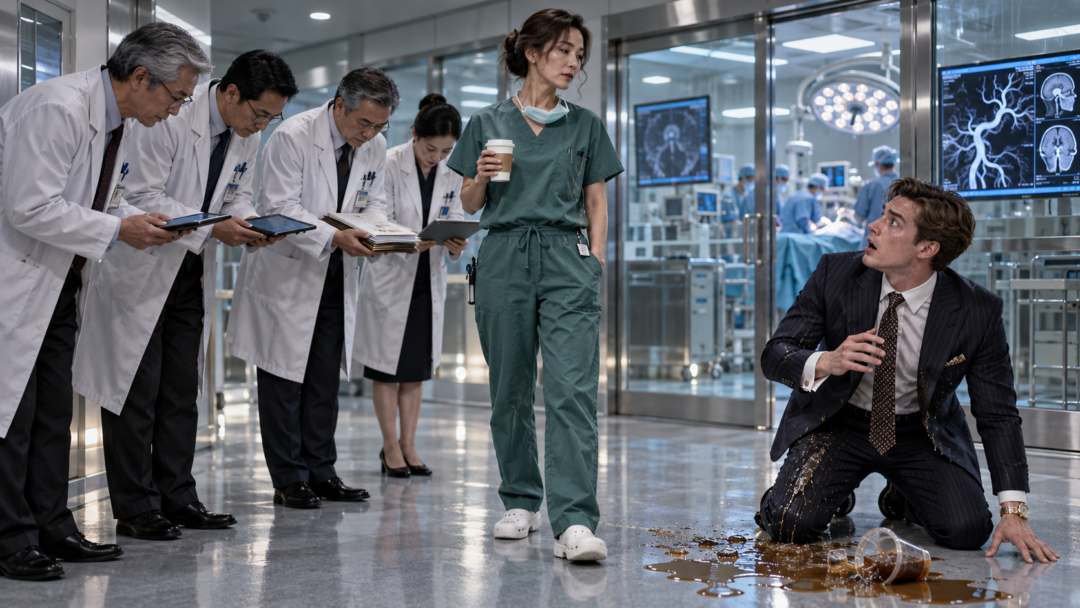
The Spilled Latte In The Surgical Pavilion And The Master Surgeon
CHAPTER 4: THE FIVE-MILLIMETER MARGINS
The atmosphere inside Operating Suite Four was as cold and focused as deep space. The ambient temperature was maintained at sixty-two degrees Fahrenheit to protect the patient’s brain during hypothermic circulatory arrest. Ten high-intensity overhead surgical lamps illuminated the sterile blue drape covering the open chest of seventy-one-year-old Arthur Harrington.
The rhythmic, mechanical chirp of the arterial line monitor sounded like a ticking clock: ninety beats per minute, eighty-five, seventy-two.
“Mean arterial pressure is thirty-two millimeters of mercury,” the lead anesthesiologist announced, his voice tight with panic. “The aortic adventitia is paper-thin. It’s weeping blood into the anterior mediastinum. If we don’t cross-clamp right now, the vessel tears open.”
Sarah stood on the surgeon’s platform, her hands encased in double-layered sterile latex, holding a long, slender Potts scissors in her right hand and a DeBakey vascular forceps in her left. Over her scrubs, she wore a sterile gown with a high-definition 4K surgical camera mounted to her optical loupes.
Beside her, Luke Mercer stood as first assistant, holding the suction cannula with steady, unwavering focus.
“Prepare the systemic hypothermia,” Sarah commanded, her voice calm, melodic, and radiating total, unshakeable authority. “Cool the patient to eighteen degrees Celsius. Initiate retrograde cerebral perfusion through the right axillary artery at four hundred milliliters per minute.”
From the glass-walled observation gallery above the operating theater, Julian Harrington stood against the railing, his face pale and furious as he watched the monitor displays.
“Chief Miller,” Sarah said without looking up from the surgical field, “administer two hundred milligrams of our proprietary neutralizing peptide through the bypass reservoir. It will reverse the synthetic glycoprotein inhibitor within ninety seconds.”
“Neutralizing peptide?” Bradley protested from the corner of the room, his face white with terror. “That compound hasn’t been approved by the hospital therapeutics committee!”
“I hold the federal patent on the compound, Dr. Bradley,” Sarah said, her voice dropping into a chilling, absolute register. “And under the federal Right to Try Act, I am the primary physician of record. Suction, Luke. Expose the proximal ascending aorta.”
Sarah made the first delicate cut into the dissected vessel wall. Blood welled up, thick and dark, but Luke’s suction cleared the field with surgical precision.
Inside the torn vessel, the inner lining had sheared away from the muscular wall over a length of twelve centimeters. It looked like shredded silk fluttering in a gale. The margin of healthy tissue available for suturing was barely five millimeters wide.
“Five-zero polypropylene on a double-armed needle,” Sarah called out calmly. “Felt pledget strip. We have precisely four minutes before myocardial ischemia becomes irreversible. Clock starts now.”
Inside the chilled operating theater, the surgical lights focused a blazing, four-thousand-lumen beam onto the operative field, rendering every capillary and muscle fiber with crystalline clarity. The bypass pump was turning steadily, its roller heads compressing the silicone tubing with a soft, rhythmic thwack-thwack-thwack that sustained the billionaire’s life while his own heart lay motionless in cold cardioplegic arrest.
Sarah worked with the supernatural economy of motion that distinguished true surgical genius from mere competence. Every stitch of five-zero polypropylene was placed precisely one point two millimeters from the vessel edge, perfectly perpendicular to the fragile aortic wall. Her hands did not tremble by a single micron; her fingers tied knots with the fluid, effortless grace of a master weaver working with silk.
“Luke, watch the coronary ostia,” Sarah commanded softly, her eyes locked to her optical loupes. “The dissection flap has extended into the right coronary artery sinus of Valsalva. We must re-implant the coronary button using a continuous suture line before we complete the distal arch anastomosis.”
Beside her, Luke held the micro-retractor with absolute stillness, his breathing synced to hers. In the background, the perfusionist called out core body temperatures: “Twenty degrees… nineteen… eighteen degrees. Systemic hypothermic circulatory arrest achieved. Brain is protected.”
Sarah had precisely sixteen minutes of safe circulatory arrest time to excise the shredded aorta, seat the synthetic Dacron-bioresorbable composite graft, and re-establish forward arterial flow to the carotid vessels. Under her fingers, the fragile tissues were as thin as wet parchment, but her sutures held with unflinching, mechanical perfection.
The silence in the operating theater was absolute, broken only by the steady, metronomic hiss of the mechanical ventilator and the rhythmic hum of the cardiopulmonary bypass pump. Sarah did not blink through her high-magnification optical loupes. She placed three reinforcing Teflon felt strips along the transected aortic root, anchoring each pledget with surgical knots tied with calibrated tension.
A lesser surgeon would have panicked under the ticking clock of deep hypothermia, but Sarah’s movements were as rhythmic and tranquil as a calm sea. She knew that every second saved in the arch reconstruction was another million cerebral neurons preserved from ischemic death. Luke worked beside her like an extension of her own mind, anticipating each instrument pass before she even spoke the command. Together, they rebuilt the main trunk of human life from shredded fragments of collagen, restoring structure where chaos had threatened total collapse. Her concentration was absolute, her hands an instrument of divine healing against the cold encroachment of mortal peril across the surgical field. Every breath was controlled, every heartbeat accounted for, as the miraculous repair restored the flow of life through the patient’s reconstructed vessel with breathtaking, mathematical perfection, preserving a father for his family and a beacon of everlasting hope for the entire world of healing.